








You’ve got vehicles sitting at an auction two states away and a customer expecting delivery by Friday. Or maybe you’re running a small buy-here-pay-here lot and tired of paying transport charges that consume too much of the margin on a $6,000 car. Either way, bringing at least some transportation in-house can make financial sense when the trailer is used often enough. The question is which trailer actually matches your inventory, tow vehicle, routes, and licensing requirements.
Not every car hauler is built for the same job, and the wrong choice creates problems that may not become obvious until you’re already traveling at highway speed with valuable inventory behind you. Deck dimensions, usable payload, loading angle, tie-down locations, axle and tire ratings, braking equipment, hitch capacity, and legal operating classification all matter. Here’s a straight look at the four main categories and where each one earns its keep for a dealer.
Open Car Haulers: The Workhorse for Volume Buyers
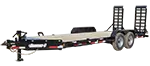
If you’re pulling cars from Manheim, ADESA, or a dealer trade network regularly, an open car hauler is usually the most cost-effective place to start. Open trailers are available as compact single-car bumper-pull units, longer two-car goosenecks, and specialized multi-vehicle configurations. For many small dealerships, a dependable single-car trailer is the practical choice for local trades and individual auction purchases, while a true two-car gooseneck becomes attractive when the additional utilization justifies the larger trailer and tow vehicle.
It is important not to treat every open car hauler as a 40-foot, 14,000 lb two-car trailer. Current single-car models cover a much wider range. H&H’s steel open Car Hauler line, for example, uses an 82-inch bed and is offered in 16-foot through 24-foot lengths with GVWRs from 7,000 to 9,900 lbs. Its standard configuration includes a steel treadplate dovetail and slide-in ramps, while items such as a winch plate and upgraded tie-down arrangements depend on the build. H&H’s aluminum open car haulers cover 14-foot through 20-foot lengths and GVWRs from 7,000 to 14,000 lbs.
Diamond C’s current GTF is also a single-car bumper-pull trailer rather than a two-car carrier. It is available in 14-foot through 22-foot lengths with an 83-inch bed and GVWR choices from 7,000 to 9,890 lbs. Standard running gear includes two 3,500 lb Lippert drop axles, with a two-6,000 lb axle upgrade available on applicable configurations. That makes the GTF useful for passenger cars and appropriately sized light vehicles, but the vehicle, trailer options, fuel, winch, spare tire, tools, and every other item carried on the trailer must still fit within its certified payload.
True two-car open goosenecks commonly start around 35 to 36 feet and extend into the low-40-foot range, with current pickup-tow models frequently rated between approximately 14,000 and 18,000 lbs. The GVWR is not the amount of vehicle weight you can load. Payload is the trailer’s certified GVWR minus its actual empty weight and installed equipment. A 14,000 lb trailer that weighs several thousand pounds empty cannot legally carry 14,000 lbs of automobiles. Two midsize cars may fit a properly selected two-car trailer, but two full-size pickups or large SUVs can exceed its payload even when their combined curb weights appear to be below the trailer’s GVWR.
Winches, winch plates, rub rails, stake pockets, D-rings, wheel-stop systems, and adjustable track can be standard, optional, or unavailable depending on the manufacturer and model. Confirm the exact build sheet rather than assuming that every quality trailer includes the same equipment. Tie-down anchor locations also need to match the wheelbases and track widths of the vehicles you normally buy.
The big advantage is operating cost. Open haulers generally cost less to purchase than comparable enclosed units, and their lower empty weight can preserve more payload and reduce the demands placed on the tow vehicle. The tradeoff is exposure. Road debris, rain, snow, salt, hail, tree sap, and public visibility are all factors. For normal used inventory headed to a retail lot, that may be acceptable. For high-value, freshly restored, collector, or presentation-ready vehicles, an enclosed trailer deserves serious consideration.
Wedge Multi-Car Trailers: Stack More, Trip Less
A pickup-tow wedge trailer is normally a long, sloped open gooseneck with multiple vehicle positions. It is not necessarily a full two-level carrier like a commercial tractor-trailer auto transporter. Its raised front deck, angled loading surfaces, extensions, and movable ramps are arranged to place several vehicles on one trailer while maintaining usable clearance and axle loading.
Current pickup-tow wedge trailers vary significantly. Two-car goosenecks can be approximately 35 to 36 feet long with GVWRs around 12,000 to 14,000 lbs, while three-car models commonly extend into the 43-foot to 51-foot range and may carry ratings from roughly 14,000 to 20,000 lbs or more. Many are intended for three vehicles. A fourth compact vehicle may be possible only on a manufacturer-approved configuration with the necessary extensions, deck space, payload, axle distribution, and legal overall length. It should never be assumed merely because four small cars appear to fit.
There is no universal rule that every wedge trailer may be 53 feet long. The often-quoted 53-foot figure applies to particular semitrailer configurations and is not a blanket trailer-length allowance for every pickup-and-gooseneck combination. Indiana and federal length rules distinguish among ordinary combinations, truck-tractor semitrailers, and qualifying automobile transporters. The legal limit can depend on the complete combination, transporter design, load overhang, route, and states traveled. Dealers should measure from the front of the tow vehicle to the rearmost point of the trailer or load and verify the classification of the complete rig before ordering a long wedge.
A dual-rear-wheel pickup is common with these trailers, but the presence of dual rear wheels does not automatically make a combination properly rated. The truck must have sufficient VIN-specific towing capacity, payload, rear gross axle weight rating, gooseneck rating, tire capacity, braking capability, and gross combination weight rating. Pin weight, passengers, tools, fuel, the hitch, and anything carried in the truck all count against available payload.
When the complete setup is properly rated and legally operated, the economics can improve sharply. Moving three vehicles per auction trip instead of one or two can reduce fuel, hotel, toll, and driver cost per vehicle. Those savings are only real when the trailer is loaded within its GVWR, the truck remains within every applicable rating, and the business has accounted for commercial vehicle compliance.
The loading sequence matters. Vehicle weights and positions affect pin weight and axle loading, so the heaviest unit cannot simply be placed wherever it is easiest to unload. Low-clearance sports cars and luxury sedans may also contact ramp transitions, deck peaks, exhaust components, or front splitters. Before buying, compare the trailer’s approach angle, breakover points, usable deck lengths, extension limits, and ramp capacity with the actual vehicles your dealership transports.
Enclosed Trailers: Right Choice for High-Value Inventory
Some inventory should not ride open. Classic cars, exotics, restored vehicles, high-dollar trucks headed to a premium lot, and vehicles that have already been detailed for photography can justify the additional protection of an enclosed trailer. The enclosure helps shield the vehicle from road debris and weather, but it does not eliminate the need for ventilation, moisture control, proper securement, or careful loading.
Wells Cargo offers enclosed automotive transport models, including the Road Force Auto line. Current Road Force Auto configurations have interior lengths ranging from approximately 16 feet 5 inches to 28 feet 6 inches. Depending on size, listed GVWRs are 7,000 or 9,990 lbs, with approximate payload capacities ranging from a little over 3,300 lbs to about 5,820 lbs. Those numbers make most Road Force Auto configurations single-vehicle trailers. The longest box may have enough physical floor length for more than one very small vehicle, but floor space alone does not create enough legal payload for a two-car load.
H&H’s current enclosed automotive lineup covers a broader duty range. Its HH Series enclosed car haulers are offered in approximately 20-foot through 28-foot lengths with GVWRs from 9,900 to 14,000 lbs. The heavier TOPLINE enclosed car hauler family extends from approximately 20 feet to 32 feet and is available with GVWR configurations reaching 24,000 lbs. The exact axle package, curb weight, payload, interior height, door opening, floor construction, and standard equipment vary by model.
A true two-car enclosed trailer must be selected by measurements and weight, not by a generic box-length rule. Add the bumper-to-bumper lengths of both vehicles, the space needed between them, front clearance, rear-door clearance, cabinetry, a winch, and the loading method. Then compare the combined vehicle weight with the trailer’s certified payload. Depending on vehicle size and layout, some 28-foot configurations may work while others require 30, 32, or more feet. A trailer can be long enough yet still be legally incapable of carrying the load because of its empty weight or GVWR.
Interior features that matter for dealer use include rated floor anchors or track positioned for different wheelbases, adequate interior and loading lights, a side access door, a properly rated rear ramp door, removable or escape-door provisions for wide vehicle doors, and sufficient interior width at the fenders. A winch is especially useful for non-running auction vehicles, but its mount, battery, cable routing, and pulling capacity must be appropriate for the intended load.
E-track and similar systems are useful only when the track, fasteners, supporting structure, fittings, and straps are rated as a complete securement system. Track attached only to thin wall material should not be treated as a structural vehicle anchor. Floor coatings and finished surfaces can improve cleanup, but condensation and trapped moisture still require ventilation and sensible storage practices.
Aluminum construction can reduce empty weight and improve corrosion resistance, but an aluminum trailer is not automatically the lightest or highest-payload choice. Compare actual curb weight, GVWR, structure, repair requirements, and price with the equivalent steel build. A properly engineered steel enclosed trailer may offer a higher duty rating, while a properly engineered aluminum model may preserve more towing margin for a particular truck.
The price difference is real, but a fixed percentage does not apply across the market. Enclosed pricing changes substantially with length, height, axle package, construction material, escape doors, flooring, interior finish, cabinets, electrical equipment, climate-control preparation, and graphics. For expensive inventory, avoiding road-debris damage, hail exposure, contamination, or an unnecessary re-detail can justify the added investment. Get a model-specific quote rather than estimating the cost from the price of an open trailer with a similar nominal length.
Tilt Trailers: The Underrated Option for Single-Car Dealers
Not every dealer is running high volume. Plenty of specialty dealers, small independents, service departments, and lot managers need to move one vehicle at a time without handling separate ramps. A properly selected tilt trailer can be an efficient answer.
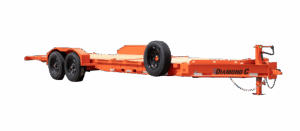
On a tilt trailer, the rear edge of the deck lowers to the ground while the deck remains at an angle for loading. The trailer does not become completely flat at ground level. Tilt operation may be gravity-based, hydraulically dampened, manually hydraulic, or powered by a 12-volt hydraulic system, depending on the model. Each design has different maintenance, battery, loading-balance, and operating considerations.
A tilt deck can reduce the number of separate ramp transitions, but it does not guarantee that every low vehicle will load without contact. Approach angle, deck angle, breakover angle, stationary-deck length, wheelbase, tire diameter, front overhang, splitter height, exhaust clearance, and ramp-edge shape all matter. A long-wheelbase car can clear the initial approach and still contact the trailer near the hinge or deck transition.
Current H&H Speed Loader car haulers illustrate the range available in this category. The steel Speed Loader line uses an 82-inch bed, is offered in 18-foot through 30-foot lengths, and carries GVWR choices from 7,000 to 16,000 lbs. Depending on configuration, its hydraulic tilt can be manually operated or powered. The Aluminum Speed Loader is available in 18-foot through 24-foot lengths with GVWRs from 7,000 to 14,000 lbs and uses a 12-volt hydraulic tilt system. H&H also offers a 102-inch-wide full-width tilt configuration in 18-foot through 24-foot lengths with GVWRs from 9,900 to 14,000 lbs for vehicles that need more usable width around the fenders.
Diamond C’s HDT belongs to a heavier equipment-trailer class. The current bumper-pull HDT is available in 16-foot through 28-foot lengths, has an 80-inch to 82-inch bed, and offers GVWR configurations from 15,500 to 24,000 lbs. Standard running gear begins with two 7,000 lb Lippert axles, with higher-capacity packages available. Its standard design uses hydraulically dampened gravity-tilt operation. On appropriately configured HDT trailers, Diamond C’s Pro Tilt option allows the operator to switch between gravity and powered tilt modes for greater control when load balance or terrain makes gravity operation less convenient.
The HDT can be useful for heavy pickups, commercial vehicles, equipment, and mixed dealership work, but its greater GVWR does not automatically make it the right car trailer. Confirm bed width, fender clearance, loading geometry, empty weight, hitch weight, and the tow vehicle needed for the selected package. Many HDT configurations belong behind a properly equipped heavy-duty pickup and can place the combination at or above commercial licensing thresholds.
The limitation of a conventional tilt car hauler is usually one vehicle per trip. The tradeoff is fast setup, fewer loose ramps, and easier loading of non-running vehicles when the trailer includes a properly installed winch. It may be easier to maneuver than a long two-car or wedge trailer, but it is not automatically suitable for a half-ton pickup. Tow-vehicle compatibility must be based on the exact truck, trailer, hitch, and loaded weight.
Comparing the Options Side by Side
| Trailer Type | Typical GVWR | Cars Per Load | Best For |
|---|---|---|---|
| Open Car Hauler | 7,000–18,000 lbs | 1–2 | Dealer trades, auction purchases, and routine used-car transport |
| Wedge Multi-Car | Approximately 12,000–20,000+ lbs | Usually 3; configuration-dependent | High-volume dealers with a properly rated truck and commercial transport program |
| Enclosed Car Hauler | 7,000–24,000 lbs | 1–2 | High-value, classic, restored, exotic, or presentation-ready inventory |
| Tilt Trailer | 7,000–24,000 lbs | 1 | Low-clearance vehicles, non-running cars, heavy pickups, and single-vehicle moves |
What to Get Right Before You Buy
A few things dealers consistently overlook when spec’ing a car hauler:
- Actual payload, not advertised GVWR. GVWR is the maximum permitted weight of the loaded trailer. Subtract the trailer’s actual empty weight, factory options, spare tire, winch, battery, fuel or hydraulic equipment, tools, and everything else carried on it. Use the certification label and final build information rather than estimating payload from axle ratings alone.
- Tongue or pin weight on the tow vehicle. Calculate hitch load from the trailer’s actual loaded weight and follow the truck and trailer manufacturers’ loading instructions. Conventional trailers commonly require roughly 10 to 15 percent tongue weight, while gooseneck combinations often place about 15 percent or more on the truck. That weight, along with the hitch, driver, passengers, tools, and bed cargo, must remain within truck payload, rear axle, tire, and hitch ratings.
- Vehicle dimensions. Record wheelbase, track width, tire-to-tire width, overall body width, ground clearance, front overhang, vehicle height, and bumper-to-bumper length for the inventory you commonly haul. A trailer can have enough payload but still be unusable because the car will not clear the fenders, ramp door, roof, deck transition, or front bulkhead.
- Tie-down type, anchor location, and working load limit. For automobiles, light trucks, and vans weighing 10,000 lbs or less individually, federal commercial securement rules require restraint at both the front and rear using a minimum of two tiedowns that prevent movement in every direction. Wheel-over or wheel-around systems must restrain lateral, longitudinal, and vertical movement. Structural straps must connect only to vehicle points designed for securement. Many dealers prefer four wheel straps for flexibility and redundancy, but every strap, fitting, track, D-ring, and supporting structure must be properly rated and used according to its instructions.
- CDL classification. A trailer rated over 10,000 lbs does not, by itself, create a federal Class A CDL requirement. The Class A threshold is reached when the combination’s GCWR or actual gross combination weight, whichever is greater under the applicable rule, is 26,001 lbs or more and the towed unit has a GVWR or actual gross weight over 10,000 lbs. A heavy wedge, enclosed trailer, or Diamond C HDT can easily place a properly rated pickup-and-trailer combination in that category.
- Commercial carrier compliance below the CDL threshold. A dealership transporting inventory is conducting business rather than making a personal recreational move. In interstate commerce, a vehicle or combination at 10,001 lbs or more by the applicable GVWR, GCWR, GVW, or GCW test can fall under the Federal Motor Carrier Safety Regulations even when no CDL is required. Depending on the operation, that can involve a USDOT number, driver qualification and medical requirements, inspections, hours-of-service records, insurance filings, and other obligations. Review the complete operation rather than treating the CDL threshold as the only rule that matters.
- Braking systems. Indiana law requires a trailer with a gross weight of at least 3,000 lbs to have brakes adequate to control, stop, and hold the trailer. The driver must be able to apply them from the cab, and a compliant breakaway system must automatically apply the trailer brakes if the trailer separates. Electric drum, electric-over-hydraulic drum, and electric-over-hydraulic disc systems can all be appropriate when correctly specified. The controller, breakaway battery, wiring, connectors, brakes, tires, and tow-vehicle system must work together.
- Overall length and route legality. Do not assume that a long pickup-and-wedge combination receives the same length allowance as a qualifying tractor-trailer automobile transporter. Measure the entire combination and its load, check Indiana’s classification rules, and review every state on the planned route. Also account for turning radius, auction-lane access, fuel stations, hotel parking, toll classifications, and storage space at the dealership.
- Title and registration timing. Indiana residents generally need to title and register a newly acquired, previously unregistered trailer within 45 days of purchase to avoid an administrative penalty. Make sure the manufacturer’s certificate of origin or assigned title, bill of sale, VIN information, weight information, and tax paperwork are complete before the deadline.
- Tax timing and documentation. Current federal law generally provides a 100 percent additional first-year depreciation deduction for qualifying property acquired and placed in service after January 19, 2025, subject to eligibility, business-use, acquisition, basis, and election rules. A trailer purchase is not automatically deductible merely because it is used by a dealership. Have a qualified tax professional determine whether bonus depreciation, Section 179, regular depreciation, or another treatment is appropriate for the business.
A Quick Note on Brand Reliability
The trailer market has a lot of names in it, but the decal on the side is only the beginning of the comparison. For dealer use, look closely at the exact model’s frame design, crossmember spacing, coupler and jack ratings, axle GAWR, tire load range, wheel capacity, brake type, wiring protection, ramp capacity, deck material, empty weight, payload, and securement structure. A manufacturer’s light-duty and heavy-duty trailers may share a brand name while being designed for very different work.
The brands we carry at Spencer Trailers, including H&H, Diamond C, and Wells Cargo, offer several construction and duty classes rather than one universal car-hauler specification. H&H’s current range includes steel and aluminum open haulers, multiple Speed Loader tilt designs, and enclosed car haulers extending into heavier TOPLINE configurations. Wells Cargo’s automotive models provide enclosed protection in several lengths, but their payload ratings still need to be matched carefully to the vehicle.
Diamond C is a family-owned, USA-based manufacturer founded in 1985 and builds trailers in Mt. Pleasant, Texas. Diamond C uses Lippert axles across its trailer lineup, including its premium FMAX, HDT, LPT, LPX, WDT, and DEC families. Its trailers also use the DM Difference Maker multi-stage coating system, which includes surface blasting, a multi-stage wash, force drying, zinc-rich epoxy primer, powder topcoat, and curing. Those manufacturing details matter, but the selected model, GVWR package, dimensions, options, and tow-vehicle match still determine whether a trailer is right for dealership transport.
Specifications and standard equipment can change between model years and even between configurations within the same model family. The certification label, manufacturer’s current build sheet, final sales order, and tow vehicle documentation should control the decision. Do not rely on a generic online listing, an axle count, or a model name by itself.
If you’re trying to figure out whether a specific model matches your tow vehicle setup or your typical payload, that’s exactly the kind of question we work through with dealers regularly. Reach out to the Spencer Trailers team and we can spec the right unit for how you actually use it. You can also browse current inventory to see what’s on the lot and available now.
The right trailer for your dealership is out there. The bigger risk is buying one based only on advertised GVWR or deck length, discovering that it will not legally carry your normal inventory, and then continuing to pay outside transport costs while replacing it. Get the payload, dimensions, securement, truck ratings, brakes, and operating classification right the first time, and the trailer has a much better chance of earning back its cost through dependable use.


