








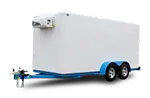


Your shop may not need four permanent walls. For a mobile mechanic, the right enclosed trailer can provide secure tool storage, organized parts inventory, electrical power, compressed air, lighting, and a protected work area wherever the service truck goes. The wrong trailer, however, can leave you with overloaded axles, inadequate tongue-weight capacity, poor ventilation, insufficient electrical service, or equipment that will not pass through the door. A successful rolling shop starts with realistic weights, measurements, power requirements, and room for the business to grow.
Why Enclosed Cargo Trailers Win for Mobile Mechanics
Open trailers have their place, but a mobile mechanic usually needs weather protection, theft resistance, lighting, organized storage, and a workspace that can be secured at the end of the day. An enclosed cargo trailer provides that foundation. It does not automatically arrive climate-controlled, insulated, or properly ventilated, however. Insulation, roof or wall ventilation, heating, air conditioning, electrical service, and safe storage for fuels and chemicals must be specified as part of the build.
A 7×16 enclosed cargo trailer is a practical starting point for a lighter mobile-service operation. Its nominal rectangular footprint is about 112 square feet, before accounting for the V-nose, wall thickness, wheel boxes, cabinets, electrical equipment, and clear working aisles. A carefully planned 7×16 can carry hand tools, diagnostic equipment, parts bins, a moderate-size compressor, a workbench, and a properly secured rolling cabinet. Larger operations often move to an 8.5×18, 8.5×20, or 8.5×24 trailer when they need tire-service equipment, welding gear, transmission tools, larger cabinets, fluid storage, or portable lifting equipment.
Do not select a trailer from nominal dimensions alone. Measure the compressor, tool cabinet, workbench, generator, welder, jacks, and largest replacement parts you expect to carry. Then compare those measurements with the trailer’s actual interior width, distance between the wheel boxes, rear-door opening, side-door opening, and usable interior height. A piece of equipment that fits inside an 8.5-foot-wide box may still be too wide or tall for the ramp-door opening.
Ceiling height matters as much as floor space. Many commercial 7-foot-wide trailers provide approximately 6 feet 6 inches of interior height, while extra-height and several current 8.5-foot-wide configurations provide approximately 7 feet. The additional height is valuable when you will be standing at a bench, servicing components, installing overhead lighting, or working inside the trailer for several hours. Remember that finished ceilings, air-conditioning ducts, lights, cabinets, and roof vents can reduce usable headroom.
Top Trailer Picks for Mobile Shop Builds
Wells Cargo Road Force Enclosed Trailers
Wells Cargo’s Road Force line is built as a commercial enclosed cargo platform and is available in multiple widths, lengths, axle packages, and GVWR configurations. A typical 7×16 Road Force V-Front tandem-axle configuration carries a 7,000 lb GVWR, while larger 8.5-foot-wide builds may be configured at higher ratings such as 9,990 lb. The certification label and final factory specification sheet are the authority for the GVWR, axle ratings, tire capacity, curb weight, and payload of any individual trailer.
The published Road Force V-Front construction specification includes tubular vertical posts, floor crossmembers, and roof bows positioned 16 inches on center, along with a bonded .030 aluminum exterior, a one-piece aluminum roof, 3/4-inch PlexCore decking, a finished wall liner, a rear ramp door, and a side-access door. A published 7×16 configuration provides approximately 6 feet 6 inches of interior height and a 36-inch side door, making it a workable base for a compact professional shop.
That framing layout is useful when installing cabinets, a workbench, hose reels, electrical boxes, and rated cargo-control track. Heavy fixtures still need to be attached to structural framing or manufacturer-approved backing, not merely screwed into the interior wall liner. Ask for framing diagrams before finishing the walls, and plan attachment points while the structural members are easy to locate.
Road Force trailers can be ordered with different electrical, lighting, ventilation, door, interior-finish, and cargo-control options. For a mechanic build, prioritize actual payload, door clearance, floor structure, cabinet mounting, and electrical capacity rather than selecting the trailer from exterior appearance alone.
Legend Thunder Series
Legend Manufacturing’s Thunder Series is an all-aluminum enclosed trailer line that works well for owners who want lower empty weight and resistance to the corrosion commonly associated with unfinished steel components. Aluminum construction does not eliminate inspection or maintenance, but a lower trailer curb weight can leave more of the GVWR available for tools and equipment when comparing otherwise similar builds.
A current 7×16 Thunder V-Nose tandem-axle configuration is rated at 7,000 lb GVWR and uses two 3,500 lb torsion axles with electric brakes. Published construction details include a tubular perimeter frame, tubular floor crossmembers, bonded .030 aluminum exterior panels, a one-piece aluminum roof, a 3/4-inch engineered floor, finished engineered walls, approximately 78 inches of interior height, a rear ramp door, and a 30-inch side door.
Legend’s current 8.5-foot-wide Thunder models are offered in several lengths and GVWR configurations, including builds up to approximately 9,990 lb. These wider models generally provide a 36-inch side door, more room between interior fixtures, and heavier framing than the narrower Thunder trailers. Floor, wall, and roof-member spacing also varies by model, so the order sheet should identify the exact structure being purchased.
The side door is especially useful in mobile service because it allows access to frequently used tools, parts, power cords, and diagnostic equipment without lowering the rear ramp. For an efficient layout, keep daily-use items near the side entrance while reserving the rear portion for rolling equipment and larger components.
United UXT Commercial Cargo
United Trailers’ UXT is a commercial cargo platform designed for highly customized work, contractor, motorsports, and service-trailer applications. It is available in numerous widths, lengths, body styles, axle packages, interior heights, and GVWR ratings. That flexibility makes it a strong candidate when a standard 7,000 lb cargo trailer does not provide enough payload or structural capacity for the planned shop.
An 8.5×20 UXT can be configured differently depending on the intended duty. Some builds are ordered near the 9,990 lb GVWR threshold, while heavier commercial versions can be equipped for approximately 14,000 lb GVWR. Those two trailers may look similar from the outside but have significantly different axles, tires, brakes, frame components, curb weights, payloads, and tow-vehicle requirements.
Many commercial United builds are available with approximately 7 feet of interior height and closely spaced wall, floor, and roof framing. Nevertheless, do not assume every UXT includes the same framing spacing, ramp capacity, floor thickness, or axle package. Require the factory build sheet to identify the GVWR, GAWR, tire ratings, floor construction, framing layout, rear-opening dimensions, and written ramp-door capacity before placing an order.
The UXT is particularly useful when the build requires a dedicated electrical panel, shore-power connection, air-conditioning system, workbench, multiple cabinets, compressor compartment, generator storage, additional access doors, or reinforced mounting locations. Because it is a configurable commercial platform, the best results come from supplying the dealer with a complete equipment list rather than ordering a generic empty shell and trying to solve every structural issue afterward.
Darkhorse Cargo Enclosed Units
Darkhorse Cargo is another practical option available through Spencer Trailers, with current enclosed models ranging from lighter single-axle and tandem-axle cargo trailers to larger 8.5-foot-wide commercial configurations. The exact construction depends on the model and option package, so compare individual inventory specifications rather than assuming every Darkhorse trailer is built identically.
Current tandem-axle 7-foot-wide Darkhorse builds are available at 7,000 lb GVWR with dual 3,500 lb axles, electric brakes, approximately 7 feet of interior height, a rear ramp with a transition flap, a side-access door, a 3/4-inch high-performance floor, finished walls, and cargo-control features. That combination is well suited to a compact mobile shop when the completed payload remains within the trailer’s rating.
Current heavy 8.5-foot-wide Darkhorse configurations are also available at approximately 9,990 lb GVWR with two 5,200 lb axles, electric brakes, 7-foot interior height, 16-inch-on-center floor and wall construction, a rear ramp door, a 36-inch side door, and recessed cargo-control track in selected wall and floor locations. Examples in the 8.5×18 and 8.5×24 range provide substantially more layout flexibility than a 7×16, but their additional empty weight must be deducted from GVWR when calculating usable payload.
Recessed track can be useful for securing rolling cabinets, parts carts, jacks, and removable fixtures, provided the track, fasteners, fittings, and underlying structure are all rated for the load and direction of force. Permanently mounted compressors, cabinets, batteries, and heavy machinery should use dedicated mounting points tied into structural members rather than relying only on removable track fittings.
A V-nose can provide valuable room for cabinets, an electrical panel, a battery bank, or a compact workbench. It should not be purchased solely on the assumption that it will guarantee a major fuel-economy improvement. Trailer height, frontal area, tow-vehicle aerodynamics, road speed, wind, tire pressure, load distribution, and total weight can affect fuel use more than the nose shape by itself.
What to Spec for a Mobile Mechanic Build
Picking the base trailer is only half the decision. The floor structure, payload, doors, ventilation, power system, equipment mounts, lighting, and load distribution determine whether the finished trailer functions as a safe and efficient shop.
Air Compressor Considerations
Mobile mechanic rigs use compressors ranging from compact portable units to larger vertical or horizontal shop compressors. Tank capacity is only one part of the specification. Select the compressor according to its delivered SCFM at the required PSI, duty cycle, motor voltage, starting current, and the continuous air demand of the tools you expect to run. An impact wrench used intermittently has a different requirement from a tire machine, blast cabinet, air grinder, or other high-duty-cycle equipment.
Measure the complete compressor, including the motor, pump, belt guard, drain, regulator, service clearances, and vibration isolators. Verify that it will pass through the intended door and that filters, belts, oil-fill points, and drain fittings remain accessible after installation. Manufacturer dimensions can vary considerably even among compressors with the same nominal tank size.
A stationary compressor should be mounted to a reinforced base connected to the trailer’s structural crossmembers or another manufacturer-approved support. Fastening a heavy compressor only to the wood floor or to light-duty cargo track can allow the floor or fasteners to fail during emergency braking or a collision. Use suitable vibration isolation, locking hardware, backing plates where appropriate, and restraint designed for travel loads in multiple directions.
An exterior bulkhead air connection is a worthwhile feature when most tire and repair work will be performed beside the trailer. It allows the compressor to remain secured while keeping doors closed against weather. Include a properly rated hose, regulator, moisture separator, pressure relief protection, and enough ventilation to prevent excessive compressor-compartment temperature.
Power must be sized from the compressor’s actual nameplate and startup requirements. A 30-amp, 120-volt shore-power connection can supply a theoretical maximum of approximately 3,600 watts before normal design margins and simultaneous loads are considered. That may be adequate for lighting, chargers, receptacles, and a modest compressor, but it may not support a large compressor, air conditioner, welder, heater, and other equipment at the same time. A properly designed 50-amp, 120/240-volt system may be more appropriate for a high-demand shop build.
Have the electrical system designed and installed by a qualified professional using a listed inlet, properly sized conductors, overcurrent protection, grounding and bonding appropriate to the system, GFCI protection where required, and equipment rated for vibration and mobile use. A portable generator or gasoline-powered compressor must be operated outdoors, away from doors, vents, windows, and occupied areas. Never run an engine-driven generator or compressor inside the enclosed trailer, even with the ramp or side door open, because carbon monoxide can accumulate rapidly.
Tool Storage
Aluminum or steel cabinets designed for mobile, commercial-vehicle, or motorsports use can provide secure storage, but cabinet selection should follow the trailer’s payload calculation. A large cabinet may be manageable when empty and become extremely heavy after sockets, pullers, power tools, fasteners, and replacement parts are added. Weigh the loaded cabinet or calculate its contents rather than relying only on the cabinet manufacturer’s empty weight.
Plan storage around workflow instead of filling every wall. Frequently used hand tools and diagnostic equipment should be accessible from the side door or primary workbench. Heavy items should be kept low and secured, while lighter supplies can occupy upper cabinets. Leave clear access to the electrical panel, fire extinguisher, emergency exit, roof vent, battery disconnect, compressor controls, and tie-down points.
Heavy cabinets and benches should be attached to wall studs, floor crossmembers, manufacturer-installed backing, or a purpose-built substructure. Interior plywood or engineered wall panels provide a finished surface, but they are not automatically rated to support a fully loaded cabinet during a sudden stop. Through-bolts, backing plates, brackets, and reinforcement should be selected for the trailer’s actual framing material and layout.
L-track, airline track, E-track, and proprietary recessed track systems can all be useful, but they are not interchangeable. Each has its own fittings, working-load limits, installation requirements, and preferred load directions. The capacity of the finished restraint system is limited by its weakest component, which may be the fitting, fastener, track, wall structure, or floor attachment. Specify the intended loads when ordering factory-installed track.
Balance is as important as total weight. Placing every tool chest, compressor, battery, and parts cabinet at the front can overload the hitch and tow vehicle even when the trailer remains below GVWR. Placing too much weight behind the axles can reduce tongue weight and promote sway. A bumper-pull trailer commonly needs approximately 10% to 15% of its loaded weight on the hitch, subject to the trailer and tow-vehicle manufacturers’ instructions.
Lift Gear
This is where trailer planning becomes more specialized. QuickJack and similar portable frame-engaging lift systems are not two-post lifts. They consist of movable lifting frames that are positioned beneath a vehicle and used on a stable, suitable surface. Current QuickJack offerings cover multiple vehicle capacities, including models in the 3,500 lb through 8,000 lb range. The correct model must match both the vehicle’s weight and its lifting-point spread.
For most mobile-mechanic operations, the enclosed trailer is used to transport the portable lift, hydraulic power unit, hoses, wheel chocks, jack stands, and related equipment. The vehicle is then lifted outside on a level, stable surface that meets the lift manufacturer’s instructions. Before purchasing, compare the lift’s collapsed dimensions and weight with the trailer’s door opening, available floor area, tie-down locations, and remaining payload.
Do not assume that an additional sheet of plywood makes a cargo trailer floor suitable for lifting a vehicle inside the trailer. A lifting system can impose concentrated loads that must be carried through the deck, floor crossmembers, main frame, suspension, tires, stabilizers, and ground contact points. The trailer may also become unstable when a vehicle is elevated or when weight shifts during service.
A permanent two-post automotive lift normally requires an engineered foundation, specified concrete thickness and strength, approved anchors, adequate ceiling height, and installation dimensions established by the lift manufacturer. A conventional enclosed cargo trailer with a wood floor is not a substitute for that foundation. Installing a permanent vehicle lift inside a mobile trailer requires a purpose-engineered trailer and lift system designed together by qualified manufacturers or engineers.
Most mobile mechanics are better served by carrying a correctly rated portable lift, floor jack, wheel-lift equipment, ramps, and jack stands and setting them up outside the trailer. The enclosed body can then remain dedicated to storage, diagnostics, parts, power, compressed air, and bench work without attempting to support an elevated vehicle inside a standard cargo box.
GVWR: Don’t Guess, Calculate
| Setup Type | Trailer Size | Recommended GVWR |
|---|---|---|
| Light mobile service (hand tools, diagnostics, moderate compressor) | 7×16 enclosed | Approximately 7,000 lb, subject to actual empty weight |
| Full shop (larger cabinets, compressor, tire or welding equipment) | 8.5×18 or 8.5×20 enclosed | Approximately 9,990 to 14,000 lb, based on calculated payload |
| Heavy commercial build (portable lift gear, transmission equipment, extensive inventory) | 8.5×20 or 8.5×24 and larger | Approximately 14,000 lb or a purpose-built higher-capacity configuration |
These figures are planning ranges, not universal specifications. Two trailers with the same exterior dimensions can have different curb weights, axle ratings, frame structures, tires, brakes, couplers, and payload capacities. The trailer’s VIN certification label and factory documentation determine its legal ratings.
Start with the trailer’s actual empty weight as equipped, not the lightest catalog weight for the model family. Subtract that figure from GVWR to estimate the maximum cargo capacity, then account for every installed component: cabinets, bench, compressor, batteries, electrical equipment, air conditioner, generator compartment, flooring, wall finish, spare tire, lift equipment, jacks, fluids, parts, hoses, cords, and the tools themselves.
Do not forget the tow vehicle. The truck must have adequate tow rating, gross combined weight rating, receiver rating, hitch rating, rear-axle capacity, tire capacity, payload, and braking capability. Tongue weight is carried by the truck and uses part of its payload capacity. Passengers, fuel, bed cargo, aftermarket accessories, and the hitch hardware itself also consume payload.
Build in reasonable capacity for future growth rather than ordering a trailer that reaches its rating on the first day. A planning margin of approximately 10% to 20% can be useful, but it does not authorize exceeding any rating. GVWR, axle ratings, tire capacities, coupler ratings, hitch limits, and tow-vehicle ratings must all be respected independently.
After the shop is completed and fully stocked, weigh the combination at a certified scale. Obtain truck-steer-axle, truck-drive-axle, trailer-axle, and total-combination weights when possible. This confirms whether the loaded trailer is within GVWR and GAWR and whether weight is distributed appropriately between the tow vehicle and trailer.
A Quick Q&A for Buyers on the Fence
Do I need a V-nose or a flat-front trailer?
A V-nose can provide useful storage or workbench space ahead of the main rectangular box. The amount of added room varies by manufacturer and model, so compare actual interior dimensions rather than assuming a fixed 18- or 24-inch gain. A V-nose may influence airflow, but it does not guarantee a specific fuel-economy improvement. For a mobile shop, choose the nose design that gives you the best cabinet layout, tongue-weight distribution, access, and equipment clearance.
Single or tandem axle?
A tandem-axle trailer is usually the better foundation for a serious mobile shop because it can provide higher GVWR, better load distribution, and improved stability when properly loaded. It also gives the trailer more tire contact with the road. However, axle count alone does not determine payload, and a second axle does not make it safe to continue driving after a tire, wheel, bearing, or suspension failure. Stop immediately and inspect the trailer after any failure.
Single axles are not universally limited to 3,500 lb, but many common enclosed cargo trailers use a 3,500 lb single-axle package and may be rated at 2,990 or 3,500 lb GVWR. That capacity disappears quickly after subtracting the empty trailer and adding cabinets, tools, and a compressor. For most professional mobile-mechanic builds, a properly specified tandem trailer provides more realistic payload and room for future equipment.
What’s the best floor for heavy equipment?
A 3/4-inch plywood, engineered-wood, or composite deck is common in commercial enclosed trailers, but the floor material is only the top layer of the structure. Crossmember size and spacing, main-frame capacity, fastener design, axle placement, and load distribution determine how concentrated equipment loads reach the chassis.
Adding another layer of plywood can improve surface durability and provide a better finished work surface, but it does not automatically increase the structural rating of the crossmembers or frame. Compressors, cabinets, tire machines, and other heavy fixtures may require added steel or aluminum reinforcement, through-bolted mounting plates, or factory-installed supports. Any reinforcement should be approved for the specific trailer structure.
A chemical-resistant floor coating, commercial vinyl, rubber coin flooring, or another durable finish can make cleanup easier, but consider fluid compatibility, slip resistance, fire performance, and the added weight. Keep spills contained and follow applicable requirements for storing and transporting oils, fuels, solvents, batteries, refrigerants, and other automotive materials.
What braking equipment does an Indiana shop trailer need?
Indiana requires brakes on trailers over 3,000 lb GVWR. A qualifying trailer needs an effective braking system, and a breakaway system must be capable of applying the trailer brakes if the trailer separates from the tow vehicle. Most tandem mobile-shop trailers use electric brakes and require a compatible in-cab brake controller. Inspect the breakaway battery, switch, wiring, connectors, brake adjustment, drums or rotors, and tires as part of a regular maintenance schedule.
Will I need a CDL?
A trailer weighing more than 10,000 lb does not automatically create the federal Class A CDL threshold by itself. The typical Class A threshold is a combination with a GCWR of 26,001 lb or more when the towed unit has a GVWR over 10,000 lb. These are vehicle ratings, not merely the measured weight on one trip. Commercial use, interstate operation, hazardous materials, exemptions, employer policies, and other state or federal requirements can affect licensing and compliance, so verify the completed truck-and-trailer combination before operating it for business.
How soon must an Indiana buyer register the trailer?
Indiana provides a 45-day penalty-free window for titling and registering a newly acquired trailer. Keep the bill of sale, manufacturer’s certificate of origin or assigned title, financing documents, and any temporary permit with the trailer as required. Do not assume that the registration window permits operation without the documents, plate, permit, insurance, or equipment otherwise required for the trip.
Can a mobile-shop trailer qualify for business depreciation?
A trailer and permanently installed business equipment may qualify for federal depreciation when the property is eligible and used in the business. Current federal law restored 100% bonus depreciation for qualifying property acquired and placed in service after January 19, 2025. Eligibility is not automatic, and the treatment of the trailer, tools, installed equipment, business-use percentage, financing, trade-ins, and state taxes can differ. Have a qualified tax professional review the purchase and placed-in-service records before relying on a deduction.
Where to Start
We carry Wells Cargo, Legend, United, and Darkhorse Cargo at our Spencer, Indiana lot and can order configurations that are not currently on the floor. Bring a detailed equipment list with dimensions, individual weights, electrical loads, air requirements, and an estimate of the tools and parts you expect to add over the next several years. That information allows us to match the trailer’s GVWR, payload, axle package, tires, brakes, interior height, doors, framing, ventilation, and electrical options to the real build.
Before ordering, ask for the proposed trailer’s GVWR, GAWR, estimated empty weight, tire capacities, coupler rating, interior dimensions, wheel-box dimensions, rear and side-door openings, framing spacing, floor material, electrical specification, and written ramp-door capacity. Confirm that the tow vehicle can carry the expected tongue weight while remaining within its receiver, payload, axle, tire, tow, and gross combined ratings.
Think through daily workflow as well. Decide where the mechanic will enter, where diagnostic equipment will be used, how parts will move through the trailer, where dirty components will be placed, how fluids will be contained, and how emergency equipment will remain accessible. A well-planned 7×16 can outperform a poorly organized 8.5×24, while an overloaded compact trailer will never become safer through better shelving alone.
Browse what’s available now at our current inventory or check recently sold units for a sense of what configurations move. And if you want to talk through a specific build, reach out directly at (812) 829-0226. A mobile shop is a serious investment. Get the trailer spec right the first time.


