








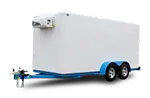

You pull up to a job site with a pickup bed piled three layers deep: sprayers under ladders under buckets under drop cloths. Something shifts on the highway. You spend twenty minutes digging before you touch a brush. Sound familiar? A dedicated enclosed cargo trailer solves that problem by giving high-value tools, coatings, and supplies a secure, weather-resistant place of their own. It can also reduce damage to sprayer pumps, guns, tips, hoses, and accessories that were never designed to bounce around uncovered in a pickup bed.
This guide is written for painting contractors and serious DIY painters who need a trailer that works as an organized mobile equipment room. We’re talking enclosed units with enough payload for spray equipment and paint, shelving anchored to structural members, safe load restraint, practical ventilation, adequate interior height, and ladder storage that does not interfere with doors, lighting, or working space.
Why Enclosed, Not Open
Open utility trailers work well for many construction and landscaping loads, but professional painting equipment benefits from more protection. A commercial airless sprayer, hose reel, spray guns, tips, pressure washers, dust-control equipment, ladders, and job-specific coatings can represent a substantial investment. Lockable doors help deter casual theft, while an enclosed body reduces exposure to rain, road spray, grit, and direct sunlight. Remember, however, that an enclosed cargo trailer is weather-resistant rather than guaranteed waterproof or climate-controlled. Door seals, roof seams, vents, fasteners, and exterior joints still need periodic inspection.
An enclosed trailer also lets you establish a repeatable workflow. Frequently used hand tools can stay near the side door, sprayers can be restrained near the axle area, ladders can be secured overhead or on a properly supported exterior rack, and lighter consumables can be organized on shelves. The goal is not simply to fit everything inside. The goal is to reach everyday equipment without unloading half the trailer and to keep the load from shifting during braking, cornering, or emergency maneuvers.
There is one important limitation: an ordinary cargo trailer is not automatically an approved flammable-liquid storage room or spray booth. Solvent-based coatings, thinners, cleaners, and fuels must be handled according to their labels, Safety Data Sheets, OSHA requirements, local fire codes, and insurance rules. Passive vents alone do not make an unsafe quantity of flammable material safe to store.
What Size Do You Actually Need?
The three most useful size classes for painting crews are approximately 6×12, 7×14, and 8.5×20. Exterior dimensions alone do not tell you whether a trailer will work. Compare interior height, rear-door opening, side-door dimensions, empty trailer weight, listed payload, axle ratings, tire ratings, coupler rating, floor construction, and the actual weight of everything you plan to carry.
Before shopping, make a load list that includes paint, sprayers, hoses, ladders, scaffolding, generators, pressure washers, compressors, tools, shelving, spare tires, batteries, and any water or fuel carried for equipment. Shelving, wall liners, E-track, workbenches, cabinets, insulation, and electrical upgrades all reduce the remaining payload. After the build-out is complete, weigh the loaded combination at a certified scale instead of relying only on estimates.
6×12 Enclosed (Solo Operators and Residential Work)
A common single-axle 6×12 enclosed trailer uses a 3,500-pound axle but is rated at 2,990 pounds GVWR. Current 2026 Darkhorse examples at Spencer Trailers list a 6-foot width, 12-foot floor length, 6-foot-6-inch interior height, a 3,500-pound axle, and a 2,990-pound GVWR. Depending on the rear-door configuration and installed equipment, listed empty weights are approximately 1,575 to 1,675 pounds, leaving about 1,315 to 1,415 pounds of published payload before any additional build-out is installed.
That payload can disappear faster than many buyers expect. A sprayer, pressure washer, ladders, shelving, spare tire, tools, and a load of five-gallon containers can put a single-axle trailer close to its rating. Do not assume that the axle’s component rating raises the trailer’s legal GVWR. The certification label on the trailer controls, and neither the GVWR nor any axle, tire, wheel, coupler, hitch, or tow-vehicle rating may be exceeded.
A 6×12 works best for a solo residential painter carrying one primary spray system, compact ladders, drop cloths, hand tools, and a limited quantity of job-specific coatings. A collapsed extension ladder may fit overhead or diagonally, but measure its actual stored length before ordering a rack. Some 6×12 and 6.5×12 trailers are also available as tandem-axle 7,000-pound models, so do not assume every trailer of the same floor size has the same running gear or payload.
The advantages are easier maneuvering, a smaller parking footprint, and less empty trailer weight than a larger tandem model. The tradeoff is limited payload and working room. Once two people, multiple sprayers, scaffolding, or a large coating inventory are involved, a single-axle 6×12 can become crowded and overloaded.
7×14 Enclosed (Two-Person Crews, Light Commercial)
A 7×14 tandem-axle enclosed trailer is a strong middle-ground choice for many painting contractors. Current steel-frame and aluminum-frame examples commonly carry a 7,000-pound GVWR with two 3,500-pound axles and electric brakes. Current Spencer inventory includes 7×14 units with a 7-foot interior height, 16-inch-on-center floor construction on certain models, rear ramp doors, side entry doors, 12-volt lighting, floor tie-downs, and flow-through wall vents. Exact empty weight and payload vary substantially by frame material and option package.
Fourteen feet of floor length provides space for two spray systems, drop-cloth bins, smaller scaffold components, a front cabinet, and a clear aisle when the interior is planned carefully. It may also accommodate the collapsed length of some extension ladders, but advertised ladder length is not the same as stored length. Measure the ladder, the interior body, the V-nose, the ramp-spring area, and the side-door swing before designing an overhead system.
This is the size we most often recommend to painting contractors at Spencer Trailers because it can support a two-person workflow without the length and width of a larger commercial trailer. It is still a substantial trailer, however. Check driveway access, residential parking restrictions, overhead branches, alley width, job-site turning room, and the tow vehicle’s ratings before purchase.
8.5×20 and Larger (Multi-Crew, Commercial)
For commercial painting operations, an 8.5×20 enclosed trailer can function as a high-capacity equipment trailer or mobile supply room. A current 2026 Darkhorse 8.5×20 example at Spencer Trailers has a 9,990-pound GVWR, two 5,200-pound axles with electric brakes, a listed empty weight of 3,900 pounds, and a listed payload capacity of 6,090 pounds. It also has a 7-foot interior height, 16-inch-on-center floor and wall construction, a rear ramp door, a side entry door, floor tie-downs, and two flow-through vents.
That capacity can support multiple sprayers, scaffold components, ladders, dust-control equipment, pressure washers, and organized coating zones, but the trailer must still be loaded by weight rather than by available floor space. Heavy containers should stay low and be secured against sliding or tipping. Avoid concentrating the entire load at the front wall, which can overload the hitch or tow vehicle, or behind the axles, which can reduce stability.
Do not select a tow vehicle only by calling it a half-ton, three-quarter-ton, or one-ton pickup. Verify the exact truck’s conventional trailer rating, receiver rating, payload label, rear-axle rating, tire ratings, gross vehicle weight rating, gross combination weight rating, and allowable tongue weight. Passengers, tools, bed cargo, accessories, and trailer tongue weight all consume the truck’s available payload. The fully loaded trailer, not its empty weight, is the number that matters.
At this size, the organization system matters as much as the trailer. A poorly planned 20-foot trailer can still require unloading half the contents to reach a sprayer. Design around an open aisle, low heavy storage, accessible tie-downs, adequate lighting, and a clear path to every exit.
Brands Worth Considering
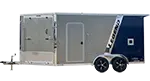
Spencer Trailers carries enclosed cargo trailers from several established builders, including Darkhorse Cargo, Legend Trailers, United Trailers, Wells Cargo, and other manufacturers represented in the dealership’s broader inventory. Availability changes as units are sold and new trailers arrive, so compare the specification sheet for the individual trailer rather than assuming every model from a brand uses the same frame, floor, wall, axle, or roof construction.
Darkhorse Cargo is regularly represented in practical contractor sizes such as 6×12, 7×14, 7×16, and 8.5×20. Current examples include engineered wood wall liners, high-performance wood flooring, one-piece aluminum roofs, LED interior lighting, flow-through vents, and either single- or tandem-axle running gear depending on the model.
United Trailers offers conventional enclosed models as well as all-aluminum models in certain sizes. A current 7×14 all-aluminum example uses tandem 3,500-pound torsion axles, electric brakes, a 7,000-pound GVWR, 16-inch-on-center wall, floor, and roof construction, an engineered wood floor, interior lighting, and recessed floor tie-downs. Aluminum construction can reduce empty weight, but payload must still be calculated from the certification label and actual finished weight.
Legend Manufacturing, Wells Cargo, and H&H Trailers provide additional choices across the dealership’s inventory and ordering network. Construction details vary by product line, so ask for the actual crossmember spacing, wall-stud spacing, floor thickness, roof design, rear-door rating, warranty, and available contractor options. The most recognizable brand name is not automatically the best configuration for your tools.
See what’s currently available in our enclosed trailer inventory for current stock and pricing.
Ventilation: Non-Negotiable for Painters
Ventilation matters for heat, odors, moisture, and worker exposure, but it must be discussed accurately. Some oil-based coatings, lacquers, solvents, reducers, cleaners, and related products can release flammable vapors. Their classification depends on the specific formulation and flash point shown on the label and Safety Data Sheet. Never treat every can marked “paint” as having the same storage requirements.
The first practical approach is factory passive ventilation. Many enclosed cargo trailers use a pair of flow-through wall vents, while roof vents are available on some models or can be installed when the roof structure and warranty permit. Passive vents may reduce trapped heat and ordinary odors, but they do not prove that vapor concentration is below a flammable limit. A roof vent’s dimensions, location, weather seal, and compatibility with roof bows should be confirmed before installation.
The second approach is powered ventilation. A generic automotive or recreational-vehicle exhaust fan should not be installed as a cure-all where flammable vapors may be present. Motors, switches, wiring, lights, chargers, inverters, heaters, and other electrical equipment can become ignition sources. Any system intended for an area containing flammable vapor must be designed for the actual hazard classification by a qualified professional and must discharge safely. OSHA’s spray-finishing rules require mechanical ventilation and appropriately classified electrical equipment in regulated spraying areas.
Do not use an ordinary enclosed cargo trailer as a spray booth, mixing room, or drying enclosure. Spraying flammable or combustible finishes involves ventilation, electrical, grounding, fire-protection, and residue-control requirements that a standard cargo trailer does not meet merely because a fan or vent has been added. Perform spraying in a location designed and approved for that work.
Keep products in closed, labeled containers and follow each manufacturer’s Safety Data Sheet. Approved containers or cabinets may be required for particular flammable liquids and quantities. Keep ignition sources away, maintain a clear exit, secure containers against movement, and place solvent-soaked rags and similar waste in appropriate covered, fire-resistant metal containers until disposal. Consult the local fire authority and your insurer before using a trailer for routine storage of solvent-based materials.
Shelving and Storage Systems
The right shelving turns an enclosed trailer into an efficient equipment room. The wrong shelving tears away from thin wall liner, overloads the front of the trailer, blocks an exit, or drops equipment during a hard stop. Build the storage system around structural attachment points and published component ratings.
- E-track wall systems: Horizontal or vertical E-track provides flexible attachment points for sprayer carts, hose reels, tool cases, and supply bins. The rail’s advertised rating applies only when it is installed with the correct fasteners, spacing, backing, and supporting structure. Interior wall liner alone is not a dependable structural anchor. Locate wall studs or added blocking and follow the trailer and E-track manufacturers’ instructions.
- Fixed shelving: Use shelves with raised lips, positive latches, or closed bins so smaller containers cannot slide into the aisle. Store heavy five-gallon buckets low, preferably in restrained floor-level compartments or containment trays near the axle area. Upper shelves are better suited to brushes, rollers, masking products, filters, tips, protective equipment, and lightweight supplies.
- Sprayer platform or slide-out tray: A low platform can keep an airless sprayer accessible without repeated lifting. Bolt the assembly through suitable backing plates or approved structural members rather than relying on a few wood screws in the floor. Confirm that drilling will not damage wiring, brake lines, crossmembers, or the trailer frame, and make sure the tray is positively latched for travel.
- Overhead ladder track: Interior ladder storage can save floor space, but the ladder’s collapsed length must fit the trailer and the rack must attach to structure capable of carrying the load. Roof bows and ceiling liner are not automatically rated for concentrated rack loads. Maintain head clearance, protect lights and vents, and secure each ladder against forward, rearward, and side movement. A properly engineered exterior ladder rack may be the better choice for longer ladders.
Leave enough room to operate door latches and reach emergency exits. Keep the heaviest equipment low, avoid placing all paint at the nose, and do not use the rear ramp area as permanent storage if it interferes with the ramp spring or door closure. After installation, inspect every fastener and restraint regularly because trailer vibration can loosen hardware over time.
A Quick Q&A on Common Questions
Can I store paint in an enclosed trailer overnight? It depends on the product, temperature, quantity, and fire classification. Water-based coatings can be permanently damaged by freezing, while excessive heat can shorten shelf life or increase container pressure. Manufacturer guidance commonly calls for a dry, controlled storage area protected from freezing and extreme heat; one general Benjamin Moore recommendation is approximately 60 to 80 degrees Fahrenheit, while individual technical data sheets may specify different limits. Follow the label and Safety Data Sheet for each product rather than using one temperature rule for every coating.
An enclosed trailer parked in direct sun is not controlled storage. Passive vents, a white roof, reflective coating, or insulation may help reduce heat gain, but none guarantees an acceptable product temperature. Use a minimum-and-maximum thermometer or data logger if coatings remain in the trailer, and move temperature-sensitive products to approved indoor storage when conditions fall outside their specified range.
Solvent-based coatings, thinners, and cleaners require additional attention. Check flash points and storage instructions in the Safety Data Sheets, keep containers closed and restrained, separate incompatible materials, eliminate ignition sources, and comply with applicable OSHA and fire-code requirements. A vented cargo trailer is not automatically approved for storing an unlimited quantity of flammable liquid.
What floor material handles paint spills best? Start with a sound subfloor and add a durable, non-slip surface compatible with the chemicals you carry. Rubber coin flooring is easy to sweep, but some solvents can soften, stain, or damage certain rubber and adhesive products. Commercial sheet flooring, properly applied floor coatings, aluminum tread plate, or removable protective panels may work better depending on the coating system.
Use drip trays or secondary containment under sprayers, cleaners, and liquid products. Seal seams and edges where practical, keep absorbent material and spill supplies accessible, and clean spills promptly according to the product’s Safety Data Sheet. Do not let liquid soak into wood flooring or remain trapped beneath a loose floor covering.
Do I need brakes on my cargo trailer? Indiana Code 9-19-3-3 requires a trailer or semitrailer with a gross weight of at least 3,000 pounds, when operated on a highway, to have brakes adequate to control, stop, and hold the trailer. The brakes must be controllable from the towing vehicle’s cab and must apply automatically if the trailer accidentally breaks away.
Most 7×14 tandem enclosed trailers and larger contractor trailers use electric brakes, which means the tow vehicle needs a compatible brake controller, properly wired seven-way connector, charged breakaway battery, and functional breakaway switch. A trailer with hydraulic surge brakes operates differently and does not use the same in-cab electric controller. Test the brakes, controller, lights, and breakaway system before travel.
Does a larger enclosed trailer automatically require a CDL? No. Trailer length alone does not trigger a CDL, and a trailer rated over 10,000 pounds does not by itself create a Class A CDL requirement when the combination remains below the federal threshold. A Class A CDL is generally required when the combination has a GCWR or actual gross combination weight of at least 26,001 pounds and includes a towed unit with a GVWR or actual gross weight over 10,000 pounds. Other CDL categories and hazardous-material requirements can also apply.
CDL and USDOT requirements are not the same. A painting contractor operating in interstate commerce may be subject to federal motor-carrier rules when the truck or combination reaches 10,001 pounds by the applicable rated or actual-weight test, even when a CDL is not required. Commercial use, interstate travel, hazardous materials, and state-specific rules should be reviewed separately.
How quickly must an Indiana buyer handle the paperwork? Indiana residents generally must title and register a newly acquired, unregistered vehicle within 45 days of purchase or acquisition. Do not confuse that period with the validity of a separately issued temporary registration permit.
What to Look for When You’re on the Lot
When you’re evaluating an enclosed trailer for painting work, walk through this checklist before you commit.
- Interior height: Measure the tallest crew member and account for lights, roof bows, ladder racks, and shelving. A 6-foot-6-inch or 7-foot interior is generally more comfortable for daily walk-in use than a low-roof model.
- Floor construction: Ask about floor material, thickness, crossmember spacing, fastening method, warranty coverage, and the correct procedure for mounting equipment. A screwed floor can be useful, but fastener type alone does not determine floor strength.
- Wall liner and framing: Smooth, light-colored liner improves visibility, but determine what is behind it before mounting shelves. Ask for wall-stud material and spacing, and add structural blocking where needed.
- Door type: Rear ramp doors simplify rolling sprayers and carts but add weight and have published load limits. Double rear doors eliminate the ramp angle and may suit crews that hand-carry equipment. Compare opening height, opening width, ramp rating, ramp flap, spring hardware, threshold height, and side-door access.
- Ventilation: Identify the existing wall or roof vents and determine whether additional heat management is needed. Do not assume ordinary vents satisfy requirements for storing or handling flammable products.
- Electrical: Separate basic 12-volt trailer lighting from a true 120-volt shore-power system. Contractor outlets, battery chargers, fans, heaters, air conditioners, breaker panels, and GFCI receptacles should be designed and installed by qualified professionals for the intended environment.
- Payload and ratings: Read the certification label and compare GVWR with actual empty weight. Verify axle, tire, wheel, coupler, jack, ramp, safety-chain, and tie-down ratings. Ask whether listed empty weight includes the spare tire and installed options.
- Brakes and wiring: Confirm brakes are installed on the required axles, inspect the breakaway system, and make sure the tow vehicle has the correct connector and controller. Do not accept a warning light or controller display as proof that every brake is functioning.
- Security and serviceability: Look at door-bar design, lock protection, hinge access, spare-tire location, roof-seam warranty, replacement-part availability, and access for brake and bearing maintenance. Locks, GPS tracking, equipment marking, and appropriate insurance work best as a combined theft-deterrence plan.
What It Costs
Current pricing is higher than the figures that were common several model years ago. As of July 2026, current Spencer Trailers listings show single-axle 6×12 Darkhorse enclosed trailers at approximately $4,995 to $5,300, depending on rear-door configuration and included equipment. Current 7×14 tandem 7,000-pound Darkhorse listings are approximately $7,500 to $7,850, while a current 8.5×20 9,990-pound Darkhorse listing is approximately $12,750. All-aluminum construction, additional height, upgraded interiors, insulation, cabinets, windows, electrical packages, premium wheels, and custom contractor equipment can raise the price significantly.
Prices and availability change as trailers are sold and replacement inventory arrives. Compare out-the-door figures that identify the trailer price, options, taxes, title and registration costs, financing charges, delivery, and any dealer fees. Also budget for the brake controller, hitch equipment, locks, shelving, tie-downs, spill-control supplies, electrical work, ladder rack, and any required tow-vehicle upgrades.
A trailer used in a qualifying trade or business may be eligible for depreciation deductions. Federal law restored a 100-percent additional first-year depreciation deduction for certain qualifying property acquired and placed in service after January 19, 2025. Eligibility, business-use percentage, elections, basis, financing, and future depreciation recapture depend on the taxpayer’s circumstances, so discuss the purchase with a qualified tax professional rather than assuming the entire invoice is automatically deductible.
Pricing changes with materials, equipment packages, and inventory, so the best move is to check current stock directly. Browse what we have on hand at spencertrailers.com/all-inventory or call us at (812) 829-0226.
Putting It Together
The right enclosed trailer for a painting contractor is not automatically the biggest one or the most expensive. It is the trailer that has enough payload for the finished build-out, fits the actual crew and equipment, matches the tow vehicle, and can be loaded without blocking exits or creating unstable weight distribution.
For many two-person painting operations, a properly configured 7×14 tandem trailer is an excellent starting point. A useful setup may include dual 3,500-pound axles, electric brakes, a 7,000-pound GVWR, adequate standing height, factory ventilation, a side entry door, a rear ramp or double doors selected for the equipment, structurally anchored E-track, low storage for heavy paint containers, accessible sprayer restraints, and a ladder system designed around measured ladder lengths.
Do not finish the build and assume the numbers still work. Weigh the trailer in normal working condition, including coatings, tools, spare tire, shelving, batteries, and crew equipment. Verify the trailer’s total weight, individual axle loads, and tongue weight against every applicable rating. Recheck the load whenever the equipment package changes significantly.
If you’re not sure what size fits your rig and workflow, talk to someone at Spencer Trailers before you buy. We’re at 291 West State Hwy 46 in Spencer, Indiana, and we stock enclosed cargo trailers from multiple builders. Bring your equipment list, estimated load weights, tow-vehicle information, and ladder measurements, and we’ll work through the available configurations with you.


