








A concrete contractor without the right trailer is constantly improvising. You are either renting equipment near the job because you cannot move your own machine, making two trips because the trailer has run out of legal payload, or leaving forms and tools behind to keep the load under its rating. None of those workarounds is cheap. The trailer behind your truck is a production tool, and choosing the wrong capacity, deck style, hoist, ramp system, or hitch can cost far more than the difference between two trailer models.
Here is how to match a trailer to what concrete work actually demands: heavy equipment, demolition debris, forms, mixers, and gear that is dense, awkward, abrasive, and hard on trailer floors. The correct choice starts with actual weights and ratings, not bed size or appearance.
What Concrete Contractors Actually Haul
Before buying anything, make an honest list of every machine, attachment, form package, and material that may go on the trailer. Concrete contractors commonly move:
- Towable, skid-mounted, or self-loading concrete mixers. Empty weights vary widely by design, and the manufacturer’s identification plate or manual should be used instead of a general estimate. A mixer that is light when empty can become dramatically heavier if it contains water, aggregate, concrete residue, or a partial batch.
- Steel, aluminum, or wood forms that may be long, bulky, sharp-edged, and difficult to secure without stake pockets, rub rails, blocking, and properly rated tiedowns.
- Broken concrete, reinforcing steel, demolished block, and other construction waste that can overload a dump trailer long before the box looks full.
- Plate compactors, power trowels, concrete saws, bull floats, screeds, generators, pumps, hand tools, fuel containers, and jobsite accessories.
- Skid steers, compact track loaders, mini excavators, or small wheel loaders used for excavation, grading, demolition, and material handling.
Many established contractors eventually use two trailers: an equipment trailer for machinery and forms, plus a dump trailer for debris and bulk material. A one-trailer approach can still work, but only when the trailer’s payload, deck dimensions, ramp or tilt system, tie-down layout, and tow-vehicle requirements match the heaviest realistic job rather than the lightest load you expect to carry.
Heavy Equipment Trailers: Moving Your Big Iron
If you own a skid steer, compact track loader, mini excavator, or self-loading mixer, calculate the complete transported weight before choosing a trailer. Include the machine, bucket, forks, breaker, auger, fuel, tracks packed with material, chains, binders, spare tire, toolbox, and anything else placed on the deck. A 14,000-pound-class trailer can work for some compact machines, but many concrete contractors need a 14,900- or 15,500-pound GVWR trailer or a heavier configuration to maintain useful payload headroom. The trailer’s published payload is only a starting point because installed options increase empty weight.
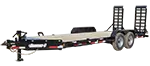
A Diamond C LPX Low Profile Extreme Duty Equipment Trailer is built for this type of work. Current LPX configurations range from 15,500 to 24,000 pounds GVWR, with bumper-pull lengths from 16 to 30 feet and bed widths of approximately 80 to 82 inches. The standard 15,500-pound package uses two 7,000-pound Lippert axles, while available packages include triple 7,000-pound, dual 8,000-pound, and dual 10,000-pound axle configurations. Higher-GVWR packages and longer trailers can use Diamond C Engineered Beam Technology, while other configurations use heavy I-beam construction. The low-profile deck between the fenders helps reduce the loading angle and keeps equipment closer to the road than a deck-over design. A gooseneck LPX-GN is also available for contractors who want the handling, bed-mounted hitch position, and additional configuration choices of a gooseneck trailer.
For contractors who want a conventional 14,000- or 16,000-pound equipment trailer, the H&H 82″ x 20′ Industrial Equipment Trailer is a current option. The 14,000-pound version uses two 7,000-pound axle ratings and has a published curb weight of approximately 3,200 pounds before added options, leaving about 10,800 pounds of theoretical payload. A 16,000-pound version with 8,000-pound axle ratings is also offered. Current standard equipment includes slipper-spring suspension, a 2-inch pressure-treated pine deck, a dovetail, and 5-foot spring-assisted skid-loader ramps. That is different from assuming every heavy equipment trailer uses torsion axles; the actual suspension and axle package must be confirmed on the trailer’s certification label and build sheet.
Key specifications to look for on any equipment trailer used for concrete work include:
- A pressure-treated wood deck, steel deck, or other manufacturer-approved surface suited to the machine’s tracks and point loads. Wood is easier to replace and often provides useful traction, while steel can be more resistant to gouging but may become slick when wet or covered with slurry.
- A loading system rated for the actual machine and its concentrated axle or track loads. Ramp length alone does not establish capacity. Diamond C options may include MAX Ramps, XDR Ramps, or the X-Ramp depending on the trailer model and configuration.
- Clearly rated D-rings, stake pockets, rub rails, chains, binders, straps, and attachment points. For commercial cargo securement, the complete tiedown system must be sized by working load limit, not by appearance. Federal rules generally require aggregate tiedown working load limit of at least one-half the cargo weight, with additional securement requirements based on the cargo’s length and type.
- Service brakes, a compatible in-cab brake controller, a charged breakaway battery, properly adjusted brake assemblies, and tires with sufficient load capacity. Heavy equipment trailers should have functioning brakes on every wheel required by their design and applicable law.
Dump Trailers: The Right Call for Debris
Concrete is exceptionally dense. Normal-weight solid concrete is commonly estimated at about 140 to 150 pounds per cubic foot, which is approximately 3,780 to 4,050 pounds per solid cubic yard. Broken concrete does not pack like a solid cube because air spaces form between the pieces, so the actual bulk weight per cubic yard can vary substantially with chunk size, rebar, soil, moisture, and how tightly the material settles. That variation is exactly why a contractor should not rely on box volume alone. A 14,000-pound dump trailer with a 4,100-pound empty weight has only about 9,900 pounds available before options and cargo are considered. That is equivalent to less than two and one-half solid cubic yards of normal-weight concrete, and a scale ticket is the reliable way to confirm the finished load.
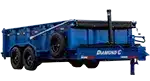
The Diamond C LPT Heavy Duty Telescopic Dump Trailer is the appropriate heavy-duty low-profile Diamond C model for this job. Current LPT bumper-pull configurations range from 15,500 to 24,000 pounds GVWR, with 12-, 14-, and 16-foot lengths and an approximately 81- to 82-inch-wide body. Standard axle equipment begins with two 7,000-pound Lippert axles, with heavier Lippert packages available. The LPT uses a telescopic hydraulic cylinder, reaches a published 45-degree dump angle, and has a standard 10-gauge body with the sides integral to the floor. A 7-gauge, 3/16-inch Super Duty body upgrade is available for especially severe point-impact and demolition use. Buyers can also select different side heights, but the selected body, axle, tire, and option package must always be matched to the certification-label GVWR.
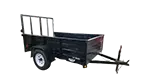
The H&H 83″ x 14′ Industrial Dump Trailer is another current heavy-duty option. The bumper-pull 14,000-pound configuration has two 7,000-pound axle ratings and a published curb weight of approximately 4,100 pounds, while the 16,000-pound configuration uses 8,000-pound axle ratings and has a published curb weight of approximately 4,500 pounds. Standard features include a one-piece 10-gauge steel floor, a hydraulic scissor hoist, powered-up and powered-down hydraulic operation, an onboard deep-cycle battery and pump, a charger, integrated loading ramps, a tarp system, and a combination barn-door and spreader-style gate. The onboard hydraulic system does not require the truck engine to remain running during normal dumping, but the trailer battery still needs routine charging, inspection, and maintenance.
One thing buyers regularly overlook is the relationship between sidewall height and legal payload. Taller sides increase box volume; they do not increase GVWR, axle ratings, tire capacity, or payload. For concrete demolition, a standard lower-sided body can make loading easier to observe and can discourage crews from building an oversized mound of dense material. Side extensions are most useful for lighter, bulky material such as brush or packaging debris. When hauling concrete, load low and evenly, avoid dropping large slabs from excessive height, keep heavy chunks away from the tailgate when practical, and stop loading based on estimated weight and scale verification rather than how much empty space remains above the load.
Flatbed and Tilt Trailers: Hauling Forms and Mixed Loads
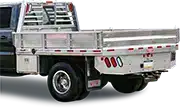
Steel and aluminum form packages are heavy, long, and often have sharp edges that can damage straps or catch on dump-trailer sides. A flatbed or low-profile equipment trailer is frequently the cleanest way to move them because forklifts can approach the load from the side, crews can block and strap bundles directly to the deck, and sidewalls do not interfere with long or irregular pieces. Use edge protection where straps contact sharp form edges, prevent bundles from sliding longitudinally, and confirm that every chain, strap, binder, and anchor point has a visible working load limit appropriate for the load.
The Diamond C FMAX gooseneck flatbed series is appropriate when a contractor needs to combine long form packages, pallets, attachments, and heavy equipment on one trailer. The FMAX name refers to Diamond C’s Flatbed Max gooseneck line, not a single generic 20-ton model. For example, the FMAX210 is currently rated at 25,000 pounds GVWR and uses two 10,000-pound Lippert axles, while selected FMAX216 and FMAX312 configurations can be ordered with GVWR ratings up to 40,000 pounds. GVWR is the maximum rated weight of the loaded trailer, not the payload by itself; the trailer’s empty weight must still be subtracted. For smaller operations, the H&H 82″ x 20′ Industrial Equipment Trailer in a 14,000- or 16,000-pound configuration provides an open deck, treated wood flooring, stake pockets, rub rails, a dovetail, and equipment ramps without moving into a high-GVWR gooseneck.
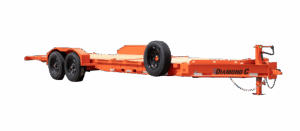
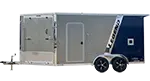
Tilt trailers deserve special attention when a mixer, compactor, saw cart, or machine is awkward to push up separate ramps. The Diamond C HDT Hydraulically Dampened Tilt Equipment Trailer is offered in bumper-pull configurations from 15,500 to 24,000 pounds GVWR and lengths from 16 to 28 feet. It starts with two 7,000-pound Lippert axles and can be configured with heavier Lippert axle packages. Buyers can select a full-bed tilt or configurations with a stationary front deck, depending on length and load needs. Standard hydraulically dampened gravity-tilt operation controls deck movement, while powered tilt and Pro Tilt options are available for configurations where precise hydraulic control is useful. The result is ramp-free loading without incorrectly assuming that every tilt trailer is a light-duty 7,000-pound car hauler.
A Side-by-Side Look
| Use Case | Recommended Trailer | GVWR | Key Feature |
|---|---|---|---|
| Skid steer / track loader | Diamond C LPX Equipment Trailer | 15,500-24,000 lb | Low-profile equipment deck, Lippert axle packages, heavy I-beam or Engineered Beam configurations |
| Demo debris hauling | Diamond C LPT Telescopic Dump | 15,500-24,000 lb | Telescopic hoist, 45-degree dump angle, 10-gauge body with available 7-gauge upgrade |
| Forms and mixed gear | H&H 82″ x 20′ Industrial Equipment | 14,000-16,000 lb | Open treated-wood deck, stake pockets, rub rails, dovetail, and spring-assisted ramps |
| Mixer hauling | Diamond C HDT Tilt Equipment | 15,500-24,000 lb | Hydraulically dampened tilt with full-tilt and stationary-deck configurations |
| General mid-size loads | H&H 83″ x 14′ Industrial Dump | 14,000-16,000 lb | 10-gauge floor, hydraulic scissor hoist, onboard power unit, and combination gate |
Common Mistakes to Avoid
Buying based on bed size instead of payload and axle capacity. A 16-foot or 20-foot bed tells you how much space is available, not how much weight the trailer can legally carry. Start with the certification-label GVWR, subtract the trailer’s actual empty weight with installed options, and then verify axle ratings, tire ratings, coupler capacity, jack capacity, and tow-vehicle limits. Remember that a trailer’s GVWR may be higher than the combined axle ratings because part of the loaded weight is carried by the tongue or gooseneck pin. That does not permit overloading an axle, tire, hitch, receiver, or the truck.
Ignoring the complete brake and licensing picture. Indiana Code IC 9-19-3-3 requires a trailer or semitrailer with a gross weight of at least 3,000 pounds to have brakes adequate to control, stop, and hold it, with cab-applied braking and automatic application in a breakaway. Every trailer discussed in the heavy equipment and dump categories is well above that threshold. A properly adjusted brake controller and functioning breakaway system are essential. A CDL is not triggered merely because the trailer itself is rated above 10,000 pounds. A Class A CDL threshold is reached when the combination’s GCWR is 26,001 pounds or more and the towed vehicle’s GVWR is over 10,000 pounds. Commercial operating rules can still apply below the CDL threshold, so contractors should evaluate the complete truck-and-trailer combination and how it is used.
Choosing the wrong floor or failing to maintain it. A demolition dump trailer should have a manufacturer-rated steel body suited to concentrated impact, while an equipment trailer may use pressure-treated wood or steel depending on the machine and operating conditions. Concrete slurry, trapped moisture, rebar, track cleats, and dropped chunks can damage any floor. Wash off residue before it hardens, inspect welds and crossmembers, replace damaged deck boards, repair exposed coating, lubricate hinges and hoist points as specified, and never assume a heavy-looking floor makes the trailer immune to point-load damage.
One Trailer or Two?
Here is the practical answer: if a larger crew consistently performs both equipment moves and demolition hauling, two purpose-built trailers usually save time and reduce abuse. A 14,000- to 24,000-pound dump trailer can handle debris and bulk material, while a properly sized equipment or tilt trailer moves machines, attachments, and forms without placing them inside a dump body. The two trailers may not use the same hitch hardware. A bumper-pull equipment trailer may use a 2-5/16-inch ball, a heavy dump trailer may use a different-rated adjustable coupler or pintle arrangement, and a gooseneck requires a properly installed bed-mounted hitch. A three-quarter-ton or one-ton badge alone does not establish legal towing capacity; use the truck’s door labels, owner’s manual, hitch ratings, axle ratings, payload, and configuration-specific tow chart.
If you operate one truck and can purchase only one trailer, a dump trailer may be the more versatile choice when debris removal is the primary service. Some dump trailers can also transport compact equipment when equipped with manufacturer-rated ramps, rear stabilizers, enough payload, adequate inside width, and a body designed for the machine’s point loads. That does not mean every dump trailer is suitable for a skid steer or excavator. Conversely, a flatbed can carry equipment and forms extremely well but cannot safely contain loose concrete debris unless the material is placed in an approved container or otherwise properly contained and secured.
Quick Q&A
Can I haul a 1-ton concrete mixer on a standard 7,000 lb trailer?
Possibly, but the words “1-ton mixer” do not provide enough information by themselves. Confirm whether one ton describes the machine’s actual transport weight, its batch capacity, or a marketing class. A typical 7,000-pound GVWR tandem-axle trailer may have approximately 4,500 to 5,000 pounds of payload after its own weight is deducted, but options, spare tires, tools, forms, and tongue-weight distribution reduce the available margin. The mixer should be transported in the condition permitted by its manufacturer, and a towable mixer should not be assumed safe to move with wet concrete inside. Normal-weight concrete can add roughly 4,000 pounds per cubic yard. Weigh the complete loaded setup and verify trailer, axle, tire, hitch, and truck ratings before towing.
What hitch do I need?
Use the hitch type and ball size stamped or specified on the trailer coupler. Ball size is not determined solely by GVWR. Lighter trailers often use a 2-inch ball, while many commercial equipment and dump trailers use a 2-5/16-inch ball; other trailers may use a pintle-type connection or gooseneck coupler. The receiver, ball mount, hitch ball, coupler, safety chains, gooseneck system, and truck must each be rated for the actual trailer and tongue or pin weight. The lowest-rated component controls. Weight-distribution equipment should be used only when approved by the truck, receiver, trailer, and coupler manufacturers.
Are aluminum trailers worth it for concrete work?
They can be, depending on the assignment. Aluminum equipment trailers reduce empty weight and resist red rust, which may increase usable payload within a given GVWR. However, concrete demolition creates concentrated impact, abrasion, sharp rebar contact, and difficult repair conditions. Steel dump bodies and heavy steel equipment trailers are generally the more practical choices for repeated demolition and severe jobsite abuse. An aluminum equipment trailer can still be suitable for transporting a mixer or compact machine when the manufacturer rates it for the load and the crew protects the deck from damaging point loads. Compare payload, floor construction, ramp capacity, repair access, and expected use rather than rejecting or choosing a trailer based on material alone.
Where to Start
Spencer Trailers carries Diamond C and H&H trailers in Spencer, Indiana, and can help match a current model and build configuration to your machine weights, payload, truck, hitch, and jobsite routine. Diamond C has built trailers in Mt. Pleasant, Texas, since 1985, and its current premium equipment, dump, and FMAX lines use Lippert axle packages and the DM Difference Maker multi-stage coating system. Browse the current inventory to see what is available, or check the recently sold page to see configurations purchased by other area contractors. Compare the trailer’s VIN label and final build sheet rather than relying on a generic model description, because axle packages, body thickness, deck material, ramps, tires, brakes, and installed options can change payload. Indiana buyers should complete title and registration paperwork within the state’s 45-day penalty-free period. As of July 1, 2026, Indiana’s stated documentation-preparation-fee enforcement threshold is $261.72. Contractors purchasing qualifying business equipment should also ask a tax professional about the restored 100% federal bonus depreciation rules for eligible property acquired and placed in service after January 19, 2025. Eligibility, business use, basis, elections, and individual tax circumstances must be reviewed by a qualified adviser. For help selecting a trailer, call (812) 829-0226 or reach out online.
The right trailer does not slow the crew down or force the truck beyond its limits. It carries the intended load legally, secures it correctly, unloads it efficiently, and gets out of the way so the concrete work can continue.

