








You’re walking a lot full of trailers, comparing prices and features, and on the tongue or forward frame of one unit you spot a small oval NATM compliance decal. On the next trailer, you do not see one. Does it matter? It can, but not because the decal is a government approval or a promise that the trailer will never have a problem. A valid NATM compliance decal indicates that the manufacturer voluntarily joined the National Association of Trailer Manufacturers and successfully completed the association’s required Compliance Verification Program. That makes the decal a useful third-party signal about the manufacturer’s documented production and regulatory-compliance processes.
What NATM Is (and Isn’t)
The National Association of Trailer Manufacturers is a trade association serving light- and medium-duty trailer manufacturers and related suppliers in the United States. NATM is not a government agency, and participation in NATM is not required by federal law or Indiana law. Manufacturers choose whether to join. Once a trailer manufacturer becomes an NATM member, however, participation in the Compliance Verification Program is mandatory for maintaining compliant manufacturer status.
It is also important to understand how trailer compliance works under federal law. The National Highway Traffic Safety Administration does not inspect and pre-approve every trailer before it is sold. Instead, the manufacturer is legally responsible for self-certifying that each new trailer conforms to all applicable Federal Motor Vehicle Safety Standards and for attaching the required federal certification label. NATM does not replace that legal responsibility. Its Compliance Verification Program adds an independent review of the manufacturer’s procedures, records, facility, and representative trailers. The consultation is generally performed on a two-year cycle using an extensive checklist based on applicable federal regulations and NATM’s published Guidelines. If deficiencies are identified, the manufacturer must document corrective action before successfully completing the process and becoming eligible to use current compliance decals.
What the Audit Actually Checks
The NATM consultation covers substantially more than a quick visual inspection. The compliance consultant reviews administrative records, federal certification practices, vehicle identification number procedures, component documentation, manufacturing processes, quality-control practices, consumer information, and a sample of trailers available at the facility. The exact checklist items depend on the type, size, weight rating, and equipment of the trailers being manufactured. It is not a destructive engineering test, and it is not an individual inspection of every trailer leaving the plant. It is a structured review of whether the manufacturer has processes in place to build and label trailers in accordance with applicable requirements and recognized industry practices.
Lighting and Electrical
New trailers manufactured for highway use must comply with the applicable portions of Federal Motor Vehicle Safety Standard No. 108, which governs required lamps, reflective devices, conspicuity treatments, and associated equipment. The requirements vary according to trailer width, length, configuration, and GVWR. For example, trailers that are at least 80 inches wide require additional identification and clearance lighting, while many trailers over 10,000 lb GVWR and at least 80 inches wide are also subject to federal conspicuity-treatment requirements.
During the compliance review, representative trailers may be checked for the proper type, color, location, visibility, and installation of required lights and reflectors. Wiring practices are also reviewed under the applicable requirements and NATM Guidelines. That can include wire routing, grounding, protection from abrasion, connector installation, and support for wiring exposed beneath the trailer. A compliance decal does not eliminate the owner’s responsibility to test the lights before every trip, but it provides evidence that the manufacturer has undergone a formal review of how those systems are designed, documented, and installed.
Brakes
Brake requirements must be stated carefully because there is no single federal rule declaring that every privately operated trailer at or above 3,000 lb GVWR must have a particular brake system. State operating laws and federal commercial-motor-vehicle rules both may apply. In Indiana, a trailer with a GVWR greater than 3,000 lb must be equipped with brakes as required by Indiana Code 9-19-3-3. Commercial trailers operating under federal motor-carrier regulations may also be subject to requirements governing braking performance and the automatic application of trailer brakes if the trailer separates from the towing vehicle.
NATM’s review considers whether the manufacturer has identified the applicable requirements and correctly installed and documented the braking equipment used on its trailers. Depending on the trailer, that can include electric or electric-over-hydraulic brakes, brake wiring, hydraulic components, brake controls, breakaway switches, onboard breakaway batteries, charging circuits, and owner instructions. Buyers should still test brake operation and the breakaway system regularly. A decal cannot confirm that a battery remains charged, that corrosion has not damaged a connection, or that a brake controller in the tow vehicle has been adjusted correctly.
Couplers, Safety Chains, and Hitching Hardware
The trailer’s coupler, gooseneck connection, lunette ring, kingpin, safety chains, breakaway attachment, and related mounting hardware must be appropriate for the intended application. NATM’s compliance process reviews component documentation, installation practices, markings, and the manufacturer’s procedures for selecting properly rated hitching equipment. The exact requirements differ among bumper-pull, gooseneck, fifth-wheel, and commercial trailer configurations.
For the buyer, the manufacturer’s rating is only one part of the towing system. The ball, ball mount, receiver, pintle hitch, gooseneck ball, safety-chain attachment points, tow vehicle, and any weight-distributing equipment must also be rated for the actual loaded trailer. A properly manufactured trailer can still be unsafe when connected to an undersized receiver, the wrong ball diameter, a worn coupler, or safety chains attached to an unsuitable point. The compliance decal signals that the manufacturer’s hitching practices were reviewed; it does not increase the capacity of the customer’s tow vehicle or hitch.
Tires and Axles
Tire, rim, axle, suspension, GAWR, and GVWR information must be consistent with the trailer’s certified configuration. Federal tire and rim requirements are divided principally between FMVSS 110 for vehicles at or below 10,000 lb GVWR and FMVSS 120 for vehicles above 10,000 lb GVWR, with additional tire-manufacturing requirements under FMVSS 119. The required federal certification label identifies the trailer’s GVWR and the GAWR for each axle, while the tire-information portion identifies the tire size and recommended cold inflation pressure.
A common misunderstanding is that the combined load rating of all trailer tires must always equal or exceed the trailer’s entire GVWR. Federal requirements focus on axle loading: the combined load-carrying capacity of the tires fitted to an axle must be sufficient for that axle’s GAWR. On a bumper-pull or gooseneck trailer, part of the loaded trailer weight is carried as tongue or pin weight by the tow vehicle rather than by the trailer axles. NATM’s review helps identify mismatches among the manufacturer’s axle ratings, tire and wheel selections, suspension components, certification labels, and supporting records. Owners must still maintain the correct inflation pressure, inspect tire age and condition, stay within the trailer’s certified GVWR and axle ratings, and verify the actual payload available after accounting for the trailer’s empty weight and installed options.
Structural Integrity
There is no single federal rule prescribing one frame-rail size, crossmember spacing, deck thickness, ramp design, or weld pattern for every trailer. Those details vary according to the trailer’s intended use, engineering, weight rating, dimensions, and options. NATM’s process therefore does not amount to a universal structural load certification. Instead, the consultant reviews the manufacturer’s documented production practices, quality procedures, component selection, fabrication and assembly methods, required records, and representative completed trailers against applicable regulations and NATM Guidelines.
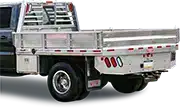
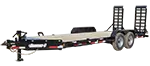
For a buyer, physical inspection still matters. Look at frame construction, visible welds, deck attachment, hinges, tie-downs, ramp retainers, jack mounting, hydraulic components, wiring protection, fasteners, and evidence of shipping or lot damage. On dump and tilt trailers, inspect the hoist, cylinder mounting, hydraulic hoses, safety support, pivot areas, and battery enclosure. On equipment and flatbed trailers, inspect the ramp system, deck, rub rail, stake pockets, and tie-down points. NATM compliance supports confidence in the manufacturer’s processes, but it is not a substitute for choosing the correct trailer, reading the owner’s manual, maintaining the unit, and loading it properly.
The Brands That Go Through It
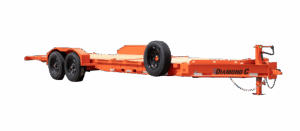
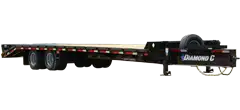
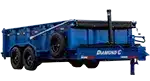
Several manufacturers represented in the Spencer Trailers market are listed in NATM’s current compliant trailer manufacturer directory. Diamond C is a family-owned American manufacturer founded in 1985 and based in Mt. Pleasant, Texas. Its current product families include the LPX Low Profile Extreme Duty Equipment Trailer and the FMAX Flatbed Max gooseneck flatbed lineup. LPX configurations generally begin around the 15,500 lb class and extend into heavier 24,000 lb configurations, while FMAX GVWR depends on the specific model and build. Diamond C’s premium lines, including FMAX, HDT, LPT, LPX, WDT, and DEC, use Lippert axles as standard. Exact axle capacity, brakes, tires, dimensions, ramps, payload, and GVWR must always be confirmed from the certification label and build sheet for the individual trailer.
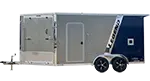
H&H Trailers, manufactured in Clarinda, Iowa, and Legend Manufacturing, based in Alma, Michigan, are also listed in NATM’s compliant manufacturer directory. Wells Cargo is a longstanding enclosed-trailer manufacturer whose trailers may be encountered in new or used inventory, but NATM participation and compliant status should always be verified using the current directory and the information attached to the specific trailer. Membership can change, facilities can change ownership, and a decal on an older unit reflects the manufacturer’s status when that decal was issued rather than guaranteeing the company’s status indefinitely.
So when you’re standing in front of a trailer in our inventory and see a valid serialized NATM compliance decal, you’re looking at a trailer built by a manufacturer that successfully completed NATM’s compliance-verification process. You should still read the federal certification label, confirm the trailer’s actual specifications, and inspect the unit. The decal is valuable supporting evidence, not a replacement for those steps.
What the Decal Looks Like and Where to Find It
The NATM compliance decal is generally an oval, serialized label displaying the NATM logo. Current designs commonly use red, white, and blue elements with a contrasting border, although the appearance has changed over the years. Some newer versions may include a scannable code or other verification information. The important features are that it is an official compliance-program decal and that it carries a unique serial number. A general NATM member logo printed in advertising or displayed on a website is not necessarily the same thing as a serialized compliance decal placed on a trailer.
Manufacturers commonly place the decal on the tongue, front frame, forward sidewall, or near the trailer’s federal certification label, but there is no universal NATM decal location for every trailer design. Do not confuse it with the legally required federal certification label. The federal label is normally affixed to the forward half of the left side of the trailer in a location readable from outside and identifies the manufacturer, date of manufacture, GVWR, GAWR, VIN, vehicle type, and federal conformity statement.
If you’re buying used, the NATM decal may be faded, damaged, removed during repainting, or absent because the manufacturer did not participate when that particular trailer was built. Check the certification label first and use the manufacturer name, VIN, model year, and decal serial number when available. NATM’s current Compliant Trailer Manufacturer Directory can help confirm present status, and NATM may be able to identify the manufacturer associated with a serialized decal within its available records. A current directory listing does not retroactively inspect a used trailer, and the absence of a decal by itself does not prove that the trailer was illegally manufactured.
Why It Matters More Than You Might Think
Consider two trailers advertised for the same job. The first has a readable federal certification label, a clear VIN, a documented GVWR and axle rating, tires and wheels that match the certified configuration, a build sheet, an established warranty process, and a serialized NATM compliance decal from a currently listed manufacturer. The second has an unreadable or missing certification label, uncertain axle information, component ratings that do not agree, and no reliable documentation. The serious concerns in that comparison are the missing or contradictory legal and technical information. NATM participation gives the buyer one additional reason to trust the first manufacturer’s production controls and documentation.
NATM compliance does not guarantee that a wheel bearing, tire, brake, light, hydraulic pump, weld, or other component will never fail. It does not provide insurance coverage, extend the manufacturer’s warranty, excuse overloading, or prevent an enforcement officer from placing an unsafe commercial vehicle out of service. At a roadside inspection, the officer is concerned with the trailer’s actual condition and legal operation, including brakes, lights, tires, load securement, registration, weight, breakaway equipment where required, and the towing combination. An NATM decal does not cure a defective light, an overloaded axle, a discharged breakaway battery, or an improperly secured machine.
It is also risky to attach a fixed dollar amount to the difference between an NATM-compliant trailer and another trailer. Prices change with steel costs, dimensions, GVWR, axle configuration, deck material, ramps, hydraulic equipment, finish, options, freight, and current inventory. Compare trailers on an apples-to-apples basis: certified GVWR, actual empty weight, usable payload, bed dimensions, axle and suspension ratings, brake equipment, tire and wheel specifications, coupler capacity, ramp design, frame construction, warranty, parts support, and dealer service. NATM compliance should be part of that comparison, not the only item considered.
| What NATM Review Covers | Relevant Standard or Guidance |
|---|---|
| Required lighting, reflectors, and conspicuity equipment | FMVSS 108 |
| Brake systems and breakaway equipment, when applicable | Indiana IC 9-19-3-3 and applicable state or federal operating requirements |
| Couplers, safety devices, chains, and hitching hardware | Applicable regulations and NATM Guidelines |
| Tires, rims, GAWR, GVWR, and load-rating documentation | FMVSS 110, 119, and 120; 49 CFR Part 567 |
| VIN, certification, records, and documented production processes | 49 CFR Parts 565, 567, and 574; NATM Guidelines |
A Quick Q&A
Does NATM compliance mean the trailer is covered by NATM if something breaks?
No. NATM is a trade association that administers a compliance-verification program; it is not the trailer’s warranty provider or insurer. Warranty coverage is determined by the written terms supplied by the trailer manufacturer and, where applicable, the component manufacturer. The dealer can help document and submit a claim, but the NATM decal itself does not create additional warranty coverage.
Do all trailers over 10,000 lb GVWR need NATM certification?
No. NATM participation is not legally required at 10,000 lb GVWR or at any other GVWR. Federal motor-vehicle safety requirements still apply to new trailers according to their classification and configuration. The 10,000 lb threshold affects which specific tire, rim, labeling, and other provisions apply; it does not transfer responsibility for trailer manufacturing from NHTSA to the Federal Motor Carrier Safety Administration. FMCSA rules primarily govern the operation and maintenance of commercial motor vehicles used in commerce. NATM’s regular trailer-manufacturer program is focused on light- and medium-duty trailers under 26,000 lb GVWR, so buyers of heavier specialized trailers should evaluate the manufacturer’s applicable federal compliance, engineering documentation, certification label, component ratings, and support directly.
Can a small manufacturer be NATM-compliant?
Yes. Eligible regional and specialty manufacturers can join NATM and complete the Compliance Verification Program. Company size alone does not determine compliance. What matters is whether the manufacturer has appropriate documentation, labeling, production controls, records, and corrective-action procedures and whether it has successfully completed the current verification process. Buyers should check the current NATM directory instead of assuming that a familiar brand name or a large factory automatically means active compliant status.
Is NATM compliance required to sell trailers in Indiana?
No. Indiana does not require a trailer manufacturer or dealer to hold NATM membership. However, a new trailer manufactured for sale in the United States must still satisfy applicable federal requirements and carry the required manufacturer certification and VIN information. The trailer must also have the equipment required for legal operation in Indiana, including brakes on trailers over 3,000 lb GVWR. NATM participation is a voluntary additional layer of review, not an alternative to federal or state compliance.
What to Ask at the Dealership
When you’re comparing trailers, ask specific questions: “Is this manufacturer currently listed in NATM’s compliant manufacturer directory? Does this exact trailer carry a serialized NATM compliance decal? Can you show me the federal certification label and the manufacturer’s build sheet?” Then verify the GVWR, each GAWR, tire size, cold inflation pressure, coupler or gooseneck rating, brake configuration, empty weight, estimated payload, bed dimensions, and installed options. Do not rely only on an online model description because axle packages, lengths, ramps, tires, hydraulic systems, and GVWR configurations can vary within the same model family.
At Spencer Trailers, we can help you review those details instead of asking you to rely on a decal alone. Diamond C, H&H, and Legend can be checked against NATM’s current compliant manufacturer information, while Wells Cargo, older inventory, trade-ins, and other used units should be verified according to their manufacturer of record, model year, certification label, and available documentation. We can review the axle ratings, tires, brakes, hitching equipment, dimensions, payload information, and available build specifications for a unit on the lot. If you want to dig into a specific model before you drive out, give us a call at (812) 829-0226 or stop by at 291 West State Hwy 46 in Spencer. And if you want to see what’s available right now, browse the full inventory here.
Buying a trailer is a long-term investment. The NATM decal is not a magic shield, a government approval, or a substitute for proper maintenance and safe towing. It is a meaningful, serialized signal that the manufacturer completed an independent compliance-verification process in addition to carrying its own legal responsibility to certify the trailer. Pair that signal with a readable federal certification label, accurate build specifications, an appropriately rated tow vehicle and hitch, a careful pre-trip inspection, and support from a knowledgeable dealer. That is the combination worth looking for before you sign.


