









You just bought a gooseneck trailer rated at 14,000 lbs GVWR. The certification label on your Ford F-350 lists an 11,500 lb GVWR. You use the combination to haul equipment across state lines for your landscaping company. Do you need a USDOT number?
Yes. The combination is being used to transport property in interstate commerce and is well above the federal 10,001 lb commercial-motor-vehicle threshold. Operating it before obtaining the required USDOT number would violate federal motor-carrier registration requirements.
The DOT number question trips up many trailer buyers, especially small businesses running one pickup and one trailer. The threshold for a USDOT number is much lower than the threshold commonly associated with a commercial driver’s license. Being a small company, hauling only your own equipment, or making interstate trips only occasionally does not automatically create an exemption.
What a USDOT Number Actually Is
A USDOT number is a unique identifier issued by the Federal Motor Carrier Safety Administration, or FMCSA. The agency uses it to collect and monitor a motor carrier’s safety information, including roadside inspections, compliance reviews, audits, reportable crashes, and enforcement history.
The USDOT number is a safety-registration identifier. It is not the same thing as interstate operating authority, commonly called an MC number. A private motor carrier hauling its own tools, machinery, products, or supplies may need a USDOT number without needing an MC number. A for-hire carrier transporting federally regulated property owned by someone else for compensation may need both.
When federal marking rules apply, the carrier’s legal name or registered trade name and its USDOT number must appear on both sides of the self-propelled commercial motor vehicle. The number belongs on the truck or other power unit, not merely on the trailer. The markings must contrast with the background and remain legible in daylight from 50 feet away.
The USDOT number itself is issued without the $300 filing fee associated with each type of federal operating authority. As of 2026, FMCSA registration activity is handled through its Motus USDOT Registration System. Applicants should use FMCSA’s official registration pages because private filing companies may charge service fees for work a carrier can complete directly.
Getting registered is only the first step. A carrier must keep its information accurate, complete the required biennial update, and comply with every safety rule that applies to its operation. Knowing whether registration is required is therefore more important than simply obtaining a number and putting decals on the truck.
The Federal Triggers: Interstate Commerce
Federal FMCSA rules generally apply when a commercial motor vehicle operates in interstate commerce. That includes crossing a state line, traveling between two points in one state through another state, or participating in transportation that originates or terminates outside the state even when the truck itself never crosses the border.
If the transportation is in furtherance of a business and meets any of the following triggers, a USDOT number is generally required:
- A GVWR, GCWR, gross vehicle weight, or gross combination weight of 10,001 lbs or more. Federal rules compare the applicable weight ratings with the vehicle’s actual weight and use whichever figure is greater. For a truck-and-trailer combination, both the power unit and the towed unit matter.
- More than 8 occupants for compensation. A vehicle designed or used to transport more than eight passengers, including the driver, for compensation meets the federal commercial-motor-vehicle definition.
- More than 15 occupants without compensation. A vehicle designed or used to transport more than 15 passengers, including the driver, can meet the definition even when passengers are not paying. Compensated passenger transportation already triggers the rule at more than eight occupants.
- Placarded hazardous materials. Transporting hazardous material in a type and quantity that requires placarding triggers federal motor-carrier requirements regardless of whether the vehicle reaches the normal weight threshold.
For most equipment, dump, utility, flatbed, and enclosed-trailer operators, the 10,001 lb threshold is the controlling issue. It is not 26,000 lbs, and it is not based only on the trailer’s rating. A pickup and relatively modest trailer can qualify as a federal commercial motor vehicle even though neither unit would appear especially large by commercial-trucking standards.
The 26,001 lb figure is associated with separate requirements, particularly commercial driver’s licensing. A Class A CDL generally comes into play when the applicable gross combination weight rating is 26,001 lbs or more and the towed unit has a GVWR of more than 10,000 lbs. That is a different test from the 10,001 lb USDOT-number threshold. A combination can require a USDOT number while remaining below the normal Class A CDL threshold.
The GCWR Math in Practice
Trailer operators often add the truck’s GVWR to the trailer’s GVWR as an initial screening calculation. That is useful, but it should not be confused with assuming that every truck’s legal GCWR is simply the two label ratings added together.
Under the federal definition, GCWR is generally the greater of the combination rating specified by the power-unit manufacturer or the applicable sum of the truck and trailer ratings or actual weights that produces the highest value. That means a manufacturer’s stated GCWR may control when it is higher, and actual operating weight can also trigger the rule even when the label-based screening total appears lower.
Here are several simplified examples based on the vehicle certification labels:
| Truck GVWR | Trailer GVWR | Sum of Label Ratings | DOT Required (Interstate)? |
|---|---|---|---|
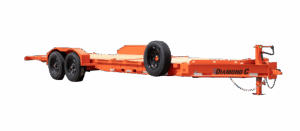
| Pickup (8,800 lbs) | Diamond C GTU utility trailer (7,000 lbs) | 15,800 lbs | Yes |
| Half-ton pickup (7,200 lbs) | Single-axle utility trailer (5,000 lbs) | 12,200 lbs | Yes |
| One-ton pickup (11,500 lbs) | Gooseneck trailer (14,000 lbs) | 25,500 lbs | Yes |
| Pickup (7,050 lbs) | Small cargo trailer (2,500 lbs) | 9,550 lbs | Not from the label sum alone |
The final row requires an important qualification. A 9,550 lb sum of GVWR labels is below the weight-rating threshold, but the operation could still qualify if the manufacturer’s GCWR is 10,001 lbs or more, the truck and trailer actually weigh 10,001 lbs or more, placarded hazardous materials are transported, or a passenger-capacity trigger applies.
The ratings in the table are examples, not universal specifications for every pickup configuration. Truck GVWR and GCWR vary by model year, cab, drivetrain, wheelbase, suspension package, axle configuration, and other factory equipment. Always check the certification label, owner’s documentation, manufacturer towing data, trailer VIN label, registration documents, and actual scale weight where relevant.
So if you’re running a Diamond C, Delco, or H&H trailer for a business involved in interstate commerce, start by checking the truck’s GVWR and manufacturer GCWR and the trailer’s GVWR. Also remember that the federal rule considers actual gross weight and actual gross combination weight when those numbers are greater than the ratings being compared. If the applicable figure is 10,001 lbs or more, federal safety registration is generally not optional unless a specific exemption applies.
The “For Commercial Purposes” Question
Some people hear “commercial motor vehicle” and picture only tractor-trailers, delivery fleets, or trucking companies hauling freight for customers. That is not how the federal safety definition works. A qualifying pickup and trailer used to transport property in furtherance of a business can be a commercial motor vehicle even when the company owns the cargo and transportation is not separately billed to a customer.
A contractor hauling a skid steer to a paid job, a landscaper transporting mowers and materials, a roofer carrying equipment, or a business delivering its own products can be operating as a private motor carrier. “Private” in this context does not mean personal or recreational use. It means the business is transporting property it owns, leases, uses, sells, or buys rather than operating as a for-hire carrier of someone else’s property.
That distinction affects operating authority, but it does not eliminate the USDOT-number requirement. FMCSA states that a private motor carrier transporting its own goods may need a USDOT number but generally does not need interstate operating authority solely for that private carriage.
So a landscaper using a RAM 2500 and a 7,000 lb equipment trailer to carry business equipment from Indiana into Illinois for a job is operating in interstate commerce. If the applicable rating or actual-weight calculation reaches 10,001 lbs, a USDOT number is required even though the landscaper is hauling company-owned equipment rather than charging a separate freight fee.
A qualifying farmer may have different exemptions, but “farm use” is not a blanket exclusion from every federal rule. A Covered Farm Vehicle must meet specific conditions involving farm identification, who operates it, what it transports, where it operates, whether the transportation is for hire, its weight, and whether placarded hazardous materials are involved.
Under 49 CFR 390.39, a qualifying Covered Farm Vehicle and its driver may be exempt from federal CDL requirements, drug and alcohol testing, certain medical-qualification rules, hours-of-service rules, and federal inspection, repair, and maintenance requirements. That provision does not create a universal exemption from USDOT registration and marking. Indiana separately lists an intrastate USDOT exemption for qualifying farm-plated operations when both the truck and trailer are farm-plated and the combination does not cross the state line.
Indiana Intrastate Rules
If an operation remains entirely within Indiana and is not part of an interstate shipment or movement, the federal interstate-commerce test does not control by itself. Indiana is one of the states that requires USDOT numbers for certain intrastate commercial motor vehicles, and its rules must be reviewed separately.
Indiana Department of Revenue Motor Carrier Services defines an intrastate commercial motor vehicle using substantially the same core triggers: an applicable GVWR, GCWR, gross vehicle weight, or gross combination weight of 10,001 lbs or more; placardable hazardous-material transportation; more than eight passengers including the driver for compensation; or more than 15 passengers including the driver when transportation is not for compensation.
Indiana’s published guidance also identifies important intrastate exemptions. A carrier may be exempt when it remains entirely in Indiana, transports only its own nonhazardous private property, and the applicable combined or single-vehicle rating remains below 26,000 lbs. Because that exemption applies to private carriage, an intrastate for-hire carrier hauling someone else’s property cannot assume the same weight-based relief.
Indiana also lists an exemption for a truck and trailer that are both farm-plated and do not cross the Indiana state line. Once a farm-plated operation crosses a state line, federal registration, Unified Carrier Registration, and other interstate requirements must be evaluated based on the actual operation and any applicable agricultural exemption.
For-hire intrastate carriers operating below the USDOT weight threshold may still need an Indiana identification number. Passenger carriers, household-goods carriers, hazardous-material carriers, and other specialized operations can have additional insurance, operating-authority, credential, or filing requirements that are separate from obtaining a USDOT number.
When an Indiana intrastate operation is required to display a USDOT number, the identification belongs on the power unit and must comply with the applicable marking rules. The Indiana Department of Revenue’s Motor Carrier Services division administers USDOT, UCR, and related state motor-carrier programs, while the Indiana State Police Commercial Vehicle Enforcement Division handles roadside enforcement.
What Happens If You’re Missing a DOT Number
Pickup-and-trailer combinations can be inspected at roadside, directed into inspection facilities, or reviewed after a crash. Enforcement officers do not need to see a tractor-trailer before applying commercial-motor-vehicle rules. A work pickup with equipment, business markings, and a substantial trailer can be treated as a CMV when the legal definition is met.
Operating without a required USDOT number can lead to citations, civil penalties, registration complications, and closer examination of the carrier’s other compliance obligations. A carrier required to have federal operating authority can be placed out of service for operating without that authority or beyond the scope of its authority. Missing, inaccurate, obstructed, or unreadable vehicle markings can also be documented as violations.
The consequences can extend beyond the roadside citation. After a crash, investigators, insurers, attorneys, and customers may examine whether the carrier was properly registered, whether the driver was qualified, whether required inspections were completed, whether hours-of-service rules applied, and whether the equipment and cargo were properly maintained and secured.
Obtaining a USDOT number does not cure every compliance issue. Depending on the operation, the carrier may also need an MC number, Unified Carrier Registration, a medical certificate, driver qualification records, hours-of-service records, annual inspections, maintenance files, cargo-securement compliance, drug and alcohol testing, hazardous-material credentials, or a CDL.
Registration should therefore be completed before the first regulated trip, not after an officer or insurance adjuster raises the question. Carriers should also complete the required biennial update even when their company information has not changed. Failure to update can result in deactivation of the USDOT number and civil penalties.
What You Don’t Need a DOT Number For
Not every trailer purchase creates a USDOT-number requirement. Common situations that may fall outside the requirement include:
- Occasional transportation of personal property by an individual when it is neither for compensation nor in furtherance of a commercial enterprise
- Recreational towing, including a personally used camper, boat, race vehicle, horse, or off-road vehicle, when the transportation is genuinely non-business and no compensation or commercial benefit is involved
- Strictly intrastate Indiana transportation of the carrier’s own nonhazardous private property when the operation satisfies Indiana’s published exemption and remains below the applicable 26,000 lb limit
- A qualifying Indiana farm-plated operation in which both the truck and trailer are farm-plated and the vehicle combination does not leave Indiana
- A commercial interstate combination that remains below 10,001 lbs under every applicable rating and actual-weight measure and does not trigger the passenger or hazardous-material provisions
Calling a trip “personal” does not make it personal under the regulation. Prize money, sponsorship obligations, business advertising, tax treatment, reimbursement, hauling inventory for sale, transporting company tools, or using the trip to support a commercial enterprise can change the analysis.
If you’re buying a Wells Cargo enclosed trailer to carry your own merchandise to weekend markets that never leave Indiana, the operation is still commercial. However, it may fit Indiana’s private-carrier exemption if you haul only your own nonhazardous property, remain entirely in Indiana, and stay below the state’s published weight limit. If the merchandise is part of an interstate movement, you cross the state line, or you begin transporting property for other people, the answer can change.
Farm, nonprofit, school, government, emergency, passenger, and recreational operations can involve specialized exceptions or separate rules. Do not rely on a general label such as “farm truck,” “not for hire,” or “personal trailer” without comparing the actual operation with the applicable federal and Indiana definitions.
The Trailer Buying Consideration
When you’re shopping for a trailer, it is worth factoring the USDOT question into the decision early. A Delco 10K flatbed may be the correct capacity for the equipment you need to move, but pairing a 10,000 lb GVWR trailer with nearly any full-size pickup will put the combination above the 10,001 lb federal threshold for interstate commercial operation.
That is not a reason to buy a trailer that is too small for the load. Undersizing a trailer can create payload, axle, tire, braking, cargo-securement, stability, and structural problems. It is a reason to choose the right trailer and plan for the legal obligations that accompany the truck-and-trailer combination.
Do not confuse lowering the registered weight, carrying a light load, or operating the trailer empty with changing its manufacturer GVWR. FMCSA considers the applicable ratings and actual weights and uses the greater figure. An empty trailer can still be part of a regulated combination when its ratings meet the threshold and it is being operated in interstate commerce.
Trailer capacity also needs to be evaluated independently from the truck’s towing capacity. A legal combination must stay within the truck manufacturer’s towing limits, GCWR, axle ratings, tire ratings, hitch ratings, trailer GVWR, trailer axle ratings, and every applicable state and federal weight law. Obtaining a USDOT number does not authorize overloading or make an otherwise unsafe combination legal.
Some customers focus entirely on payload and towing specifications. Those numbers matter, but the regulatory picture matters too. Once an interstate business combination reaches the federal CMV threshold, the carrier may need more than a number on the door. Medical qualification, inspections, maintenance records, cargo securement, hours of service, UCR, and other requirements should be reviewed before the equipment goes into service.
The CDL question should be checked separately. A combination may require a USDOT number beginning at 10,001 lbs while remaining below the normal CDL threshold. A Class A CDL is generally required when the applicable combination rating is 26,001 lbs or more and the trailer’s GVWR exceeds 10,000 lbs, subject to exemptions and the driver’s licensing jurisdiction. Do not determine CDL status from the trailer rating alone.
Have questions about what setup makes sense for your work and your compliance situation? Reach out to us or stop by our lot in Spencer. We’re not compliance attorneys, but we know our trailer inventory and can help you compare trailer ratings, payload needs, hitch types, and towing configurations. For a binding compliance determination, consult FMCSA, Indiana Department of Revenue Motor Carrier Services, Indiana State Police Commercial Vehicle Enforcement, your insurance professional, or a qualified transportation-compliance adviser. FMCSA’s website and USDOT Wizard can help identify federal registration requirements, while Indiana Motor Carrier Services covers state-specific USDOT, UCR, identification-number, and operating-authority questions.


