








You’re shopping for a trailer and you keep seeing numbers like 80″, 82″, 83″, 96″, or 102″ thrown around. Those numbers may describe the usable deck, the space between the fenders, the body width, or the trailer’s overall width, depending on the design and manufacturer. That distinction matters. Width affects whether your equipment fits, whether a load extends beyond the trailer, how easily you can see around it, and whether the complete trailer-and-load combination stays within legal limits.
Here’s a plain breakdown of what those width figures mean, where the legal lines sit, and how to pick the right width for your situation. Before ordering, always verify the exact measurement shown on the manufacturer’s specification sheet and the certification label for the individual trailer.
What “Deck Width” Actually Means
Deck width is the usable width of the trailer’s loading surface. It is not automatically the measurement from the outside of one fender to the outside of the other. On a conventional equipment or car-hauler trailer, the deck normally sits between the fenders, so the published 82″ or 83″ width usually describes the usable deck between those fenders. The trailer’s overall width, measured at its widest fixed point, will be greater.
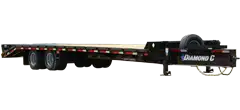
On a deckover trailer, the deck is positioned above the tires. That allows the floor to extend across most or all of the trailer’s legal overall width. A deckover advertised with a 102″ deck can therefore provide a full 102″ usable platform without wheel wells interrupting the loading surface.
Utility-trailer terminology varies. A nominal 77″, 80″, 82″, or 83″ utility trailer may be identified by its floor width between the side rails, but lights, fenders, hinges, or other fixed components can make its overall road width substantially greater. When checking whether a trailer will pass through a gate, garage door, barn entrance, or storage space, ask for the overall width rather than relying on the nominal deck-width code.
Inside width is different again. On an enclosed trailer, labels such as 7-wide or 8.5-wide generally describe a nominal body class, not a guaranteed unobstructed interior measurement. Wall framing, interior lining, trim, wheel boxes, door hardware, and construction method all reduce or interrupt usable space. The narrowest dimension may be the distance between the wheel boxes or the rear-door opening rather than the wall-to-wall interior width.
If you’re fitting equipment inside a Wells Cargo or Legend enclosed trailer, confirm the current model’s interior box width, width between wheel boxes, and rear-door opening. Those three measurements can differ by many inches, and all three may determine whether a machine fits.
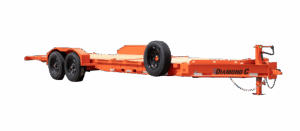
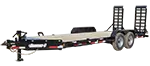
On open trailers, usable width depends on the layout. A Diamond C 102″ deckover provides a full-width deck, while a low-profile equipment trailer such as the Diamond C LPX uses an approximately 82″ deck positioned between the fenders. Both can be appropriate heavy-equipment trailers, but they solve different loading problems.
The Legal Maximum: 102 Inches
Federal regulations generally establish a 102-inch, or 8-foot-6-inch, maximum width for commercial motor vehicles operating on the National Network and qualifying federal-aid highways. The federal width rules are found in 23 CFR Part 658. Mirrors and certain narrowly defined safety devices may be excluded from the width measurement, but ordinary cargo and structural components are not automatically excluded.
That federal rule does not mean every road in the country is guaranteed to accommodate every 102″ trailer. States control many roads outside the National Network, and local roads, bridges, construction zones, and posted routes can impose additional restrictions. Drivers remain responsible for checking the route and complying with state and local requirements.
Indiana’s ordinary legal-width limit is also 8 feet 6 inches. A vehicle or vehicle-and-load combination wider than 102″ generally requires an Indiana oversize permit before traveling on public roads. Permit eligibility and operating conditions depend on the vehicle, the load, the route, and whether the load is divisible. A permit may also impose signs, flags, lighting, travel-time, route, or escort requirements; escort vehicles are not required merely because every load is one or two inches over 102″.
A trailer with a 102″ overall width is therefore at the ordinary legal limit. A 102″ deckover can be operated without an oversize permit when the trailer, its equipment, and its load remain within the applicable width limit and no other dimension or weight requires a permit. However, a load extending beyond a 102″ deck will generally make the combination oversize.
The practical upside of a 102″ deckover is maximum uninterrupted deck space within the ordinary width limit. It can accommodate wider machinery, pallets, attachments, and loads that would not fit between the fenders of a low-profile trailer. The trade-off is that the deck is higher and the complete trailer occupies the full 8-foot-6-inch road envelope.
The Workhorse Standard: 96 Inches
A 96-inch, or 8-foot, figure is common in trailer advertising, especially for certain enclosed bodies and older or specialized flatbed configurations. As with every width code, determine whether 96″ means body width, floor width, interior width, or overall width. An enclosed trailer advertised as 8 feet wide may still be wider overall once its external wheels and fenders are included.
Many modern open equipment trailers are not built around a 96″ usable deck. Low-profile car and equipment trailers commonly provide approximately 82″ or 83″ between the fenders, while full-width deckover trailers commonly provide a 102″ deck. Those layouts use available width in different ways: one keeps the deck lower between the tires, while the other raises it above the tires to eliminate fender interference.
H&H and Delco offer utility, equipment, and deckover configurations whose widths vary by model. Diamond C follows the same basic layout distinction across its equipment lineup. Its traditional low-profile equipment trailers use an approximately 82″ deck between the fenders, while Diamond C deckover equipment and FMAX gooseneck flatbed models use a 102″ deck. Current Diamond C premium lines use LIPPERT axles and the DM Difference Maker multi-stage coating process, with capacities and equipment determined by the specific model and configuration.
For landscaping, construction, farm, vehicle, and compact-equipment work, an 82″ or 83″ between-the-fenders deck often provides a useful combination of low loading height and adequate machine clearance. A 96″ nominal body may suit enclosed cargo or specialized applications, but it should not be treated as the universal middle size between a compact utility trailer and a 102″ deckover.
Commercial open auto transports and deckover equipment trailers are frequently built to the 102″ maximum overall width. Conventional single-car haulers commonly use an approximately 82″ to 83″ deck between the fenders. A buyer should compare the vehicle’s tire-to-tire width, body width, ground clearance, door clearance, and loading angle rather than choosing from the nominal width alone.
The Compact Option: 80 Inches and Under
Smaller utility and landscape trailers commonly offer floors in the 60″, 72″, 77″, 80″, 82″, or 83″ range. A size such as 77″ or 80″ normally refers to the usable floor between the side rails, not the complete outside width across the fenders. That is why an 80″-class utility trailer may not fit through an 80″ opening.
A compact utility trailer can be easier to position in a driveway, barn, or crowded job site. It may be suitable for one ATV, a compact zero-turn mower, garden equipment, building materials, or residential cleanup work, provided the load fits within the trailer’s dimensions and rated payload. Fit must be checked against the machine’s widest point, including tires, mower decks, mirrors, implements, guards, and attachments.
The trade-off is reduced loading flexibility. Two ATVs may not fit side by side, and a mower deck can be wider than the tractor or zero-turn chassis. A full-size pickup is not an appropriate load for a light compact utility trailer, and a tow dolly is a purpose-built towing device whose suitability depends on the towed vehicle’s dimensions, drive configuration, curb weight, and the dolly’s ratings.
H&H and other manufacturers build utility trailers in several compact width classes. These can make sense for residential hauling, grounds-maintenance work, ATVs, and smaller landscaping operations. Choose one by measuring the actual cargo and checking the trailer’s deck width, gate opening, ramp capacity, GVWR, empty weight, payload, axle ratings, tire ratings, and tie-down arrangement.
Why It Matters Beyond the Numbers
Getting the width wrong creates real problems.
Too narrow: The tires, tracks, implement, or attachment may contact the fenders or side rails, or the equipment may not align safely with the ramps. Side overhang by itself does not automatically shift a load’s center of gravity; poor positioning does. A machine loaded off-center can create unequal tire and axle loading, reduced stability, and poor handling. The load must fit the trailer, remain within legal dimensions, and be positioned so axle, tire, hitch, and tow-vehicle ratings are not exceeded.
Loads also need adequate support. A tire or track should not hang partly off the deck unless the trailer and loading method are specifically designed and approved for it. Fender contact can damage the trailer or equipment, while insufficient clearance can make loading hazardous.
Too wide: A 102″ trailer uses more lane width than a compact utility trailer and demands additional attention around parked vehicles, mailboxes, bridge rails, construction barriers, fuel pumps, gates, and narrow county roads. The difference between a 96″ and 102″ overall width is six inches total, or three inches per side when centered. The practical clearance difference between an 80″-class deck and a 102″ overall-width deck can be much greater once the compact trailer’s fenders are considered.
There’s also the tow vehicle to consider. The driver must be able to see traffic behind and alongside the combination. Indiana law requires a vehicle whose construction or load obstructs the driver’s rearward view to have a mirror positioned to provide a view of the highway for at least 200 feet behind the vehicle. If the factory mirrors cannot provide that view around the trailer, properly fitted towing-mirror extensions or wider towing mirrors may be necessary. Do not assume a trailer is safely visible simply because the tow vehicle itself is wide.
Width also affects loading height and angle. A between-the-fenders equipment trailer can keep the deck lower, which may reduce the breakover angle for low-clearance machines. A 102″ deckover offers more uninterrupted width but places the deck above the tires. Ramp length, ramp style, approach angle, machine wheelbase, and ground clearance therefore matter along with width.
A Quick Comparison
| Width Code | Typical Use | Legal Without Permits? | Example Models |
|---|---|---|---|
| 60″–83″ compact decks | ATVs, mowers, small lawn equipment, residential utility work | Normally, when overall trailer-and-load width stays at or under 102″ | H&H utility configurations; Diamond C GTU 83″-wide configurations |
| Approximately 82″–83″ between fenders | Landscaping, compact equipment, single-vehicle hauling, construction | Normally, when the complete combination stays within legal limits | Diamond C LPX and HDT; comparable H&H and Delco equipment trailers |
| 96″ nominal body or deck | Selected enclosed, specialty, and older flatbed configurations | Normally, but verify actual overall width and load width | Model-specific 8′-wide enclosed or specialty trailer configurations |
| 102″ deckover | Wide equipment, attachments, pallets, farm loads, maximum usable deck | Yes, when the complete trailer and load do not exceed 102″ or another applicable limit | Diamond C FMAX and DEC; 102″-wide H&H deckover configurations |
Enclosed Trailers: Outside Width vs. Inside Width
This distinction matters most when you’re buying an enclosed trailer. An 8.5-wide enclosed trailer may have a legal overall width of approximately 102″, but that does not guarantee a 102″ interior. The exterior body can be narrower than the overall dimension across the fenders, and the finished interior is reduced by wall construction. Wheel boxes can further reduce floor width in the axle area.
Current Wells Cargo and Legend specifications illustrate why model-specific measurements matter. Depending on the series and construction, an 8.5-wide trailer may provide an interior width near 8 feet while offering substantially less clearance between its wheel boxes. A 7-wide enclosed trailer may provide an interior box width around the upper-70-inch range, but the exact dimension, door opening, and wheel-box clearance must be confirmed for the chosen model year and configuration.
Do not calculate enclosed-trailer clearance by simply subtracting a fixed number from the advertised width. Steel and aluminum models can use different framing, wall assemblies, exterior profiles, and wheel-box arrangements. Options such as finished walls, cabinets, E-track, insulation, interior trim, and ramp-door hardware may reduce usable space further.
Motorcycles, dirt bikes, and some compact recreational vehicles may fit in a 7-wide enclosed trailer, but the decision should be based on actual dimensions. A golf cart can be roughly 47″ to 50″ wide before mirrors, tires, fender flares, or accessories are considered. Shelving and workbenches also consume aisle space. For a mobile workshop, race trailer, or equipment-heavy job trailer, an 8.5-wide body can provide substantially more usable workspace, but payload, axle capacity, door ratings, and tow-vehicle limits still govern.
Wells Cargo and Legend both offer enclosed trailers in multiple nominal width classes. Side by side on a lot, the difference can look modest. Inside, the added wall-to-wall room and aisle space may be significant. Measure the cargo at its widest and tallest points, then compare those figures with the interior box, narrowest wheel-box area, rear-door opening, side-door opening, and ramp transition.
What About Load Width?
The trailer deck width is only half the equation. What you put on it is the other half.
Indiana generally requires an oversize permit when the vehicle or vehicle-and-load combination exceeds 8 feet 6 inches in width. For example, a 96″ platform carrying a centered load that extends four inches beyond each side creates a total load width of 104″, which is wider than the ordinary legal limit. The relevant measurement is the combination’s widest point, not merely the trailer deck.
That rule can apply to machinery, attachments, wide lumber or building-material bundles, and farm equipment. Some commodities, implements, safety devices, or specific operations may be governed by exceptions or separate rules, so unusual loads should be checked against current Indiana requirements rather than assumed legal.
An oversize permit is not blanket permission to carry any wide load anywhere. Indiana’s permitting process generally addresses nondivisible oversize loads and specifies the approved dimensions, route, dates, and operating conditions. A load that can readily be divided may not qualify simply because carrying it in one piece is more convenient.
For routine hauling without oversize-permit requirements, keep the complete trailer and load at or under 102″. Measure attachments in their transport position and account for buckets, blades, tracks, tires, axles, folded ramps, tie-down hardware, and anything projecting from the cargo. Securement devices should also be arranged so they do not create an unsafe or unlawful projection.
If you regularly move equipment wider than 102″, plan the trip through Indiana’s oversize/overweight permitting system and review the permit conditions before departure. Depending on the dimensions and route, those conditions can include approved travel times, signs, flags, lights, routing, or escort vehicles.
Which Width Is Right for You?
The honest answer is: start with what you haul most, not what you might haul once.
Measure the machine in its normal transport configuration. Manufacturer widths can change with track or tire options, buckets, mower decks, blades, mirrors, and other attachments. Also check operating weight with attachments and fluids, because a machine can fit physically while exceeding the trailer’s payload or another component rating.
A John Deere 333G compact track loader, for example, is approximately 78.9″ wide with its narrower 15.8″ tracks and approximately 80.7″ wide with 17.7″ tracks, before considering a bucket or other attachment that may be wider. An 82″ between-the-fenders trailer could leave very little track clearance in a wide-track configuration. A 102″ deckover provides considerably more loading margin, but the trailer must still have adequate payload, axle capacity, tire capacity, ramp capacity, tie-down points, and compatible loading geometry.
Clearance should be calculated from the actual configured width, not a rounded catalog description. An 80.7″-wide machine on an 82″ deck leaves only about 1.3″ total, or roughly 0.65″ per side when perfectly centered. That is very different from having nine inches per side. A wider bucket or attachment can also extend beyond the machine’s tracks and may determine the required trailer width.
For a machine or attachment approaching 90″ wide, a 102″ deckover will often be the practical choice, but it is not automatically the only legal or safe solution. Some equipment trailers have wider usable areas above or ahead of the fenders, and some attachments can be transported in an approved alternate position. The correct choice depends on full-load dimensions, support points, securement, loading angle, and ratings.
For an ATV, weekend projects, or lawn equipment moving between job sites, a compact utility trailer may be enough. An 82″ or 83″ deck offers more flexibility for larger mowers and compact machines, while a 102″ deckover is useful when uninterrupted width is the priority. A 96″ nominal enclosed trailer can work for cargo and shop applications, but its actual interior and door clearances must be verified.
Before buying, compare at least these measurements: usable deck width, overall trailer width, space between fenders or wheel boxes, rear gate or door opening, deck height, ramp width, ramp length, and approach angle. Then compare the trailer’s GVWR and actual empty weight with the loaded cargo weight to determine available payload. The tow vehicle’s tow rating, GCWR, GVWR, axle ratings, hitch rating, tire ratings, and required tongue or pin weight must also remain within their limits.
Still not sure which deck width fits your equipment? Call us at (812) 829-0226 and we’ll work through the actual machine, attachment, clearance, payload, and towing numbers with you. Or browse our current inventory to see what’s in stock across Diamond C, H&H, Delco, and the other lines we carry. Width is just one specification. We’ll help you match the deck layout, capacity, ramps, hitch, and running gear to the work you need the trailer to do.


