







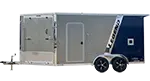
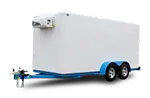
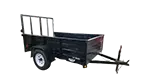

Here’s the number many buyers overlook until it becomes a problem: the trailer’s empty weight. Everyone asks about GVWR. Far fewer buyers ask what the trailer itself weighs in the exact length and configuration they are considering. The difference between those two numbers establishes the trailer’s theoretical cargo capacity, but safe loading also depends on axle, tire, wheel, coupler, hitch, and tow-vehicle ratings.
Payload capacity is calculated from the completed trailer’s ratings and weight. Subtract the trailer’s actual empty weight from its Gross Vehicle Weight Rating, or GVWR, to estimate how much cargo it can carry. Options, accessories, modifications, and permanently installed equipment increase empty weight and reduce the remaining payload pound for pound.
The Calculation, Plain and Simple
GVWR stands for Gross Vehicle Weight Rating. It is the maximum allowable weight of the loaded trailer, including the trailer itself, cargo, fluids, accessories, and equipment carried on or installed in it. The manufacturer establishes that rating for the completed trailer, and it appears on the trailer’s federal certification label.
Empty weight may also be described as curb weight, unloaded vehicle weight, or estimated trailer weight. These terms are not always used identically. A published weight may describe a representative base trailer and may not include every factory option, dealer-installed accessory, spare tire, battery, winch, toolbox, or other addition on the unit you are buying.
Estimated Payload = GVWR – Actual Empty Weight
For example, a trailer with a 15,500 lb GVWR that weighs 3,650 lbs as equipped has an estimated payload capacity of 11,850 lbs. If a winch, spare tire, toolbox, and other equipment add 300 lbs, the remaining cargo capacity falls to 11,550 lbs.
That subtraction is the correct starting point, but it is not permission to load every pound anywhere on the deck. The loaded trailer must remain within its GVWR and every applicable component rating. Proper load placement and tongue or pin weight are also essential.
Real Examples With Real Numbers
Let’s work through several current trailer classes so you can see how dramatically trailer construction, length, and equipment can affect usable payload. Published empty weights are normally approximate, so confirm the certification label, manufacturer’s documentation, and the weight of the particular trailer before loading close to a limit.
Light Utility Trailer (Single Axle)
A current single-axle rail-side utility trailer from H&H Trailers may be rated at 2,990 lbs rather than a full 3,500 lb GVWR, even when it uses a 3,500 lb axle. For example, H&H lists its 76-inch-by-10-foot single-axle rail-side model at approximately 970 lbs curb weight and 2,990 lbs GVWR.
The calculation is straightforward: 2,990 minus 970 leaves approximately 2,020 lbs of published payload capacity before optional equipment or cargo is added. That may be appropriate for many lawn tractors, smaller ATVs, landscaping supplies, and general household loads, provided the individual load fits within the trailer’s dimensions and ratings. It is not a suitable class for a skid steer or other compact construction machine that weighs several thousand pounds.
Do not assume that a 3,500 lb axle automatically gives a trailer a 3,500 lb GVWR. The completed trailer’s certification label controls, and its GVWR can be lower than the nominal rating of one component.
Tandem Axle Utility or Equipment Trailer
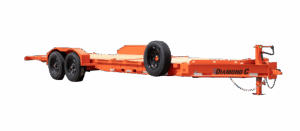
Step up to a tandem-axle equipment trailer from Diamond C Trailers, such as the HDT hydraulically dampened tilt trailer, and both the ratings and available configurations change substantially. Current HDT configurations span approximately 15,500 to 24,000 lbs GVWR, with published trailer weights across the model family ranging from roughly 2,300 to 5,830 lbs. Length, axle package, deck arrangement, frame construction, and options determine where a particular unit falls within those ranges.
A 15,500 lb GVWR HDT equipped with tandem 7,000 lb LIPPERT axles cannot be assigned a dependable payload number until you know that trailer’s as-equipped empty weight. If the completed trailer weighs 3,650 lbs, the arithmetic yields an estimated 11,850 lb payload. If another configuration weighs 4,200 lbs, its estimated payload at the same GVWR is 11,300 lbs.
The HDT uses a tilt-deck loading system rather than requiring separate loading ramps for the tilting portion of the deck. Its hydraulic system dampens deck movement; it is not a powered lifting mechanism intended to raise equipment. Before loading a skid steer, excavator, tractor, or attachment package, total the operating weight of the machine, attachments, fuel, buckets, and everything else carried on the trailer.
Enclosed Cargo Trailer
Enclosed trailers carry a substantial empty-weight requirement because the trailer includes walls, roof structure, doors, interior framing, flooring, and body panels. A current Wells Cargo Wagon HD seven-foot-wide trailer with a 9,990 lb GVWR can have an approximate curb weight of 2,755 lbs in a listed configuration, producing approximately 7,235 lbs of published payload capacity.
Another enclosed trailer with the same nominal exterior dimensions can weigh more or less because of its frame material, wall and roof construction, axle package, interior height, ramp door, cabinetry, insulation, flooring, electrical system, air conditioning, shelving, and other equipment. A Legend Trailers aluminum-framed model should therefore be evaluated from its own model-specific documentation rather than assumed to match a steel-framed trailer’s weight.
An enclosed trailer used as a contractor trailer can lose available cargo capacity quickly. Shelving, workbenches, generators, compressors, tools, spare parts, batteries, and stored materials all count toward loaded trailer weight. Motorcycles, side-by-sides, golf carts, or vehicles must be counted at their actual ready-to-haul weights, including fuel and accessories.
Gooseneck or Heavy Equipment Trailer
This is where payload calculations become especially important. The current Diamond C FMAX210 is a tandem-dual-wheel gooseneck flatbed with a 25,000 lb GVWR and two 10,000 lb LIPPERT axles. Diamond C’s published estimated-weight information lists a 25-foot MAX Ramps configuration at approximately 5,840 lbs with few or no options.
Using those published figures, 25,000 minus 5,840 produces an estimated payload of 19,160 lbs. That does not mean every FMAX210 has that exact capacity. Longer decks and equipment such as a hydraulic dovetail can add substantial trailer weight, while other loading configurations and options produce different results. The specific trailer’s documented or scaled empty weight must be used for final planning.
It is also important to understand that GVWR is the maximum loaded-trailer weight, not the amount of equipment the trailer can carry. A 25,000 lb GVWR trailer cannot carry 25,000 lbs of cargo because the trailer’s own weight is already part of that total.
Why Empty Weight Varies So Much
Two trailers with identical GVWRs can have very different payload capacities depending on how they are constructed and equipped. Steel and aluminum structures have different weight and engineering characteristics, but material alone does not determine the result. Frame design, crossmember spacing, deck material, body construction, length, width, axle package, suspension, ramps, tires, wheels, jacks, and coupler all affect empty weight.
A 20-foot deck carries more trailer structure than a comparable 16-foot deck. A spare tire, winch, battery, toolbox, hydraulic power unit, expanded-metal sides, extra deck width, stabilizer legs, interior cabinets, or contractor package all consume part of the available capacity before cargo is loaded. Permanently installed equipment remains part of the trailer’s empty or operating weight on every trip.
Darkhorse Cargo and Wells Cargo offer enclosed trailers in multiple construction levels and axle packages. Aluminum exterior skin does not automatically mean an all-aluminum trailer, because many enclosed cargo trailers use aluminum skin over a steel structural frame. The manufacturer’s specification for the exact model and configuration is what matters.
On a trailer with an 8,000 lb GVWR, a 400 lb difference in as-equipped empty weight creates a 400 lb difference in theoretical cargo capacity. That can determine whether a vehicle, tools, and accessories fit within the trailer’s rating or whether some equipment must travel separately.
When comparing trailers, request the model-specific estimated empty weight and ask which options that figure includes. Then examine the completed trailer’s certification label and paperwork. For maximum confidence, especially after installing accessories or building out an enclosed trailer, weigh the empty trailer at a certified public scale.
Tongue Weight Is Part of the Picture Too
Payload capacity tells you how much cargo weight may fit within the trailer’s overall rating. Tongue weight or gooseneck pin weight determines how much of the loaded trailer’s weight is carried through the hitch by the tow vehicle.
For many bumper-pull trailers, a commonly used starting range is approximately 10 to 15 percent of loaded trailer weight, unless the trailer or tow-vehicle manufacturer specifies otherwise. A 10,000 lb loaded bumper-pull trailer may therefore place roughly 1,000 to 1,500 lbs on the hitch. Gooseneck trailers commonly require a higher percentage on the ball, often approximately 15 to 25 percent, but the correct target depends on the trailer, cargo, and manufacturer’s instructions.
That vertical hitch load counts against the truck’s payload capacity and rear Gross Axle Weight Rating. Passengers, tools, fuel, auxiliary tanks, bed accessories, the hitch itself, and other cargo in the truck also use payload. A trailer can be below its GVWR while the truck is over its GVWR, rear-axle rating, tire capacity, receiver rating, or gooseneck-hitch rating.
Too little tongue weight can contribute to trailer instability and sway. Too much can overload the tow vehicle’s rear axle, tires, suspension, receiver, ball, or coupler and can reduce weight on the truck’s steering axle. The goal is not merely to hit the payload number; it is to distribute the load correctly while staying within every rating.
This is why matching a trailer to a tow vehicle requires more than comparing one advertised tow rating with one GVWR number. You need adequate trailer payload, an appropriate hitch system, sufficient truck payload, acceptable axle loads, properly rated tires and wheels, and a loaded combination that stays within the tow vehicle manufacturer’s limits.
A Quick Reference Table
| Trailer Type | Typical or Listed GVWR | Approx. Empty Weight | Estimated Payload |
|---|---|---|---|
| H&H 76 x 10 single-axle rail-side utility | 2,990 lb | 970 lb | 2,020 lb |
| Diamond C HDT equipment tilt | 15,500-24,000 lb | 2,300-5,830 lb across configurations | Configuration-specific |
| Wells Cargo Wagon HD seven-foot-wide configuration | 9,990 lb | 2,755 lb | 7,235 lb |
| Diamond C FMAX210, 25-foot MAX Ramps example | 25,000 lb | Approx. 5,840 lb | Approx. 19,160 lb |
These figures illustrate the calculation and are not substitutes for the documentation on a particular trailer. Published weights may be estimates, specifications can change, and optional equipment reduces available payload. When loading near a rating, use an actual scale weight and verify the trailer’s certification label.
The Overloading Trap
Axles are only one part of a trailer’s load-carrying system. The trailer’s GVWR may be limited by its frame, suspension, axles, hubs, bearings, wheels, tires, coupler, safety equipment, or another component. In addition, the sum of the axle ratings does not always equal the trailer’s GVWR because part of the loaded trailer weight is carried at the hitch.
For example, a trailer with two 7,000 lb axles does not automatically have a 14,000 lb GVWR, and a higher labeled GVWR does not authorize more than 14,000 lbs on those two axles. The loaded trailer must stay within its GVWR, each axle’s GAWR, each tire and wheel rating, and the ratings of the hitch and tow vehicle.
Overloading increases heat and stress in tires, bearings, hubs, brakes, suspension components, and the frame. It can increase stopping distance, reduce stability, accelerate wear, damage cargo, and cause component failure. A tire or bearing failure at highway speed can result in loss of control, property damage, injury, and an expensive roadside recovery.
Warranty coverage is governed by the manufacturer’s written warranty and the cause of the failure. Damage caused by overloading, improper loading, misuse, or unauthorized modification is commonly excluded. An overloaded condition does not necessarily cancel every unrelated warranty obligation, but the owner should not expect coverage for damage caused by exceeding ratings.
Insurance outcomes are also policy- and fact-specific. Overloading can affect liability and claim handling when it contributes to a crash or loss, but coverage should not be described as automatically denied in every case. The practical answer is simple: document the load, stay within all ratings, secure the cargo properly, and maintain the trailer and tow vehicle.
How to Get the Right Trailer the First Time
Before you buy, write down the heaviest complete load you realistically expect to haul. Include the machine’s operating weight, attachments, buckets, forks, fuel, tools, pallets, tie-down equipment, spare parts, and anything permanently mounted to the trailer. Manufacturer-listed machine weight may describe a base unit and may not include every attachment or fluid.
Add reasonable capacity for normal variations and future needs, but do not treat a percentage buffer as a substitute for weighing the load. A planning margin of 10 to 15 percent above your known cargo weight can be useful when selecting a trailer. The final loaded trailer must still remain within GVWR, GAWR, tire, wheel, hitch, and tow-vehicle ratings.
If you’re looking at Delco Trailers or Liberty Trailers and comparing models in the 7,000 to 10,000 lb GVWR range, obtain the specifications for each exact model. A heavier trailer may provide additional structural features but leave less cargo capacity within the same GVWR. A lighter trailer may offer more theoretical payload, but construction quality, intended use, component ratings, warranty terms, and dealer support must also be evaluated.
Do not choose solely by the largest payload figure. Choose a trailer designed for the cargo, loading method, road conditions, duty cycle, and tow vehicle involved. Deck dimensions, load angle, fender clearance, tie-down locations, brakes, tires, suspension, ramps or tilt system, and weight distribution can be just as important as the final subtraction.
The team at Spencer Trailers works through this math with customers every week. It’s not complicated, but it takes a few minutes of real conversation to do it correctly. You can see what’s in stock at our current inventory, or reach out to us directly at (812) 829-0226. We’re at 291 West State Hwy 46 in Spencer, Indiana.
Before you finalize any trailer purchase, ask for the empty weight of the actual configuration, find the GVWR on its certification label, and do the subtraction. Confirm the tow vehicle’s ratings and calculate the expected tongue or pin weight. If the result does not leave adequate room for your complete heaviest load, accessories, and a sensible operating margin, move to a more appropriate configuration. The right trailer is the one whose payload, component ratings, dimensions, and towing requirements all work together safely.


