








You’ve loaded the equipment, the trailer is hooked up, and you’re ready to roll. But one of the easiest hauling mistakes is grabbing whatever strap or chain is nearby without checking whether the complete securement system is suitable for the cargo. That can lead to shifted loads, damaged equipment, roadside violations, or a serious crash. Choosing the right tie-down is not complicated, but it does require knowing the cargo weight, understanding Working Load Limit, using enough tie-downs, and confirming that every component and trailer anchor point is rated for the job.
WLL Ratings: The Number That Matters Most
Working Load Limit (WLL) is the maximum load a tie-down component or assembly is designed to handle in normal service. It is not the same as minimum breaking strength, and breaking strength should never be used to calculate whether a cargo-securement system is adequate. Manufacturers establish WLL below minimum breaking strength to provide an appropriate design factor for the product and its applicable industry standard.
Many synthetic-web ratchet straps are assigned a WLL equal to one-third of the assembly’s minimum breaking strength. For example, a complete strap assembly with a 10,000 lb minimum breaking strength may be labeled with a 3,333 lb WLL. Grade 70 transport chain commonly uses a 4-to-1 design factor, meaning its WLL is generally one-fourth of its minimum breaking force. These ratios are not interchangeable, so always use the WLL assigned by the manufacturer or the applicable regulatory table instead of estimating capacity from appearance.
The rating of a complete tie-down assembly is limited by its weakest component. A 3,333 lb webbing strap does not remain a 3,333 lb assembly if it is fitted with a ratchet, hook, connector, or attachment point rated for less. The same principle applies to chain, hooks, binders, shackles, D-rings, rub rails, stake pockets, and any other component that carries the securement force.
Federal rules do not require every securement device to carry a visible WLL marking. When a tiedown is unmarked, 49 CFR 393.108 assigns WLL values from regulatory tables based on the material, grade, and size that can be identified. Even so, using clearly tagged or permanently marked equipment is the better practical choice because it makes inspection, replacement, and roadside verification much easier. If you cannot confidently identify a strap’s capacity or a chain’s grade and size, remove it from service rather than guessing.
DOT Tie-Down Rules: The Basics You Can’t Skip
Federal Motor Carrier Safety Administration (FMCSA) cargo-securement requirements appear in 49 CFR Part 393, Subpart I. They apply to cargo carried by commercial motor vehicles in interstate commerce, while Indiana and other states may apply comparable securement requirements through their own laws and enforcement programs. A compliant load must be contained, immobilized, or secured so it cannot leak, spill, blow, fall, roll, tip, slide, or otherwise shift in a way that affects vehicle stability or maneuverability.
The general strength rule is based on aggregate WLL. The aggregate WLL of the tie-downs used to secure an article or group of articles against movement must be at least one-half of the cargo’s weight. How much each tie-down contributes to that calculation depends on how it is attached. A tie-down that runs from one trailer anchor point, over or through the cargo, and back to another trailer anchor point contributes its full WLL. A direct tie-down that runs from a trailer anchor point to an attachment point on the cargo contributes one-half of its WLL.
That distinction is especially important when securing machinery with four separate chains connected directly between the machine and trailer. Four chains rated at 6,600 lb WLL do not contribute 26,400 lb of aggregate WLL under the federal formula. Each direct chain contributes one-half of its WLL, producing an aggregate WLL of 13,200 lb for the four-chain system.
Heavy vehicles, equipment, and machinery weighing 10,000 lbs or more are covered by the commodity-specific requirements in 49 CFR 393.130. Equipment with crawler tracks or wheels must be restrained against movement in the lateral, forward, rearward, and vertical directions using at least four tie-downs. The tie-downs must be attached as close as practical to the front and rear of the equipment or to manufacturer-designated mounting points. The rule does not establish a universal 5,000 lb minimum WLL for every one of those four tie-downs. The complete system must instead satisfy the four-direction securement requirement, the aggregate-WLL calculation, and all applicable component ratings.
Accessory equipment such as hydraulic shovels, booms, arms, buckets, and articulated components must be lowered and secured as required by 49 CFR 393.130 unless the equipment is designed to be transported in another position and is restrained according to the manufacturer’s instructions. A bucket resting on the deck is not automatically secured merely because its weight holds it down.
For individual articles subject to the general tie-down-count rule and not blocked or positioned to prevent forward movement, the minimum count is:
- Cargo 5 feet or shorter and 1,100 lbs or less: 1 tie-down minimum
- Cargo 5 feet or shorter and over 1,100 lbs: 2 tie-downs minimum
- Cargo longer than 5 feet but no longer than 10 feet: 2 tie-downs minimum
- Cargo longer than 10 feet: 2 tie-downs for the first 10 feet, plus 1 additional tie-down for every additional 10 feet or fraction of 10 feet
If an article is properly blocked, braced, or immobilized against forward movement, a different minimum may apply: at least one tie-down for every 10 feet of article length or fraction of 10 feet. Commodity-specific rules can require more securement than the general length formula, so both the cargo type and its dimensions must be considered. Adding tie-downs can provide useful redundancy, but extra hardware does not correct poor attachment geometry, inadequate aggregate WLL, an unrated anchor, or a failure to secure an articulated component.
Ratchet Straps: Fast, Versatile, Right for Most Jobs
Ratchet straps work well for many trailer loads, including ATVs, UTVs, lawn equipment, building materials, and cargo with surfaces that could be damaged by bare chain. They are relatively quick to apply, easy to store, and available with numerous hook and end-fitting configurations. They must, however, be protected from sharp edges, abrasion, heat, and any surface that could cut or weaken the webbing.
Two-inch and four-inch web straps are common in trailer and flatbed service, but width alone does not determine capacity. Many familiar 2-inch commercial ratchet-strap assemblies are rated at 3,333 lb WLL, while some 4-inch assemblies are rated around 5,400 lb WLL. Other ratings are available in both widths. The assembly’s actual tag and the ratings of its ratchet, end fittings, and attachment points control. Never assume that every strap of the same width has the same capacity.
Choose end fittings that properly engage the trailer’s rated securement points. Flat hooks, wire hooks, chain extensions, snap hooks, and other fittings are designed for different attachment arrangements. A hook should bear in its intended direction without being side-loaded, tip-loaded, balanced on an edge, or placed where it can disengage as the cargo settles. When webbing passes over an edge that could cut or abrade it, use suitable edge protection.
Brands such as Kinedyne, Ancra, and US Cargo Control offer commercial cargo-control products with published ratings. Brand recognition alone is not enough, however. Confirm the tag, WLL, end-fitting compatibility, and condition of the exact assembly in your hands. Cam-buckle straps and light-duty utility straps may be appropriate for small items, but they should not be substituted for properly rated ratchet assemblies when the load requires higher tension or capacity.
A few things to inspect every time you use a strap:
- No cuts, tears, holes, melted fibers, severe fraying, broken stitching, knots, or chemical damage in the webbing
- The WLL tag is readable and matches the intended application whenever identification is needed to verify capacity
- Hooks and other fittings are not bent, twisted, cracked, excessively worn, or damaged, and any latch originally supplied with the fitting operates correctly
- The ratchet mechanism, handle, pawls, and mandrel operate correctly and hold tension without slipping
- The webbing is routed flat, without twists, and is protected anywhere it contacts a sharp or abrasive edge
Federal regulations prohibit knotting a tie-down because a knot can seriously reduce strength and creates an unpredictable failure point. A strap with rejectable damage should be removed from service and rendered unusable so it is not accidentally returned to the trailer. Follow the manufacturer’s inspection and removal criteria rather than relying on a rough percentage estimate of remaining strength.
Chains: When You Need to Go Heavier
Chain is often the preferred choice for heavy construction equipment, steel, machinery with robust attachment points, and cargo exposed to abrasion or conditions that would quickly damage synthetic webbing. Chain is not immune to damage, and it still requires compatible hooks, binders, anchor points, and proper attachment geometry.
Grade 70 transport chain is widely used for cargo securement. Under the federal WLL table, 5/16-inch Grade 70 chain has a 4,700 lb WLL, 3/8-inch Grade 70 chain has a 6,600 lb WLL, and 1/2-inch Grade 70 chain has an 11,300 lb WLL. Grade 70 is intended for transport and load-binding service; it is not approved for overhead lifting.
Grade should be identified from the manufacturer’s markings on the chain, not from color alone. Grade 70 chain commonly has a yellow or gold chromate finish and grade markings such as 7, 70, or 700, but finishes can wear, become dirty, or vary by manufacturer. The chain’s size must also be measured and confirmed because WLL changes substantially with link diameter.
Lower-grade chain is not automatically excluded from cargo securement. Federal tables assign WLL values to Grade 30 proof-coil chain and Grade 43 high-test chain, but their capacities are lower than Grade 70 chain of the same nominal size. For example, the federal table assigns 5/16-inch Grade 30 chain a 1,900 lb WLL, 5/16-inch Grade 43 chain a 3,900 lb WLL, and 5/16-inch Grade 70 chain a 4,700 lb WLL. Use the correct value for the grade and size actually present; never count lower-grade chain as Grade 70.
Chain should be inspected for:
- Stretched, elongated, bent, twisted, gouged, or cracked links
- Weld damage, heat damage, unauthorized repairs, or links that no longer move freely
- Excessive wear, including loss of link diameter beyond the manufacturer’s removal criteria
- Severe corrosion, pitting, or other deterioration that may reduce strength
- Hooks, grab hooks, clevis pins, and connectors that are distorted, cracked, improperly installed, or rated below the chain
A damaged link can compromise the entire assembly. Do not weld, heat, bend back, or otherwise improvise a repair to transport chain unless a qualified manufacturer-approved process specifically permits it. Remove questionable components from service and replace them with properly rated hardware.
Binders: Lever vs. Ratchet
Chains do not create or maintain adequate tension by themselves. A load binder takes up slack and applies tension to the chain. The two familiar designs are lever binders and ratchet binders, and each must be sized and rated for the chain being used.
Lever binders, sometimes called snap binders, use an over-center lever to tension the chain. They can be quick to apply, but the handle stores substantial energy as it moves over center. Loss of control can cause the handle to spring back and strike the operator. Never use an unauthorized cheater bar, stand in the handle’s travel path, or operate a binder with damaged or mismatched components. The handle must be secured after the binder is closed so vibration cannot cause it to open.
Ratchet binders use a threaded mechanism and ratcheting handle to shorten the assembly progressively. They generally allow more controlled tensioning and release than an over-center lever binder. They require additional handle movement and enough thread engagement in both ends, but they reduce the sudden snap-over action associated with lever binders. The ratchet mechanism should be positioned so it can be operated safely without contacting the cargo, trailer, tires, or road.
Match the binder’s stated chain-size range and WLL to the chain. Some binders are approved for more than one chain size or grade, but the printed or forged ratings must confirm that combination. A binder designed for a particular range should not be forced onto larger chain simply because the hooks appear to fit. The capacity of the tie-down assembly is limited by whichever part has the lowest WLL: chain, binder, hook, connector, cargo attachment point, or trailer anchor point.
Putting It Together: A Practical Example
Say you’re hauling a 14,000 lb tracked excavator on a properly configured 22′ x 102″ Diamond C FMAX210 gooseneck flatbed. The current FMAX210 is a 25,000 lb GVWR tandem-dual-wheel model with two 10,000 lb Lippert axles, a 102-inch bed, and available deck lengths that include 22 feet. Before loading, confirm the specific trailer’s VIN label, empty weight, available payload, tire and wheel ratings, hitch requirements, and the ratings and locations of every securement point you plan to use. GVWR is not payload, so the excavator, attachments, chains, tools, and all other cargo must fit within the trailer’s actual available capacity and the tow vehicle’s ratings.
Because the excavator weighs 10,000 lbs or more, use at least four tie-downs attached as close as practical to the front and rear of the machine or to its manufacturer-designated securement points. The four tie-downs must restrain the machine in the forward, rearward, lateral, and vertical directions. Lower and separately restrain the boom, arm, bucket, blade, or other accessories when required. Engage the equipment’s parking brake and follow its transport instructions, but do not count the parking brake or hydraulic system as a substitute for the required tie-downs.
Four 3/8-inch Grade 70 chains paired with compatible ratchet binders provide a 6,600 lb WLL per chain assembly only if every binder, hook, connector, machine attachment point, and trailer anchor is rated at least that high. Because these are direct tie-downs running between the trailer and excavator, each contributes one-half of its WLL to the federal aggregate calculation. The four chains therefore provide 4 x 3,300 = 13,200 lbs of aggregate WLL. That exceeds the general minimum of 7,000 lbs, which is one-half of the excavator’s 14,000 lb weight, while also satisfying the minimum four-tie-down requirement for heavy equipment.
Those numbers do not eliminate the need for correct placement. Attach chains so they cannot slide across the machine, contact sharp moving parts, damage hoses, or loosen as the suspension and tracks settle. Hooks must be fully and correctly engaged, binders must be closed and secured, and excess chain must be prevented from dragging or interfering with the trailer.
Inspect the equipment, chains, binders, and anchor points before departure. For commercial operations subject to 49 CFR 392.9, the driver must inspect the cargo and securement devices within the first 50 miles and make any necessary adjustments. The system must then be reexamined when the driver’s duty status changes, after three hours of driving, or after 150 miles, whichever occurs first, subject to the regulation’s stated exceptions. Even when those federal commercial-carrier intervals do not apply to a personal haul, stopping safely to recheck tension after the load settles is a sound practice.
What Trailer You’re Running Matters Too
The trailer’s securement points are part of the load path. A high-capacity chain cannot provide its full usable capacity when attached to an unrated, damaged, corroded, or improperly loaded anchor. D-rings, rub rails, stake pockets, spools, and other attachment points are not automatically interchangeable, and their ratings can vary by trailer model and configuration. Never wrap a chain around a component that was not designed as a cargo anchor.
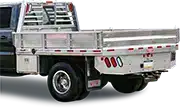
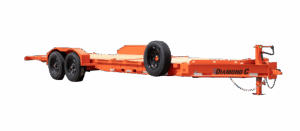
Browse Spencer Trailers’ inventory to compare Diamond C and H&H equipment and flatbed trailers with the deck layout, payload capacity, and securement provisions needed for real hauling work. Diamond C builds its trailers in Mt. Pleasant, Texas, and its current heavy-duty flatbed and equipment lines use Lippert axles. Equipment, anchor points, ramps, tires, suspension packages, and GVWR can vary by model and selected options, so confirm the specifications of the individual trailer rather than relying on a general model description.
If you’re not sure whether your current trailer has the right payload capacity or securement points for what you’re moving, bring the cargo weight, dimensions, center-of-gravity information, and equipment-manufacturer transport instructions to the lot. The team at Spencer Trailers in Spencer, Indiana can help identify a properly sized trailer and explain its available securement features. The trailer must still be matched to the tow vehicle’s GCWR, towing capacity, hitch rating, axle ratings, tire ratings, and applicable licensing requirements.
A Quick Reference: Strap vs. Chain
| Situation | Better Choice |
|---|---|
| ATVs, UTVs, finished surfaces, and cargo without sharp edges | Properly rated ratchet straps, with vehicle-specific attachments and edge protection where needed |
| Heavy construction equipment, steel, and abrasion-prone cargo | Properly rated transport chain with compatible binders |
| Mixed loads with delicate and heavy components | Rated straps on suitable sensitive surfaces and rated chains at robust attachment points |
| Areas exposed to heat, sharp edges, or severe abrasion | Chain or another manufacturer-approved heat- and abrasion-resistant securement method |
| Quick setup without sacrificing control or capacity | Correctly rated ratchet straps or properly operated binders selected for the cargo |
One Last Thing
DOT compliance is not just about avoiding a fine. An inadequate securement system means the load may move under braking, cornering, acceleration, bumps, or evasive maneuvers. A machine that appears stable while parked can produce much greater forces once the trailer is moving. Proper securement must account for those forces before the trip begins.
Good securement habits come down to knowing the cargo’s actual weight, calculating aggregate WLL correctly, meeting both general and commodity-specific tie-down requirements, and using compatible hardware in serviceable condition. The trailer anchors and equipment attachment points must also be rated and correctly loaded. Check the setup before departure, recheck it during the trip, and replace questionable components instead of trying to get one more haul out of them.
Need help matching the right trailer to the loads you’re hauling? See what’s in stock at Spencer Trailers or call (812) 829-0226 to talk through your options.


