












Pull onto a busy highway at night without the right lights, and you are not just risking a citation. You are making the trailer difficult for other motorists to see, judge, and avoid. A loaded equipment trailer can weigh many thousands of pounds, and an unlit or poorly marked trailer at highway speed can create a deadly hazard. Before you hook up and go, it pays to understand what federal law requires, what applies because of the trailer’s width or length, and what must remain operational after the trailer leaves the manufacturer.
Federal Motor Vehicle Safety Standard 108 (FMVSS 108), codified at 49 CFR 571.108, establishes federal requirements for original and replacement lamps, reflective devices, and associated lighting equipment. It applies to most newly manufactured trailers, excluding pole trailers and trailer converter dollies. Operational requirements for trailers already in service can also come from state vehicle codes and, for commercial motor vehicles, the Federal Motor Carrier Safety Regulations. FMVSS 108 is therefore the essential federal starting point, but owners must also maintain the equipment and comply with the rules governing how the trailer is used.
The Basic Light Package Every Trailer Must Have
Regardless of width, ordinary trailers covered by FMVSS 108 require a core group of rear and side lighting devices. Some lamps can be combined in one housing, but every required function must still meet the applicable color, visibility, activation, and photometric requirements.
- Tail lamps (red, rear): Two lamps, one on each side of the trailer’s vertical centerline, mounted at the same height and as far apart as practicable. They must illuminate whenever the tow vehicle’s headlamps or parking lamps are on.
- Stop lamps (red, rear): Two lamps, one on each side, activated when the tow vehicle’s service brakes are applied. Stop-lamp and tail-lamp functions are commonly combined in the same approved housing.
- Turn-signal lamps (amber or red, rear): Two rear-facing lamps, one on each side. Many North American trailers use a combined red stop-and-turn circuit, while compliant separate amber turn signals are also permitted.
- License-plate lamp (white): At least one white lamp arranged to illuminate the rear registration plate. More than one lamp may be used when necessary to provide the required illumination.
- Rear reflex reflectors (red): Two, mounted symmetrically at the rear, at the same height and as far apart as practicable. Their centers generally must be between 15 and 60 inches above the road surface.
- Front side-marker lamps (amber): One on each side, mounted as far forward as practicable. Side-marker lamps face sideways and indicate the trailer’s presence and length.
- Rear side-marker lamps (red): One on each side, mounted as far rearward as practicable.
- Front side reflex reflectors (amber): One on each side, positioned as far forward as practicable and generally 15 to 60 inches above the road.
- Rear side reflex reflectors (red): One on each side, positioned as far rearward as practicable and generally 15 to 60 inches above the road.
That is the foundation for a small utility trailer, a single-axle cargo trailer, a tilt-deck equipment trailer, or a heavier flatbed. The side devices are defined by their forward and rearward locations, rather than by drawing a strict dividing line at the trailer’s midpoint. A side-marker lamp may incorporate a reflex reflector if the combined device is designed and certified to perform both functions.
Length creates one additional requirement that is easy to miss. A trailer measuring 30 feet or more in overall length requires an amber intermediate side-marker lamp and an amber intermediate side reflex reflector on each side, located at or near the midpoint. This requirement is based on length, not on the 80-inch width threshold.
Where 80 Inches Changes Everything
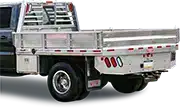
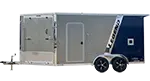
FMVSS 108 adds another group of lamps when a trailer is 80 inches or more in overall width. That threshold includes many equipment trailers, deck-over trailers, dump trailers, gooseneck flatbeds, and 8.5-foot enclosed cargo trailers. For example, an 83-inch deck-width equipment trailer ordinarily meets the width threshold, while an 8.5-foot-wide enclosed trailer may have an overall width approaching the 102-inch federal maximum for general highway operation.
Once the trailer is 80 inches or more in overall width, the following become mandatory:
- Front clearance lamps (amber): Two lamps identifying the trailer’s overall width, positioned at the front, one on each side and as far apart as practicable. On a trailer, the front clearance lamps may be mounted at a location other than the extreme front when necessary to indicate the trailer’s overall width.
- Rear clearance lamps (red): Two lamps at the rear, one on each side, mounted as high and as far apart as practicable. Their purpose is to show the trailer’s width and outer edges.
- Rear identification lamps (red): Three red lamps in a horizontal row, grouped near the trailer’s vertical centerline and mounted as high as practicable. The lamp centers are closely spaced to identify a vehicle that is 80 inches or more wide.
Side-marker lamps and side reflex reflectors remain required on narrower trailers as well. Width determines whether clearance and identification lamps are added; it does not create the underlying front and rear side-marker requirement.
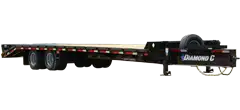
An 83-inch-wide tandem-axle equipment trailer is at or above the federal threshold, so it requires front and rear clearance lamps and the three-lamp rear identification cluster. A 32-foot Diamond C FMAX gooseneck flatbed also requires those width-related lamps and, because its overall length is at least 30 feet, amber intermediate side-marker lamps and intermediate side reflectors near the midpoint of both sides.
Reflectors: Placement Is Not Optional
People sometimes treat reflex reflectors as decorative additions. FMVSS 108 treats them as required safety devices. For ordinary rear and side reflex reflectors, the center of each device generally must be at least 15 inches and no more than 60 inches above the road surface when the unloaded trailer is at curb weight. Rear reflectors must be mounted at the same height, symmetrically about the vertical centerline, and as far apart as practicable.
Longitudinal placement matters as well. The amber front side reflectors belong as far forward as practicable, while the red rear side reflectors belong as far rearward as practicable. On a trailer 30 feet or longer, the additional amber reflectors belong at or near the midpoint. Required lamps and reflectors must be securely mounted to a rigid part of the trailer and must remain visible with normal trailer equipment, ramps, gates, toolboxes, and other obstructions considered.
FMVSS 108 repeatedly uses the phrase “as far as practicable” because trailer structures differ. That flexibility accommodates real frame, body, and door configurations, but it does not permit arbitrary placement. If a ramp, gate, spare tire, or dealer-installed accessory blocks a required device so it cannot meet the applicable visibility requirements, an additional device of the same type may be necessary.
| Required Item | All Trailers | 80-inch+ Wide | 30+ Feet Long |
|---|---|---|---|
| Tail lamps (red, rear) | Yes | Yes | Yes |
| Stop lamps (red, rear) | Yes | Yes | Yes |
| Turn signals (rear) | Yes | Yes | Yes |
| License-plate lamp (white) | Yes | Yes | Yes |
| Rear reflex reflectors (red) | Yes | Yes | Yes |
| Front and rear clearance lamps | No, unless 80 inches or wider | Yes | Only if also 80 inches or wider |
| Front and rear side-marker lamps | Yes | Yes | Yes |
| Front and rear side reflex reflectors | Yes | Yes | Yes |
| Rear identification lamps (three red) | No, unless 80 inches or wider | Yes | Only if also 80 inches or wider |
| Intermediate side-marker lamps (amber) | No, unless 30 feet or longer | Only if 30 feet or longer | Yes |
| Intermediate side reflex reflectors (amber) | No, unless 30 feet or longer | Only if 30 feet or longer | Yes |
Conspicuity Tape: The Rule That Catches People Off Guard
Retroreflective conspicuity treatment is where FMVSS 108 becomes especially specific. For newly manufactured trailers, the federal requirement generally applies when both conditions are met: the trailer is 80 inches or more in overall width and has a GVWR over 10,000 pounds. Trailers designed exclusively for living or office use are excluded from this particular requirement. For commercial trailers already in service, 49 CFR 393.11 contains corresponding conspicuity requirements, including provisions addressing older trailers.
That means GVWR alone does not trigger FMVSS 108’s trailer conspicuity system. A narrow trailer with a GVWR over 10,000 pounds does not meet both federal conditions, and a wide trailer rated at exactly 10,000 pounds does not have a GVWR “over” 10,000 pounds. Manufacturers and owners may still install compliant reflective treatment voluntarily on trailers outside the mandatory category.
The approved system may use retroreflective sheeting, conspicuity reflex reflectors, or a compliant combination. Most equipment trailers use alternating red-and-white sheeting along the lower sides and lower rear, with white treatment at the upper rear corners. This treatment helps approaching drivers recognize the trailer’s length, width, and orientation when its lamps alone do not clearly define its outline.
A few specifics from the standard:
- On each side, alternating red-and-white material must cover at least half the trailer’s overall length. The elements should be distributed as evenly as practicable, with the treatment beginning and ending as close to the front and rear as practicable.
- The lower side treatment ordinarily must be between 15 and 60 inches above the road. If the trailer’s structure prevents installation within that range, FMVSS 108 permits the side treatment to be placed as high as 96 inches.
- Across the lower rear, alternating red-and-white treatment must extend horizontally as close as practicable to the full width of the trailer. If doors, hinges, ramps, or other required equipment interrupt the line, the material is placed on available rigid surfaces as close to the required location as practicable.
- The upper rear treatment consists of two pairs of white strips, each pair forming an inverted “L” near an upper outer corner. Each strip is 300 mm, or about 12 inches, long. If the trailer’s shape does not permit the specified corner arrangement, the standard provides alternate placement rules.
- Compliant sheeting is marked for its classification. The familiar 50-mm material is marked DOT-C2; wider compliant materials may be marked DOT-C3 or DOT-C4. The marking, color pattern, segment dimensions, photometric performance, and installation all matter. Ordinary decorative reflective tape is not an equivalent substitute.
Many current heavy-duty trailers, including Diamond C flatbeds, dumps, and equipment trailers that meet the federal width and GVWR conditions, leave the Mt. Pleasant, Texas factory with the required conspicuity treatment installed. Owners should still inspect the material periodically. Missing sections, paint overspray, road grime, abrasion, corrosion, or equipment mounted over the tape can reduce visibility and create an in-service compliance problem.
GVWR is the rating assigned by the manufacturer and shown on the certification label; it does not change merely because an owner loads more cargo. Loading a 9,990-pound-GVWR trailer past its rating does not legally convert it into a higher-rated trailer or excuse overloading. Conversely, operating a trailer empty does not remove lighting or conspicuity requirements tied to its certified width and GVWR.
Wiring Connections: The 4-Pin and 7-Pin Reality
FMVSS 108 governs required lighting performance and associated equipment, but it does not require every trailer to use one particular consumer connector format. In practice, connector condition and correct circuit assignment determine whether the compliant lamps actually work when the trailer is attached to a tow vehicle.
A standard 4-way flat connector has four conductors: ground, tail/running lamps, left stop/turn, and right stop/turn. It is common on small utility trailers without electric brakes. Because the stop and turn functions share the left and right circuits, describing the connector as carrying separate brake, left-turn, and right-turn circuits would be inaccurate.
A common 7-way RV-style blade connector adds circuits normally used for electric trailer brakes, 12-volt auxiliary power, and an auxiliary or reverse-light function, in addition to ground, running lamps, and the combined left and right stop/turn circuits. Wire colors and terminal assignments are not safe to assume solely from appearance, especially on used trailers, commercial 7-way connectors, or equipment that has been rewired. The tow vehicle and trailer should be checked against the correct connector diagram and tested with a circuit tester.
If a trailer has electric brakes but is connected through a basic 4-way adapter, the adapter does not magically supply brake-controller output or auxiliary power. The lamps may work while the electric brakes remain inoperative. That creates a serious safety problem and may violate Indiana’s braking requirements, which generally require trailers with a gross weight of more than 3,000 pounds to have adequate brakes. Our team at Spencer Trailers can walk you through connector compatibility, brake-controller requirements, and safe tow-vehicle setup before you put a trailer on the road.
What FMVSS 108 Does Not Cover
FMVSS 108 is primarily a federal motor-vehicle manufacturing and equipment standard. It establishes the lighting configuration with which a covered new trailer must be manufactured and certified, as well as requirements for replacement lighting equipment. State law and the Federal Motor Carrier Safety Regulations can govern continued operation, maintenance, and inspection after the trailer enters service.
Federal law generally preempts a state from establishing a nonidentical motor-vehicle equipment standard governing the same aspect of performance, but that principle should not be reduced to the claim that states can never impose additional operational rules. States retain authority over vehicle use, registration, inspection, maintenance, and traffic operation within the limits of federal law. Commercial operators must also consider 49 CFR Part 393 and applicable inspection requirements.
FMVSS 108 permits properly designed combination lamps. A trailer can therefore use a single rear lamp assembly that performs tail, stop, turn-signal, and reflex-reflector functions, provided the assembly and installation meet every applicable requirement for each function. The fact that several functions share a housing does not reduce the required number of left- and right-side signals.
Interior cargo lights, loading lights, dump-body work lights, and many auxiliary flood lamps are not part of the ordinary mandatory trailer-light package in Table I-b. However, an auxiliary lamp cannot impair the effectiveness of required lighting. A rear-facing white work light should be wired and used so that it cannot confuse or glare at other motorists during normal forward travel.
Color still matters. A required red lamp must emit red light, an amber lamp must emit amber light, and the license-plate lamp must emit white light. Lens appearance alone does not always determine emitted color because some approved LED assemblies use clear lenses over colored emitters. The correct question is whether the complete lamp produces the required color and meets the applicable federal performance requirements.
A Quick Word on Lamp Replacement
Required original and replacement lamps must conform to FMVSS 108’s applicable design, color, photometric, visibility, and physical-test requirements. The current regulation incorporates many of those requirements directly, while also referencing applicable SAE publications. SAE J585 is associated with tail lamps, SAE J586 with stop lamps, and SAE J588 with turn-signal lamps; treating J585 as the stop-lamp standard or J586 as the turn-signal standard mixes up the functions.
Do not rely only on a generic “trailer light” description. Purchase a lamp sold by a reputable manufacturer for the required function and confirm that it is certified for use on U.S. motor vehicles. FMVSS 108 permits most covered lamps other than headlamps to carry a “DOT” certification marking, but that marking is not universally mandatory on every ordinary trailer-lamp lens. Product documentation, the intended function, installation instructions, lens codes where provided, and manufacturer certification should all be considered.
If you are replacing lights on a Diamond C flatbed, H&H equipment trailer, or enclosed cargo trailer, match every original function. A combination tail/stop/turn lamp should not be replaced with a tail-only marker lamp simply because it fits the same opening. Likewise, replacing a lamp-reflector combination with a lamp that lacks the reflector function can leave the trailer short of a required reflex reflector.
LED replacements are legal when the complete lamp is designed and certified for the required application. LEDs illuminate more quickly than incandescent filaments, draw less current, resist vibration well, and generally provide long service life. Those benefits do not make every LED bulb or lamp compliant. Installing an LED bulb in a housing designed and certified only for a particular incandescent source may alter its intensity, beam pattern, color, heat management, or electrical behavior. A complete sealed LED assembly certified for the intended function is the safer replacement choice.
Know Your Trailer’s Width Before You Assume
The 80-inch threshold is a common source of compliance mistakes because owners sometimes measure only the cargo bed or dump body. FMVSS 108 defines overall width in relation to the nominal design dimension of the widest part of the vehicle, excluding certain items such as rearview mirrors, flexible fender extensions, mud flaps, and flexible splash or protective equipment. Permanent fenders and other fixed structural components can affect the overall width, so the manufacturer’s certification information and published dimensions are more reliable than a quick measurement of the floor.
A trailer with a 77-inch bed may remain below 80 inches overall, but that cannot be assumed if fixed fenders or other structural components make the complete trailer wider. Likewise, “83-inch” in a model description may refer to usable deck width rather than the trailer’s maximum outside dimension. Verify the manufacturer’s stated overall width instead of using the deck or box width as a substitute.
If you are shopping for a new trailer and want to understand which lighting tier applies, check the certification label and current specification sheet carefully. A narrow single-axle utility trailer generally stays within the basic lighting category. Move to an 83-inch deck-width equipment trailer or an 8.5-foot enclosed cargo trailer, and the unit will ordinarily require clearance lamps and the three-lamp rear identification cluster. If the trailer is also 30 feet or longer, it needs the intermediate amber side lamps and reflectors. If it is at least 80 inches wide and rated over 10,000 pounds GVWR, the federal conspicuity system is also required.
Width, length, and GVWR trigger different requirements, so none should be used as a shortcut for the others. Clearance and identification lamps are tied to width. Intermediate side markers and reflectors are tied to overall length. Conspicuity treatment requires both the applicable width and GVWR conditions. Brakes, registration, towing capacity, and commercial-driver licensing are governed by separate rules and ratings.
Before every trip, connect the trailer and test the tail lamps, both turn signals, brake lamps, side markers, clearance lamps where equipped, and the license-plate lamp. Confirm that the three rear identification lamps illuminate together, inspect reflectors and conspicuity material for obstruction or damage, and make sure ramps or a raised dump body have not damaged the harness. A helper makes the inspection easier, but a reflection from a wall or a trailer-light tester can also reveal failed circuits.
Want to see what is currently in stock and verify the lighting configuration before you buy? Browse our current inventory or call us at (812) 829-0226 and we will pull the current specification information on any unit you are considering. Knowing the trailer’s actual overall width, length, GVWR, connector, brake system, and factory lighting package before it is on your hitch is always easier than correcting a compliance problem afterward.


