







You’ve got the trailer properly coupled, the load secured, and you’re ready to go. Then someone waves you toward a tight spot and says, “Just back it right in there.” Your palms get wet. You steer too aggressively, the trailer starts closing toward the truck, and suddenly it feels as though everyone nearby is watching.
That moment does not have to turn into a damaged fender, bent coupler, crushed tailgate, or scraped trailer. Backing a trailer is a learnable skill, and it becomes much easier once you understand how the tow vehicle and trailer interact. The keys are a good setup, walking-speed movement, small steering inputs, useful mirrors, and a willingness to stop and pull forward whenever the approach stops looking right.
Why Trailers Feel Backwards
A bumper-pull trailer pivots at the hitch ball or pintle connection. When the tow vehicle begins turning while reversing, the movement of its rear end pushes the trailer tongue in one direction and causes the rear of the trailer to move in the opposite direction. For example, turning the top of the steering wheel left while backing initially moves the rear of the trailer toward the right.
Your brain naturally resists this relationship because ordinary forward driving has trained you to associate steering left with traveling left. Backing a trailer adds another articulated vehicle behind you, and many new drivers respond to that unfamiliar movement with large, fast steering corrections. Those corrections can make the angle between the truck and trailer increase rapidly, particularly with a short trailer.
The solution is not strength or speed. It is a simple steering reference, deliberate observation, and small corrections made early. You should also remember that steering begins the turn, but countersteering is needed to reduce the angle and follow the trailer into the space.
The Hand-on-Bottom Trick (and Why It Works)
Place one hand near the bottom of the steering wheel, around the 6 o’clock position. Move that hand toward the direction you want the rear of the trailer to travel.
Want the rear of the trailer to move left? Move your bottom hand left. Want it to move right? Move your bottom hand right.
This method simplifies the initial steering decision. It does not mean you should hold that steering angle throughout the maneuver. Once the trailer begins turning toward the target, gradually return the steering wheel toward center and then countersteer as necessary so the tow vehicle follows the trailer instead of continuing to increase the articulation angle.
Practice the sequence in a large, level, empty area where trailers are permitted: steer to start the trailer moving, reduce the steering input as it approaches the desired angle, and then follow it into line. Use painted markings or properly placed cones, keep all people clear, and get out to inspect the space whenever you are unsure. Most drivers improve quickly once they stop chasing the trailer with large corrections.
Small Inputs, Slow Speed
If there is one principle that matters more than any steering trick, it is this: small inputs preserve your options, while large inputs can create an angle faster than you can comfortably correct it.
When a trailer starts drifting off course, the natural urge is to turn the steering wheel sharply. That can send the trailer past the intended line, prompting an equally sharp correction in the other direction. Repeating that cycle can quickly put the trailer and tow vehicle at a severe angle. The risk is not defined by a universal number of degrees because safe clearance varies with the hitch type, tongue or gooseneck geometry, tow vehicle, trailer structure, cargo, and surrounding obstacles.
Instead, use a modest input and observe the result. At walking speed, the driver has time to watch both mirrors, recognize which side of the trailer is becoming more visible, and make another small adjustment. If conditions are crowded, visibility is poor, or the ground is uneven, move even more slowly and stop as often as needed. Never use momentum to force a backing maneuver.
Pull-ups are always an option. If you lose the desired angle or cannot confirm clearance, stop, set the brake as appropriate, and pull forward to straighten and reposition the combination. Experienced commercial and noncommercial drivers use pull-ups because resetting early is safer than trying to rescue a poor approach near an obstacle. There is no prize for completing a difficult back in one continuous move.
Setting Up the Approach Angle
Many backing problems begin before the transmission is placed in reverse. A spacious, deliberate setup reduces the amount of steering needed and improves visibility through the driver’s side mirror.
For a straight-line back, begin with the tow vehicle and trailer aligned as straight as practical with the destination. Pull far enough forward to create working room, stop, inspect the path, and reverse using very small corrections. If the trailer begins drifting, correct early and then unwind the steering so it does not swing through the centerline.
For an angled back into a parking space, driveway, or storage bay, there is no single correct offset angle. The proper setup depends on the length from the hitch to the trailer axles, the tow vehicle’s wheelbase and turning radius, the hitch location, the available swing room, and the location of obstacles. Whenever the site permits, favor a driver-side back because the driver’s mirror generally provides a better view than a blind-side approach.
Before moving, check overhead clearance, surface slope, soft ground, curbs, posts, gates, roof edges, people, animals, and cross traffic. A trailer follows a different path from the tow vehicle, and its front corners, fenders, tires, rear overhang, ramps, and cargo can each swing through a different arc. Lower tailgates, raised dump bodies, unsecured ramps, or equipment attachments can create additional hazards.
Longer trailers generally react more gradually to the same small steering movement than very short trailers, but they need more room for the tow vehicle and trailer to swing. For example, the current Diamond C LPX bumper-pull equipment-trailer line is offered in lengths from 16 to 30 feet and in GVWR configurations from 15,500 to 24,000 pounds. Those figures describe the trailer’s rated size and capacity range, not how much a particular tow vehicle may safely pull. Always use the certification label and actual configuration of the individual trailer.
When to Use a Spotter
Use a spotter whenever the driver cannot positively verify the path, especially around buildings, parked vehicles, pedestrians, children, equipment, drop-offs, overhead hazards, or concealed ground-level obstacles. Enclosed trailers, tall cargo, wide loads, and tight sites can all block critical portions of the driver’s view.
Agree on signals before starting. The driver and spotter should both understand exactly what each signal means. Simple signals may include:
- Come back (a clear, repeated motion directing the driver to continue reversing)
- Stop (one or both hands clearly displayed with palms toward the driver)
- Trailer left / trailer right (a clear indication of the direction the rear of the trailer needs to move)
Use directions based on the trailer’s intended movement rather than ambiguous phrases such as “turn this way.” The spotter should stand where the driver can continuously see them in an agreed mirror while remaining well outside the vehicle and trailer paths. The spotter must never stand between the tow vehicle and trailer, directly behind the trailer, or where the combination could pin them against another object.
If the spotter disappears from view, the driver must stop immediately and remain stopped until communication and visual contact are restored. Anyone may give an emergency stop signal, but one designated spotter should provide routine directional instructions so the driver does not receive conflicting commands.
A properly installed rear-view or backup camera can improve visibility, especially on enclosed cargo trailers and long gooseneck combinations. Camera availability varies by trailer, camera manufacturer, installation, and tow vehicle, so it should not be assumed to be standard equipment. A camera supplements mirrors, direct observation, and a spotter; it does not show every side, overhead, or low-level hazard. Keep the lens clean and understand that screen perspective can make distances appear different from what the driver expects.
Trailer Type Changes the Feel
Not all trailers respond identically. Axle placement, distance from the hitch to the axle group, overall length, hitch type, suspension, rear overhang, load distribution, tire condition, and surface slope all affect how quickly a trailer changes direction. The following ranges are general examples rather than universal specifications:
| Trailer Type | Common Length Range | Backing Feel |
|---|---|---|
| Open utility trailer | Approximately 8-16 ft | Short configurations react quickly and are easy to overcorrect |
| Enclosed cargo trailer | Approximately 12-24 ft | Usually reacts more gradually, but the body can obstruct rear and corner visibility |
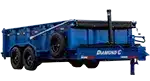
| Equipment/flatbed trailer, including Diamond C LPX | LPX: 16-30 ft | Longer axle-to-hitch distance produces a more gradual response, while overall width and length require more setup room |
| Gooseneck flatbed, including Diamond C FMAX models | Varies by model and configuration | Hitch placement over the truck bed changes the pivot geometry and requires attention to cab, bed, and trailer-neck clearance |
A short single-axle utility trailer can change direction very quickly because the distance from its coupler to its axle is relatively short. A longer tandem-axle equipment trailer usually reacts more gradually, but its size, weight, fenders, deck, and rear overhang introduce different clearance concerns. GVWR alone does not make a trailer easier to back: geometry has a much greater effect on steering response, while weight affects the consequences of an error and the demands placed on the tow vehicle.
The current Diamond C LPX uses Lippert axles as standard, with axle and GVWR packages varying by configuration. Diamond C’s FMAX Flatbed Max gooseneck family includes multiple single-wheel, dual-wheel, and triple-axle configurations, with GVWRs ranging from approximately 15,500 pounds to 40,000 pounds depending on the exact model. Drivers should learn the response and clearance requirements of the specific trailer rather than relying on experience with a different length or hitch type.
Building the Skill With Intentional Practice
Use a large, level area where practice is permitted and where there are no pedestrians, parked vehicles, light poles, curbs, or other hazards in the maneuvering zone. Set up flexible cones with generous clearance and practice three specific scenarios:
- Straight back over at least 50 feet, using the mirrors to keep the trailer centered within a wide practice lane
- 90-degree back into a simulated space, beginning with ample room and favoring a driver-side approach
- Offset back from one marked lane into another, using small inputs and pull-ups whenever alignment is lost
Practice starting the trailer’s turn, reducing the angle, and following it into line. Repeat the exercises from different starting positions because a slight change in setup can alter the entire maneuver. Also practice stopping, securing the combination, getting out, and inspecting the path. “Get out and look” is a professional habit, not an admission of uncertainty.
Do not deliberately add distractions. Effective practice should be controlled and focused, with phones put away and bystanders outside the practice area. Once the basic movements become comfortable, practice with a trained spotter using the signals you will rely on in real situations. The goal is calm observation and repeatable control, not speed.
If you are new to towing, begin with a trailer that is properly matched to your tow vehicle and load. A smaller utility trailer may appear less intimidating, but a very short trailer can respond faster than a longer one. Before practicing, confirm the tow vehicle’s tow rating, hitch and ball or coupler ratings, gross combined weight rating, receiver limits, tire ratings, and allowable payload. Include the trailer’s loaded tongue or pin weight when calculating how much weight the tow vehicle is carrying.
Regardless of size, complete a proper hookup inspection. Confirm that the coupler or gooseneck is fully seated and locked, the hitch components are correctly pinned, safety chains are crossed or attached as required for the connection, the breakaway cable is connected independently of the chains, the jack is raised and secured, ramps and doors are latched, lights work, and the electric-brake controller is adjusted and tested. Under Indiana law, a trailer with a gross weight of more than 3,000 pounds must be equipped with brakes adequate to control and stop the trailer.
What to Do When You’ve Already Jackknifed
If the angle between the tow vehicle and trailer becomes severe, stop immediately. Do not continue backing in the hope that the combination will correct itself. Set the parking brake, keep everyone clear, and inspect the truck, hitch, coupler or gooseneck, safety chains, wiring, breakaway cable, jack, trailer frame, cargo, and surrounding obstacles before deciding how to proceed.
If there is sufficient clearance and nothing has made contact, carefully pulling forward while steering to open the angle can usually straighten the combination. The correct steering direction depends on the existing angle and available space, so do not assume that holding the wheel perfectly straight will always be enough. Move at idle or walking speed, watch the trailer in both mirrors, and stop if the angle worsens or any component approaches the truck.
Never disconnect a heavily angled trailer merely to solve a backing problem. An angled or loaded trailer can move unexpectedly when uncoupled, especially on a slope or uneven surface. Do not try to push or reposition a trailer by hand based only on its GVWR or axle count; actual weight, tongue weight, grade, surface condition, and available control determine whether manual movement is safe. Use rated trailer-moving equipment or qualified assistance when repositioning cannot be completed safely with the tow vehicle.
After any contact or suspected jackknife damage, do not resume highway travel until the affected components have been inspected. Hidden damage to the coupler, hitch, safety-chain attachments, jack, wiring, trailer tongue, gooseneck, truck bed, or frame can compromise safe towing. The best remedy remains prevention: catch the developing angle early, stop, pull forward, and reset while plenty of clearance remains.
Mirrors Are Your Best Allies
The driver must have mirrors that provide the field of view required for the particular tow vehicle, trailer, cargo, and route. Standard mirrors may be adequate for some narrow open trailers but inadequate for a wide enclosed trailer or equipment trailer. Properly fitted towing mirrors can extend the sightline along the trailer’s sides and help the driver monitor its wheels and rear corners.
Before reversing, adjust the mirrors while seated in the normal driving position. Each mirror should provide useful coverage along the trailer rather than showing mostly the side of the tow vehicle. Supplemental convex sections can help reveal nearby objects, but they make objects appear farther away and should not be used alone to judge exact clearance.
Aim the mirrors to balance side and lower-area visibility without sacrificing awareness of the trailer’s upper corners and surrounding traffic. One fixed mirror position may not reveal every curb, post, person, roof edge, or trailer corner. If you cannot verify a clearance, stop and get out to look or use a properly positioned spotter. Do not lean out of an open door or attempt to back with the driver’s door open, because the door can strike an obstacle and the driver can fall or become trapped.
Keep the windows, mirrors, camera lenses, and trailer lights clean. At night, avoid relying on excessive work-light glare that can wash out the mirrors or blind a spotter. If visibility becomes inadequate because of darkness, rain, fog, dust, or a blocked sightline, stop until the maneuver can be completed safely.
Ready to practice with a trailer properly matched to your vehicle and intended load? Check our current trailer inventory to compare available utility, cargo, equipment, dump, and gooseneck trailers. The team at Spencer Trailers can help you understand GVWR, payload, unloaded weight, tongue or pin weight, hitch requirements, brake-controller compatibility, and tow-vehicle limits for the exact trailer under consideration. Call us at (812) 829-0226 or stop by 291 West State Hwy 46 in Spencer, Indiana, and we’ll sort it out together.


