





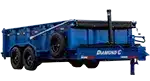
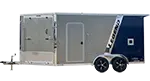

Your animals are already under enough stress on haul day. The trailer should not add heat, poor footing, sharp edges, loose gates, or unpredictable movement to the trip. Inadequate ventilation can contribute to heat stress, worn flooring can fail under an animal, and an unsecured divider can injure cattle, horses, sheep, or handlers. Before pulling onto a county road with livestock aboard, inspect the trailer as an animal-transport system rather than looking only at its length or advertised GVWR.
This post covers the four things that matter most: ventilation, flooring, dividers, and whether a gooseneck or bumper pull hitch makes sense for your operation. We will also identify current livestock trailer configurations worth comparing and explain the ratings you need to check before deciding how many animals a trailer can safely carry. Animal count alone is never a reliable capacity measurement. Average animal weight, trailer empty weight, floor area, axle placement, tongue or pin weight, weather, trip length, and the tow vehicle’s ratings all matter.
Ventilation: More Than Just Open Slats
A trailer that looks open from the outside can still develop hot, humid, stagnant conditions when it is fully loaded, stopped in traffic, or parked during loading. The goal is effective cross-ventilation, with outside air able to enter, move through the animal compartment, and exit without being blocked by solid panels, equipment, bedding, or tightly packed animals. This matters during hot and humid southern Indiana summers, but ventilation is also necessary in winter to remove heat, moisture, and respiratory contaminants.
Look for a livestock-specific design with open bar-top sides, properly sized slat openings, adjustable windows, or manufacturer-designed vents appropriate for the species being hauled. Current Delco livestock designs illustrate the range of available approaches. Its Cattleman gooseneck family uses an open bar-top layout, while other configurations combine solid lower sides with open upper areas or a metal roof for additional weather protection. Bumper-pull stock models can also be configured with ceiling ventilation. The right design depends on whether you primarily haul cattle, horses, sheep, goats, or a mixture of animals.
Do not judge ventilation by a single sidewall-opening percentage. There is no universal 40- or 50-percent rule that makes every trailer safe. Trailer width and length, interior height, animal density, roof design, opening location, road speed, outside temperature, humidity, and whether the rig is moving all affect airflow. Openings must also be shaped and guarded so animals cannot trap a head, horn, hoof, halter, or lead rope.
Cold-weather panels can be useful, but they should be properly fitted, securely fastened, and used without eliminating essential airflow. Closing every opening to keep animals warm can allow moisture and respiratory contaminants to build up. For horses, adjustable windows or vents provide more control than permanently open stock slats. For cattle and sheep, open bar sections may deliver more airflow, but solid lower panels can reduce road spray and help contain smaller animals.
Roof or ceiling vents can improve air exchange on a trailer with a solid roof, especially when the rig is stopped or moving slowly, but the number and placement vary by model. They should not be assumed to be standard equipment. A side access or escape door is valuable for handler access and emergencies, but it should not be treated as the trailer’s primary ventilation system.
Before loading, open and close every vent, window, panel, and door. Make sure nothing has been bent shut, blocked by stored equipment, or covered by a winter panel that was never removed. During warm-weather stops, minimize stationary time, park in shade when practical, and check the animals rather than assuming the trailer remains comfortable because it felt cool when it was empty.
Flooring: The Difference Between a Safe Trip and a Vet Bill
Slick or deteriorated flooring is one of the quickest ways to injure a large animal in transit. Cattle and horses continually adjust their stance as the truck accelerates, turns, brakes, and travels over uneven roads. A wet, manure-covered, polished, or damaged floor can take away that footing. A floor can also look acceptable from above while rot, corrosion, cracked welds, or damaged crossmembers are hidden underneath.
The three flooring options you will see most often:
- Treated wood planking: Treated pine and other manufacturer-specified wood floors are common in steel livestock trailers, including current Delco stock and horse configurations. Wood can provide useful natural traction and individual boards can often be replaced, but it must be inspected for softness, splitting, raised fasteners, gaps, urine damage, and deterioration where the boards rest on crossmembers. Inspect from both above and below; tapping only the visible surface is not enough.
- Aluminum flooring: Extruded or treaded aluminum does not rot like wood and may reduce empty weight in an aluminum trailer, but metal is not automatically slip-resistant. Smooth, worn, wet, or manure-covered aluminum can be slick. Rubber mats or another manufacturer-approved traction surface are commonly used for horses. Aluminum under mats must still be cleaned and inspected because trapped urine, salts, and moisture can contribute to corrosion.
- Rubber matting over a structural floor: Rubber mats can improve grip, reduce noise, and provide cushioning, particularly for horses. The mats are not the structural floor, however. The wood, aluminum, or steel underneath must remain sound. Mats should fit securely without curled edges or gaps, and they need to be removed periodically so the underlying floor can be washed, dried, and inspected.
For cattle, a sound treated-wood floor is common and practical, provided it has adequate traction and is kept clean. Factory-designed textured metal flooring can also work when it is intended for livestock and maintained properly. For horses, rubber mats over a sound structural floor are often preferred because they improve traction and reduce vibration and noise. For sheep and goats, secure footing remains important because smaller animals can slide, bunch together, or be knocked down during a turn or sudden stop.
Bedding can absorb moisture and improve comfort in some situations, but it does not repair a slippery or weak floor. Excessively deep or loose bedding may also make footing unstable. Use bedding appropriate for the species, weather, trip length, and trailer design, and remove wet material before it hides damage or accelerates deterioration.
Do not try to determine floor strength by dividing the trailer’s GVWR by its floor length or square footage. GVWR is the maximum allowable weight of the complete loaded trailer, not a stand-alone floor rating. Payload is approximately the trailer’s GVWR minus its actual empty weight, and that payload must still be carried without exceeding the axle, tire, wheel, coupler, hitch, truck, or floor-structure limits. Optional gates, mats, spare tires, tack rooms, hay racks, and other equipment add empty weight and reduce available payload.
Use the VIN certification label and the build information for the exact trailer. Verify GVWR, GAWR, tire load capacity, empty weight when available, and the manufacturer’s floor construction. When the load will be close to a rating, weigh the truck and loaded trailer on a certified scale. A trailer with unused floor space can still be overloaded, and a trailer that is below GVWR can still overload one axle or place too much weight on the truck.
Dividers: Who They Are Really For
Dividers and center gates control animal movement, separate incompatible animals, and help keep the load positioned where the trailer and tow vehicle are designed to carry it. The correct design differs by species. Gate strength, latch security, opening size, placement, and emergency-release access are more important than simply counting how many partitions the trailer has.
For horses, use a horse-specific stall or gate arrangement with smooth surfaces, adequate head and body room, and no exposed edges or hardware that can catch a halter, leg, or tail. Horse dividers are generally partial-height components rather than solid walls extending from floor to ceiling. Depending on the trailer, horses may travel in straight-load, slant-load, or open-box arrangements. Dividers should be padded where appropriate, securely latched, and capable of being released in an emergency without requiring a handler to stand directly behind a distressed horse.
Breast bars, butt bars, center gates, and stall dividers must be matched to the horse’s size. A divider that is too low, too high, too narrow, or installed with an unsafe gap can create an entrapment hazard. An access or escape door can give a handler another route into or out of the animal compartment, but the complete loading and unloading procedure should be planned before the horse enters the trailer. Do not assume a trailer marketed for two or three horses includes the particular stall arrangement your horses require; verify the exact gate and divider package on the build sheet.
For cattle, center gates are used to limit movement through a long trailer, separate groups, and keep a partial load positioned correctly. They can separate cows from calves, bulls from other cattle, or animals of substantially different sizes. A long, lightly loaded compartment may allow animals to gain momentum during braking or cornering, while overcrowding prevents animals from recovering their balance. The goal is an appropriate group size and stocking density, not maximum compression or a completely open trailer in every situation.
A cattle gate must be strong enough to withstand pressure from the loaded animals, and its hinges, pins, and latches should be checked before every trip. Rear gates with a built-in sliding section can make sorting and unloading easier without opening the full gate. Current Delco S6 and S8 bumper-pull stock configurations use a solid center gate and a full-swing rear gate with a sliding section, while additional or sliding center-gate arrangements may be available depending on the ordered configuration.
For sheep and goats, pay close attention to openings in gates, bar-top sides, and lower panels. Small animals can put their heads or legs through gaps designed for adult cattle. Horned animals create additional entanglement concerns. Use manufacturer-designed small-stock panels, properly sized mesh, or smooth solid containment sections intended for the trailer. Loose plywood, wire panels with sharp cut ends, or improvised inserts can splinter, shift, detach, or create new pinch points.
Gate count and placement vary by length, width, model, and intended species. A center gate that is standard on one bumper-pull stock trailer may be optional or positioned differently on a gooseneck. Longer stock trailers may need multiple compartments, but every added gate also adds weight and reduces payload. Compare the actual gate layout, not just a brochure photo of a similarly named trailer.
Gooseneck vs. Bumper Pull: The Hitch Question
This is where the argument gets real on livestock operations, because the answer depends on loaded weight, trailer length, trip frequency, road conditions, available truck payload, and how easily the rig must maneuver around barns, gates, and loading facilities. Hitch style does not determine legal capacity by itself, and a gooseneck is not automatically safe behind every pickup simply because the truck has a ball in the bed.
Bumper Pull (Ball Hitch)
Current livestock bumper pulls span more than one weight class. For example, Delco’s current lineup includes 7,000-lb GVWR H6 and H8 horse trailers with tandem 3,500-lb electric-brake torsion axles. Its S6 stock configuration is available in a 7,000-lb class, while the heavier S8 stock configuration is listed at 12,000 lb GVWR with tandem 6,000-lb electric-brake torsion axles. Lengths, widths, empty weights, and equipment vary, so confirm the VIN-specific build rather than assuming that every bumper pull is a 9,900-lb trailer or uses 5,200-lb axles.
A bumper pull can be a practical choice for two or three horses, smaller cattle loads, sheep, goats, veterinary trips, local shows, and operations that do not need the length or payload of a large gooseneck. It leaves the pickup bed available and can be easier to move with different properly rated tow vehicles. The truck still needs sufficient tow rating, payload, rear-axle capacity, tire capacity, receiver rating, and braking capability for the loaded trailer.
The downside is that a conventional trailer places tongue weight behind the truck’s rear axle. A long, tall, heavily loaded, or poorly balanced bumper pull can be more sensitive to crosswinds, steering inputs, road unevenness, and passing traffic. A weight-distribution hitch or sway-control system may help when it is approved by the truck, receiver, hitch, and trailer manufacturers, but it cannot correct an overloaded truck, inadequate tongue weight, worn suspension, weak tires, or livestock positioned improperly.
Every livestock trailer in the weight classes discussed here is above Indiana’s trailer-brake threshold. The braking system must be operable from the tow vehicle, and the breakaway system must be able to apply the trailer brakes if the trailer separates. Test the brake controller, breakaway battery, plug, safety chains, lights, and all wheel brakes before loading animals.
Do not assume that pulling a bumper trailer with a three-quarter-ton pickup automatically avoids commercial-driver requirements. For a Class A CDL, the key federal and Indiana weight threshold is a gross combination weight rating of 26,001 lb or more when the towed vehicle has a GVWR greater than 10,000 lb. Commercial use, vehicle ratings, and any applicable farm exemptions also matter. The trailer alone does not trigger the 26,001-lb threshold, and hitch style does not decide the issue.
Gooseneck
A gooseneck couples to a ball mounted in the pickup bed, normally near or slightly ahead of the rear axle. That geometry generally gives a longer, heavier trailer better directional stability and places the trailer’s pin weight more directly over the truck’s rear suspension. It also allows tighter low-speed turning than many long bumper pulls, although the gooseneck can contact the cab or bed rails if the truck, coupler height, or turning clearance is wrong.
Current Delco gooseneck livestock offerings include open bar-top Cattleman configurations, metal-top Cowboy configurations, premium Rodeo King models, and commercial groundload Bison designs. These are not one uniform 14,000-lb product. GVWR, axle arrangement, width, length, roof, sides, gate layout, and coupler rating vary substantially across the families. As one common comparison point, current Rodeo King P6 through P9 configurations are listed in the 14,000-lb GVWR class with tandem 7,000-lb electric-brake torsion axles, treated pine floors, solid lower sides, and butterfly rear gates. Heavier livestock models require a different level of tow vehicle and hitch capacity.
A gooseneck coupler stamped for 25,000 or 30,000 lb does not make the complete trailer or truck capable of carrying that amount. The usable limit is controlled by the lowest-rated component in the combination, including the trailer GVWR, axles, tires, wheels, coupler, safety chains, hitch, truck GCWR, truck rear GAWR, truck tires, and available payload. Livestock, gates, mats, tack, feed, water, tools, and passengers all count against the applicable ratings.
Gooseneck hitch installation cost varies widely by truck, hitch design, underbed hardware, bed construction, labor, and whether the truck has a factory towing-preparation system. Choose an installation rated for the intended combination and completed according to both the hitch and truck manufacturers’ instructions. A high hitch rating does not override the truck manufacturer’s towing or payload limits.
A tack room, dressing room, hay rack, or enclosed nose can be useful for horses and mixed-use operations, but it is not free capacity. These features add empty weight and may reduce the length available for animals. For a cattle-focused operation, compare a straightforward stock layout with a horse-oriented configuration and decide whether the storage space is worth the payload and compartment-space tradeoff.
Whichever hitch style you choose, load the animals according to the trailer manufacturer’s instructions and verify the completed rig on a scale. The truck’s published maximum tow rating often assumes a particular cab, drivetrain, axle ratio, equipment package, and limited cargo. The door-jamb payload label, rear-axle rating, tire ratings, hitch rating, and actual scale weights are just as important as the number printed in a towing advertisement.
A Quick Comparison for Common Use Cases
The examples below are starting points, not animal-capacity guarantees. A 1,400-lb cow and a 700-lb yearling cannot be counted as the same “one head,” and horse weights vary widely by breed and size. Subtract the trailer’s actual empty weight from its GVWR, account for installed options and supplies, and confirm that the floor area and compartment arrangement are appropriate for the animals and weather.
| Use Case | Hitch | Recommended Floor | Key Feature | Est. GVWR |
|---|---|---|---|---|
| 2-3 horses, local shows or vet trips | Bumper pull | Sound wood or aluminum substrate with properly fitted rubber mats | Horse-specific gate or stall layout, secure latches, and safe handler access | 7,000-lb class, subject to payload |
| Larger horse group, equipment-heavy trip, or regular long haul | Gooseneck | Rubber mats over an inspected structural floor | Configured dividers, controlled ventilation, emergency access, and correctly sized storage | 14,000 lb and up, VIN-specific |
| Small cattle load based on actual animal weights | Bumper pull | Treated wood or another factory-approved livestock floor | Strong center gate, secure rear gate with sorting access, and open ventilation | 7,000-12,000 lb class |
| Larger or regularly transported cattle load | Gooseneck | Treated wood or factory-designed textured livestock flooring | Multiple properly placed compartments, adequate airflow, and a truck with sufficient rear-axle capacity | 14,000 lb and up, model-specific |
| Sheep or goats | Either | Non-slip wood, rubber-covered substrate, or factory-textured flooring | Small-stock containment with safe gaps, smooth lower panels, and correctly sized partitions | 7,000 lb and up, depending on load |
GVWR is only the beginning of the comparison. Ask for the trailer’s empty weight, axle ratings, tire capacities, interior dimensions, floor construction, gate layout, coupler rating, and standard versus optional equipment. Then compare those numbers with the exact truck configuration you will use. A lighter 7,000-lb horse trailer may be a better match for one operation, while a 12,000-lb bumper-pull stock trailer or a 14,000-lb gooseneck may be appropriate for another.
What We Stock at Spencer Trailers
Spencer Trailers carries Delco trailers, and Delco’s current livestock catalog includes S6 and S8 bumper-pull stock trailers, H6 and H8 bumper-pull horse trailers, and several gooseneck livestock families. The Cattleman line is designed around open bar-top ventilation, Cowboy configurations add metal-roof options, Rodeo King models combine solid lower sides with premium access features, and Bison groundload trailers serve larger commercial operations. Specifications vary by width, length, axle package, and ordered equipment, so each trailer must be evaluated from its current build sheet.
Livestock inventory and factory-order availability change regularly at our lot at 291 West State Highway 46 in Spencer. The best way to see what is physically available is to check our current inventory or call or text us at (812) 829-0226. If the exact livestock configuration is not sitting on the lot, we can discuss current ordering options and compare them with your truck and intended load.
If you have a specific load in mind, bring the useful numbers: species, number of animals, realistic average and maximum weight per animal, total estimated livestock weight, trip distance, seasonal use, and the truck’s VIN-specific ratings. Also tell us whether you need separate compartments, a rear slider, side access, horse dividers, small-stock panels, a roof, winter closures, mats, a tack area, or extra center gates. Those details narrow the field faster than asking only for a 16- or 20-foot trailer.
We can also walk you through what has moved off our lot recently so you can compare real configurations, but a recently sold trailer is not automatically the right match for your operation. Model-year specifications, available options, pricing, and factory packages can change. Verify the VIN label and written build information for the actual trailer being purchased.
Before the first loaded trip, inspect the hitch and coupler, safety chains, breakaway switch and battery, brake controller, wheel brakes, tires, wheel fasteners, lights, floor, crossmembers, gates, hinges, latch pins, vents, and every interior surface the animals can contact. Confirm that the trailer is registered and titled on time; Indiana generally gives a newly acquired vehicle a 45-day registration window before penalties apply. Keep the trailer level when coupled and make sure the loaded combination remains within every truck, hitch, axle, tire, and trailer rating.
The divider question, the flooring question, the ventilation question, and the hitch question do not have one universal answer. They do have a correct answer for your animals, your truck, your loading facilities, your roads, and the way you work. What does your current setup get wrong?
Ready to talk specifics? Reach out here or stop by the lot.


