







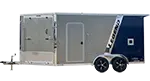
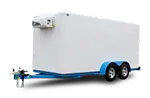
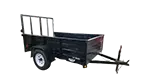

Picture a landscaper outside Kokomo who buys a 6×12 single-axle trailer for one zero-turn mower and a few handheld tools. It works well at first. Then the business adds a second mower, a stand-on machine, fuel cans, trimmer racks, and another employee. The trailer may still be structurally sound, but it has become the reason the crew cannot take on another account safely or efficiently.
That’s the real cost of buying wrong. It is not always a blown tire or a damaged axle. It can be capacity you never have, jobs you cannot accept, and equipment you cannot move in one trip. Buying the right trailer for your business is not about choosing the most expensive option. It is about matching the trailer to the work you do now while leaving reasonable room for growth.
Here’s how to think through it.
Start with the Load, Not the Trailer
Many buyers walk in and say, “I need something to pull my skid steer.” That is only the beginning. The useful questions are: What does the machine weigh in its working configuration? Which bucket or attachment will be installed? What tools, fuel, chains, and other cargo will ride with it? How often will the trailer be used?
A current Bobcat T450 compact track loader has an operating weight of roughly 6,400 pounds before you account for certain attachments, optional equipment, and other cargo. Add a heavy bucket, forks, an auger, securement equipment, and jobsite tools, and the transported load can move well beyond the base machine weight. A trailer with a 10,000-pound GVWR may sound sufficient, but if that trailer weighs approximately 2,800 pounds as equipped, its nominal payload is only about 7,200 pounds.
The basic formula is simple: GVWR minus the trailer’s actual empty weight equals its nominal payload capacity. That is not the only limit, however. Axles, tires, wheels, coupler, hitch, frame, deck, and tow vehicle all have ratings that must be respected. Use the weight of the trailer as it is actually equipped, not the lightest published base-model weight.
For Landscapers: Stop Undersizing
A small single-axle open or enclosed trailer can be a sensible starting point for a solo operator carrying one mower and a modest tool package. Problems begin when a crew adds machines and accessories without recalculating the total load. Mowers, fuel, batteries, blowers, trimmer racks, spare tires, shelving, and debris all consume payload.
For a growing lawn-care operation, a tandem-axle open trailer in the 16- to 20-foot range is often the more practical choice. The correct GVWR may be 7,000 pounds, 9,900 pounds, or higher depending on the machines being carried. H&H trailers include tandem utility configurations for both routine landscaping work and heavier commercial loads. Compare the standard rail-side models with the heavier-duty versions rather than assuming every tandem utility trailer has the same frame or payload.
For enclosed hauling, Wells Cargo and United both offer commercial cargo-trailer configurations worth comparing. Wells Cargo’s Road Force line uses closely spaced tubular steel framing rather than the aluminum-frame and steel-subframe construction sometimes incorrectly attributed to it. United also offers a range of tandem enclosed trailers, with the exact axle, wall, roof, floor, and door specifications depending on the model and options selected.
A 7×16 tandem enclosed trailer rated at 7,000 pounds will often provide considerably more payload than a similarly sized single-axle trailer, but there is no universal payload figure. Interior height, ramp door construction, extra ceiling height, finished walls, cabinets, shelving, spare tires, and upgraded floors all increase empty weight. Read the VIN label and configured specification sheet before deciding that two zero-turns and the rest of the crew’s equipment will fit within the rating.
For Hauling Heavy Equipment: GVWR Is the Starting Point, Not the Goal
Skid steers, mini excavators, track loaders, trenchers, and compact tractors concentrate a great deal of weight into a relatively small area. That makes frame design, crossmember spacing, deck construction, tie-down placement, loading angle, tires, and brakes just as important as the number printed beside GVWR.
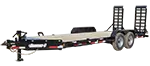
For bumper-pull equipment hauling, Diamond C’s LPX is the Low Profile Extreme-Duty Equipment trailer. Current configurations begin around the 15,000-pound class and extend to approximately 24,000 pounds, depending on axle and build choices. Available Diamond C loading systems include MAX Ramps, XDR Ramps, and the X-Ramp system on applicable models. There is no current Diamond C ramp system called “MegaRamp.”
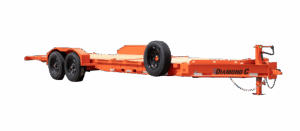
For operators who prefer a tilt deck, the Diamond C HDT is the Hydraulically Dampened Tilt equipment trailer, with current GVWR configurations ranging from approximately 15,500 to 24,000 pounds. Its dampened tilt mechanism controls deck movement during loading and unloading. It should not be confused with the LPT, which is Diamond C’s Heavy Duty Telescopic Dump trailer rather than a tilt-deck equipment model.
Diamond C’s premium lines, including LPX, HDT, LPT, FMAX, WDT, and DEC, use Lippert axles as standard equipment on current builds. They are manufactured in Mt. Pleasant, Texas, where Diamond C has built trailers since 1985. Current trailers also use the company’s DM Difference Maker multi-stage powder-coating system. Exact axle capacities, deck dimensions, loading systems, and empty weights vary by model and should be checked on the current build sheet.
For Daily Contractor Use: The Case for a Dump Trailer
If you are doing demolition, landscaping installations, roofing, property cleanups, or material delivery, a dump trailer can eliminate a large amount of manual unloading. That benefit is obvious after a long day spent shoveling stone, soil, or debris from a trailer that was never designed to dump.
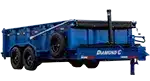
Delco offers dump trailers across several weight classes rather than one universal 10,000- to 14,000-pound design. In the 14,000-pound class, the D3 is a bumper-pull dump that uses a straight hydraulic-cylinder arrangement, while the D5 is Delco’s telescoping dump line and is offered in 14,000- and 16,000-pound configurations. Bed length, side height, axle package, hoist, gate, and empty weight depend on the exact model.
The dump trailer section at Spencer Trailers includes Delco and other options that can be compared side by side. Do not assume that a scissor hoist is automatically safer or more stable than a telescopic hoist, or that every trailer from a particular manufacturer uses the same system. A properly engineered scissor, straight-cylinder, or telescopic hoist can perform well when the trailer is level, the load is distributed correctly, and the trailer is operated within its ratings.
Payload must be calculated from the configured trailer’s actual empty weight. A 14,000-pound GVWR dump trailer does not automatically provide 11,000 pounds of payload; many commercial dump trailers weigh substantially more than 3,000 pounds after the hoist, battery, tarp, ramps, spare tire, heavy floor, and other equipment are included. Wet soil can weigh more than a ton per cubic yard, and its weight changes with moisture and composition. Let the payload rating, not the volume of the bed, determine how many yards you haul.
For Gooseneck Haulers: Weight Distribution Changes Everything
For frequent heavy hauling, a gooseneck can offer better stability than a comparable bumper-pull trailer because its coupling point is located in the truck bed near the rear axle instead of behind the rear bumper. That does not create free capacity. Gooseneck pin weight counts against the truck’s payload, rear-axle rating, tire ratings, and gross vehicle weight rating.
Diamond C’s FMAX family is its Flatbed Max gooseneck line. The FMAX207 is the entry model in that family, with a 15,500-pound GVWR, a 102-inch-wide deck, available deck lengths generally ranging from 20 to 35 feet, and dual 7,000-pound Lippert axles on the standard configuration. Higher FMAX models are available in progressively heavier configurations, with the family extending to approximately 40,000 pounds GVWR. The model number does not refer to a grade of steel, and the FMAX207 does not come standard with dual 10,000-pound axles or a fixed 22-plus-5-foot deck.
Spencer’s gooseneck trailer inventory runs from general-use flatbeds to heavy commercial models. Before selecting one, check the truck manufacturer’s maximum trailer rating, GCWR, GVWR, payload, rear-axle rating, tire capacity, and the rating of the installed gooseneck ball or hitch. The lowest applicable rating controls the combination.
A trailer rated above 10,000 pounds does not automatically require a CDL. Under the federal Class A threshold followed for Indiana licensing, the combination must have a GCWR of at least 26,001 pounds and the towed trailer must have a GVWR greater than 10,000 pounds. Commercial use, interstate operation, hazardous materials, passenger transportation, and certain farm operations can involve additional rules, so businesses should confirm their specific situation with the Indiana BMV and FMCSA.
For Truck Beds: When the Trailer Is Integrated
Some operations do not need a separate trailer for every task. A properly matched flatbed, service body, or gooseneck truck body can reduce repeated hooking and unhooking while keeping tools and equipment organized on the tow vehicle.
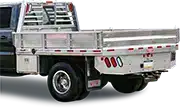
Spencer Trailers carries Zimmerman and Martin truck beds. Zimmerman offers steel and aluminum flatbeds and service bodies in multiple configurations. Martin specializes in aluminum truck bodies, including flatbeds, service bodies, and gooseneck-style bodies for compatible trucks generally through Class 5. Fitment depends on cab-to-axle measurement, chassis width, single- or dual-rear-wheel configuration, payload, lighting, fuel-fill location, and hitch requirements.
Truck bed options at Spencer are worth considering if your crew loses time connecting and disconnecting a trailer several times per day. A truck bed can improve efficiency for certain workflows, but it does not replace a trailer when the load exceeds the truck’s payload, bed dimensions, axle ratings, or securement capacity.
The Weekend Hobbyist Buy
Not everyone reading this operates a commercial fleet. Some buyers need to move an ATV, haul brush, carry a compact tractor attachment, or bring materials home from an auction. For occasional use, a lighter trailer may be entirely appropriate when it is correctly matched to the load and tow vehicle.
A Liberty LU is a real utility-trailer line, but its ratings depend on configuration. Current single-axle LU models are commonly rated at 2,990 pounds, while tandem-axle LU models are available with a 7,000-pound GVWR. Likewise, a light H&H single-axle utility should not be described as a 7,000-pound trailer unless the specific VIN label says so. For a premium 7,000-pound Diamond C utility, the GTU is a tandem-axle bumper-pull model with dual 3,500-pound axles and a 4-inch channel frame. It is not a gooseneck and does not stand for “General Transport Utility.”
It is reasonable to leave room for future uses, but there is no rule that every buyer needs exactly 20 percent more capacity. Choose enough deck space and payload for the heaviest realistic load, then verify that the tow vehicle is rated for it. Trailer prices vary by model year, steel and component costs, freight, dealer preparation, and options, so fixed price gaps between 7,000- and 10,000-pound trailers quickly become outdated.
What to Actually Ask at the Dealer
When you’re at the lot, these are the questions that actually matter:
- What is this trailer’s configured empty weight? Use the actual build sheet or scale weight, not the lightest catalog example.
- What are the individual component ratings? Check the axles, tires, wheels, coupler, hitch, safety chains, brakes, jack, and suspension.
- How is the deck rated for concentrated equipment loads? A pounds-per-square-foot figure is useful only when the manufacturer actually publishes one for that model.
- What are the deck height and loading system? Deck height, dovetail length, ramp design, and machine wheelbase all affect the real loading angle.
- What does the written warranty cover? Ask about structural coverage, component warranties, commercial use, maintenance requirements, and exclusions.
Two 7,000-pound axles do not automatically make every trailer a 14,000-pound-GVWR trailer. The manufacturer’s certified GVWR also accounts for the frame, suspension, coupler or pin connection, tires, wheels, brakes, and intended load distribution. Use the rating on the certification label.
Indiana also requires adequate brakes on a trailer or semitrailer with a gross weight of at least 3,000 pounds. The brakes must be controllable from the tow vehicle, and the trailer must have a system that applies the brakes automatically if it separates from the tow vehicle. Confirm that the brake controller, breakaway switch, battery, wiring, and brakes are working before towing.
Business ownership does not automatically remove title, registration, or tax obligations. Indiana purchasers generally must apply for title within the applicable 45-day period, register the trailer as required, and pay Indiana’s 7 percent sales or use tax unless a documented exemption applies. Agricultural or business use by itself is not a blanket exemption. Confirm unusual transactions with the Indiana BMV, the Indiana Department of Revenue, or a qualified tax professional.
The Real Cost of Buying Wrong
Go back to the landscaper from the beginning. The mistake was not simply buying a 6×12 trailer. It was buying without calculating the weight and space the business would need after adding another machine and employee. Replacing an undersized trailer can mean depreciation, another round of registration and setup costs, equipment downtime, and jobs that cannot be completed efficiently.
Buying the largest trailer on the lot is not the answer either. An unnecessarily heavy trailer can reduce payload, require a larger truck, increase operating costs, and create licensing or insurance complications. The right choice is the smallest practical trailer that safely handles the heaviest realistic load and leaves sensible room for growth.
Buy for where your business is going, not just where it is today. The right trailer is one that fits the equipment, stays within every component and vehicle rating, and continues to serve the operation long enough to justify the investment.
If you’re not sure which direction to go, Spencer Trailers’ full inventory is worth browsing after you calculate your heaviest load, required deck space, and tow vehicle ratings. Bring the truck’s payload and towing information along with the machine weights. That is enough to begin a useful conversation about what actually fits your operation.
What’s the most expensive trailer mistake you’ve seen someone make? There’s a good chance it involved an underrated hitch, an overloaded trailer, or a machine that was far heavier than the buyer expected.


