


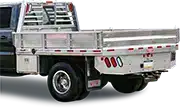
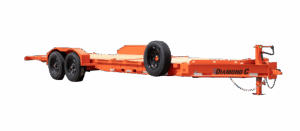



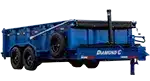


Pull up next to a Big Tex or a PJ at a job site and, from a distance, the trailers may look similar. They all use steel frames, trailer axles, wood or steel decks, and familiar loading systems. But load a Diamond C FMAX210 back-to-back with a similarly equipped gooseneck and the differences become easier to see: how the engineered neck transfers load into the frame, how the deck and camber behave under weight, how the ramps support concentrated equipment, how wiring and storage are integrated, and how the coating protects the finished trailer. It is not simply a cosmetic upgrade. It is an engineering approach that runs through the frame, neck, loading system, running gear, and finish.
We’ve been a Diamond C dealer here in Spencer, Indiana since 2001, and we’ve earned the Diamond C Dealer of the Year award more than once. That’s not something we lead with just to sell trailers. It matters because we have watched these trailers work in construction, agriculture, landscaping, hotshot hauling, and everyday equipment transport. We also see them when they come back for service, trade-in, or resale, which gives us a practical view of what holds up and what buyers appreciate after the new-trailer shine is gone.
The Engineered Beam 2.0: Why the Neck Matters More Than the Deck
Most buyers begin with deck length, payload, axle capacity, and GVWR. Those numbers matter, but the gooseneck and main frame determine how the trailer manages the forces created by repeated loading, braking, turning, and highway use. A long deck is only useful when the structure underneath it is properly matched to the trailer’s intended weight class.
Diamond C does not rely on a single off-the-shelf structural I-beam for every FMAX configuration. Its Engineered Beam system is fabricated in-house so the web height, flange dimensions, material grade, rib placement, and camber can be optimized for the specific trailer model. On Fleetneck Engineered Beam 2.0 frames, Diamond C uses Grade 100 material for the main beam webs. That is separate from the curved neck web, which uses 10-gauge Grade 80 material to reduce unnecessary weight while maintaining the required strength.
The neck itself is a one-piece fabricated 12-inch curved design. Instead of creating abrupt corners where forces can become concentrated, the curved profile transfers those forces through the neck and into the main frame. Diamond C also builds a slight camber into the frame. An unloaded trailer may appear slightly arched, but the frame is designed to settle toward level under an appropriate load rather than beginning its working life with a permanent sag.
The revised Grade 80 neck-web construction reduced the neck assembly’s weight by roughly 65 pounds compared with the earlier design. That does not increase the trailer’s published GVWR, but reducing empty trailer weight can preserve more usable payload within the ratings of the trailer, hitch, tires, axles, and tow vehicle.
Additional changes incorporated into Fleetneck Engineered Beam 2.0 include:
- Cutouts through the main beam webs for cleaner, better-protected wiring and cable routing instead of hanging those components below the frame
- Larger gusset flanges and full-height cross members intended to strengthen the connection between major structural components
- Revised rib orientation near the front of the frame to provide better support where the neck assembly transfers load into the trailer
- Grade 100 material used for the hydraulic dovetail toe-board support on trailers equipped with that loading option
- An under-deck passenger-side spare-tire location with a winch-assisted lowering system that keeps the spare accessible without occupying deck or toolbox space
The Engineered Beam design is used across the current FMAX gooseneck lineup, although beam height, axle configuration, suspension, empty weight, and GVWR vary by model. The range begins with the single-wheel tandem-axle FMAX207 at 15,500 lb GVWR and extends through tandem-dual and triple-dual models capable of 25,000, 25,900, 30,000, or as much as 40,000 lb GVWR in the appropriate FMAX216 or FMAX312 configuration. The common feature is the engineered-beam concept, not one identical beam or axle package installed under every trailer.
MAX Ramps and XDR Ramps: 44 Inches Is the Right Number
Conventional equipment-trailer ramps are often narrow enough that an operator has to line up the machine carefully before every load. That may be manageable for occasional use, but the inconvenience becomes more noticeable when a skid steer, tractor, or loader goes on and off the trailer several times a day.
Diamond C’s full-size MAX Ramps used on compatible FMAX, DEC, PX, and SDX configurations are 44 inches wide per ramp. Each ramp uses four 50 ksi steel frame members, heavy-duty spring assistance, and a two-point hinge arrangement designed to transfer loading forces into the ramp knees. The wider loading surface gives tires and tracks more room while reducing the need to approach the trailer with perfect alignment.
The MAX Ramp system also uses an over-center hold-down latch to secure the ramps during transport. The springs assist movement from both the deck and ground positions, but operators should still follow the trailer’s loading instructions, confirm that the trailer is coupled and stabilized correctly, and verify that the machine’s weight and track or tire placement are compatible with the selected ramp system.
Ramp dimensions depend on the trailer. On the LPX, the available MAX Ramps are 37 inches wide and are offered only on compatible lengths and configurations. The LPX can also be equipped with Diamond C’s full-width X-Ramp when paired with the appropriate max-width package, frame extensions, and drive-over fenders. That X-Ramp measures approximately 92.5 inches wide by 44.25 inches long and uses the same basic two-part hinge concept with spring assistance.
For backhoes, excavators, and other equipment that creates concentrated loading and needs open space between the ramps for bucket, fork, or knuckle clearance, Diamond C offers XDR Extreme Duty Knee Ramps on compatible gooseneck, pintle-hitch, and step-deck trailers. The XDR ramps measure 24 by 60 inches, use 50 ksi steel frames, incorporate a support knee, and leave an open center area between the ramps. They are a purpose-built option for certain machine profiles rather than a universal replacement for every ramp style.
The LPX equipment trailer is currently offered from 15,500 to 24,000 lb GVWR, depending on axle and package selection. Standard configurations begin with dual 7,000 lb Lippert axles, while available packages can include triple 7,000 lb, dual 8,000 lb, or dual 10,000 lb axle arrangements. MAX Ramps are an available loading option on compatible LPX builds rather than a standard feature on every LPX.
The HDT: Solo Loading Without the Ramp Fight
The hydraulically dampened tilt system on the HDT is one of those features that can sound optional until you use it regularly. For operators who frequently move compact construction equipment, forklifts, scissor lifts, tractors, or other machines that are well suited to a tilt bed, eliminating separate ramps can simplify every loading cycle.
The standard HDT uses a gravity-tilt bed controlled by a hydraulic dampening cylinder with valve control. After the trailer is correctly coupled, parked, and prepared for loading, the operator releases the bed, allows it to tilt, drives the machine onto the deck, and lets the bed return in a controlled manner. The dampening system regulates movement so the deck does not simply drop without resistance. The result is a controlled loading process without two individual ramps to lower, raise, align, and secure.
The current bumper-pull HDT and gooseneck HDT-GN are listed from 15,500 to 24,000 lb GVWR, with deck lengths from 16 to 28 feet and bed widths generally ranging from 80 to 82 inches. The standard running gear uses two 7,000 lb Lippert axles. Depending on the selected package, available running-gear upgrades include three 7,000 lb axles, two 8,000 lb axles, or two 10,000 lb torsion axles, along with the corresponding frame, coupler, tire, wheel, and suspension changes required by the higher-capacity build.
The HXD and HXD-GN serve a different need. These are 102-inch-wide hydraulically dampened tilt models with drive-over fenders and a stationary front deck. Their published GVWR range is 15,500 to 23,000 lb, and their full-width deck is useful for wide vehicles and equipment that will not fit between conventional fenders. The HXD should therefore be compared as a distinct extra-wide model, not merely as an 82-inch HDT with a few more inches added to the deck.
Diamond C also offers powered tilt choices on compatible HDT configurations. The electric-over-hydraulic powered tilt includes a wireless remote, while the Pro Tilt option allows the operator to switch between gravity and powered operation depending on the load, terrain, and working conditions. Those options are especially useful for rental fleets, recovery work, steel-deck builds, and operators who need positive hydraulic control instead of relying only on gravity tilt.
For solo operators moving equipment daily, the advantage is not just convenience. Removing repeated ramp handling reduces setup steps, eliminates loose ramps that can be misplaced, and can make the loading procedure more consistent. The machine, deck style, weight distribution, breakover angle, ground clearance, and job-site surface still need to be evaluated before choosing a tilt trailer, but when the application is right, an HDT can remove a meaningful source of wasted time.
The DM Difference Maker Coating: Six Steps, Not Two
Many trailer finishes begin with basic surface preparation followed by primer and a sprayed topcoat. Diamond C’s DM Difference Maker Coating System is a multi-step powder-coat process designed to provide more consistent surface preparation, corrosion resistance, adhesion, gloss, and color retention.
The current process begins by blasting the assembled steel trailer frame clean. The frame then moves through a five-stage reverse-osmosis wash process before being force-dried at approximately 300°F to remove moisture and reduce flash rust. A zinc-rich epoxy primer is applied for corrosion protection, followed by a smooth, high-gloss powder topcoat. The coated trailer is then cured in a 165-foot oven at approximately 450°F so the primer and topcoat can bond correctly.
That distinction matters because powder coating is only as good as the preparation underneath it. Applying an expensive topcoat over mill scale, welding residue, oil, moisture, or improperly cleaned steel will not create a durable finish. Blasting, washing, controlled drying, priming, topcoating, and curing are all parts of the system rather than interchangeable marketing terms.
No trailer coating is immune to damage. Chains, buckets, rocks, road debris, salt, impacts, and normal work can chip or scratch even a properly applied powder coat. Exposed steel should be cleaned and touched up promptly before corrosion spreads beneath the surrounding finish. The DM system’s advantage is the controlled preparation and layered coating process it provides before the trailer ever reaches an Indiana road.
In practical ownership terms, finish condition affects more than appearance. Corrosion around welds, seams, cross members, fenders, and high-impact areas can complicate maintenance and reduce buyer confidence at resale. A better coating system cannot replace washing, inspection, and touch-up care, but it gives the trailer a stronger starting point than a minimal clean-and-spray process.
The Lineup: From 6,000 lb to 40,000 lb GVWR, All Under One Brand
Diamond C was founded in 1985 and remains a family-owned American trailer manufacturer. Its trailers are built in Mt. Pleasant, Texas and distributed through an authorized dealer network across North America. The current open-trailer lineup covers utility, car-hauler, equipment, tilt, deck-over, dump, gooseneck, pintle-hitch, and step-deck applications.
- GTU (Premium Tandem Axle Utility): 7,000 lb GVWR, two 3,500 lb Lippert brake axles, an 83-inch bed, and a 4-inch channel main frame for mowers, ATVs, side-by-sides, and general contractor use
- LPX (Low Profile Extreme Duty Equipment): 15,500 to 24,000 lb GVWR, 80- to 82-inch bed widths, dual 7,000 lb Lippert axles standard, and several ramp, width, axle, brake, tire, and frame packages
- DEC (Heavy Duty Deck Over Equipment): 15,500 to 23,000 lb GVWR, a 102-inch deck over the tires, 20- to 30-foot lengths, and bumper-pull or pintle-hitch configurations
- HDT / HDT-GN (Hydraulically Dampened Tilt): 15,500 to 24,000 lb GVWR, gravity-tilt loading with hydraulic dampening, and available powered or Pro Tilt control on compatible builds
- HXD / HXD-GN (Extra-Wide Hydraulically Dampened Tilt): 15,500 to 23,000 lb GVWR, a 102-inch-wide deck, drive-over fenders, and a stationary front deck for wider machines and vehicles
- GST (Single Axle Telescopic Dump): 6,000 lb GVWR, one 6,000 lb Lippert axle, an 8-foot by 60-inch dump body, a three-stage telescopic cylinder, approximately 2.2 cubic yards of capacity, and a 45-degree dump angle
- LPT (Heavy Duty Low Profile Telescopic Dump): 15,500 to 24,000 lb GVWR, 12- to 16-foot body lengths, a three-stage telescopic cylinder, a 45-degree dump angle, and dual 7,000 lb Lippert axles in the base package
- DOD (Deck Over Dump): 15,500 to 23,000 lb GVWR, a 96-inch-wide dump body, 14- and 16-foot lengths, fold-down sides, a telescopic hoist, and bumper-pull or gooseneck versions
- WDT (Workhorse Dual Tandem Gooseneck Dump): 25,000 to 30,000 lb GVWR, a 96-inch body, telescopic hoist, Engineered Beam frame, and heavy-duty Lippert axle packages for commercial dumping applications
- FMAX series (Flatbed Max Gooseneck): FMAX207, FMAX208, FMAX210, FMAX212, FMAX216, FMAX307, FMAX310, and FMAX312 models covering single-wheel tandem, triple single-wheel, tandem-dual, and triple-dual configurations from 15,500 lb to as much as 40,000 lb GVWR
What remains consistent is not that every Diamond C uses the same frame, axle capacity, or suspension. Each model is built for a different duty class. The consistency comes from the manufacturer’s approach to engineered structures, DM coating, sealed wiring, integrated loading options, and the use of Lippert axles as standard equipment across Diamond C’s premium FMAX, HDT, LPT, LPX, WDT, and DEC lines.
That range makes Diamond C worth considering as a fleet brand instead of only as a one-time purchase. A contractor can use a GTU for lighter equipment, an LPX or HDT for machinery, an LPT or DOD for material, and an FMAX for larger loads while working with one dealer network and one manufacturer’s service and parts documentation. The correct model still depends on actual payload, tongue or pin weight, tow-vehicle ratings, loading method, axle placement, and how the trailer will be used.
You can browse what we have in stock across the dump trailer lineup and the full Spencer Trailers inventory at any time.
On Price: Yes, It Costs More. Here’s the Honest Math.
A Diamond C LPX, HDT, LPT, DEC, or FMAX will often cost more than a basic trailer with similar outside dimensions. The comparison changes, however, once the trailers are equipped to the same working specification. Axle brand and capacity, tires, suspension, brakes, coupler, frame design, ramp system, floor, hydraulic equipment, coating, storage, jacks, and included accessories can create a large difference between two trailers that are both advertised with the same length and approximate GVWR.
For a buyer on a tight budget who will use the trailer occasionally and remain well within its capacity, a simpler trailer may be the better financial decision. Buying more trailer than the work requires is not automatically smart. The purchase makes more sense when the additional features solve real operating problems or reduce long-term downtime.
For the buyer putting 150 to 200 working days per year on a trailer, the price gap can close when you factor in:
- Finish preparation and repairability. The blasted, washed, zinc-primed, powder-coated, and oven-cured DM system gives the steel a strong starting point. Regular washing and prompt chip repair are still required, particularly where Indiana road salt and moisture are involved.
- Structural design. Engineered Beam frames are optimized by model rather than built around one generic beam size. Proper load placement remains essential, but a frame designed for the specific axle and GVWR package is an important part of long-term durability.
- Loading efficiency. MAX Ramps, XDR Ramps, the LPX X-Ramp, hydraulic dovetails, gravity tilt, powered tilt, and telescopic dump hoists are not interchangeable features. Choosing the correct one can save labor on nearly every job.
- Running gear and service support. Current premium models use Lippert axles, with electric drum, electric-over-hydraulic disc, torsion, oil-bath, and higher-capacity packages available where applicable. Parts availability and correct service information matter when a working trailer cannot afford extended downtime.
- Resale condition. Used buyers look at frame alignment, deck condition, axles, tires, brakes, hydraulics, wiring, coating, and maintenance history. A properly specified and maintained premium trailer generally presents better than one that has been overloaded, neglected, or poorly matched to the job.
The real question is not simply whether Diamond C costs more. It is whether the trailer’s structural design, loading system, coating, running gear, and configuration will create enough value during ownership to justify the purchase. For a business using the trailer every week, avoiding one unsuitable loading system, undersized axle package, or repeated repair problem can matter more than the initial price difference.
GVWR is also not the same as payload. The trailer’s empty weight must be subtracted from its GVWR, and the resulting number still does not override the ratings of the truck, hitch, coupler, tires, wheels, axles, brakes, or any other component. A heavier-duty model may provide more capacity, but it can also require a more capable tow vehicle and different commercial licensing or operating considerations. The entire combination should be evaluated before ordering the trailer.
“Buy what you need to run your business. If that’s a Diamond C, we can show you the right model. If it isn’t yet, we’ll tell you that too.” (Spencer Trailers Team)
We stock Diamond C trailers across the lineup at our lot at 291 West State Hwy 46 in Spencer, Indiana. Questions about Lippert axle configurations, electric drum versus hydraulic disc brakes, ramp systems, tilt options, dump hoists, payload, or which model fits your equipment? Call or come out and bring the machine specifications with you. We’ve been doing this since 2001, and we would rather match you with the correct trailer than sell you the wrong one based only on deck length or a GVWR number. Full product specifications and current configuration options are available at diamondc.com, with final equipment, pricing, availability, and specifications confirmed through the dealer.


