










The used trailer looks like a deal. Say it is a 20-foot tilt-deck equipment trailer, two years old, and priced $7,500 below a similarly equipped new unit. Walk away from it, and you may feel like you left money on the table. Buy it without checking the axle tags, brakes, tires, frame, title, warranty status, and financing terms, and you may hand much of that apparent savings back over the next few years.
This guide works through the real cost comparison: purchase price, depreciation, likely maintenance and repair bills, remaining warranty coverage, financing costs, taxes, resale value, and the one cost many working buyers ignore entirely, downtime. The math does not always favor new, but it does not automatically favor used either. The better choice depends on the exact trailer, its documented history, how it will be used, and where it sits in its useful life.
Depreciation: Where the Real Money Is
Equipment trailers do not follow one dependable depreciation schedule. Claims that every new steel trailer loses a fixed percentage in the first year and another fixed percentage by year three are too broad to use as a buying formula. Brand reputation, GVWR, axle configuration, deck length, ramp or tilt system, coating condition, tire age, regional supply, title status, and demand for that configuration can move resale value substantially.
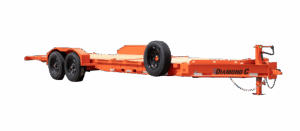
It is also important to compare equivalent trailers. A Diamond C LPX is a low-profile equipment trailer that loads with ramps, while the HDT is a hydraulically dampened tilt equipment trailer. Two trailers may both have 22-foot decks but carry different GVWRs, axle packages, suspension systems, fenders, ramps, and payload capacities. Comparing a used tilt trailer to the least expensive new ramp trailer is not a true cost comparison.
Current Diamond C LPX configurations extend from approximately 14,900 or 15,500 pounds GVWR, depending on the model-year configuration, through 24,000 pounds GVWR. Current LPX production uses Lippert axles as standard, with tandem 7,000-pound axles on the base configuration and heavier or triple-axle packages available. At the time of writing, advertised 2026 22-foot LPX examples in Spencer Trailers inventory range from approximately $11,250 for a 15.5K LPX207 with flip-knee ramps to approximately $17,700 for a 20K LPX210 with MAX Ramps. Those are different trailers, not simply two prices for the same trailer, and inventory pricing can change with options and availability. :contentReference[oaicite:0]{index=0}
The first owner often absorbs the largest retail-to-used adjustment, but that does not mean every two- or three-year-old trailer is automatically the value sweet spot. A lightly used three-year-old trailer with service records, a clean title, properly rated tires, functioning brakes, and no structural damage can be a strong buy. A trailer of the same age that spent every weekday carrying a skid steer near its rated capacity may be entering a period of brake, tire, suspension, bearing, deck, and ramp repairs.
After the initial adjustment from new to used, a well-maintained steel equipment trailer can become more price-stable. However, the curve is not guaranteed to be flat. A decline in new-trailer prices, a major redesign, corrosion, an outdated configuration, a branded title, or a new set of tires and brakes can change the used value by thousands of dollars.
The correct method is to compare the used asking price with the current out-the-door price of a genuinely comparable new trailer. Match the deck length, usable width, GVWR, payload, axle count and rating, suspension, tire size and load capacity, ramp or tilt system, fender package, spare tire, winch provisions, jack, tie-down system, and warranty. Do not compare the used price with an old MSRP, a base model advertised without equivalent options, or the price the first owner claims to have paid.
Repair Costs: The Variable Nobody Budgets
Here is a practical planning table for a tandem-axle equipment trailer. These are budgeting allowances, not Spencer Trailers repair quotes. The actual cost depends on the trailer’s axle rating, wheel and tire package, parts availability, damage, labor time, and whether the repair involves one wheel position or the complete axle system.
| Repair Item | Illustrative Planning Allowance | New Trailer, Years 0-2 | Used Trailer, Years 3-6 |
|---|---|---|---|
| Tire replacement, ST235/80R16 commercial trailer tire or equivalent | Approximately $225-$375 per tire installed; 17.5-inch commercial tires can cost more | Possible after a puncture, impact, alignment problem, overloading, or heavy mileage; normal tire wear is not automatically a trailer-warranty claim | Inspect the DOT date code, sidewalls, tread, load rating, inflation history, and spare; a complete matched set may be needed immediately |
| Wheel-bearing inspection, grease service, seals, or bearing replacement | Approximately $150-$350 per axle for routine service; damaged hubs, drums, spindles, or bearings can raise the bill substantially | Still required as scheduled maintenance; a warranty covers qualifying defects, not ordinary inspection and lubrication | Budget for immediate inspection when records are unavailable or grease contamination, heat, play, noise, or seal leakage is present |
| Electric brake inspection, adjustment, shoes, magnets, wiring, or drum service | Approximately $250-$600 per axle, depending on the parts replaced | Brake adjustment and inspection remain owner responsibilities; damage and normal wear may not be covered | Common catch-up work when the trailer has uneven braking, weak output, damaged wiring, worn shoes, scored drums, or an inoperative wheel |
| Breakaway switch, battery, charger, or related wiring | Approximately $75-$300 | Test before every trip even when the trailer is new | Replace weak batteries, damaged cables, corroded terminals, or nonfunctioning switches before towing |
| LED light, connector, junction box, or wiring repair | Approximately $75-$500, depending on whether the problem is one lamp or a damaged harness | Manufacturing defects may qualify for coverage; impact damage, corrosion, modifications, and rodent damage generally do not | Inspect every lamp, ground, plug terminal, junction, and section of exposed wiring |
| Ramp, spring-assist, latch, hinge, pin, or hydraulic-tilt service | Approximately $100-$750 for ordinary hardware or adjustment; bent ramps and hydraulic repairs can cost more | Operate and inspect the system before loading; do not assume a new component is maintenance-free | Check alignment, pivot wear, cracks, missing retainers, cylinder leakage, hoses, battery condition, and deck movement |
| Frame, tongue, crossmember, suspension-mount, or structural repair | Inspection and written quote required; proper structural repair can exceed $1,000 | A qualifying manufacturing defect may be covered, but overloading, impact damage, misuse, and unauthorized alterations can be excluded | Do not tow until cracks, distorted members, poor prior welds, or shifted suspension mounts are evaluated by a qualified trailer repair facility |
A prudent first-year contingency for a three- to six-year-old commercial equipment trailer with no reliable service history may be $1,000 to $2,500. That is not a prediction that every used trailer will need that amount. It is a reserve for the possibility of tires, brake work, bearing service, wiring repairs, a breakaway battery, deck repairs, and worn ramp hardware. A professionally inspected trailer with recent documented service may need far less.
A new trailer is not maintenance-free, and its first-year out-of-pocket cost should not automatically be entered as zero. Tire punctures, impact damage, routine lubrication, brake adjustment, lug-nut retorquing, cleaning, coating touch-up, and transportation to a repair facility can remain the owner’s responsibility. Diamond C’s current maintenance schedule calls for pre-trip checks, inspections at six months or 6,000 miles, annual service at 12 months or 12,000 miles, and initial lug-nut torque checks after the first 10, 25, and 50 miles. :contentReference[oaicite:1]{index=1}
The biggest used-trailer variable is unknown history. A trailer that transported compact equipment several days a week has a different wear profile from one that hauled a side-by-side a few weekends each year. Ask for invoices, tire dates, bearing-service records, brake work, axle repairs, deck replacement, and any insurance or collision history. When the seller cannot provide records, price the trailer as though it needs a full safety inspection and catch-up service before its first loaded trip.
Warranty: What It’s Actually Worth
Spencer Trailers sells Diamond C, Liberty, Legend, and H&H trailers, but the warranty is not identical across those brands or across every model year. Never assume that a used trailer has the same coverage advertised on a current new trailer. Warranty duration, transferability, start date, registration requirements, covered components, exclusions, claim authorization, and transportation costs must be checked against the written warranty for that VIN and model year.
Diamond C’s Warranty 2.0 coverage for 2026 and later models includes a six-year limited structural warranty and a two-year limited comprehensive warranty. The structural coverage applies to specified structural components, including the main frame, crossmembers, railings, and subframe components, when defects in materials or workmanship occur under normal use. The comprehensive coverage applies to trailer components for qualifying defects under normal operating conditions. Approval is required, and warranty service must be performed by an authorized dealer or an approved provider with prior written consent. :contentReference[oaicite:2]{index=2}
That coverage is valuable, but it is not the same as unlimited bumper-to-bumper protection. The current written terms exclude incidental and consequential damages such as downtime, lost income, inconvenience, and commercial losses. Transportation to and from the dealer or repair facility is also the owner’s responsibility. Overloading, accidents, negligence, misuse, improper application, and unauthorized modifications or repairs can void coverage.
Pre-2026 Diamond C trailers follow different terms. Diamond C states that pre-2026 models have three-year structural coverage from the trailer’s manufacture date, along with one-year comprehensive coverage against qualifying manufacturing defects. Added components are governed by their individual manufacturer warranties, which Diamond C identifies as nontransferable from the original purchaser. A used pre-2026 trailer may therefore have some structural coverage remaining while having no transferable component coverage. Verify the VIN and in-service information rather than relying on the seller’s statement. :contentReference[oaicite:3]{index=3}
Other brands also publish their own schedules. For example, H&H currently publishes a three-year limited trailer warranty along with separate tire, axle, suspension, and hydraulic-component provisions. Those provisions still contain limitations and do not turn normal maintenance or damage into warranty work. :contentReference[oaicite:4]{index=4}
It is misleading to assign every new-trailer warranty a fixed cash value such as $500 or $900. Its value depends on what fails, whether the failure is covered, how quickly parts and service are available, and what it costs to transport the trailer for an approved repair. A structural warranty may be extremely valuable if a covered defect occurs and worth nothing in cash if the trailer never experiences a covered problem. Treat it as risk protection, not as a rebate from the purchase price.
For a used trailer, ask the seller for the VIN before agreeing to buy. Spencer Trailers can help identify the model and configuration, but final warranty status must be confirmed under the applicable manufacturer’s terms. A remaining structural warranty should be viewed as a benefit only after its dates, ownership provisions, and claim requirements have been verified.
Financing Rates: The Silent Price Difference
New trailers can qualify for better rates, longer terms, or promotional financing, but that is not guaranteed. The actual APR depends on the lender, the buyer’s credit, down payment, loan amount, term, business or consumer classification, collateral age, and fees. A highly qualified buyer may obtain a competitive used-equipment rate, while another buyer may find that a smaller used purchase receives a high APR or a shorter allowable term.
Use the following only as a mathematical illustration, not as a financing quote:
- New 22-foot equipment trailer, $15,350 financed at 7.9% APR for 48 months with no down payment: approximately $374 per month and approximately $2,603 in total interest.
- Comparable used trailer, $10,500 financed at 12.5% APR for 48 months with no down payment: approximately $279 per month and approximately $2,896 in total interest.
The used payment is lower because the amount borrowed is $4,850 lower. However, the used borrower pays more total interest despite borrowing substantially less. That does not make the used trailer more expensive overall, but it shows why sticker price and monthly payment are incomplete comparisons.
Ask each lender for the amount financed, APR, finance charge, payment count, monthly payment, total of payments, prepayment terms, origination fees, required insurance, and whether taxes or service contracts are included in the loan. Compare the total cash paid during the ownership period, not merely the payment printed in the advertisement.
Indiana buyers must also account for sales or use tax. The sale of a trailer is generally subject to Indiana sales or use tax unless a statutory exemption applies, and a private-party purchase is not automatically tax-free. The title application should be completed within 45 days of purchase to avoid an administrative penalty. Add the actual title, registration, plate, county, financing, and insurance costs to both sides of the comparison. :contentReference[oaicite:5]{index=5}
Commercial buyers should not treat a tax deduction as an immediate reduction in the dealer’s price. Current federal rules provide permanent 100% additional first-year bonus depreciation for qualifying property acquired and placed in service after January 19, 2025. Certain qualifying used property can also be eligible, so this is not necessarily a new-trailer-only benefit. Eligibility, business-use requirements, basis, related-party rules, elections, and the interaction with Section 179 should be reviewed with a qualified tax professional. :contentReference[oaicite:6]{index=6}
The cleaner path is to compare a written out-the-door purchase figure and a written financing disclosure for each trailer. Monthly payment alone is a distraction when the term, APR, down payment, or amount financed is different.
Downtime: The Cost Nobody Puts on a Spreadsheet
If you run a landscaping operation, fencing crew, excavation company, rental business, or farm, a disabled trailer on Monday morning is not merely an inconvenience. It can mean a delayed job, paid employees waiting for equipment, an emergency rental, towing charges, missed delivery windows, and a customer who must be rescheduled.
Age alone does not prove that a used trailer will break down, and a new trailer can still have a problem. The practical difference is uncertainty. A used trailer with several years of commercial service and incomplete maintenance records normally presents more unknowns than a new trailer with unworn components, a documented configuration, and active warranty coverage.
Calculate downtime with your own numbers. For example, three employees with a fully burdened labor cost of $35 per hour who lose four productive hours create $420 in labor cost before adding towing, rental, delivery, fuel, or lost job margin. Add a $150 emergency rental or delivery charge, and one half-day interruption costs $570. A business with more employees or specialized machinery can lose much more.
Warranty coverage does not eliminate that loss. Diamond C’s current warranty specifically excludes downtime, lost income, commercial loss, and transportation costs. A covered repair can therefore protect you from the approved repair bill while still leaving your business responsible for the operational interruption. :contentReference[oaicite:7]{index=7}
A new trailer begins with new tires, new brake components, new bearings, new wiring, and unworn ramp or tilt hardware, but it still requires inspection and scheduled maintenance. Initial lug-nut retorquing, brake checks, breakaway-system testing, tire-pressure checks, and grease-point service should not be skipped simply because the trailer has just left the dealership.
A well-maintained used trailer can be just as dependable for the work you ask it to perform. The key is converting unknown condition into known condition before purchase. A professional inspection and preventive service are usually less expensive than discovering a failed bearing, weak brake circuit, dry breakaway battery, or deteriorated tire while the trailer is loaded.
Worked Cost Example: Head-to-Head Over Three Years
Here is a concrete comparison using illustrative numbers for a 22-foot commercial equipment trailer. The new price is based on the general price level of a current 18K-class LPX configuration, while the used price is hypothetical. The example assumes both purchase amounts are financed for 36 months, sales tax is paid separately, and the trailers are sold at the end of the third year.
The repair and resale figures are assumptions, not promises. Replace them with inspection findings, current lender disclosures, actual tax treatment, and comparable local resale data before making a purchase.
| Cost Category | New Trailer, Years 1-3 | Used Trailer, 3 Years Old at Purchase |
|---|---|---|
| Purchase price | $15,350 | $10,500 |
| Indiana sales or use tax, 7% assumed | $1,075 | $735 |
| Financing interest over 36 months | $1,941 at an illustrative 7.9% APR | $2,145 at an illustrative 12.5% APR |
| Initial inspection and catch-up service | $250 for routine inspection, lubrication, and adjustment | $1,600 for assumed tires, brake work, bearing service, and minor electrical repairs |
| Year 2-3 maintenance and repairs | $650 | $800 |
| Downtime or substitute-equipment allowance | $300 | $900 |
| Assumed resale value at end of year 3 | $10,500 | $7,500 |
| Illustrative net 3-year cost | $9,066 | $9,180 |
Under these assumptions, the new trailer costs approximately $114 less over three years even though its purchase price is $4,850 higher. That does not prove new always wins. It shows how interest, initial repairs, downtime, tax, and resale value can erase an apparent sticker-price advantage.
Change one assumption and the result can reverse. If the used trailer passes inspection and needs only $400 of initial service instead of $1,600, used wins by more than $1,000. If the used trailer needs a complete tire set, brake assemblies, deck work, and a structural repair, new wins by a much wider margin. If the buyer pays cash, the interest rows disappear. If the buyer keeps the trailer for ten years, the three-year resale assumptions become far less important.
Title, registration, county charges, insurance, optional service contracts, accessories, and dealer-specific charges are not included in this example. Add the actual figures to each column. When comparing a dealer trailer with a private-party trailer, use the complete out-the-door cost rather than assuming that the advertised price is the final amount due.
The honest takeaway is that used often wins when its condition is documented, its price reflects real wear, and the buyer can absorb maintenance without interrupting work. New often wins on predictability, warranty protection, configuration choice, financing, and lower near-term repair uncertainty. Neither result should be assumed before inspecting the used trailer and calculating the full ownership cost.
What to Actually Check Before Buying Used
- VIN, title, and data plate: confirm that the VIN on the title matches the frame and certification label. Check the listed manufacturer, model, GVWR, GAWR, tire information, and year. Do not buy on a handwritten bill of sale alone when a title is required, and check for liens or a branded title.
- Actual payload: subtract the trailer’s verified empty weight from GVWR. Added toolboxes, spare tires, winches, steel decking, hydraulic systems, and aftermarket equipment reduce available payload. Axle capacity alone does not determine legal payload.
- Frame, tongue, and crossmembers: inspect high-stress areas around the coupler or tongue, suspension hangers, crossmembers, fenders, rear transition, ramp hinges, tilt pivots, and tie-down points. Look for cracks, buckling, elongated holes, shifted components, fresh paint hiding repairs, and welds that differ from factory work.
- Axles and suspension: read the axle identification tags rather than accepting the seller’s description. Current Diamond C LPX and HDT trailers use Lippert axles as standard, but the exact configuration on a used trailer must be verified from its tags and VIN. Inspect springs, equalizers, hangers, wet bolts or bushings, U-bolts, and axle alignment.
- Brakes and breakaway system: connect the trailer to a compatible tow vehicle and verify braking at every wheel. Weak or uneven braking can come from adjustment, wiring, grounds, controller settings, magnets, shoes, drums, grease contamination, or damaged components. Test the breakaway switch and battery independently.
- Indiana brake compliance: a trailer or semitrailer with a gross weight of at least 3,000 pounds must have brakes adequate to control, stop, and hold it, controllable from the tow vehicle, with automatic application during an accidental breakaway. A used equipment trailer with disabled brakes is not road-ready simply because the tow vehicle can move it. :contentReference[oaicite:8]{index=8}
- Tires and wheels: inspect the DOT date codes, sidewalls, tread, load range, speed rating, inflation, valve stems, wheel damage, lug seats, and spare. Replace tires that are cracked, damaged, improperly rated, mismatched, or otherwise unserviceable even when tread remains.
- Wheel bearings and hubs: raise each wheel safely, check for play and noise, inspect for heat discoloration and grease leakage, and review service records. An easy-lube fitting does not prove that the bearings were correctly inspected or serviced.
- Coupler, safety chains, and jack: verify the correct ball size, coupler rating, positive latch engagement, mounting hardware, chain condition, hooks, breakaway cable routing, and jack operation. Excessive wear, poor lockup, bent hardware, or undersized components require correction before towing.
- Deck and fenders: check wood boards for rot, splitting, loose fasteners, chemical damage, and crushing at concentrated load points. Inspect drive-over or removable fenders for distortion and verify that the usable deck width fits the intended machine.
- Ramps: inspect ramp capacity, length, hinge pins, retainers, spring assist, latch alignment, traction surface, and storage position. Confirm that the ramps are suitable for the machine’s axle load and approach angle, not merely its total operating weight.
- Tilt system: on a tilt trailer, inspect pivots, dampening or hydraulic components, hoses, cylinders, battery, charger, controls, safety locks, and deck movement. Load and unload only according to the manufacturer’s procedure.
- Lighting and wiring: test running lights, brake lights, turn signals, clearance lamps, license-plate light, reverse lights when equipped, electric brakes, auxiliary power, and breakaway charging. Inspect the seven-way plug, junction box, grounds, and wiring where it passes through steel.
- Coating and corrosion: Diamond C’s DM Difference Maker coating is a multi-stage system, but chips and scratches still require prompt maintenance. Inspect seams, welds, deck edges, the underside, and areas exposed to road salt, fertilizer, or chemicals. Surface appearance can reveal how the trailer was stored and maintained. :contentReference[oaicite:9]{index=9}
- Evidence of overloading: bent axles, abnormal tire wear, flattened springs, cracked hangers, distorted crossmembers, damaged fenders, bowed decks, and repeated weld repairs can indicate loads or loading practices beyond the trailer’s design.
When New Makes More Sense
Buy new when you need a specific GVWR, payload, deck width, deck length, ramp arrangement, tilt configuration, fender package, winch setup, suspension, or tire package that is difficult to find used. A trailer that is too light for the intended machine is not a bargain, and a heavier trailer can reduce payload or push the tow combination into a different regulatory and licensing category.
For buyers who want a low-profile ramp trailer, the Diamond C LPX is available across heavy-duty GVWR configurations with Lippert axles and multiple ramp and fender options. For buyers who need a tilt trailer, the HDT provides a hydraulically dampened tilt configuration across approximately 15,500- to 24,000-pound GVWR models. Choosing between them should be based on the machine, loading angle, concentrated axle loads, tow vehicle, and daily workflow rather than price alone. :contentReference[oaicite:10]{index=10}
Buy new when your operation cannot tolerate uncertain service history or a week of catch-up repairs. Buy new when active warranty coverage, known specifications, and predictable maintenance matter more than the lowest initial cash price. Buy new when competitive financing narrows the total cost difference or when used asking prices remain too close to current retail.
A new equipment trailer from our current inventory is a known configuration from day one. You can verify its GVWR, empty weight, payload, axles, tires, suspension, ramps or tilt system, warranty, and options before signing rather than reconstructing those details from a used seller’s memory.
Do not select a trailer solely to avoid a CDL without checking the entire combination. For a Class A combination under federal and Indiana CDL rules, the relevant threshold is a GCWR of 26,001 pounds or more when the towed vehicle has a GVWR greater than 10,000 pounds. A trailer rated above 10,000 pounds does not by itself create that Class A threshold; the truck and trailer combination rating must also reach at least 26,001 pounds. Commercial-use rules, farm exemptions, actual weight, registration, medical-card requirements, and interstate operation may create additional considerations. :contentReference[oaicite:11]{index=11}
When Used Makes More Sense
Buy used when the seller has service records, the title and VIN are clean, the trailer passes a competent inspection, and the asking price leaves room for immediate maintenance. A trailer being three to five years old is not by itself a reason to buy it. Condition, usage, loading history, storage, repairs, and price matter more than a preferred age window.
Buy used when you are paying cash or have financing that does not erase the purchase-price advantage. Buy used when the tires, brakes, bearings, deck, suspension, wiring, breakaway system, ramps or tilt components have already been serviced and the work can be documented. Buy used when a particular deck length, full-width tilt arrangement, drive-over fender package, or other configuration is available at a meaningful discount from an equivalent new unit.
A private seller’s asking price should be below dealer retail unless the condition, recent service, included accessories, and configuration justify the difference. Dealer inventory may include inspection, title processing, financing access, trade handling, and post-sale support that are absent from a private transaction. Compare what is actually included rather than treating every listing price as equivalent.
Check our recently sold listings to calibrate what comparable trailers have been offered for in this market. Match the year, model, GVWR, length, axle package, ramps or tilt system, and options as closely as possible. If a private seller is asking close to current dealer retail for a trailer that needs tires, brake work, or bearing service, the discount may disappear before the first job.
Still unsure which direction makes sense for your situation? Call the Spencer Trailers team at (812) 829-0226. We can walk through current inventory, compare the correct specifications, explain available financing, and help determine whether a used trailer you are considering is priced appropriately. Sometimes the new trailer is much closer to the used one after repairs, financing, tax, downtime, and resale are included. Sometimes the inspected used trailer is a genuine value. The correct answer comes from the complete numbers, not the asking price alone.


