





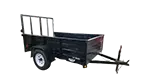

You back up to hitch your trailer and something looks wrong. The coupler is no longer centered with the tow vehicle, or the tongue has a visible bow, twist, crease, or kink between the coupler and the trailer frame. That deserves immediate attention. A bent tongue is not cosmetic damage like a dented fender. It can affect the load path between the trailer and tow vehicle, coupler alignment, tongue weight distribution, tracking, weld integrity, and the reliability of the entire hitch connection.
Do not tow a trailer with a visibly bent tongue until it has been inspected by the trailer manufacturer, an authorized dealer, or a qualified trailer-frame repair facility. The right response depends on the type and extent of the deformation, the original frame design, the trailer’s weight ratings, whether any welds or adjoining frame members were damaged, and whether the manufacturer authorizes a repair. In many cases, replacement of the damaged structural members is safer and more practical than attempting to straighten them.
How Trailer Tongues Bend in the First Place
Impact is one of the most common causes. Backing the coupler or tongue into a dock, post, tree, concrete barrier, loading-ramp edge, or other fixed object can introduce a concentrated load that the structure was not designed to absorb. Trailer tongues are engineered primarily to carry towing, braking, and vertical tongue loads through a specific load path. A sharp lateral, twisting, or compressive impact can deform the tongue even when the impact occurs at relatively low vehicle speed.
Jackknifing can cause similar damage. During a tight backing maneuver, the tow vehicle’s bumper, tailgate, receiver, or hitch hardware can contact the tongue. The resulting sideways force may bend a tongue member, distort the coupler mount, damage the tongue jack, or twist the front section of the trailer frame. A severe jackknife can also damage safety-chain mounts, wiring, breakaway components, hydraulic equipment, and the tow vehicle’s receiver.
Overloading and poor load placement can contribute to structural damage, but tongue weight cannot be judged from GVWR alone. For many conventional bumper-pull trailers, a commonly used starting range is approximately 10-15% of the trailer’s actual loaded weight on the hitch. The correct target can vary with the trailer design, cargo, tow vehicle, hitch system, and manufacturer instructions. Gooseneck trailers generally place a larger percentage of actual loaded weight on the truck than conventional bumper-pull trailers. In every case, the actual load must remain within the trailer GVWR, axle ratings, tire and wheel ratings, coupler rating, hitch rating, receiver rating, and the tow vehicle’s payload, rear-axle, and towing limits.
Excessive tongue or pin weight can overload the coupler, jack, tongue structure, hitch, receiver, truck suspension, or rear axle. Too little tongue weight can create instability and sway. Uneven loading can also twist the trailer frame rather than producing an obvious straight downward bend. If overload is suspected, weigh the loaded combination by axle group and measure tongue or pin weight with suitable equipment instead of relying on appearance or a percentage estimate.
Hitch mismatches are another serious problem. The ball size must match the size marked on the coupler, and every part of the connection must have an adequate rating. A smaller ball must never be used with a larger coupler, because the latch may appear closed without safely retaining the ball. A ball that is too large will not seat correctly. Excessive coupler adjustment, a worn ball, a damaged latch, incorrect hitch height, or loose mounting hardware can also create shock loading and abnormal movement. Any mismatched or damaged component should be corrected before the trailer is moved.
Corrosion, previous unapproved repairs, poor welds, missing fasteners, and fatigue can reduce the structure’s ability to handle normal loads. Hidden rust inside tubing or between overlapping components is especially important on an older trailer. A bend that appears to have happened suddenly may be the final result of deterioration that developed over years.
Doing Your Own Damage Assessment
Before arranging an inspection, park the unloaded trailer on a firm, flat, level surface. Chock the wheels, disconnect it from the tow vehicle if doing so is safe, and support it only at manufacturer-approved locations. Do not crawl beneath a trailer supported only by its tongue jack or a hydraulic jack. Use correctly rated stands on sound ground, and never place yourself beneath a visibly unstable structure.
A preliminary visual check can help document the damage, but it cannot establish that the trailer is safe to tow. Frame alignment is measured from known reference points, and a professional may need manufacturer dimensions, tram gauges, lasers, levels, straightedges, or other alignment equipment.
- Lateral bend or twist: Sight along the tongue and frame from the front and rear, then compare the coupler centerline with the trailer centerline. Look for asymmetric gaps, displaced storage boxes, a jack that no longer sits vertically, or one tongue leg that appears higher or farther forward than the other. There is no universal one-inch tolerance that applies to every trailer. Any new visible deviation warrants professional evaluation.
- Vertical bow: View both sides at tongue height and compare the lower and upper edges of corresponding members. A downward or upward curve may indicate deformation, but do not assume its cause from the direction alone. Impact, overload, poor support during loading, prior repair, or distortion elsewhere in the frame can produce similar symptoms.
- Kink, crease, or local buckling: A sharp change in shape, rippling flange, collapsed tube wall, stretched bolt hole, or buckled web shows that the member has undergone concentrated permanent deformation. This is more serious than a smooth alignment difference and commonly leads to replacement of the affected member or assembly.
- Weld inspection: Examine the tongue-to-frame connections, coupler mount, jack mount, crossmembers, safety-chain attachments, gussets, and nearby brackets. Look for visible cracks, gaps, torn base metal, shifted components, corrosion, or coating that has split or lifted along a joint. A crack in the coating is not automatically a cracked weld, but it is a reason to remove the trailer from service until the joint is evaluated.
- Coupler integrity: Check the housing, ball socket, latch, pivot points, mounting plate, bolts, welds, and adjustment mechanism. Do not use a wiggle test as the sole inspection. Some movement is design-dependent, while damage can exist without obvious looseness. The coupler’s identification and rating markings should remain legible.
- Safety equipment: Inspect the safety chains or cables, their frame attachments, breakaway switch and lanyard, electrical connector, wiring, battery box, tongue jack, hydraulic pump enclosure, and any front-mounted spare or toolbox. An impact can damage these parts even when the tongue remains generally aligned.
- Adjoining frame and running gear: Look beyond the visible bend. Measure diagonally between repeatable frame points if the manufacturer or repair facility supplies the correct procedure. Inspect spring hangers, equalizers, axle attachment points, tires, and wheels for signs that the frame or running gear shifted during the event.
Take clear photographs from both sides, above, below, directly in front, and directly behind. Photograph the VIN and certification label, the coupler rating, the damaged area, and the surrounding structure. Record what happened, whether the trailer was loaded, and any noises or handling changes. These details will help the dealer, manufacturer, insurer, or repair facility evaluate the next step.
When Straightening Is a Legitimate Option
Straightening should never mean attaching a chain to a tree, pulling against another vehicle, heating the steel with a torch, or forcing the tongue with an improvised jack. Those methods provide no control over alignment, material temperature, residual deformation, weld loading, or hidden damage. They can make a repair look straighter while leaving the structure weaker or transferring distortion into another part of the frame.
A controlled straightening procedure may be considered only when the trailer manufacturer or a qualified engineer and frame-repair professional determines that the original construction and damage are suitable for it. The decision cannot safely be based on a universal tube size, trailer GVWR, or visual estimate of how many inches the tongue moved.
A professional evaluation should establish all of the following before straightening is approved:
- The exact member material, section, wall thickness, frame design, and original geometry are known or can be verified.
- The deformation is limited and has not produced local buckling, tearing, severe wall collapse, elongated holes, or damage at a critical weld.
- The coupler, safety-chain mounts, jack mount, crossmembers, frame rails, and suspension attachment points remain serviceable or will be replaced as part of the documented repair.
- The facility has appropriate frame-alignment and hydraulic equipment, suitable fixtures, and a written procedure for restoring the manufacturer’s geometry without uncontrolled heating or loading.
- The proposed repair complies with the trailer manufacturer’s instructions and will not reduce any component rating.
- Any required nondestructive examination will be performed by qualified personnel using a method appropriate for the material, weld, coating, and suspected defect.
- The shop will document measurements before and after the work and will identify exactly which parts were straightened, replaced, or rewelded.
Liquid penetrant testing can reveal certain surface-breaking discontinuities on clean, nonporous material. Magnetic-particle testing can reveal surface and some near-surface discontinuities in suitable ferromagnetic steel. Neither method proves that an entire assembly is undamaged, and neither replaces dimensional inspection, engineering judgment, or the manufacturer’s repair requirements. Coatings and surface condition may need to be addressed before testing.
Warranty approval is a separate issue from technical repairability. Diamond C’s current published warranty provides a six-year limited structural warranty and a two-year limited comprehensive warranty, both measured from the original warranty start date and subject to their written terms. Accident, misuse, overloading, and unauthorized modifications or repairs are excluded, and warranty service by a provider other than an authorized dealer requires prior written consent from Diamond C. Contact Spencer Trailers before authorizing structural work on a Diamond C trailer.
When You Replace Instead of Repair
Replacement is generally the safer direction when permanent deformation is concentrated, the original section has buckled, or the damage has spread into multiple structural connections. The final decision should be made for the specific trailer, but the following conditions strongly favor replacement of the damaged member, complete tongue, or front frame assembly:
- A sharp kink, crease, tear, split seam, collapsed tube wall, buckled web, or distorted flange is present.
- A crack is visible in the base metal, weld, coupler mount, safety-chain attachment, gusset, or adjoining frame member.
- The coupler housing, ball socket, latch, mounting plate, or mounting holes have been distorted or damaged.
- The tongue has been heated, pulled, cut, drilled, plated, sleeved, or welded previously without a documented manufacturer-approved procedure.
- The front crossmember, main rails, A-frame connections, neck structure, suspension alignment, or multiple welds have moved.
- Corrosion or metal loss prevents the original section thickness and strength from being restored reliably.
- The trailer carries livestock, valuable equipment, or commercial loads for which downtime and failure consequences make an uncertain repair unacceptable.
- The manufacturer recommends replacement or cannot approve the proposed straightening procedure.
- A qualified repair facility cannot obtain reliable reference dimensions, replacement material, or access for proper inspection and welding.
Open structural channel is not automatically unsafe, and closed tubing is not automatically repairable. Properly engineered trailers use channel, tube, I-beam, formed sections, and fabricated engineered beams successfully. What matters is the original design, the direction and degree of deformation, the condition of the flanges, webs, walls, and welds, and whether the approved repair restores the intended load path.
Trailer weight rating is also not a universal repair cutoff. Damage on a 3,500-lb utility trailer can require replacement, while a manufacturer may publish a controlled repair for a particular heavier assembly. Higher-capacity trailers do, however, carry greater loads and often use integrated structural members that require manufacturer-specific procedures and specialized equipment.
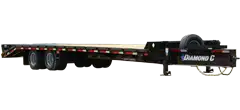
For example, current Diamond C LPX and HDT equipment trailers are offered in GVWR packages beginning around 15,500 pounds and extending into the 20,000-plus-pound range. Their tongue is integral with the frame, and current configurations can use heavy I-beam or engineered-beam construction depending on model, length, and GVWR package. On such a trailer, damage near the tongue cannot responsibly be treated as a generic piece of bent channel. The VIN-specific configuration and factory guidance should determine whether an approved section replacement, a larger front-frame replacement, or retirement of the trailer is appropriate.
The same principle applies to a gooseneck. A bent neck can affect the uprights, main beams, gussets, coupler tube, deck, and jack structure. Replacing only the most visibly bent piece may leave the remaining assembly misaligned. The manufacturer or an experienced heavy-trailer frame facility should evaluate the entire neck and forward frame before developing an estimate.
Why This Is Professional Work
Many routine trailer-maintenance jobs can be completed by a capable owner using the correct manual, tools, parts, and safety procedures. Servicing bearings, replacing approved lighting components, or replacing deck boards may fall into that category. Work involving a bent tongue or neck is different because it changes or restores a primary structural load path.
Structural steel has specified mechanical properties, but the grade cannot be identified reliably just by looking at it. For reference, ASTM A500 Grade B square and rectangular structural tubing has minimum specified tensile strength of 58,000 psi and minimum yield strength of 46,000 psi under the applicable standard. Those figures do not establish that every trailer tongue is A500 Grade B, nor do they provide a repair recipe. I-beams, formed channels, high-strength steel, fabricated engineered beams, cast coupler components, and other materials have different properties and requirements.
When a member remains bent after the load is removed, at least part of it has undergone plastic deformation. That does not by itself prove that it reached ultimate tensile strength or contains hidden cracks. It does mean that the original geometry and residual-stress condition have changed. Local buckling, thinning, tearing, work hardening, weld damage, and loss of section stability must be evaluated rather than assumed.
Welding presents additional concerns. The shop must select compatible replacement material, joint design, filler metal, preparation, welding process, sequence, and any required inspection. Adding reinforcement without engineering approval can create a stiff transition that concentrates stress at the end of the added plate. Welding over a crack, filling a gap without restoring alignment, or attaching a sleeve to thin or corroded metal can conceal rather than solve the problem.
The coupler and chains are also rated components. A structural repair must not reduce ground clearance, interfere with the jack, restrict the coupler latch, relocate safety-chain attachments improperly, damage wiring, or change tongue weight and hitch height beyond acceptable limits. After repair, the trailer must still comply with its certification label and must not be represented as having a higher capacity than the manufacturer assigned.
A qualified facility should provide a written estimate, identify the damaged components, document material and parts used, and state what inspections were performed. Documentation does not eliminate the owner’s responsibility, guarantee that every defect will be detected, or automatically resolve liability. It does provide useful evidence that the work was evaluated and completed through a defined professional process.
What Replacement Actually Costs (and What to Compare)
There is no dependable national flat-rate price for tongue replacement. Material, labor, alignment work, disassembly, refinishing, freight, coupler rating, wiring, hydraulic equipment, frame design, and regional shop rates can change the total substantially. Prices quoted online for raw tubing or a coupler do not represent the cost of returning a damaged trailer to verified service condition.
| Trailer Type / GVWR | Construction to Verify | What the Estimate Should Include |
|---|---|---|
| Light single-axle utility trailer | VIN-specific tongue section, wall thickness, coupler mount, welds, and safety-chain attachments | Alignment check, approved material, coupler and jack inspection, welding, wiring repair, coating, and final inspection |
| Tandem-axle utility or enclosed cargo trailer | A-frame design, frame-rail connections, front crossmember, body attachment, coupler rating, and axle alignment | Body or floor removal as needed, structural replacement, coupler hardware, electrical work, refinishing, and dimensional verification |
| Heavy equipment or car-hauler trailer | Integrated frame-and-tongue design, I-beam or engineered members, gussets, crossmembers, and rated hitch components | Manufacturer-approved procedure, fixtures and alignment labor, structural material, qualified welding, nondestructive examination when specified, coating, and load-path inspection |
| Heavy gooseneck trailer | Neck beams, uprights, gussets, main-frame connections, coupler tube, jacks, deck, wiring, and hydraulic components | Complete neck and frame measurement, factory guidance, removal and replacement of affected assemblies, transport or freight, inspection, and refinishing |
Damage isolated to a replaceable bolt-on coupler will cost far less than deformation extending into an integral tongue and both main rails. Conversely, a seemingly inexpensive tongue repair can grow after the floor, toolbox, hydraulic pump, wiring, spare mount, jack, or front body panels are removed and hidden damage becomes visible.
Ask for an itemized estimate showing parts, material specifications, labor hours, alignment work, welding, testing, coating, freight, and taxes. Confirm whether the estimate includes a new coupler, safety-chain assemblies, breakaway components, jack repair, wiring, and post-repair inspection. Ask whether the shop warrants its work and whether the manufacturer has approved the procedure in writing.
Compare the complete repair total with the trailer’s undamaged market value, remaining service life, condition of the axles and suspension, tire age, deck condition, corrosion, and expected downtime. Insurance may be involved if the bend resulted from a collision or other covered event, so document the trailer before disassembly and contact the insurer when appropriate.
A Quick Note on Couplers
If an impact was severe enough to bend the tongue, treat the coupler as a separate rated component requiring inspection. The housing, ball pocket, latch, pivot, spring, adjustment mechanism, mounting plate, fasteners, and welds can be damaged even when the latch still opens and closes. A coupler that appears locked during a stationary check may not retain the ball under braking, articulation, or road shock if the socket or latch geometry has changed.
Use only a replacement coupler of the correct type, mounting pattern, ball size, and rating, and ensure that its rated capacity is appropriate for the trailer’s certified GVWR and application. Current Diamond C LPX configurations, for example, may use rated flat-mount Demco EZ-Latch couplers, with the specific coupler capacity changing by GVWR package. The VIN-specific build and current manufacturer specifications should control the replacement choice.
Do not select a coupler solely because it physically fits the existing bolt holes or is advertised with a high gross trailer weight rating. The mounting structure, bolt grade and size, weld procedure, vertical load limits, latch clearance, and compatibility with the tongue design all matter. A replacement coupler cannot restore capacity to a bent, cracked, elongated, or weakened mounting area.
After installation, verify that the coupler fully seats on the correctly sized ball and that the latch closes and secures as designed. Check ball and coupler wear against the component manufacturer’s instructions. Connect safety chains independently to approved tow-vehicle attachment points, cross them when required by the trailer or hitch instructions, and provide enough length for turning without allowing them to drag. Attach the breakaway lanyard to a suitable point independent of the safety chains, following the manufacturer’s directions.
Before You Get Back on the Road
A test tow should happen only after the repair facility has completed and documented the repair, confirmed alignment, reassembled all safety equipment, and released the trailer for service. A cautious test drive is not a substitute for structural inspection, and an unapproved trip on public roads should not be used to determine whether a visibly damaged tongue is safe.
Before movement, verify the coupler is fully engaged and secured, the ball size and hitch height are correct, the safety chains and breakaway lanyard are connected properly, the tongue jack is fully raised, and the electrical plug is secure. Test the running lights, turn signals, brake lights, electric or electric-over-hydraulic brakes, and breakaway system according to the applicable manufacturer procedures. Confirm tire pressure, wheel condition, lug-nut torque, cargo securement, and all applicable weight ratings.
Begin with the trailer empty unless the repair facility or manufacturer specifies another inspection procedure. Use a controlled route and low speed before progressing to normal operation. Stop immediately if the trailer tracks abnormally, the hitch produces new movement or noise, the tow vehicle pulls to one side, braking changes, the coupler shifts, or the repaired area shows coating cracks, displacement, or other changes.
Have the repair rechecked at the interval specified by the manufacturer or repair facility. Do not rely on a universal mileage interval for every frame repair. Reinspection may include fastener torque, dimensional measurements, weld examination, coupler operation, and confirmation that the repair area has not moved during initial load cycles.
If the trailer may still qualify for manufacturer warranty coverage, contact the dealer before authorizing any third-party structural repair. Diamond C’s current published coverage is a six-year limited structural warranty and a two-year limited comprehensive warranty, subject to the written warranty’s exclusions and conditions. Accident damage, negligence, misuse, overloading, and unauthorized modifications or repairs are not covered, and work by another service provider requires Diamond C’s prior written consent when it is to be handled as authorized warranty service.
Want to talk through what you’re looking at? Bring the trailer by 291 West State Hwy 46 in Spencer after confirming that it can be transported safely, or check our contact page and send us the VIN, photographs, and a description of the damage before making the drive. If the trailer should not be towed, arrange an appropriate flatbed, rollback, or other professional transport method rather than pulling it on the damaged tongue.
If the repair estimate does not make financial or structural sense, compare it with our current inventory. A properly engineered replacement trailer may be the better investment when damage extends into the main frame, the manufacturer cannot approve the proposed repair, or the cost approaches the value of the existing trailer. The goal is not merely to make the tongue look straight again. It is to restore a documented, correctly rated, dependable connection between the trailer and tow vehicle.


