









Picture a controlled convoy of two or three Class 8 trucks traveling on a limited-access highway, with the following vehicles using low-latency vehicle-to-vehicle communication to coordinate acceleration and braking with the lead truck. In a partially automated platoon, drivers generally remain responsible for steering, supervising the system, and responding when conditions fall outside its capability. Controlled testing has documented fuel savings, especially for following trucks benefiting from reduced aerodynamic drag, but the results vary substantially with speed, spacing, vehicle configuration, traffic, wind, road grade, and cooling-system demands. Platooning is real technology, but it should not be confused with fully driverless trucking or treated as routine operation on every highway.
For owner-operators and small haulers, the subject can still feel distant. You are more likely to be checking whether your pickup has enough payload, rear-axle capacity, hitch rating, and gross combined weight rating for a loaded gooseneck than wondering whether it has Level 4 automation. Even so, the technology being developed for commercial trucking is already influencing pickup-truck driver assistance, trailer brake control, blind-zone monitoring, camera systems, tire-pressure monitoring, fleet tracking, and maintenance planning. Those changes affect anyone who owns one trailer, operates a small contracting fleet, or regularly pulls a Diamond C flatbed to a job site.
Where Commercial Autonomy Actually Stands
SAE International defines six levels of driving automation, from Level 0, or no driving automation, through Level 5, or full driving automation. The distinction that matters most is who is responsible for driving. At Levels 0, 1, and 2, the human driver is still driving and must continuously supervise the vehicle, even when features such as adaptive cruise control and lane-centering assistance are active. At Level 3, the automated driving system performs the complete driving task under limited conditions but expects a human fallback when requested. At Level 4, the system can perform the complete driving task and manage fallback within a defined operational design domain. Level 5 is intended to operate under all roadway and environmental conditions in which a human driver could reasonably drive.
The commercial-truck market now extends beyond closed-course demonstrations, but deployment remains highly constrained. Aurora began carrying customer freight without a driver between Dallas and Houston in May 2025 and reported in July 2026 that its commercial network had expanded to 10 driverless routes in the Sun Belt. Kodiak has operated driverless industrial trucks in West Texas while continuing supervised long-haul freight operations and working toward a separate driverless long-haul launch. These systems rely on tightly defined operational design domains that may specify approved roads, mapped terminals, weather limits, construction handling, minimum visibility, maintenance procedures, remote-support protocols, and incident-response plans. A truck that can operate driverlessly on one approved interstate corridor is not automatically capable of handling every rural road, snowy job site, residential delivery, farm entrance, or construction zone.
The realistic near-term picture for most haulers is incremental rather than revolutionary. Pickups and highway tractors will continue gaining better collision warnings, adaptive cruise control, lane-support features, camera views, trailer profiles, brake diagnostics, and connected maintenance tools. Large carriers will be the first to justify expensive automated systems on repetitive, high-volume lanes between compatible terminals. Driverless operation will grow on selected routes, but Level 5 operation across unrestricted public roads remains a long-range objective rather than a feature buyers should expect on an ordinary work truck in the next model year.
ADAS Features That Are Already Trailer-Aware
Advanced Driver Assistance Systems, or ADAS, are the foundation on which more capable automated-driving systems are built. Several current pickup-truck features already recognize that the vehicle is towing, although availability, trailer compatibility, and operating limits vary by manufacturer, trim, hitch type, trailer dimensions, and model year. None of these systems increases the truck’s published payload, gross vehicle weight rating, gross combined weight rating, rear gross axle weight rating, hitch rating, or legal towing capacity.
Trailer Sway Control is widely available on late-model pickups. The truck’s stability-control system monitors information such as yaw rate, steering input, wheel speed, and lateral acceleration to identify oscillation that may indicate trailer sway. Depending on the vehicle, the system may reduce engine torque and apply braking at selected truck wheels to help stabilize the combination. It cannot overcome an overloaded trailer, excessive speed, incorrect tire pressure, poor weight distribution, inadequate tongue or pin weight, worn suspension components, or unsafe steering input. If sway begins, the driver should follow the truck and trailer manufacturers’ instructions rather than accelerating or making abrupt steering corrections.
Ford’s available Pro Trailer Backup Assist allows the driver to use a control knob to indicate the desired trailer direction while the truck manages steering during low-speed reversing. It is offered on selected F-150 and Super Duty configurations, but setup procedures and compatible trailer types differ by vehicle and system generation. Ram’s available Trailer Reverse Steering Control uses a similar driver-selected trailer-direction concept while controlling the truck’s steering wheel. These systems still require the driver to control speed, watch the trailer and surrounding area, obey system warnings, and stop before a collision or jackknife develops. Trailer profiles, measurements, camera calibration, electrical connections, stickers, or other setup steps may be required depending on the specific truck.
Integrated trailer brake controllers are another practical advancement, but their capabilities are often overstated. A properly configured factory controller can use brake-pedal input and vehicle data to provide proportional electrical output to compatible trailer brakes. The driver must still select the correct trailer profile, set and test brake gain, confirm that every required trailer brake is functioning, and adjust the system for the load and road conditions. An integrated controller does not automatically give a conventional electric-brake trailer individual-wheel antilock braking. It also cannot compensate for contaminated linings, damaged wiring, incorrect adjustment, weak magnets, hydraulic problems, overloaded axles, or tires with insufficient traction.
Blind-spot monitoring extended to trailer length is increasingly available from Ford, Ram, Chevrolet, and GMC. Depending on the system, the truck may use manually entered dimensions, a stored trailer profile, or automatic detection to extend the monitored side zone behind the pickup. Ford, for example, publishes specific dimensional and trailer-type limits for BLIS with Trailer Coverage, while General Motors offers Trailer Side Blind Zone Alert on selected vehicles. Compatibility with conventional trailers, fifth-wheels, and goosenecks is not identical across brands. These systems can also be affected by weather, dirty sensors, unusual trailer shapes, accessories, sharp turns, and vehicles approaching outside the monitored zone.
None of these features makes the truck autonomous. They are driver-assistance tools, and their warnings or steering inputs may be delayed, limited, or unavailable in some conditions. Used within their published limits, however, they can reduce workload and provide valuable information to drivers who tow regularly.
Platooning: Real Numbers, Real Limitations
Truck platooning uses cooperative adaptive cruise control and vehicle-to-vehicle communication to coordinate the longitudinal movement of two or more trucks. Information about braking, acceleration, and system status can be shared faster than a following driver could perceive and react to the lead truck’s brake lights. In the Level 1 platooning systems most often studied in the United States, each driver remains responsible for steering and active supervision while the system controls speed and following distance. More advanced concepts may automate additional functions, but platooning by itself does not mean the following trucks are unoccupied.
Fuel-economy claims require context. Department of Energy-backed testing of close-following truck combinations has produced combined, or team, fuel savings in the low-to-mid single digits in some configurations, with the following truck commonly receiving a larger aerodynamic benefit than the leader. Other tests and simulations have reported higher follower savings under favorable conditions. Real-world results can be reduced by hills, traffic cut-ins, crosswinds, mismatched trailers, changing speeds, engine-fan operation, cooling requirements, and the fuel needed to form or dissolve the platoon. A fixed 20- or 30-foot gap should never be presented as a universal operating target. At 65 mph, 30 feet represents only about three-tenths of a second, so safe deployment depends on the approved system, vehicle configuration, road, regulation, and operating plan rather than a simple distance number.
For owner-operators, platooning remains primarily a fleet and logistics application. A workable operation needs compatible trucks, coordinated dispatch, common routes, enough freight density to pair vehicles, dependable communications, clear responsibility between carriers, and authorization under applicable following-distance laws. State treatment of platooning and automated commercial vehicles is not completely uniform, and the federal regulatory framework is still developing. The more immediate benefit for independent haulers is the supporting technology: connected routing, predictive maintenance, electronic inspections, traffic-aware cruise control, trailer identification, and better data about how the truck and trailer are performing.
Telematics: The Part That Affects You Now
If autonomous vehicles are the long game, telematics is the technology small operators can use today. Trailer telematics can range from a battery-powered location tracker to a fully integrated commercial system connected to trailer power, tire sensors, door switches, cargo sensors, refrigeration controls, and an antilock-brake system. Depending on the installed hardware, a system may report GPS location, geofence events, unauthorized movement, cargo-door status, reefer temperature, tire pressure and temperature, battery voltage, mileage, brake-system faults, or estimated load information. Those capabilities are not automatic on every tracker, and sophisticated axle-load or brake data requires compatible sensors rather than a basic cellular GPS unit.
Tire-pressure monitoring deserves particular attention because a heavily loaded trailer tire depends on correct cold inflation pressure to carry its rated load. A tire intended to operate near 100 psi that has fallen to 75 psi is 25 percent underinflated, which can increase flexing and heat while reducing the tire’s load-carrying margin. The correct pressure should come from the trailer certification information, tire load-and-inflation data, and manufacturer instructions, not simply the maximum pressure molded on a tire’s sidewall. Aftermarket systems from companies such as PressurePro and Doran can monitor trailer tire pressure and temperature through an in-cab display, mobile device, or compatible fleet platform. Buyers should verify sensor pressure range, valve-stem compatibility, repeater requirements, battery serviceability, number of supported tires, and whether the system is suitable for frequent trailer changes.
A TPMS warning is an early alert, not a substitute for inspecting tires with an accurate gauge before a trip. The driver still needs to check tread, sidewalls, valve stems, wheel condition, lug nuts, tire age, load rating, and cold pressure. Likewise, a GPS tracker on a Wells Cargo, United, Darkhorse Cargo, or other enclosed trailer can help confirm location and send movement or geofence alerts, but it cannot guarantee recovery after theft. Some insurers may consider tracking or fleet-safety equipment when underwriting a policy, but discounts are carrier-specific and should be confirmed before a purchase is justified on insurance savings alone.
What Owner-Operators Should Actually Watch
Long-haul carriers continue to report difficulty recruiting and retaining qualified drivers for certain operations. The American Trucking Associations publishes shortage estimates focused heavily on qualified long-haul drivers, while Bureau of Labor Statistics projections also show continued employment and a large number of annual openings caused by growth, retirement, and workers leaving the occupation. Those measures describe different parts of the labor market. The issue is not simply that the country has no licensed drivers; it also involves turnover, working conditions, time away from home, compensation, location, experience, safety qualifications, and whether available drivers match a carrier’s routes and equipment.
Automation is partly intended to increase capacity on predictable long-distance lanes, but many hauling jobs involve tasks that are difficult to automate as one complete operation. Farm entrances, muddy construction sites, auction lots, residential deliveries, equipment securement, loading irregular machinery, checking tie-downs, handling paperwork, inspecting a trailer, and speaking with the customer all require judgment outside ordinary highway driving. Highway automation may eventually move the load between transfer terminals while people handle the first mile, last mile, loading, inspection, maintenance, and customer-facing work.
The transition will not happen overnight, and it will not occur evenly. A national carrier moving standard freight between two distribution centers has a different business case from a contractor towing a Diamond C equipment trailer to changing job sites, a collector pulling an enclosed trailer to car shows, or a landscaper delivering machines to residential properties. Those local and variable operations are likely to remain human-intensive longer, although the trucks used for them will continue adding assistance and monitoring features.
Here is what an owner-operator should watch and evaluate:
- Truck specs when you buy. Prioritize useful features such as a factory trailer brake controller, trailer sway control, hitch and bed cameras, compatible trailer blind-zone coverage, and a well-designed trailering app. Verify whether those features work with your conventional trailer, gooseneck, or fifth-wheel before assuming they do. More importantly, compare the truck’s payload, rear axle rating, tire ratings, GCWR, receiver or gooseneck rating, and maximum tongue or pin weight with the trailer’s loaded configuration.
- Telematics on your trailer. A basic GPS tracker, movement alert, and properly selected TPMS can be sensible protection for a trailer carrying expensive equipment. Choose hardware based on the trailer’s pressure range, number of axles, storage conditions, cellular coverage, charging arrangement, subscription cost, and who will actually respond to an alert. Data is valuable only when someone reviews it and takes action.
- CDL, brake, registration, HOS, and ELD rules. A trailer with a GVWR above 10,000 lb does not, by itself, create a federal Class A CDL requirement. The Class A threshold generally involves a vehicle combination with a GCWR or actual gross combination weight of at least 26,001 lb and a towed unit with a GVWR or actual gross weight above 10,000 lb, subject to applicable definitions and exemptions. In Indiana, trailers over 3,000 lb GVWR require brakes, and the state’s penalty-free title and registration window is 45 days. ELD rules are separate from CDL rules: they generally apply when a driver subject to federal hours-of-service regulations must maintain records of duty status, with specific exceptions. Operators should verify whether a trip is commercial, interstate or intrastate and which exemptions apply rather than relying on the trailer’s size alone.
- Fleet customer expectations. Larger shippers may eventually require location visibility, electronic inspection records, cargo-temperature reporting, maintenance documentation, or approved data-sharing systems from contract carriers. Before agreeing, understand who owns the data, how long it is retained, what happens when cellular service fails, whether the customer can see off-duty movement, and who is responsible for maintaining the sensors.
A Quick Look at the Sensor Stack
| Sensor Type | Primary Use in Trucking | Trailer Relevance |
|---|---|---|
| Radar | Adaptive cruise control, forward-collision warning, side-object detection | May support trailer-length blind-zone functions on compatible trucks; trailer sway is normally identified through vehicle-dynamics sensors rather than radar alone |
| Cameras | Lane detection, object recognition, mirrors, reversing and hitch alignment | Can provide hitch views, bed views, trailer-side views, backup guidance or an accessory rear-trailer view when the truck and trailer are compatible |
| Lidar | Detailed three-dimensional perception for some automated-driving systems | Usually mounted on the tractor as part of the automated-driving sensor suite; it does not change the trailer’s ratings or replace trailer-position and articulation monitoring |
| TPMS | Tire-pressure and temperature alerts | Can be added to many trailers with compatible sensors, displays and repeaters, but still requires manual tire inspection and correct cold-pressure setup |
| GPS/Cellular | Power-unit or asset location, dispatch data, geofencing and theft alerts | Useful for independent trailer tracking; an ELD is a separate engine-synchronized driver-hours device and is not created by installing a trailer GPS tracker |
The Trailers You’re Pulling Still Matter
No sensor system changes the physical limits of the combination. A Diamond C FMAX210 operating at its 25,000 lb GVWR still has to remain within its certified GVWR, axle ratings, tire capacities, coupler rating, safety-chain ratings, brake capacity, and the towing limits of the truck. GVWR is the maximum permissible loaded trailer weight, not the trailer’s payload. Payload must be determined by subtracting the trailer’s actual empty weight, including installed options and carried equipment, from its GVWR. A wide or oversize load may also require permits, route planning, signs, lighting, or escorts even when the weight is legal.
An enclosed trailer rated at 7,000 lb GVWR can still handle poorly if dense equipment is stacked against the nose, too much weight is placed on one side, or the cargo is able to move. Excessive tongue weight can overload the pickup’s rear axle, tires, suspension, hitch, and payload capacity even when the trailer itself remains below 7,000 lb. Too little tongue weight can increase sway. ADAS and automated-driving systems operate within the behavior of the combination they are given; they cannot correct a fundamentally unsafe load plan, loose cargo, mismatched tires, inadequate brakes, or a tow vehicle that is already over a published rating.
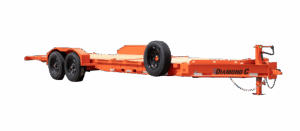
At Spencer Trailers, we sell working trailers from Diamond C, H&H, Legend, Wells Cargo, Darkhorse Cargo, Liberty, Delco, United and other established manufacturers, along with Polar King Mobile refrigeration trailers and Zimmerman truck bodies. Diamond C has built trailers in Mt. Pleasant, Texas, since 1985. Its premium FMAX, HDT, LPT, LPX, WDT, and DEC lines use Lippert axles as standard and receive the DM Difference Maker multi-stage coating process. When pairing one of these trailers with a newer truck, the discussion should cover GVWR, actual payload, axle configuration, brake type, tongue or pin weight, hitch rating, truck payload, rear axle capacity, GCWR, electrical connections, camera compatibility, and the limitations of the truck’s trailer-aware driver-assistance systems.
Check out our current inventory or give us a call at (812) 829-0226 and we’ll help you compare the trailer’s certified ratings with the capabilities of your tow vehicle. The goal is not merely to find a trailer the truck can move. It is to build a combination that can carry the intended payload legally, stop safely, remain stable, and use the truck’s available trailering technology as it was designed.
The trucks are getting smarter. Are you buying the right trailer to work with them?


