








How the Right Trailer Helps a Landscaping Business Grow
Imagine this: a two-person landscaping crew is running one truck, one 5×8 utility trailer, and a packed spring schedule. Every hauling job means extra trips. Brush and tear-out debris sit on the property while the truck runs to the disposal site. Mulch, soil, and stone deliveries take longer than they should because the trailer reaches its legal payload before the crew finishes loading. The work is there. The capacity is not.
This is a situation many growing landscaping operations face, and it is usually fixable. The right trailer does more than move material from one address to another. It changes how many jobs the crew can schedule, how much nonbillable driving is built into each estimate, how safely equipment can be moved, and how much revenue the business can produce from the same truck and the same workday.
Here is how a crew in that position can work through trailer selection, what the haul-per-trip numbers really mean, and how the right equipment can open the door to larger jobs and new services without creating a compliance or towing problem.
Start With What the Work Actually Demands
Landscaping covers a wide range of loads: mulch and compost, topsoil, gravel, river rock, sod, brush, demolition debris, palletized retaining-wall block, commercial mowers, compact tractors, skid steers, and mini excavators. Those materials do not load or weigh the same. A cubic yard of relatively dry hardwood mulch may weigh roughly 500-800 pounds, while wet mulch can be heavier. Topsoil is often around 1,800-2,400 pounds per cubic yard, and gravel or river rock can be approximately 2,400-3,000 pounds per cubic yard depending on stone size, moisture, and compaction. A trailer that has enough physical room for a load may still be overweight long before the body looks full.
That is why trailer selection has to start with the heaviest normal load, not the lightest or most convenient example. Check the trailer’s GVWR, empty weight, payload, gross axle weight ratings, tire capacities, coupler rating, and recommended tongue weight. Payload is not the number printed on the axle tag. It is the trailer’s GVWR minus the trailer’s actual empty weight, including installed options, while every axle, tire, hitch, and tow-vehicle limit must also remain within rating.
For a crew that regularly handles bulk material and debris, an approximately 7×14 dump trailer is a common commercial upgrade, but the correct size still depends on the tow vehicle, disposal access, material density, and job mix. A mowing-focused crew may get more value from an open utility trailer, while a landscape-construction crew that moves soil and tear-out material every week will usually benefit more from a dump trailer.
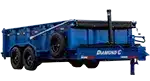
A current Diamond C LPT heavy-duty low-profile telescopic dump in the 82-inch-by-14-foot size is a strong example. The LPT line is available in 12-, 14-, and 16-foot lengths with GVWR packages from 15,500 to 24,000 pounds. Standard running gear uses two 7,000-pound Lippert axles, with higher-capacity axle packages available. The dump system uses a three-stage telescopic cylinder and reaches a 45-degree dump angle. Current LPT equipment also includes a heavy-duty three-way rear gate, a front-mounted hydraulic system, and commercial-grade tires, with the exact tire, brake, tarp, jack, side, and body configuration determined by the build.
That specification is materially different from a basic 14,000-pound dump with a scissor hoist. The LPT’s low-profile body makes hand loading and wheelbarrow work easier, while the telescopic cylinder provides strong front-of-body lifting leverage. Still, the operator must calculate the actual load. Two cubic yards of stone at 2,700 pounds per yard is already about 5,400 pounds before moisture, debris, tools, or uneven loading are considered. The correct practice is to know the trailer’s listed empty weight, confirm scale weight when practical, and keep both trailer GVWR and axle ratings within limits.
The Haul-Per-Trip Math
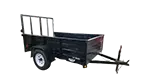
Consider an illustrative debris-removal job from a landscape renovation. Assume the crew removes three cubic yards of mixed material with an actual scale weight of about 4,000 pounds. That could include brush, old mulch, wet soil, edging, and small hardscape tear-out. Many light-duty 5×8 utility trailers have an actual payload around 1,000-1,500 pounds, depending on the VIN label and construction, so the crew may need three or four disposal runs. If the disposal site adds 25 minutes of round-trip travel and unloading per run, the crew can lose 75-100 minutes to repeated hauling before counting the extra loading, strapping, gate handling, and paperwork.
With an 82-inch-by-14-foot LPT configured at 15,500 pounds GVWR, that same mixed load may fit within one legal trip when its actual weight, tongue weight, axle loading, and body volume are all within rating. If the load is unusually wet, dense, or concentrated behind the axles, it may still need to be divided. A larger trailer does not make weight disappear, but it gives the operator enough rated capacity and body volume to avoid unnecessary repeat trips on many ordinary debris and mulch jobs.
The time benefit is easy to underestimate. Saving one hour on five haul-heavy jobs in a week returns five crew-hours. For a two-person crew, that can represent ten labor-hours that are no longer spent riding to the dump. Those hours can become another small job, more careful finish work, equipment maintenance, estimates, or simply a workday that ends when it was supposed to end.
It also changes estimating. When the crew knows the trailer’s legal payload, body volume, disposal fee, drive time, and expected number of loads, debris removal can be quoted as a real line item instead of a guess. The estimate should separate hauling revenue from landfill or transfer-station charges and should include labor, mileage, loading time, tarp or securement time, unloading, and the risk of dense material requiring an additional trip.
Equipment Transport: The Second Trailer Problem
Once a crew grows beyond basic mowing and cleanup work, heavier equipment usually follows. Compact tractors, mini excavators, skid steers, and compact track loaders make grading, drainage, pond work, retaining walls, and hardscape preparation possible. Machine weights vary widely: small mini excavators may be under 5,000 pounds, while larger compact excavators, skid steers, and track loaders can run from roughly 7,000 pounds to well above 10,000 pounds. Buckets, augers, breakers, forks, fuel, tracks, and other attachments add weight and also change how the load balances on the trailer.
Moving that equipment safely requires a trailer selected around the machine’s actual operating weight and dimensions, not a brochure’s bare-machine number. The deck must be long and wide enough, the ramps or tilt system must match the machine’s ground clearance and track width, the trailer must have properly rated tie-down points, and the axle placement must allow safe tongue weight without overloading the truck’s rear axle or receiver.
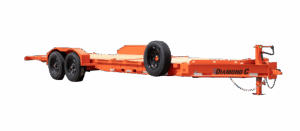
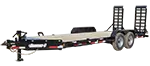
For many landscaping businesses, a Diamond C LPX low-profile equipment trailer or Diamond C HDT hydraulically dampened tilt trailer is a better equipment-hauling match than a dump body. Both lines are available from 15,500 to 24,000 pounds GVWR and use Lippert axles as standard equipment. The LPX is offered in multiple deck lengths from 16 to 30 feet and can be configured with loading systems such as MAX Ramps or the X-Ramp where available. The HDT uses a hydraulically dampened full-bed tilt design, which can reduce the need to handle separate ramps and can make repeated loading faster for machines that work well with the tilt angle.
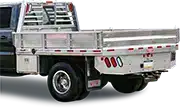
When the operation moves multiple machines, palletized material, or heavier equipment over longer distances, a Diamond C FMAX flatbed may make sense. FMAX is Diamond C’s Flatbed Max gooseneck line, with model-specific GVWRs ranging from approximately 15,500 pounds to 40,000 pounds. Depending on the model and build, FMAX trailers offer long deck choices, engineered-beam frames, gooseneck stability, and loading configurations that can include MAX Ramps or a hydraulic dovetail. The exact FMAX model must be matched to the truck, hitch, CDL status, machine weight, axle loading, and intended route; buying the highest GVWR available is not automatically the right answer.
Some crews load a compact machine into the dump trailer used for debris. That can be workable only when the trailer is specifically equipped and rated for the task, including suitable ramps, rear stabilizers, floor capacity, clearances, and securement points. A dump body has different loading geometry, a different floor and gate arrangement, and a higher center of gravity than a dedicated low-profile equipment trailer. For frequent machine transport, a dedicated LPX, HDT, or other properly rated equipment trailer usually pays back through faster loading, better securement access, less damage to the dump body, and fewer risky ramp setups.
Trailer Selection at a Glance
| Use Case | Recommended Trailer | GVWR / Capacity |
|---|---|---|
| Debris, mulch, soil hauling | Diamond C LPT 82-inch x 14-foot telescopic dump | 15,500 lb standard GVWR; higher packages available up to 24,000 lb. Actual payload equals GVWR minus the trailer’s actual empty weight. |
| Tools, mowers, and lighter equipment | Diamond C GTU 83-inch tandem-axle utility trailer | 7,000 lb GVWR with two 3,500 lb Lippert brake axles and a 4-inch channel frame; available in 14-20 ft lengths. |
| Skid steer, compact track loader, or mini excavator transport | Diamond C LPX equipment trailer or HDT dampened tilt trailer | 15,500-24,000 lb GVWR, with length and axle package selected for the machine, attachments, and tow vehicle. |
| Stone, gravel, pallets, and high-volume bulk loads | Diamond C LPT high-GVWR configuration or DOD deck-over dump | LPT: 15,500-24,000 lb GVWR. DOD: 15,500-23,000 lb GVWR with a 96-inch-wide dump body. |
What Does the Investment Actually Look Like?
Trailer pricing has moved well beyond the old assumption that every 7×14 dump falls into the same $8,000-$12,000 range. Current manufacturer base pricing for the Diamond C LPT starts in the mid-$14,000s, and a 14-foot unit can cost more after the selected GVWR package, body thickness, tarp, hydraulic jack, battery and charging equipment, spare tire, wheels, freight, dealer preparation, tax, title, and registration are included. A lighter-duty 7×14 dump from another manufacturer may cost less, but it should not be compared to an LPT solely by body dimensions.
The useful comparison is the out-the-door cost against actual capability: legal payload, hoist design, axle and brake equipment, tire capacity, gate design, tarp system, frame construction, coating, warranty, and dealer support. Diamond C’s premium steel trailers use the DM Difference Maker multi-stage coating system, which is intended to protect the steel and provide a durable finish, but even a high-quality coating still needs prompt repair when jobsite impacts expose bare metal.
Now run the return-on-investment math honestly. If added capacity lets the crew sell two debris-removal add-ons per week at $150 each, that produces $300 per week, or $4,500 over a 15-week peak period. That is meaningful revenue, but it does not make a premium dump trailer free in one season. Over two identical 15-week seasons, the gross added revenue would be $9,000 before disposal charges, fuel, maintenance, financing cost, insurance, and labor. Payback may take several seasons at that utilization, or it may happen faster when the trailer supports higher-priced tear-outs, material delivery, grading, storm cleanup, or an additional completed job each week.
Time savings should be counted separately from new sales. Fewer repeat runs can reduce unproductive mileage, but a larger trailer also requires a capable truck and will consume more fuel when heavily loaded. The real gain comes from eliminating avoidable trips while completing more work per mobilization, not from assuming that a heavy trailer is automatically cheaper to tow.
For qualifying business purchases, federal tax treatment may improve the economics. Current law provides permanent 100% bonus depreciation for eligible property acquired and placed in service after January 19, 2025, and Section 179 may also be available when the business and asset meet the rules. A deduction is not a dollar-for-dollar rebate, and basis, business-use percentage, financing, entity structure, and state treatment matter. The buyer should have a tax professional confirm eligibility before building a purchase decision around a projected write-off.
A Few Things Crews Often Overlook
- Tow vehicle ratings matter as much as the trailer. Do not select a truck by the badge on the fender. Check the specific truck’s GCWR, maximum trailer rating, payload label, rear gross axle weight rating, tire ratings, receiver or gooseneck rating, and allowable tongue or pin weight. A dump trailer loaded near 15,500 pounds can place substantial weight on the truck, and some three-quarter-ton configurations will run out of payload or rear-axle capacity before they reach the advertised tow rating.
- Brakes and the breakaway system must be operational. Indiana Code 9-19-3-3 requires a trailer or semitrailer with a gross weight of at least 3,000 pounds, when operated on a highway, to have brakes adequate to control, stop, and hold it. The driver must be able to apply those brakes from the cab, and the brakes must apply automatically if the trailer breaks away. A properly adjusted in-cab brake controller, charged breakaway battery, good wiring, and functioning brakes on the trailer are essential parts of the pre-trip inspection.
- A heavy trailer does not automatically require a CDL, but the combination may. For a commercial combination, the Class A threshold is generally reached when the combination has a GCWR of 26,001 pounds or more and the towed unit has a GVWR over 10,000 pounds. The 26,001-pound figure applies to the combination, not to the trailer by itself. Ratings, actual use, exemptions, interstate operation, and other commercial-vehicle rules can affect the answer, so a growing landscaping company should review its exact truck-and-trailer combination before dispatching it.
- Load placement is part of capacity. Staying below GVWR does not make a poorly balanced load safe. Dense soil or stone piled behind the axles can reduce tongue weight and promote sway, while too much weight forward can overload the hitch, receiver, rear axle, or truck tires. Load evenly, maintain the manufacturer’s recommended tongue-weight range, secure equipment at approved points, and verify axle weights when loads are near the ratings.
- Spare tires and support equipment save jobs. A matching spare, safe jack, correctly sized lug wrench, wheel chocks, reflective warning devices, charged hydraulic battery, tarp, and suitable chains or straps should be part of the working setup. A spare tire is useful only if the crew can safely lift the loaded trailer and remove the wheel at the roadside.
- Steel and aluminum solve different problems. Steel trailers are often more economical for heavy commercial work and are widely repairable, while aluminum can reduce empty weight and resist red rust. The better choice depends on design, payload, duty cycle, corrosion exposure, repair access, and purchase price. For a steel dump or equipment trailer, washing off salt and fertilizer, clearing trapped debris, and touching up damaged coating are more important than the material debate alone.
- Indiana paperwork has a deadline. Indiana residents generally must register a newly acquired, previously unregistered vehicle or trailer within 45 days of purchase or acquisition. Title, plate, insurance, and commercial-registration requirements should be handled before the trailer becomes a daily jobsite asset.
Scaling Past the First Upgrade
Here is what often happens after a crew fixes its hauling bottleneck: the bottleneck moves. The dump trailer handles debris efficiently, but the mower crew needs its own utility trailer. The business adds drainage and grading work, so the skid steer and attachments need a dedicated equipment trailer. A second truck becomes productive only when it has the trailer, tools, and legal capacity to operate without waiting on the first crew.
That is a good problem to have, but it is also why the first purchase should be sized around a realistic three- to five-year plan. The next step might be a 7,000-pound GTU for mowers and hand tools, a 15,500-pound LPX or HDT for a compact machine, a higher-GVWR LPT for denser material, or an FMAX gooseneck flatbed for larger equipment and multiple-load flexibility. Moving from a 15,500-pound trailer to an 18,000-, 20,000-, 24,000-, or heavier configuration can also change tire, axle, brake, hitch, truck, registration, and CDL requirements, so capacity upgrades should be evaluated as a complete combination.
Brands such as Diamond C, H&H, and Liberty Trailers offer useful choices for different budgets and workloads. The goal is not to buy the most expensive trailer on the lot. It is to avoid under-buying a trailer that becomes another bottleneck while also avoiding a trailer so heavy or specialized that it reduces payload, strains the truck, or creates licensing and operating costs the business does not need.
Before ordering, list the heaviest machine with every attachment, the densest material normally hauled, the longest item, the preferred loading method, the expected annual mileage, and the tow vehicle’s ratings. Then leave a reasonable growth margin without treating unused GVWR as a substitute for planning.
See what’s currently available at Spencer Trailers’ full inventory to compare in-stock dump, utility, equipment, tilt, and gooseneck trailers and to get a realistic picture of current configurations and pricing.
Why Local Matters for Trailer Buying
Online listings can show a photo and a price, but they rarely explain whether the listed payload works with the truck already in the driveway, whether the machine’s tracks will clear the fenders, whether a tilt angle works with a low-clearance attachment, or whether the hitch and brake controller are ready for the trailer. A local dealer can inspect the whole combination, compare deck height and loading systems, discuss tongue weight, and help the buyer understand Indiana brake, title, registration, and CDL thresholds.
That matters in and around Owen County, where hills, narrow roads, soft jobsite entrances, and uneven dump locations can expose a marginal setup quickly. The correct trailer needs enough ground clearance and departure angle for the route, but it also needs a manageable deck height, stable loading geometry, appropriate tires, and a truck with enough braking and cooling capacity for the grade.
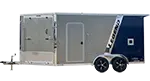
Spencer Trailers carries Diamond C, H&H, Liberty, Legend, Delco, and other working trailer brands across dump, utility, equipment, tilt, cargo, gooseneck, and specialty categories. Diamond C trailers are built in the United States in Mt. Pleasant, Texas, where the company was founded in 1985. Current premium Diamond C lines use Lippert axles as standard, and Spencer Trailers can help match the exact axle package, ramps, tilt or dump system, tires, spare, tarp, and tie-down equipment to the job instead of treating every trailer with the same outside dimensions as equivalent.
If the needed configuration is not on the lot, the team can help with an order rather than forcing the business into the wrong length, GVWR, gate, or loading system. That is especially valuable when the purchase needs to coordinate with a new truck, a planned equipment acquisition, or a specific contract start date.
You can also browse recently sold trailers to see the sizes and configurations other buyers have chosen, then compare those examples with the actual weight and workflow of your own operation.
What Counts
The right trailer is not merely an expense. Used correctly, it is a productive asset that can turn repeated disposal runs into one legal load, convert hauling from an uncertain cost into a quoted service, and make a new employee or second truck more productive. The benefit comes from matching capacity to the work and operating within every rating, not from loading the trailer until the material reaches the top rail.
One well-chosen dump trailer can reduce trip count on debris jobs. A dedicated equipment trailer can make machine loading faster and safer. A correctly matched gooseneck can support larger contracts without overloading a bumper-pull setup. Those improvements allow the business to schedule with more confidence, protect expensive equipment, reduce avoidable downtime, and pursue work that previously required rental equipment or subcontracted hauling.
If the current setup is holding the crew back, the answer may not be a larger marketing budget or more labor. It may be a trailer with the right body, payload, hoist or tilt system, loading equipment, axles, brakes, tires, and hitch for the work the company is already being asked to do.
Contact Spencer Trailers at (812) 829-0226 or stop by 291 West State Hwy 46, Spencer, IN 47460. Explain what you haul, the exact truck you use, the heaviest machine or material, the typical route, and how often the trailer will work. The team can point you toward the configuration that makes operational and financial sense, not simply the closest trailer on the lot.


