








You backed the dump trailer up to the job site, loaded it with brush and broken concrete, and drove off. Thirty seconds later, a loose piece bounced across two lanes of traffic. That moment is why cargo nets and dump tarps exist, and it is also why buying the wrong cover, attaching it poorly, or treating it as a substitute for real tie-downs is more than a nuisance.
Indiana does not have one blanket rule saying every open trailer must wear a tarp. The legal requirement depends on the load and how it is transported. Indiana’s fugitive-dust rule requires a vehicle to be constructed and moved so its contents do not drip, sift, leak, or otherwise escape and create fugitive dust. Indiana law also requires long items such as logs, lumber, pipe, poles, tanks, boilers, and similar cargo to be securely fastened; certain loads longer than 10 feet require securement near both ends and at the center. A load-securement citation may bring fines and court costs, and the financial exposure can become much larger if escaped cargo damages a vehicle or causes a crash.
So which net do you actually need? That depends on the trailer type, the material being hauled, the load profile, the available anchor points, and how the net or tarp is tensioned. This guide covers the main net families, the closure hardware that matters, practical sizing logic, and where dump trailer tarps fit into the picture. One principle applies throughout: a cover contains loose material, while rated straps, chains, binders, blocking, and chocks secure heavy cargo. Sometimes a safe load needs both.
The Main Net Types
Knotted Polyethylene Cargo Nets
Knotted polyethylene nets are among the most common choices for brush, limbs, bulky yard debris, and other lightweight material that needs perimeter containment. Twisted or braided polyethylene cord is tied at each intersection to form a grid. Mesh openings vary widely, with small-mesh versions commonly around 1.5 to 2 inches and general-purpose versions often closer to 3 or 4 inches. Tighter mesh captures more twigs and fragments, but no open-grid cargo net should be expected to retain sand, soil, gravel fines, sawdust, mulch fines, or dusty demolition material at road speed. Those loads call for a properly fitted tarp or another cover designed for fine material.
Pricing varies more than the draft numbers printed on many online listings suggest. A lightweight utility net may sell for less than $100, while a larger commercial net with reinforced borders and an engineered attachment system can cost several hundred dollars. Do not assume that a cord’s advertised break strength is the working load limit of the finished net. The complete assembly includes the mesh, border, stitching or knots, hooks, straps, connectors, and trailer anchor points, and the weakest part controls the system. Look for UV-stabilized material, but remember that “UV resistant” does not mean permanent. Inspect the net before every trip and replace it when the cord becomes chalky, stiff, split, badly abraded, melted, chemically damaged, or difficult to tension evenly.
Knotless Web Nets
Knotless construction can mean knitted high-tenacity polypropylene, polyester mesh, or a sewn webbing grid, depending on the manufacturer. Removing bulky knots can help a net lie flatter, pack more neatly, and distribute local contact across the mesh. That does not automatically make every knotless net suitable for steel pipe, pallets, machinery, or other heavy freight. Some knotless products are made only for light containment, while others are engineered and labeled as cargo-securement or lifting systems. Read the intended-use statement and the complete-system rating. Pipe, lumber, palletized goods, and equipment still require properly rated straps or chains, suitable blocking, edge protection, and anchor points unless the net manufacturer specifically approves the complete system as the primary securement for that load.
Rubber Bungee Cargo Nets
These are the compact elastic nets with pre-attached hooks commonly used on ATV racks, pickup beds, roof baskets, and enclosed-trailer shelves. They are convenient for helmets, bags, empty containers, and other light items that fit within the product’s instructions. They do not belong over a dump trailer load of demolition debris, concrete chunks, scrap, logs, or a tall pile of brush. Elastic cord stretches as the load moves, small hooks can rotate or release, and most consumer bungee nets do not carry a complete-system working load limit for highway cargo securement. Use them for the light-duty applications they were built for.
Reinforced-Border Cargo Nets
Heavy-duty containment nets often use a rope or webbing perimeter, reinforced corners, sewn attachment loops, grommets, abrasion sleeves, or replaceable straps. A reinforced border helps spread tension and protects the edge where the net contacts trailer rails, stake pockets, and rough cargo. It also gives you more controlled attachment locations than tying directly into random sections of mesh. For regular hauling, that edge construction is usually more valuable than simply buying the thickest-looking cord. Steel, concrete block, lumber, pipe, and similar dense cargo must still be secured with the appropriate rated chains or web straps, binders or ratchets, blocking, chocks, and edge protection. A reinforced net can contain small loose pieces around that cargo, but it is not automatically the primary restraint.
Dump Trailer Tarps vs. Cargo Nets: When to Use Which
This question comes up constantly, and the answer is not always one or the other. The correct cover depends on particle size, load shape, sharp edges, dust, trailer-body design, and the manufacturer’s instructions. Keep the load at a manageable height, distribute it correctly, and stay within the trailer’s GVWR, axle ratings, tire ratings, hitch rating, and tow-vehicle limits before thinking about the cover.
| Load Type | Best Cover | Why |
|---|---|---|
| Gravel, sand, dirt | Properly fitted dump tarp | Fine particles can pass through an open cargo net; use a mesh or solid tarp suitable for the material and keep it tensioned |
| Brush, branches, yard debris | Heavy-duty small-mesh net or durable mesh tarp | The cover must conform around bulky material without leaving gaps; trim or rearrange sharp branches that could puncture it |
| Demo debris, mixed rubble | Rigid-sided body, primary securement where needed, plus a suitable tarp or net | Large or heavy pieces must be kept below the body and secured; the cover controls dust and smaller fragments |
| Mulch, wood chips | Tight-mesh or solid tarp | Small chips and fines can escape through ordinary net mesh, especially as airflow lifts material from the top of the load |
| Palletized material | Rated straps or chains with blocking and edge protection | A cargo net is supplemental unless the complete net system is specifically rated and approved for primary securement |
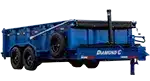
Many dump trailers are available with manual or electric tarp systems, and equipment varies by model and build. Current Diamond C LPT dump trailers, for example, are equipped with a long-arm easy-roll tarp system as standard equipment. Whether the tarp rolls by hand or electric motor does not determine how well it contains a load; material, coverage, fit, tension, installation, and condition matter more. A fitted tarp is the right starting point for dirt, gravel, sand, mulch, and other small material. For brush, arrange the load below a controllable profile, cut back limbs that project beyond the body, and use a durable net or mesh tarp that can be attached around the full perimeter without resting on sharp points.
Closure Hardware: Ratchet vs. Spring Hook
The net is only as dependable as its attachment system and the trailer structure to which that system is connected. Hooks, straps, border loops, and anchor points must be compatible, undamaged, and positioned so they stay engaged as the trailer vibrates and the load settles. More tension is not always better; the goal is even, secure tension without overloading the net, bending hardware, or pulling against a trailer component that was never designed as an anchor.
Spring Hooks (Snap Hooks)
Spring-gate snap hooks attach quickly and can work well when they are part of a rated system, correctly sized for the anchor, fully seated, and loaded in the intended direction. The problem is not the name of the hook; it is using light consumer hardware, open bungee hooks, or a mismatched connector as primary highway securement. A hook that can roll sideways out of a rail slot, ride on the tip, press its gate against the trailer, or contact a sharp edge is not a dependable connection. For a light containment net, connect every required perimeter point and confirm each gate is closed. For heavy cargo, use the rated securement hardware specified for that cargo and treat the net as supplemental unless its complete system carries the necessary rating.
Ratchet Closure Systems
Commercial trailer nets may use several adjustable web straps with ratchets, cam buckles, or other tensioning devices around the border. These systems let you draw the net down in stages and compensate for reasonable differences in load shape. Tension opposite sides progressively rather than pulling one corner completely tight first. Stop before the mesh is overstretched, the border is distorted, or the trailer rail begins to bend. Also remember that adding a ratchet does not create a working load limit for an unrated net. Current engineered trailer-net systems commonly cost in the low hundreds of dollars, with price rising for larger sizes, heavier construction, custom dimensions, and certified hardware.
A plain-border net can also be used with separate rated straps when the net manufacturer permits it. The mistake is relying on only four corners while the long sides billow, lift, or open gaps. Use the number and spacing of perimeter attachments called for by the manufacturer, keep webbing away from tires, exhaust heat, lights, hinges, and sharp edges, and do not knot tiedown webbing to shorten it. After the first few miles, stop in a safe location and check the load again because brush compresses, loose material settles, and straps can lose tension.
Sizing Your Net
This is where people make the most mistakes. A net that matches the trailer-floor dimensions usually will not cover a crowned load because it must travel up one side, over the top, and down the other side far enough to reach secure anchors. At the same time, a huge net is not automatically safer. Excess material can bunch against tires or lights, drag on the road, catch wind, cover required lamps or the license plate, and make it harder to apply even tension.
There is no universal “add 3 feet” formula that works for every trailer and load. Measure from the intended anchor line on one side, over the actual loaded profile, to the anchor line on the opposite side. Repeat that process from front to rear, then add only the overlap or tensioning allowance recommended by the net manufacturer. For a 7-by-14-foot dump body carrying a moderate brush crown, a net in the general 12-by-18-foot or 12-by-20-foot class may be a useful starting point, but the correct size depends on rail height, load height, anchor location, border design, and how much the net is meant to stretch.
Standard trailer net sizes you will find stocked at many suppliers include:
- 7 x 10 ft (often suitable for a lightly loaded 5 x 8 utility trailer after the loaded profile is measured)
- 8 x 10 ft (a possible fit for a 6 x 10 trailer carrying a low or moderate load)
- 10 x 16 ft (used on some 10- to 12-foot bodies with a controlled, low-profile load)
- 12 x 20 ft (a common starting range for many 14- to 16-foot dump-trailer brush loads)
- 14 x 24 ft (used for longer trailers or bulky loads only after confirming coverage, tension range, and anchor spacing)
If you are buying a net for a specific trailer, bring the bed dimensions, side height, anchor spacing, and a realistic description of the load when you call or stop by. A net that is too short may be overstretched, leave exposed corners, or pull hooks at unsafe angles. A net that is excessively large can bunch, flap, and interfere with trailer equipment. Custom sizing may be worthwhile for a commercial trailer that hauls the same type of material every day.
What to Look for on the Label
Start with intended use. The label or manufacturer’s documentation should say whether the product is a light containment cover, a rated cargo-securement net, or a lifting net. Those are not interchangeable categories. When a net will serve as primary cargo securement, look for a working load limit assigned to the complete system, not merely a break-strength figure for one cord, one strap, or one hook. Do not divide an advertised break strength by a guessed safety factor and call the result a WLL. The manufacturer must establish the rating, and the lowest-rated component or anchor limits the assembly.
For commercial motor vehicles subject to federal cargo-securement rules, the aggregate working load limit of the tiedowns used to secure an article or group of articles generally must be at least one-half the weight of that cargo, along with all applicable rules for the commodity and securement method. Look for mesh size, finished dimensions, material, UV treatment, border construction, attachment instructions, hardware ratings, and inspection criteria. Before each trip, check for cut or melted fibers, broken stitching, failed knots, heavy abrasion, chemical damage, UV embrittlement, bent or distorted hooks, corroded hardware, and straps that no longer hold tension. If the seller cannot identify the product’s intended use or complete-system rating, treat it as containment only.
A Quick Word on Dump Trailer Compliance
Indiana’s rules focus on preventing cargo and fugitive material from escaping, not on declaring one universal cover acceptable for every load. A properly fitted tarp is generally the correct containment tool for dirt, gravel, sand, mulch, and other fine material. A durable small-mesh net or mesh tarp may be better for brush and bulky yard debris, provided the material is loaded within the body and the cover closes the perimeter. Heavy, rigid, rolling, or concentrated cargo may also need chains, straps, blocking, bracing, or chocks. Federal cargo-securement regulations can apply to cargo-carrying commercial motor vehicles operating in interstate commerce, so commercial haulers should follow the applicable federal rules as well as Indiana requirements.
Before buying a net, inspect the actual trailer for stake pockets, D-rings, rail slots, rub rails, or other manufacturer-approved tie-down locations. Confirm their ratings and make sure the chosen hooks or straps fit without side-loading, twisting, or contacting sharp edges. Do not assume a tarp arm, tailgate latch, light bracket, fender support, safety chain, or hydraulic component is an anchor point. Most working dump and equipment trailers provide useful securement locations, but layout and capacity vary by model, year, options, and prior modifications. Attach the cover at enough points to close the perimeter, inspect the load before moving, recheck it shortly after departure, and inspect it again during normal stops.
Recommended Starting Points by Trailer Type
For a 5 x 8 or 6 x 10 utility trailer used for yard work and light hauling: choose a UV-resistant small-mesh containment net or durable mesh tarp sized over the measured loaded profile, with multiple compatible attachment straps or closed-gate hooks. Use a tighter mesh or solid tarp for mulch, soil, leaves, and small chips. Depending on size, material, hardware, and whether the product is a basic cover or an engineered system, a realistic budget can range from roughly $50 to $250 or more.
For a 14-foot dump trailer (such as a Diamond C LPT or an H&H dump trailer) doing regular brush and debris work: use the fitted dump tarp for fine material and a heavy-duty small-mesh net or durable mesh tarp for bulky brush when that cover is better suited to the load. A 12 x 20 net is a common starting size, not an automatic fit, so measure over the loaded profile and confirm the border’s tension range. Use several perimeter attachments rather than four isolated corners. Commercial or custom systems commonly run from the mid-hundreds upward depending on construction, hardware, and size.
For a 20-foot flatbed or equipment trailer carrying pipe, lumber, pallets, or machinery: put the securement budget first into correctly rated chains or web straps, binders or ratchets, edge protectors, blocking, chocks, and compatible trailer anchors. Select the number, location, and aggregate WLL of tiedowns for the cargo and applicable regulations. Add a reinforced containment net only for loose secondary material, or use a complete net system whose manufacturer specifically rates and approves it for the intended primary-securement application.
And for anybody using an elastic bungee net on a loaded open trailer: move that net back to the ATV rack, pickup bed, or light interior-storage job it was designed to handle. Replace it with a cover and attachment system suited to the trailer, road speed, and cargo. That is not simply a price question. It is a load-control and liability question.
Not sure what your trailer supports for attachment points or what net fits your specific setup? Give us a call at (812) 829-0226 or stop by 291 West State Hwy 46 in Spencer. We can inspect the available anchor points, talk through the material you haul, and help you choose a practical cover without pretending one net works for every load. And if you are still shopping for the trailer itself, browse the current inventory to see what Diamond C, H&H, Liberty, and the rest of our brands have in stock right now.


