








You’re following a trailer on the highway when a small stone strikes the windshield hard enough to leave a chip or spreading crack. The source is not always obvious. A tire may have picked the stone up from the roadway, material may have fallen from an unsecured load, or debris may have been trapped on the trailer and shaken loose. Responsibility depends on what happened and what can be proven, but the result for the following driver is the same: damaged glass, an unexpected repair, and a frustrating afternoon. A properly selected mud flap cannot stop every projectile, but it can substantially reduce the amount of water, mud, grit, and loose aggregate thrown rearward by exposed trailer tires.
So why don’t all trailers have mud flaps? And if yours doesn’t, should it? Those are fair questions. The answers depend on the trailer’s fender and body design, the tires and axle configuration, where the trailer is operated, and whether the existing equipment provides enough coverage to satisfy the laws along your route.
What Mud Flaps Actually Do
Mud flaps, also called splash guards, splash aprons, or mud guards, are flexible panels mounted behind a tire or wheel assembly. They are commonly made from molded rubber, rubber-polymer blends, or durable synthetic material. Their purpose is to intercept water, mud, sand, gravel, road salt, and other loose material carried upward and rearward by the rotating tire. Instead of allowing that material to continue into traffic, the flap absorbs some of its energy and redirects much of it toward the roadway.
At highway speed, tire tread can pick up small stones and road grit and release them as the tire rotates. Wet pavement creates an additional problem because water is drawn into and expelled from the tread grooves, producing spray that can reduce visibility for vehicles behind or beside the trailer. A properly positioned flap helps control both problems, although it should be viewed as risk reduction rather than a guarantee. Rocks can still escape around the sides, bounce beneath the flap, come from another axle, or fall from the trailer deck or cargo.
Tire size is only one factor. Tread design, tire width, vehicle speed, pavement condition, fender coverage, axle placement, and the amount of water or loose aggregate on the road all affect spray and debris. A wide ST235 trailer tire on an open equipment trailer generally exposes more rotating tire area than a narrow tire tucked beneath a well-covered utility-trailer fender. However, the correct question is not simply whether the trailer is large or small. It is whether the complete fender, body, and flap system adequately covers the tire and controls material traveling rearward.
State Laws: Where It Gets Complicated
Mud-flap requirements are not governed by one universal federal rule for ordinary trucks and trailers. Federal commercial-vehicle regulations address many items such as brakes, lighting, cargo securement, and rear-impact protection, but there is no general federal mud-flap standard that gives every trailer the same required width or ground clearance. Mud-flap and splash-suppression rules are primarily established by individual states, and the wording varies substantially.
California Vehicle Code Section 27600, for example, generally requires motor vehicles with three or more wheels, trailers, and semitrailers to have fenders, covers, flaps, splash aprons, or body construction that adequately minimizes water and mud spray to the rear. The protective equipment or body coverage must be at least as wide as the tire tread, although the statute includes exemptions, including certain trailers and semitrailers with an unladen weight under 1,500 pounds. Washington’s RCW 46.37.500 requires applicable motor vehicles, trailers, and semitrailers to have fenders, covers, flaps, or splash aprons that minimize rearward spray; the devices must be as wide as the tires and extend downward at least to the center of the axle.
Indiana does not have a specific statewide mud-flap requirement covering ordinary commercial vehicles and trailers in the same way that California or Washington does. That does not make tire coverage irrelevant. Local ordinances can impose additional requirements, special vehicle combinations can be subject to separate operating conditions, and a trailer taken across a state line must comply with the laws of the state in which it is being operated. Indiana Code 9-21-8-48 also separately prohibits operating a vehicle when its contents are dripping, sifting, leaking, or otherwise escaping, with limited exceptions. That cargo rule is different from a tire kicking up loose roadway material, but it is an important distinction when investigating a debris incident.
Some states base their rules on vehicle type, registered weight, gross weight, tire or axle configuration, body design, or a specified maximum distance above the roadway. Others use a performance standard requiring the equipment to minimize spray without setting one universal measurement. There is no dependable nationwide GVWR cutoff that tells every trailer owner whether flaps are required. If you travel across state lines, verify the current requirements for each state on the route rather than relying on a rule of thumb. Commercial operators should make that review part of their compliance process, while recreational and private owners should do the same before a long trip.
Why Many Trailers Ship Without Them
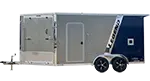
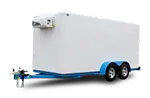
Browse the inventory at Spencer Trailers and you’ll see trailers equipped with substantial fenders but no separate rubber flap. That can be a normal factory configuration because many laws allow the fender, trailer body, or another attachment to provide the required protection. Enclosed trailers from manufacturers such as Wells Cargo and Darkhorse Cargo commonly use external fenders that cover the top and sides of the tires. Whether that construction also provides enough rearward coverage depends on the exact model, fender shape, tire position, and state law. An enclosed body alone should not be assumed to satisfy every jurisdiction.
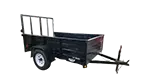
Lighter utility trailers from brands such as H&H or Delco are often designed for local landscaping, property maintenance, recreational equipment, and general hauling. Many leave the factory with formed steel or aluminum fenders but without hanging flaps. Their lower GVWR does not automatically exempt them from every state’s requirements. Factory equipment reflects the trailer’s design and standard sales configuration, while the owner remains responsible for making sure the finished setup is legal and appropriate for the roads on which it will be used.
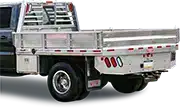
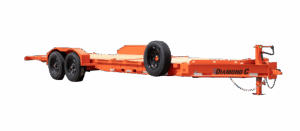
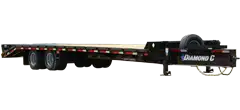
Open flatbed and equipment trailers deserve closer attention because the tire and the rear edge of the fender may be exposed to following traffic. A Diamond C LPX, HDT, FMAX, or deck-over equipment trailer can be configured with substantial tires and multiple Lippert axle packages, depending on the model and GVWR. A Liberty flatbed or equipment trailer may present a similar need for added rearward coverage. On these trailers, a properly engineered bolt-on flap and bracket assembly can be a practical addition, especially for regular highway use, wet-weather towing, gravel-road travel, or operation in states with detailed splash-guard rules.
The Rock Damage Problem
Beyond windshields, road grit and stones can damage several predictable areas on a following vehicle:
- Front bumper and lower valance, including paint, plastic trim, sensors, and active grille components
- Hood leading edge, grille, emblems, and exposed painted surfaces
- Headlight lenses, fog-light covers, camera lenses, and driver-assistance sensors
- Radiator, air-conditioning condenser, transmission cooler, and other heat exchangers behind the grille
The cost can range from a small glass or paint repair to replacement of an expensive headlamp, sensor-equipped bumper component, windshield, radiator, or condenser. Whether the trailer owner or towing driver is legally responsible depends on the evidence. A stone merely picked up from the roadway can be difficult to trace, while gravel, tools, construction debris, or other material falling from the trailer or its load presents a much clearer cargo-securement issue. Insurance coverage also varies by policy, deductible, state law, and the facts documented at the scene.
A conventional mud flap does not have one universal 45-degree deflection rating. Its effectiveness depends on placement, width, flexibility, surface design, airflow, and how closely it works with the fender. Smooth flaps can block a large portion of direct spray and debris. Commercial anti-spray designs may use grooves, ribs, textured surfaces, or bristle-like material to break up water droplets and channel water downward. These features can improve wet-weather spray control, but they still need correct positioning and adequate tire coverage.
Choosing the Right Mud Flap
Not all mud flaps are interchangeable. The first step is to read the tire size on the sidewall and inspect the actual tire and fender arrangement. Do not select a flap only from the trailer’s advertised GVWR because the same trailer model may be ordered with different axle, wheel, tire, fender, or suspension packages. The following sizes are practical starting points, not universal legal specifications:
| Trailer Type | Typical Tire Width | Flap Width to Use |
|---|---|---|
| Small utility / landscape (3,500 lb axle) | 4.80-series trailer tire to ST205/75R15 | Measure the tire; an 8- to 10-inch flap often covers a single tire |
| Single-axle heavy utility or equipment trailer | ST225- or ST235-series 15- or 16-inch tire, depending on axle package | Usually 10 to 12 inches for one tire, provided the complete tread is covered |
| Tandem-axle equipment hauler (14,000 to 15,500 lb GVWR) | ST235/80R16 is common on many 7,000 lb axle packages | Usually 10 to 12 inches per exposed tire position; verify fender and rear-axle coverage |
| Gooseneck / heavy equipment trailer | 16- or 17.5-inch single tires, or dual-wheel assemblies, depending on model | Match the full single or dual assembly; many dual applications use a commercial-width 24-inch flap |
Width is the starting point. In states requiring full tire or tread coverage, the flap must be at least as wide as the area specified by that state’s law. Measure the mounted tire rather than relying only on the nominal sidewall number, and include the complete outside-to-outside width when covering a dual-wheel assembly. The flap should be centered behind the tire path so that neither edge of the tread is left exposed. A flap that is technically wide enough but mounted several inches inward can still allow substantial side spray.
Height is also state-specific. There is no nationwide rule requiring every trailer flap to sit exactly 6 or 8 inches above the ground. Some states specify a maximum ground clearance, some measure coverage relative to the axle or tire, and others use a general performance standard. Set the trailer on level ground in its normal towing attitude, account for expected cargo weight and suspension movement, and choose a flap long enough to satisfy the strictest applicable requirement without dragging during driveway transitions, jobsite travel, loading, or ramp operation. Material should be selected by performance rather than marketing terminology alone. Look for flexibility at the lowest temperatures in which you tow, resistance to tearing and ultraviolet exposure, adequate thickness, and a design that does not curl or sail excessively at highway speed.
Installing Mud Flaps on a Trailer
Many trailer mud flaps use a bolt-on bracket attached to an existing fender support, crossmember, or manufacturer-approved mounting point. Installation may be straightforward on a trailer with suitable holes and accessible structure, but custom fabrication can be necessary on low-profile equipment trailers, deck-over models, aluminum trailers, and trailers with moving ramps or hydraulic dovetails. Before drilling, confirm that the proposed location is not a structural flange, suspension component, brake-wire route, hydraulic line, light harness, or surface protected by a warranty restriction.
The general sequence:
- Identify the correct mounting location. Position the flap immediately behind the rearmost exposed tire or wheel assembly and center it across the tire path. Confirm that the fender, body, and flap will function as one continuous coverage system.
- Check ride height and movement. Level the coupled trailer, add a representative load when practical, and measure clearance in normal travel position. Allow for suspension compression, uneven entrances, curbs, railroad crossings, and any tilt bed, dovetail, or ramp that moves near the flap.
- Use existing holes or an approved bracket whenever possible. If drilling is necessary, follow the trailer and bracket manufacturers’ guidance, protect wiring and brake components, use backing plates or large washers where required, and seal exposed steel. On aluminum components, use compatible hardware and isolation measures to limit galvanic corrosion.
- Install corrosion-resistant hardware and tighten it to the fastener or bracket manufacturer’s specification. Use appropriate locknuts or locking hardware, and make sure the flap hangs freely without rubbing the tire, brake wiring, suspension, ramp, or deck during operation.
- Inspect the installation after the first loaded trip and periodically thereafter. Check for loosened fasteners, torn mounting holes, bent brackets, tire contact, excessive curling, road abrasion, and accumulated mud, snow, or ice. Replace a damaged flap before it becomes ineffective or detaches on the highway.
If you’re adding mud flaps to a Diamond C LPX, HDT, FMAX, or another premium equipment trailer, use a bracket designed around the actual I-beam frame, fender supports, suspension, and loading system. Do not treat an engineered frame flange as a convenient drilling surface. A dealer or qualified fabrication shop can identify a noncritical mounting point and protect any exposed metal so the trailer’s DM Difference Maker multi-stage coating is not unnecessarily compromised. On fender-equipped enclosed trailers such as a Darkhorse Cargo or Legend, some models may provide usable fender-bracket holes, while others require a separate support. Verify the exact trailer rather than assuming every fender is predrilled for a flap.
A Quick Q&A
Do I need mud flaps if I only haul locally? Trip length does not determine whether an equipment law applies. Indiana does not impose a specific statewide mud-flap rule on ordinary trailers, but a local ordinance or the law of a neighboring state may apply as soon as you enter that jurisdiction. Local gravel roads, construction entrances, and chip-sealed pavement can also create more loose-stone exposure than a clean interstate, so a locally used trailer may still benefit from added coverage.
Can I get a ticket for not having them? Yes, in a state where your trailer’s fenders, body, or splash guards do not meet the applicable requirement. The officer may evaluate tire width, rearward coverage, ground clearance, device condition, or the equipment’s ability to control spray, depending on the statute. Commercial inspections can also identify missing, torn, or ineffective equipment when state law requires it. Do not assume that registration in Indiana exempts a trailer from the equipment laws of another state.
Do mud flaps affect fuel economy? Any object placed in moving air can affect drag, but there is no reliable universal miles-per-gallon penalty for a pickup towing a trailer with mud flaps. Trailer shape, speed, load, wind, flap width, stiffness, and mounting position all matter. Large solid commercial flaps can add aerodynamic resistance, while vented or aerodynamic designs are intended to reduce it. For a typical utility or equipment trailer, safety, legal compliance, and spray control are more useful selection criteria than an unsupported fuel-economy estimate.
Will any mud flap fit my trailer? No. A flap that is too narrow leaves the tire edges exposed. A flap that is too short may allow spray and gravel to pass beneath it or may violate a state’s dimensional rule. A flap that hangs too low can drag, fold beneath the tire, interfere with loading equipment, or tear its bracket from the fender. Match the flap to the actual tire width, wheel configuration, mounting structure, suspension travel, trailer geometry, and states in which the trailer will operate.
Not an Afterthought
Mud flaps often land on the “I’ll get around to it” list beside wheel-bearing service, breakaway-battery checks, tire-pressure inspections, brake adjustment, and spare-tire maintenance. They should receive more attention. Their most consistent benefit is controlling water, mud, salt, sand, and fine aggregate, which can improve visibility and reduce the amount of material directed at following traffic. They can also lower the chance of some stone strikes, although no flap can capture every object released by a tire.
If you’re picking up a flatbed, equipment hauler, or any open trailer from our inventory and it’s going to see highway miles, wet roads, gravel, or interstate travel, ask us to evaluate the existing tire and fender coverage before you leave. If you’re already running a trailer without flaps, we can help determine whether a properly mounted set is appropriate for its tires, frame, fenders, ramps, and intended route. Questions? Give us a call at (812) 829-0226 and we can point you toward what fits your specific setup.


