










You back your loaded trailer up to the truck, lower the coupler onto the hitch ball, and retract the tongue jack. Then you walk around to the front of the truck and notice it. The hood is sitting higher, the headlights are aimed upward, and the rear suspension has dropped. That change in stance is a warning sign, but it does not automatically mean a weight-distribution hitch is the only fix. The trailer could be overloaded, the tongue weight could be excessive, the ball height could be wrong, or the tow vehicle could simply be too light for the load. A properly selected and adjusted weight-distribution hitch, sometimes casually called an equalizer hitch, may be the correct solution when the truck and trailer are otherwise within all of their ratings.
The answer comes down to the tow vehicle manufacturer’s instructions, the ratings on the receiver label, the trailer’s actual loaded weight, measured tongue weight, and the truck’s remaining payload capacity. Trailer GVWR is the maximum allowable trailer weight, not necessarily what the trailer weighs during a particular trip. A weight-distribution hitch does not increase the truck’s GVWR, rear-axle rating, payload capacity, GCWR, conventional towing rating, or the capacity of an undersized receiver. Get the combination wrong and you can reduce steering response, overload tires or suspension components, and make the trailer more susceptible to sway. Get it right and the truck can retain the front-axle loading and handling characteristics specified by its manufacturer.
What a Weight-Distribution Hitch Actually Does
A standard weight-carrying ball mount places the trailer’s tongue load behind the tow vehicle’s rear axle. Because the hitch ball acts at the end of a lever, the load increases weight on the rear axle while removing some weight from the front axle. Most traditional weight-distribution systems use round or trunnion-style spring bars connected between the hitch head and the trailer frame. Other designs use tensioned chains rather than conventional spring bars. In either case, the system creates leverage that moves part of the added rear-axle load forward to the tow vehicle’s front axle and rearward to the trailer axles.
The goal is not simply to make the truck and trailer look perfectly level. The correct adjustment is the amount of front-axle load restoration specified in the tow vehicle’s owner manual. Some manufacturers provide a fender-height procedure, while others specify an axle-load-restoration percentage. Applying too little tension may leave the front end excessively light. Applying too much can overload the front axle, reduce rear-tire traction, create a harsh ride, or place unnecessary stress on the trailer frame and hitch components. Tongue weight does not disappear when the spring bars are engaged, and every truck, receiver, ball, coupler, shank, hitch head, and spring-bar rating still applies.
Brands such as Equal-i-zer, Reese STEADi-FLEX, Blue Ox SwayPro, and Andersen Weight Distribution use different combinations of spring bars, chains, brackets, hitch-head geometry, and friction-based sway resistance. They share the same basic purpose, but their capacities and trailer-frame fitment vary substantially. The exact model must be matched to the measured loaded tongue weight, the gross trailer weight, the tow vehicle’s receiver, and the available mounting space on the trailer tongue.
The Numbers That Trigger the Requirement
There is no universal rule that every trailer above 350 or 500 pounds of tongue weight must use weight distribution. The requirement is vehicle-specific. Read the towing section of the exact truck’s owner manual and inspect the label attached to the receiver. Many receiver labels show separate weight-carrying and weight-distributing limits. As one current example, Ford lists the 2026 F-150 factory receiver at a maximum of 5,000 pounds of trailer weight and 500 pounds of tongue load in weight-carrying mode, with weight-distributing capacity reaching as high as 13,500 pounds of trailer weight and 1,400 pounds of tongue load when the truck is properly configured. The truck’s VIN-specific towing, payload, GVWR, GAWR, and GCWR limits may be lower. By comparison, Ford requires an aftermarket weight-distribution hitch on a properly equipped 2026 Expedition when the loaded trailer exceeds 7,000 pounds. Those different thresholds are why the manual and receiver label control, not a general internet rule.
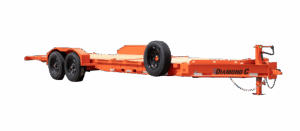
For most conventional ball-coupled cargo, utility, equipment, and travel trailers, loaded tongue weight commonly needs to remain within approximately 10 to 15 percent of the trailer’s actual loaded weight, unless the trailer or tow vehicle manufacturer specifies a different range. A Diamond C GTU loaded to its 7,000-pound GVWR could therefore place roughly 700 to 1,050 pounds on the ball. That tongue load, plus the weight of the hitch hardware, passengers, tools, and cargo in the truck, can consume a large share of a half-ton pickup’s payload capacity.
The numbers become even more important with an extreme-duty bumper-pull. A 22-foot Diamond C LPX is part of a current model line offered in GVWR configurations from 15,500 to 24,000 pounds. At an actual loaded weight of 15,500 pounds, a 10-to-15-percent tongue-weight range would be approximately 1,550 to 2,325 pounds. That can exceed the conventional towing, payload, receiver, or tongue-weight limits of many pickups and many weight-distribution systems. Installing heavier spring bars does not make an undersized truck capable of towing the load. The correct answer may be a heavier tow vehicle, a lower trailer load, or a different trailer and hitch configuration.
A quick three-number check:
- Weight-carrying and weight-distributing ratings on the receiver. Read both sets of numbers on the receiver label. Then verify the ratings of the ball, ball mount or shank, hitch head, spring bars, coupler, safety chains, and every other load-bearing component. The lowest rating in the entire system is the limit. Receiver tube size alone, whether 2-inch, 2-1/2-inch, or 3-inch, does not establish capacity.
- The truck’s payload, GVWR, front GAWR, and rear GAWR. Use the certification and tire-loading labels on the driver’s door jamb for the specific truck. Include occupants, cargo, accessories, the weight-distribution hitch itself, and the loaded trailer’s tongue weight. A weight-distribution hitch may reduce the load measured on the rear axle, but it cannot be used to justify exceeding any vehicle rating. If the truck remains over GVWR or an axle rating after the hitch is correctly adjusted, reduce the load or use a more capable tow vehicle.
- The trailer’s actual loaded weight and tongue weight. GVWR is a ceiling, not a substitute for weighing. Load the trailer exactly as it will travel, including equipment, attachments, fuel, batteries, spare tires, toolboxes, and secured cargo. Then compare the measured numbers with the tow vehicle manual, receiver label, trailer rating, tire capacities, and the selected weight-distribution system.
Four Signs You Need One Right Now
1. Rear Sag and Front-End Rise After Coupling
Noticeable rear sag accompanied by a higher front fender measurement is a strong reason to stop and evaluate the combination. Adding toolboxes, sandbags, or other cargo to the truck bed makes the rear-axle load worse; it does not restore the weight removed from the steering axle. Air springs, helper springs, and automatic leveling suspension can raise the rear of the truck visually, but they do not increase GVWR, GAWR, payload, or receiver capacity. They can also conceal front-axle unloading. When the vehicle manufacturer permits or requires weight distribution, the hitch should be adjusted according to the prescribed fender-height or scale procedure rather than by appearance alone.
2. Headlight Aim Shifts Noticeably
This is easy to notice at night. Hitch the loaded trailer on level ground, park facing a garage door or wall, and compare the beam position with the unloaded truck. Beams that climb noticeably can indicate that the rear has dropped and the front has risen. However, headlight aim is only a warning sign, not a measurement of axle weight. Some newer vehicles also have automatic suspension or headlight leveling that can hide the change. Measure the front and rear fender heights as directed by the owner manual, or use an axle scale to compare the truck unhitched, hitched without spring-bar tension, and hitched with the system adjusted. After setup, confirm that the headlights are aimed correctly.
3. The Rig Sways on the Highway
Trailer sway has multiple causes, and a weight-distribution hitch should not be used to cover up a loading or mechanical problem. Insufficient tongue weight, cargo placed too far behind the trailer axles, excessive speed, side-to-side imbalance, incorrect tire pressure, damaged tires, loose wheel bearings, worn suspension parts, incorrect hitch height, axle misalignment, and unsecured cargo can all contribute. Correct those conditions first and verify the loaded tongue-weight percentage. Systems such as the Equal-i-zer 4-Point, Reese STEADi-FLEX, Blue Ox SwayPro, and Andersen Weight Distribution include sway-control or sway-resistance features, but no hitch can guarantee that a badly loaded or overloaded trailer will remain stable. Factory electronic trailer-sway control is also a backup aid, not a replacement for correct loading and properly rated equipment.
4. You’re Pulling a Heavy Bumper-Pull with a Half-Ton
A half-ton pickup towing near its conventional limit often needs weight distribution because the weight-carrying limit of the receiver can be much lower than the truck’s advertised maximum tow rating. The current 2026 Ford F-150, for example, can be rated to tow as much as 13,500 pounds in a specific configuration, but its published factory-receiver limit in weight-carrying mode is 5,000 pounds of trailer weight and 500 pounds of tongue load. Reaching the higher receiver capacity requires an approved weight-distribution setup, and the exact truck must still have enough payload and axle capacity. Even a 7,000-pound Diamond C GTU loaded near its rating can place 700 to 1,050 pounds on the ball before the hitch hardware, people, and bed cargo are counted. Do not rely on the maximum number from an advertisement; use the truck’s door labels, receiver label, owner manual, VIN-specific towing information, and actual scale weights.
What to Look For When Choosing One
| System | Published Tongue-Weight Ratings | Integrated Sway Control | Best For |
|---|---|---|---|
| Reese STEADi-FLEX | 600 to 1,400 lbs, model-dependent | Yes | Traditional spring-bar operation with integrated friction sway control |
| Equal-i-zer 4-Point Sway Control | 400 to 1,600 lbs, model-dependent | Yes | Multiple capacities and four-point friction resistance for frequent towing |
| Blue Ox SwayPro | 350 to 2,000 lbs, model-dependent | Yes | A broad range of tongue weights, including heavier applications when the truck and receiver allow |
| Andersen Weight Distribution | Up to 1,600 lbs | Yes | A lighter chain-based design without conventional steel spring bars |
The ratings shown are product-family ranges, not a reason to choose the highest-capacity version automatically. Each exact hitch model also has a maximum gross trailer-weight rating. Spring bars that are too light may not provide enough distribution, while a poorly matched or over-tensioned system can create a harsh ride and improper axle loading. The Andersen design uses motion-dampening tension chains and a friction-cone ball housing rather than conventional spring bars, and the complete system is lighter than many steel bar-style hitches. Reese, Equal-i-zer, and Blue Ox use spring-bar systems with different bracket and sway-control designs. Before purchasing any system, confirm the receiver size, required rise or drop, ball size, coupler position, trailer-frame height, bracket location, jack clearance, and space around battery boxes, hydraulic-pump boxes, toolboxes, stake pockets, or other tongue-mounted equipment. Trailers with surge-brake actuators require a system and installation that allow the actuator to move correctly. The tow vehicle and trailer manufacturers must also permit weight distribution on that combination.
The Trailer Side of the Equation
Tongue weight is determined by the trailer’s loaded center of gravity, not just its total weight. On a 22-foot Diamond C LPX or an 18-foot bumper-pull equipment trailer, moving a skid steer, compact tractor, attachment, or vehicle only a few inches can change the ball load substantially. Place heavy cargo low, keep it centered from side to side, and position it according to the trailer manufacturer’s loading instructions. A roughly 60-percent-forward and 40-percent-rearward cargo split is sometimes used as an initial loading guideline, but it is not a substitute for measurement. Axle position, deck length, equipment geometry, fuel level, and attachment placement all affect the result. Never move a machine rearward merely to make the truck look level; reducing tongue weight below the stable range can create severe sway.
Use a tongue-weight scale with enough capacity for the expected load, or weigh the combination on a certified multi-platform vehicle scale. Many recreational tongue scales are not rated for the tongue load of a heavy equipment trailer. For a complete weight-distribution setup, obtain separate steer-axle, drive-axle, and trailer-axle readings with the truck alone, with the loaded trailer coupled but the spring bars disengaged, and with the spring bars adjusted. Those readings show how much front-axle load was removed by the trailer and how much was restored by the hitch. Weigh the rig in actual travel condition with passengers, tools, fuel, attachments, spare tires, and normal bed cargo included. That process takes more effort than judging rear sag by eye, but it removes the guesswork and confirms whether every axle and the complete combination are within their ratings.
A Quick Q&A
Do gooseneck and fifth-wheel trailers need weight-distribution hitches? They do not use a conventional bumper-pull weight-distribution hitch. A gooseneck ball or fifth-wheel hitch places the connection in the truck bed near or ahead of the rear axle, so the leverage is different from a receiver hitch mounted behind the bumper. That does not make payload unimportant. Gooseneck and fifth-wheel pin weight can be substantial, and the truck’s payload, GVWR, rear GAWR, tire ratings, hitch rating, bed structure, and GCWR must all be checked.
My truck barely sags at all. Do I still need one? Possibly. Visible sag is not the deciding factor, especially on trucks with stiff rear springs, air suspension, or automatic leveling. Follow the exact owner manual and receiver label. A current F-150 receiver, for example, has a 5,000-pound trailer and 500-pound tongue-load limit in weight-carrying mode even though certain F-150 configurations have much higher conventional tow ratings with weight distribution. Other vehicles use different thresholds, and some do not permit weight distribution at all. Measure the actual loaded trailer and tongue weight rather than assuming that a level-looking truck is within its ratings.
Will it affect my braking? A correctly adjusted weight-distribution hitch can restore some of the front-axle load removed by the trailer, which helps preserve the steering and braking behavior intended by the tow vehicle manufacturer. It does not add brake capacity, activate additional trailer brakes, or guarantee a shorter stopping distance. Properly functioning trailer brakes, the correct brake-controller setting, adequate following distance, and compliance with the truck’s GVWR and GCWR remain essential. In Indiana, a trailer or semitrailer with a gross weight of at least 3,000 pounds must be equipped with brakes adequate to control, stop, and hold it, with the required driver control and breakaway operation. Weight distribution is not a substitute for those brakes.
Don’t Guess, Check Your Setup Before the Next Haul
If you’re shopping for a trailer and you’re not sure whether your tow vehicle can handle it with a weight-carrying ball mount or needs an approved weight-distribution system, bring the truck’s information with you. We can review the door-jamb payload and axle labels, receiver ratings, towing package, intended cargo, trailer GVWR, estimated loaded weight, expected tongue weight, and available trailer-frame mounting space. That applies whether you’re considering a Wells Cargo enclosed, a Delco flatbed, a Diamond C equipment trailer, or anything else on our current inventory. The hitch, brake controller, ball height, coupler, safety equipment, and tow vehicle all need to work as one rated system.
If you already own a trailer and have been towing with noticeable sag, light steering, sway, or a receiver operating beyond its weight-carrying limit, stop and verify the combination before the next haul. Inspect the truck and trailer tires for abnormal wear, examine the receiver and mounting hardware, check the ball and coupler, inspect the spring-bar brackets and trailer frame, test the trailer brakes and breakaway system, and look for damaged suspension components. Then weigh the loaded rig and adjust the hitch according to the tow vehicle and hitch manufacturers’ procedures. Reach out to us if you need help matching the system to your truck and trailer. A weight-distribution hitch can be an important safety and handling upgrade, but only when the entire combination is properly loaded, correctly adjusted, and within every applicable rating.


