


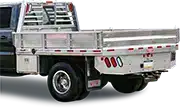
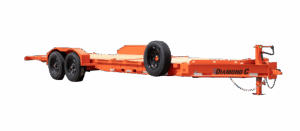


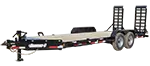


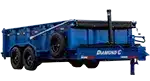

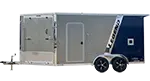
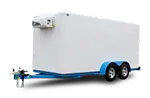
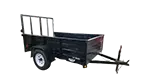

You’re standing on our lot looking at a bumper-pull equipment trailer that will weigh about 10,300 lbs after a 6,500-lb skid steer, attachments, chains, and other cargo are loaded. The price is right, and the trailer may be within its own Gross Vehicle Weight Rating. Your buddy with the same brand of truck towed a boat all summer. So can your half-ton handle this combination safely and within every published rating?
Maybe. But the honest answer depends on the truck’s model year, cab, bed, two-wheel-drive or four-wheel-drive configuration, engine, axle ratio, factory towing equipment, tire ratings, receiver rating, and actual payload sticker. Current advertisements may promote towing capacities as high as 13,500 lbs, but that number applies only to a specifically configured truck with the required towing equipment. Your truck may be rated for several thousand pounds less, even when the badge on the tailgate looks identical. :contentReference[oaicite:0]{index=0}
What Does “Half-Ton” Even Mean for Towing?
The “half-ton” label is a traditional market classification, not a statement that the truck can carry only 1,000 lbs and not a legal towing rating. Today it generally means a light-duty full-size pickup such as the Ford F-150, Chevrolet Silverado 1500, Ram 1500, GMC Sierra 1500, or Toyota Tundra. These trucks can be extremely capable, but the word “half-ton” does not tell you the vehicle’s payload, rear axle capacity, Gross Combined Weight Rating, or maximum loaded trailer weight.
Tow ratings across the class vary dramatically by configuration. A truck with a crew cab, four-wheel drive, large wheels, off-road equipment, a panoramic roof, and premium interior options may have less available payload and a lower trailer rating than a lighter regular-cab work truck. Engine choice matters, but engine output alone does not determine capacity. Wheelbase, axle ratio, cooling equipment, hitch hardware, suspension configuration, tire capacity, and the manufacturer’s certified combination rating all matter.
For example, the 2026 Ford F-150’s published engine-level maximums range from 8,400 lbs with the 2.7L EcoBoost V6 to 13,500 lbs with the 3.5L EcoBoost V6 when the required Tow/Haul Package and Max Tow Axle are installed. The 5.0L V8 is published at up to 12,800 lbs, while the 3.5L PowerBoost full-hybrid V6 is published at up to 12,400 lbs. Those are maximum available figures, not ratings that apply automatically to every truck equipped with those engines. :contentReference[oaicite:1]{index=1}
Real Numbers by Truck
Here are the current published maximum conventional towing figures for popular 2026 light-duty full-size pickups. These numbers are useful for comparison, but they are not substitutes for the towing guide, equipment record, payload label, and ratings for the exact truck being used:
| Truck | Current Engine Options | Maximum Available Conventional Towing |
|---|---|---|
| Ford F-150 | 2.7L EcoBoost V6 / 3.5L EcoBoost V6 / 3.5L PowerBoost Hybrid V6 / 5.0L V8 | Up to 13,500 lbs when properly equipped :contentReference[oaicite:2]{index=2} |
| Chevrolet Silverado 1500 | 2.7L TurboMax / 5.3L V8 / 6.2L V8 / 3.0L Duramax Turbo-Diesel | Up to 13,300 lbs when properly equipped :contentReference[oaicite:3]{index=3} |
| Ram 1500 | 3.6L Pentastar V6 / 3.0L Hurricane / 5.7L HEMI V8 | Up to 11,610 lbs when properly equipped :contentReference[oaicite:4]{index=4} |
| GMC Sierra 1500 | 2.7L TurboMax / 5.3L V8 / 6.2L V8 / 3.0L Duramax Turbo-Diesel | Up to 13,300 lbs when properly equipped :contentReference[oaicite:5]{index=5} |
| Toyota Tundra | 3.4L Twin-Turbo i-FORCE V6 / i-FORCE MAX Hybrid | Up to 12,000 lbs when properly equipped :contentReference[oaicite:6]{index=6} |
Notice that every entry says “when properly equipped.” That is not fine print to ignore. Chevrolet’s 2026 chart, for example, shows conventional trailer ratings ranging from the upper-8,000-lb range to 13,300 lbs depending on engine, cab, bed, drivetrain, GCWR, wheels, and Max Trailering Package. GMC’s chart shows the same kind of spread. Ford’s highest F-150 rating requires a particular engine and factory towing configuration, while other combinations using the same engine are rated lower. :contentReference[oaicite:7]{index=7}
Do not select a trailer from the maximum number shown in an advertisement. Verify the exact truck by VIN, review the model-year towing guide, confirm the axle ratio and factory packages, and compare the result with the truck’s payload, GVWR, rear GAWR, tire ratings, and hitch limits. The lowest applicable limit controls.
The Door Sticker Is the Law
The labels inside the driver-side door opening are the starting point for your specific truck. The Safety Compliance Certification Label identifies the truck’s Gross Vehicle Weight Rating (GVWR) and front and rear Gross Axle Weight Ratings (GAWR). A separate Tire and Loading Information label normally states the maximum combined weight of occupants and cargo for that particular vehicle. Factory options installed on that truck are already reflected in its labeled carrying capacity. :contentReference[oaicite:8]{index=8}
The door labels do not normally provide everything needed to establish trailer capacity. In particular, the Gross Combined Weight Rating (GCWR) and maximum loaded trailer weight are generally found in the manufacturer’s towing guide, owner’s manual, vehicle-specific towing calculator, or build information. Ford, for example, offers a VIN-based towing calculator for supported F-Series trucks. :contentReference[oaicite:9]{index=9}
GCWR is the maximum permitted combined weight of the loaded truck and loaded trailer. To check that limit accurately, weigh the truck as it will travel: driver, passengers, fuel, toolbox, hitch equipment, bed cargo, and anything else normally carried. Subtracting the truck’s actual loaded weight from GCWR shows how much combined-weight capacity remains, but that calculation does not override the manufacturer’s maximum trailer rating, GVWR, rear GAWR, payload label, receiver rating, tire capacity, or trailer ratings.
This is why using curb weight alone can be misleading. The truck in a towing chart may be calculated with only specified occupants and mandatory equipment. Your real truck may carry several people, a bed-mounted toolbox, recovery equipment, fuel cans, a weight-distributing hitch, and other cargo. All of that reduces the capacity available for trailer tongue weight.
Tongue Weight: The Number People Miss
A conventional bumper-pull trailer must place enough weight on the hitch to remain stable. A common target is approximately 10% to 15% of the trailer’s actual loaded weight, subject to the trailer and truck manufacturers’ instructions. Ford’s 2026 towing guide uses a 10% conventional tongue-load assumption in its F-150 calculations and warns that passengers, cargo, and tongue weight cannot cause the truck to exceed GVWR or rear GAWR. :contentReference[oaicite:10]{index=10}
That means a loaded 10,000-lb bumper-pull trailer may place roughly 1,000 to 1,500 lbs on the hitch. The exact amount must be measured rather than guessed. Tongue weight counts as cargo carried by the truck, along with the driver, passengers, tools, hitch equipment, and anything in the cab or bed.
Many well-optioned crew-cab half-tons have significantly less than 2,000 lbs of payload on their individual Tire and Loading Information labels, even though a stripped work-truck configuration may advertise a maximum payload above 2,000 lbs. Suppose a truck’s payload label allows 1,650 lbs. Two occupants weigh 350 lbs combined, a toolbox and gear add 200 lbs, and the weight-distributing hitch hardware adds another 100 lbs. That leaves about 1,000 lbs for tongue weight before reaching the payload limit, and rear GAWR or receiver limits may reduce the usable amount further.
Too little tongue weight can contribute to trailer sway. Too much can overload the truck’s rear axle, tires, suspension, or receiver and remove useful weight from the steering axle. A weight-distributing hitch can restore part of the load to the tow vehicle’s front axle and the trailer axles when correctly selected and adjusted, but it does not increase the truck’s GVWR, GCWR, GAWR, payload rating, receiver rating, or maximum trailer rating.
Overloading does not automatically erase every warranty on the truck. However, a manufacturer or service provider may deny coverage for a failure that was caused by overloading, misuse, incorrect hitch setup, or operation outside published limits. More importantly, an overloaded combination can have longer stopping distances, reduced steering control, excess tire heat, unstable handling, and greater risk during an emergency maneuver.
What Trailers Actually Weigh in the Real World
Trailer listings commonly show an empty or manufactured weight, but the tow vehicle must handle the trailer’s actual loaded weight. Options such as spare tires, winches, batteries, toolboxes, ramps, expanded-metal sides, additional decking, hydraulic equipment, and upgraded jacks add weight before the first piece of cargo is loaded. The trailer’s usable payload is approximately its GVWR minus its actual empty weight, not simply the sum of its axle ratings.
A utility trailer may be easy for a half-ton to pull when empty and much more demanding after a compact tractor, mower, side-by-side, landscaping material, or construction equipment is loaded. Enclosed cargo trailers also gain weight quickly because shelving, tools, furniture, machines, and supplies may add thousands of pounds. Large enclosed trailers introduce significant frontal area and wind resistance as well, which can affect performance even when the scale weight is below the maximum rating.
A useful current example is the Diamond C GTU premium tandem-axle utility trailer. It has a 7,000-lb GVWR, an 83-inch bed width, available lengths from 14 to 20 feet, and two 3,500-lb Lippert brake axles. That does not mean every half-ton can automatically tow a GTU at its full 7,000-lb GVWR. The truck must still have enough trailer rating, payload, rear axle capacity, receiver capacity, and tongue-weight allowance for the actual load. :contentReference[oaicite:11]{index=11}
Heavy equipment trailers are a different category. Diamond C’s LPX bumper-pull equipment line is rated from 15,500 to 24,000 lbs GVWR, while the HDT hydraulically dampened tilt line also spans 15,500 to 24,000 lbs. Both use Lippert axles as standard in their published base configurations. Those GVWR ranges place the trailers well beyond what a half-ton should be matched with at full capacity. :contentReference[oaicite:12]{index=12}
The Diamond C FMAX gooseneck flatbed family starts around 15,500 lbs GVWR and reaches as high as 40,000 lbs depending on the actual FMAX model and axle package. A trailer in that range requires a properly rated heavy-duty tow vehicle, compatible gooseneck hitch, sufficient payload for pin weight, correct tires and wheels, and careful attention to combined ratings. A half-ton’s advertised conventional towing maximum does not make it an appropriate match for an FMAX. :contentReference[oaicite:13]{index=13}
For many half-ton owners, a 7,000-lb GVWR trailer or lighter is a practical place to begin shopping, but it is not a universal rule. A properly equipped truck with adequate payload may safely handle more, while a heavily optioned truck with a low payload label may be limited to less. Common realistic pairings include a 5×10 or 6×12 utility trailer, a 7,000-lb tandem-axle utility trailer, a modest bumper-pull flatbed, a small enclosed cargo trailer, or a car hauler carrying a vehicle that keeps the complete combination within every rating.
The “Max Tow Package” Question
If you are buying a truck specifically to pull heavier trailers, the correct factory towing configuration is worth careful consideration. Package names and contents vary by manufacturer and model year. Depending on the truck, factory towing equipment may include a higher GCWR, a different rear axle ratio, upgraded cooling, a higher-rated receiver, an integrated trailer-brake controller, towing mirrors, trailer wiring, revised suspension components, camera technology, and software-based trailer functions.
On the 2026 F-150, the 13,500-lb published maximum requires the 3.5L EcoBoost V6, the Tow/Haul Package, and the optional Max Tow Axle. It is not the maximum rating for the PowerBoost hybrid. Chevrolet and GMC require the Max Trailering Package, and specific wheel configurations, for several of their highest ratings. The exact package content and rating should be verified through the original build record and the correct model-year towing chart rather than assumed from a badge or trim name. :contentReference[oaicite:14]{index=14}
If the truck was not built with the required equipment, aftermarket parts do not rewrite its certified ratings. You can add an appropriate brake controller, towing mirrors, transmission-temperature monitoring, auxiliary cooling, or a stronger receiver when the manufacturer permits it. Those upgrades may improve functionality, but they do not increase the truck’s published GVWR, GCWR, GAWR, payload rating, or maximum loaded trailer weight.
A Practical Pre-Tow Checklist
- Read both door labels. Record the truck’s GVWR, front GAWR, rear GAWR, tire capacities, and stated occupant-and-cargo limit. Find GCWR and the maximum loaded trailer rating in the model-year towing guide, owner’s manual, VIN lookup, or original build information.
- Verify the exact configuration. Confirm cab, bed, drivetrain, engine, axle ratio, factory tow package, wheel and tire package, and receiver rating. Do not assume another truck with the same trim badge has the same rating.
- Check the trailer certification label. Record trailer GVWR, GAWR, tire size, tire pressure, and other manufacturer information. Never exceed the trailer’s GVWR, axle ratings, tire ratings, coupler rating, jack rating, or cargo-securement limits.
- Weigh the complete combination. Use a public scale with the truck and trailer loaded for the trip. Obtain steer-axle, drive-axle, trailer-axle, and total combination weights when possible. Compare the results with GVWR, GAWR, GCWR, tire ratings, and the trailer’s ratings.
- Measure tongue weight. Use a suitable tongue-weight scale or a properly performed vehicle-scale method. Do not estimate tongue weight solely by placing a percentage of cargo ahead of the axles.
- Load for stability. Keep the load centered laterally, maintain the tongue-weight range specified by the manufacturers, place dense cargo low, and secure every machine or item with properly rated tie-downs and attachment points.
- Verify the brake controller. Test trailer-brake operation and adjust controller gain for the actual load. Under Indiana Code IC 9-19-3-3, trailers over 3,000 lbs GVWR require brakes. The tow vehicle’s brakes are not a substitute for functioning trailer brakes.
- Check the breakaway system. Confirm that the breakaway battery is charged, the switch operates, and the cable is attached independently to the tow vehicle rather than looped around a safety chain.
- Match the hitch components. The receiver, ball mount, hitch ball, weight-distributing equipment, coupler, and fasteners must all match the trailer and be rated for the loaded trailer and tongue weight. Use the exact ball diameter stamped on the coupler.
- Set the trailer level. Select a ball mount with the proper rise or drop. A trailer that runs noticeably nose-high or nose-low can distribute axle and tongue weight incorrectly.
- Connect the safety chains correctly. Attach them to the receiver’s designated frame-mounted loops, provide enough slack for turns without allowing the chains to drag, and cross them beneath the coupler when instructed so they can help support the tongue after a separation.
- Inspect tires and wheels. Check cold inflation pressure, load range, sidewall condition, tread, lug-nut torque, and tire age on both truck and trailer. Do not rely only on visible tread depth.
- Confirm lights and mirrors. Test running lights, turn signals, brake lights, and clearance lights. Make sure the mirrors provide an adequate view along both sides and behind the trailer.
When the Half-Ton Isn’t Enough
If you regularly tow near the truck’s maximum rating, haul skid steers or larger tractors, need a heavy dump trailer, or want a Diamond C LPX, HDT, LPT, DEC, WDT, or FMAX configuration, a three-quarter-ton or one-ton truck is generally the appropriate direction. Ford F-250 and F-350, Chevrolet Silverado 2500HD and 3500HD, GMC Sierra 2500HD and 3500HD, and Ram 2500 and 3500 trucks offer substantially more payload, rear axle capacity, receiver or gooseneck capacity, cooling capacity, and combined-weight capability when correctly configured.
There is no single 9,000-lb or 10,000-lb cutoff at which every half-ton becomes unsuitable. A well-equipped half-ton with a strong payload label may be properly rated for one 10,000-lb bumper-pull combination, while another half-ton may run out of payload with a much lighter trailer. The decision must be based on the exact loaded weights and the lowest applicable rating, not only on the engine or the advertised maximum.
Gooseneck towing requires special attention to payload because the trailer’s pin weight is carried in the truck bed. Even when a light-duty pickup has a published gooseneck rating, the truck must have a manufacturer-approved hitch installation, sufficient payload, adequate rear GAWR, compatible bed and frame configuration, and enough tire capacity. A high-GVWR equipment or flatbed gooseneck should not be selected merely because it will be operated empty on the first trip.
Trailer size also affects driver-license classification, but a trailer rated above 10,000 lbs does not automatically require a CDL by itself. Under the federal Class A definition, the combination generally reaches the threshold when the GCWR or gross combination weight is at least 26,001 lbs and the towed unit has a GVWR or gross vehicle weight over 10,000 lbs. Commercial use, hazardous materials, passenger transportation, state rules, and specific exemptions can affect the final requirement. A combination below 26,001 lbs is not made Class A solely because the trailer’s GVWR exceeds 10,000 lbs. :contentReference[oaicite:15]{index=15}
Plenty of customers at Spencer Trailers come in saying they want a gooseneck flatbed while driving a half-ton. We do not make the decision from the truck badge. We walk through the tow guide, payload label, axle ratings, hitch requirements, expected pin weight, trailer GVWR, empty weight, and actual cargo. Sometimes a lighter bumper-pull trailer solves the problem. Sometimes the equipment being hauled dictates a truck upgrade. That is a much better conversation to have on the lot than after the combination starts swaying or runs out of braking and payload margin on I-69.
If you’re not sure what your current truck can handle, or you want to look at what we have in bumper-pull flatbeds, enclosed cargo trailers, and utility trailers that may fit a properly equipped half-ton, stop in or give us a call at (812) 829-0226. We’re at 291 West State Hwy 46 in Spencer. Bring a photo of both door labels, your VIN, and any towing information you have. Those details tell us far more than the trim-level name alone.
After purchasing a trailer, remember that Indiana residents generally must apply for the required title and registration within 45 days of purchase or acquisition to avoid an administrative penalty. :contentReference[oaicite:16]{index=16} And if you’re shopping for a trailer right now, check the contact page to reach us directly. We’ll match the trailer to your actual truck, expected cargo, hitch, payload, and axle ratings, not to the truck shown in a commercial.


