







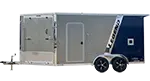
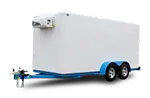
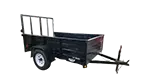

Drive down State Road 46 on a Saturday morning and it is common to see pickup trucks towing utility trailers, equipment trailers, dump trailers, and enclosed cargo trailers through Owen County. That is not an accident. Spencer, Indiana sits at the intersection of agricultural, construction, landscaping, towing, and recreational markets, and its location has helped make the town a practical place for central and west-central Indiana buyers to compare, purchase, equip, and service trailers.
The Geography Does a Lot of Work
Look at a map and Spencer’s position becomes clear. The town is approximately 17 miles west of Bloomington, about 55 miles southwest of Indianapolis, and roughly 56 miles east of Terre Haute. Those cities are not equally distant, but Spencer occupies a useful position between the Bloomington market, the Indianapolis metropolitan area, and communities throughout west-central Indiana. That service area includes farms, excavation companies, construction contractors, landscapers, property-maintenance crews, equipment owners, and rural homeowners who regularly need hauling capacity.
Interstate access matters here, even though no interstate runs directly through Spencer. State Road 46 provides a straightforward connection east toward Bloomington and I-69. From there, I-69 connects north through Martinsville to Indianapolis and south toward southwest Indiana. U.S. 231 runs through Spencer and provides a northern route toward Cloverdale and I-70, giving customers from Terre Haute, Plainfield, Avon, and other communities along the I-70 corridor another practical approach. State Road 46 also continues east through Nashville and Columbus, where it connects with I-65.
Those routes make Spencer reachable from Mooresville, Martinsville, Monrovia, Avon, Greenwood, Whiteland, Bloomington, Terre Haute, Columbus, and numerous smaller communities. The trip may not be the shortest drive for every customer, but trailer buyers frequently travel beyond the nearest lot when they need a particular GVWR, deck length, loading system, axle package, body style, or truck-bed configuration.
Owen County’s position on State Road 46 is especially useful. The highway runs east into Bloomington and continues toward Brown County and Columbus, while its western route serves communities across west-central Indiana. U.S. 231 adds a north-south connection through the county. Together, those roads make Spencer more accessible than its small-town setting might suggest.
What Central Indiana Actually Needs to Haul
The demand in this part of Indiana is not one-size-fits-all. Farms may need deck-over flatbeds, goosenecks, dump trailers, utility trailers, or stock trailers. Excavation and construction businesses need equipment trailers that can safely carry skid-steers, compact track loaders, mini excavators, attachments, and jobsite materials. Contractors often need enclosed cargo trailers that can secure tools overnight. Landscapers may need open utility trailers with rear gates, side-load access, trimmer racks, or enough payload for commercial mowing equipment.
That variety is why a multi-brand dealership can be more useful than a lot that concentrates on only one category. Spencer Trailers’ current and recently sold inventory includes Diamond C, Baseline Trailers by Diamond C, Liberty, Delco, H&H, Legend, Wells Cargo, Darkhorse Cargo, United Trailers, and Polar King Mobile units. The dealership also handles Zimmerman and Martin truck beds and bodies. Inventory changes continuously, so not every brand or configuration will be physically available on every visit.
When one contractor needs a Diamond C FMAX212 gooseneck with a 25,900 lb. GVWR and another customer needs a 2,990 lb. single-axle utility or a 7,000 lb. tandem-axle utility trailer, the dealership can compare products built for very different jobs. That breadth also helps customers avoid buying more trailer than they can safely tow or too little trailer for the equipment they intend to carry.
A few specifics on what that inventory actually covers:
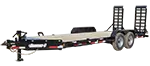
- Diamond C LPX Low-Profile Equipment Trailer: a bumper-pull, extreme-duty equipment-trailer family offered in multiple lengths and GVWR packages. Current configurations extend from approximately 14,900 or 15,500 lb. through 24,000 lb., depending on the selected package and rated configuration. Standard LPX construction uses tandem 7,000 lb. Lippert axles, with heavier axle packages available. It is designed for equipment such as skid-steers, compact track loaders, and mini excavators, subject to the trailer’s actual payload rating and load distribution.
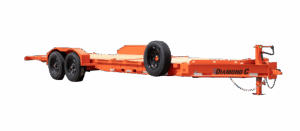
- H&H EX and EXL Tilt Trailers: Spencer Trailers’ current listings include 82-inch-wide, 20-foot electric-over-hydraulic tilt configurations with 7,000 lb. and 9,900 lb. GVWR ratings. The 7,000 lb. versions use two 3,500 lb. axles, while 9,900 lb. versions use two 5,200 lb. axles. These are practical choices for automobiles and lighter equipment when the trailer’s payload, deck dimensions, approach angle, and tie-down system match the load.
- Wells Cargo Road Force enclosed cargo trailers: the Road Force family includes conventional and V-front cargo configurations, along with wider models suited to vehicle and powersports transport. Available widths, lengths, door packages, interior heights, axle capacities, and GVWR ratings vary by model. Buyers should compare the exact unit’s data plate and build sheet rather than assuming every Road Force trailer carries the same rating.
- Liberty steel utility and car-hauler trailers: current inventory can include approximately 2,990 lb. GVWR single-axle utilities as well as 7,000 lb. tandem-axle utilities and car haulers. Heavier configurations are also available in selected categories. Liberty is built in Indiana and offers practical steel-trailer choices for homeowners, landscapers, contractors, and vehicle owners.
- Delco work trailers: Delco produces utility, dump, stock, gooseneck, and roll-off configurations. A current Spencer Trailers example is a 16-foot gooseneck roll-off trailer rated at 16,000 lb. GVWR with two 8,000 lb. axles, electric brakes, hydraulic jacks, a hydraulic tilt deck, and roll-off bins. Exact Delco inventory and specifications vary by unit.
The listed GVWR is not the same thing as payload capacity. Payload is determined by subtracting the trailer’s actual empty weight, including installed options, from its GVWR. A tarp system, spare tire, hydraulic dovetail, toolbox, winch, heavier ramps, or other option adds useful capability but also adds empty weight. The certification label and the documented weight of the individual trailer should control the calculation.
Dealer Culture in Owen County
There is a specific kind of buying experience available at a rural family dealership that is difficult to duplicate through an online listing or a general equipment retailer. The salesperson discussing the price can also help compare GVWR, payload, deck height, loading angle, coupler type, brake requirements, hitch height, axle configuration, tire capacity, and the limitations of the customer’s tow vehicle.
That knowledge matters because trailer selection involves more than looking at the truck’s advertised maximum tow rating. The truck’s receiver rating, hitch rating, gross vehicle weight rating, gross axle weight ratings, payload capacity, gross combination weight rating, tire ratings, brake controller, and actual passenger and cargo weight can all affect what it can safely tow. The trailer’s coupler, safety chains, breakaway system, tires, wheels, axles, brakes, and load-securement equipment must also be rated for the job.
Indiana generally requires brakes on trailers with a gross weight greater than 3,000 lb. A high-GVWR trailer also does not automatically create a commercial driver’s license requirement by itself. For a Group A CDL, the combination must generally have a GCWR or actual gross combination weight of at least 26,001 lb., and the towed unit must have a GVWR or actual gross weight greater than 10,000 lb., subject to vehicle use and applicable exemptions. Customers buying a large equipment trailer for commercial work should evaluate the complete truck-and-trailer combination rather than relying on the trailer rating alone.
Trailer prices now cover a much wider range than a simple $4,000-to-$18,000 estimate. A basic single-axle utility may cost several thousand dollars, while a premium Diamond C FMAX, hydraulic-dovetail trailer, heavy dump trailer, roll-off system, or high-GVWR equipment trailer can cost well over $30,000. Options, axle packages, tires, ramps, hydraulic systems, deck length, material, freight, taxes, and current manufacturer pricing all affect the final amount.
A wrong axle assumption, insufficient payload, improperly matched coupler, overloaded receiver, or poorly distributed load is not merely inconvenient. It can create instability, excessive tongue weight, inadequate braking, component failure, or a violation of weight and licensing rules. Dealers serving a close local market have a strong reason to help customers get those details right because their reputation remains visible long after the sale.
Spencer Trailers is a family-owned and operated business. According to the dealership, the family has conducted business in Spencer since 1973, and the trailer operation began in 2001. The dealership is located at 291 West State Hwy 46, Spencer, IN 47460. Customers can call or text (812) 829-0226 to ask about current inventory, specifications, financing, truck-bed installation, parts, or the availability of a particular configuration.
Why Whiteland-Area Buyers Make the Drive
The Whiteland and Greenwood corridor along I-65 south of Indianapolis includes contractors, small builders, landscapers, service companies, motorsports enthusiasts, rural property owners, and hobby-farm operators. It is suburban enough to support significant equipment purchases while remaining close to agricultural land, construction growth, and businesses that regularly use trailers.
Dealers operate throughout the Indianapolis and Johnson County markets, but exact inventory depth varies. A nearby lot may have utility trailers while lacking a high-GVWR gooseneck, a hydraulic tilt trailer, a specific dump-body size, or an enclosed trailer with the required height and door arrangement. That is where a drive to a larger multi-brand inventory becomes worthwhile.
A buyer might be searching for a 25- or 30-foot Diamond C FMAX flatbed with a 25,900 lb. GVWR, an LPX equipment trailer with MAX Ramps, an H&H electric tilt, or an 8.5-foot-wide enclosed trailer with a ramp door, side-access door, interior lighting, and sufficient payload. Those are purchases in which the exact configuration matters more than simply locating the closest trailer dealer.
Spencer is roughly 50 to 60 road miles from the Whiteland and New Whiteland area, depending on the starting point and chosen route. Travel time can be an hour or more and will vary with traffic and road conditions. For a trailer intended to remain in service for many years, comparing several suitable units in person can justify that drive.
The same logic applies to customers coming from Mooresville, Monrovia, Avon, Martinsville, Bloomington, Columbus, or Terre Haute. Spencer occupies a useful place in the regional dealer map because it combines a small-town location with inventory spanning light residential trailers, commercial equipment trailers, premium goosenecks, enclosed cargo units, dump trailers, roll-off systems, refrigeration trailers, and truck bodies.
What “Local Dealer Culture” Actually Means for Buyers
A quick breakdown of the practical differences when you buy from a local dealer versus a distant distributor or online-only source:
| Factor | Local Family Dealer | Large Chain / Online |
|---|---|---|
| Pre-sale configuration advice | In-person discussion based on the tow vehicle, load, hitch, and intended use | Often limited to published specifications, forms, or remote support |
| Walk-the-lot comparison | Compare available trailers, loading systems, deck heights, and construction in person | Usually limited to photographs, videos, or units at separate warehouse locations |
| Post-sale questions | Direct access to local sales, parts, and service staff familiar with the products | May require customer-service routing or contact with a separate service location |
| Availability of niche configs | May be stocked locally or factory-orderable; availability and lead times vary | Depends on warehouse inventory, shipping area, and manufacturer allocation |
| Truck bed installation | Professional installation is available for compatible Zimmerman and Martin products | Installation is often handled separately by a third-party upfitter |
That last row is worth a pause. Replacement truck beds, service bodies, dump bodies, and skirted work bodies are not stocked by every trailer dealership. The correct body must be matched to the truck’s bed length or cab-to-axle measurement, frame, fuel-fill location, wiring, rear suspension, axle ratings, hitch requirements, and intended towing use.
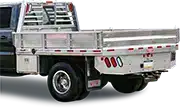
Spencer Trailers stocks Zimmerman steel and aluminum truck beds and service bodies, with professional installation available. The dealership’s site also represents Martin truck bodies. Current Zimmerman inventory includes conventional steel beds, aluminum beds, Ranch Master bodies, service bodies, and dump-bed configurations. That gives contractors and agricultural customers an opportunity to equip a work truck and select a compatible trailer through the same dealership.
A truck-bed installation should never be treated as a cosmetic swap. The completed truck must retain appropriate lighting, mud-flap coverage where required, fuel access, tire clearance, electrical connections, receiver or gooseneck-hitch compatibility, and safe axle loading. An experienced installer can evaluate those details before the original pickup bed is removed.
The Inventory Advantage in Plain Terms
It is one thing to say a dealer has “a lot of trailers.” It is more useful to explain what that means in practice. Browse the current inventory at Spencer Trailers and you can filter among enclosed cargo trailers, open utility trailers, dump trailers, roll-off systems, car haulers, goosenecks, deck-over trailers, equipment trailers, tilt trailers, mobile refrigeration trailers, truck beds, and service bodies.
The inventory page contains both available units and, at times, products that are on order. Counts and individual listings change as trailers arrive, sell, or are reserved. Customers should confirm whether a listing is physically on the lot, incoming from the manufacturer, or available only by special order before traveling.
Having a suitable trailer in stock can eliminate the need to wait for a factory build, but custom-order lead times should not be described as a fixed six-to-twelve-week window. Production schedules vary by manufacturer, model, options, dealer allocation, component availability, and season. A local dealer can provide a current estimate for the specific build rather than relying on a generic timeline.
For buyers who are not yet sure what they need, the variety is educational. Standing beside an aluminum car hauler and a steel equipment trailer makes differences in empty weight, frame design, deck construction, fenders, tie-downs, ramp geometry, and price easier to understand. Aluminum can reduce empty weight and resist red rust, but it does not automatically provide more payload or make one trailer better for every job. The GVWR, actual empty weight, structure, intended load, and maintenance requirements still control the comparison.
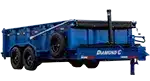
The same is true within one manufacturer’s lineup. A Diamond C LPX, HDT, DEC, LPT, and FMAX serve different loading and hauling needs even when two units carry similar GVWR ratings. The LPX is a low-profile equipment trailer, the HDT uses a hydraulically dampened tilt design, the DEC is a deck-over equipment trailer, the LPT is a heavy-duty telescopic dump, and the FMAX is a gooseneck flatbed family extending from approximately 15,500 lb. to 40,000 lb. GVWR by model.
Diamond C was founded in 1985 and builds its trailers in Mt. Pleasant, Texas. Its premium FMAX, HDT, LPT, LPX, WDT, and DEC lines use Lippert axles as standard equipment, with axle ratings and suspension packages determined by the model. Current Diamond C trailers also use the company’s multi-stage DM Difference Maker coating system. Those are the kinds of construction details customers can examine directly when several models are displayed together.
What Spencer Gets Right That Others Don’t
Small towns throughout Indiana have lost many forms of local retail during the past two decades. Businesses that continue to draw regional customers usually provide something that a general retailer or online marketplace cannot easily duplicate. Trailer dealerships fit that description because the product is large, configuration-sensitive, difficult to ship economically, and closely connected to tow-vehicle safety and post-sale support.
A photograph can show the color and general layout of a trailer, but it cannot fully communicate deck height, ramp effort, tilt speed, fender clearance, jack operation, coupler height, interior dimensions, door clearance, weld access, tie-down placement, or how a piece of equipment will approach the deck. Those factors are easier to evaluate with the trailer in front of the customer.
Spencer Trailers has remained focused on that physical, service-oriented part of the business: family ownership, a multi-brand selection, local product knowledge, parts and service access, truck-body installation, and a central location serving several Indiana markets. It is not simply a place to find a trailer with the right length printed in the listing. It is a place to compare whether the trailer’s total configuration fits the truck, load, work, and budget.
For customers throughout central and west-central Indiana who need a trailer matched to an actual use case rather than whatever happens to be closest, the drive to Spencer can make practical sense. The value is not merely the number of units on the lot. It is the ability to compare light- and heavy-duty products, ask detailed questions, verify ratings, and leave with a combination that is appropriate for the work.
Thinking about a specific brand or trailer type? Reach out before you make the drive to confirm that the unit is available and to discuss your tow vehicle, equipment weight, required payload, preferred loading system, and budget. You can also check the recently sold list to see which trailer and truck-body configurations have been moving through the dealership and which products may be available again through incoming inventory or a factory order.


