








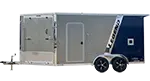


You need an enclosed trailer that can take a 1969 Camaro without scraping the nose, crowding the fenders, or leaving you nowhere to secure the car. Or maybe you haul tools and equipment every day and need a floor, frame, ramp, and wall system matched to real working loads. Either way, United Trailers is a brand you are likely to encounter, especially when you start comparing ordinary cargo trailers with purpose-built car and race haulers.
United has manufactured enclosed trailers in Bristol, Indiana since its first trailer came off the production line on April 17, 1989. The company builds steel-framed and all-aluminum cargo, commercial, car-hauler, race, gooseneck, fifth-wheel, and specialty trailers. That breadth matters for dealers like us who put their names behind the brands they sell. We carry United at Spencer Trailers because buyers can choose a straightforward cargo trailer, a dedicated car hauler, or a heavily customized race trailer without forcing one basic design to cover every possible job.
Two Directions: Aluminum vs. Steel Construction
United builds both steel-framed trailers and all-aluminum trailers, and the distinction is more important than the exterior skin. Many enclosed trailers have aluminum exterior panels over a steel frame, so a trailer should not be called all-aluminum simply because the outside is aluminum. United’s all-aluminum models use an aluminum structural frame, while models such as the UJ, UXT, UXTV, Classic, Limited, Premier, and Super Hauler use steel-frame or steel uni-body construction with aluminum exterior components.
The all-aluminum lineup includes models such as the UATV cargo trailer, UATGN gooseneck, and the A Classic, A Limited, and A Premier race-hauler packages. United describes these trailers as using its aluminum X-frame construction. Aluminum does not develop iron-oxide rust the way steel does, and the reduced empty weight can improve available payload or make the combination easier for an appropriately rated tow vehicle to handle. That does not make an aluminum trailer maintenance-free. Aluminum can still corrode, especially where dissimilar metals, road salt, trapped moisture, or damaged finishes are involved, and the plywood floor still needs protection from standing water and chemical spills.
United’s steel-framed cargo and race lines generally provide a lower entry price than a comparable all-aluminum build and offer a wide range of frame, axle, length, and customization choices. Current UXT and UXTV specifications use steel uni-body construction, I-beam main frames on larger models, 16-inch-on-center crossmembers, roof bows, and wall posts, plus protective undercoating. Steel is a practical choice for contractors, mobile workshops, commercial users, and racers who prioritize configuration flexibility and load capacity over the lowest possible empty weight.
Neither construction type is universally better. The right choice depends on the trailer’s actual empty weight, certified GVWR, payload requirement, loading method, tow vehicle, climate, storage conditions, annual mileage, and budget. A well-specified steel trailer is better than an underbuilt aluminum trailer, and an all-aluminum trailer may be worth the additional cost when corrosion resistance and weight savings are central to the job.
United’s Cargo Trailer Lineup
On the cargo side, United offers packaged general-purpose trailers, commercial steel-frame trailers, all-aluminum cargo models, and custom gooseneck or fifth-wheel configurations. Contractors, landscapers, motorsports teams, service businesses, and recreational users should compare the model family first, not just the outside dimensions.
- United UATV All-Aluminum Cargo: The UATV is an aluminum-frame V-nose cargo trailer offered in single- and tandem-axle configurations. Current published sizes include 6-foot-wide models from 10 to 14 feet, 7-foot-wide models from 12 to 16 feet, and 8.5-foot-wide tandem models extending into longer cargo and vehicle-hauling lengths. Published construction includes 16-inch-on-center floor, wall, and roof framing, a 3/4-inch plywood floor, 3/8-inch plywood walls, a one-piece aluminum roof, .030 taped exterior aluminum, torsion axles, and aluminum wheels. Door, D-ring, vent, lighting, and ramp equipment varies by size and build.
- United UJ, UXT, and UXTV Steel-Frame Cargo: The UJ is United’s packaged basic cargo model, with current sizes ranging from compact single-axle trailers through 8.5-foot-wide tandem units. It uses tube-frame construction, torsion axles, a 3/4-inch plywood floor, 3/8-inch plywood walls, a screwless-style taped exterior, an RV side door, and four bolt-in D-rings in the current standard package. The UXT and V-front UXTV are the heavier commercial lines. The 6-foot-wide UXT runs from approximately 2,990 to 7,000 pounds GVWR, while larger UXT and UXTV configurations can be ordered with heavier axles, longer bodies, and substantially higher GVWRs. The UXTV line currently lists configurations from 5,200 through 24,000 pounds GVWR, depending on length, axle count, axle rating, and the complete certified build.
United’s cargo and commercial GVWR range therefore extends far beyond the roughly 2,990-to-9,990-pound range found in many dealer-stock cargo trailers. Small single-axle models may be certified at 2,990 pounds, ordinary tandem cargo trailers are commonly found at 7,000 or 9,990 pounds, and commercial UXT or UXTV builds can be configured much heavier. The axle ratings alone do not establish the trailer’s legal GVWR. The frame, coupler, tires, wheels, suspension, brakes, safety equipment, and manufacturer’s certification all matter, so the VIN label and build sheet are the controlling references for a particular trailer.
Current United specifications list Dexter torsion axles across many cargo, all-aluminum, car-hauler, and race models. On the commercial UXT and UXTV lines, 3,000-pound axle configurations are listed without brakes, while 3,500-pound and heavier axle configurations use electric brakes. Indiana requires brakes on trailers with a GVWR over 3,000 pounds, so buyers should verify the certified GVWR, brake equipment, breakaway system, tow-vehicle brake controller, and whether every required braked axle is operating correctly before towing.
Interior height also varies by width and model. Current UJ and UATV specifications generally provide approximately 6 feet 6 inches of interior height on 6-foot-wide models and approximately 7 feet on 7-foot- and 8.5-foot-wide models. United’s commercial UXT and UXTV lines are generally listed with approximately 7 feet of interior height. Extra height may be available, but it increases frontal area, overall height, weight, wind exposure, and possibly the need for a taller rear-door opening. Measure the tallest item you plan to load rather than relying only on the nominal interior-height figure.
The Race and Car-Hauler Series
This is where United’s long involvement with motorsports becomes especially relevant. The current dedicated steel-frame car-hauler and race lineup includes the Classic, Classic V, Limited, Premier, Super Hauler, Super Hauler Gooseneck/Fifth Wheel, and Extreme stacker configurations. United also offers all-aluminum race-hauler packages under the A Classic, A Limited, and A Premier names, along with the customizable UATGN aluminum gooseneck.
Key differences from standard cargo:
- Approximately 7 feet of interior height is standard on many current United car-hauler and race packages. That provides more working room than a short cargo box, but it does not automatically guarantee that a lifted truck, roof-mounted accessory, tall race vehicle, or enclosed cab will fit. The rear-door opening, ramp transition, wheel-well spacing, interior equipment, and actual vehicle height must all be measured.
- Dedicated car haulers use a ramp door with a beavertail or transition area to reduce the approach angle. Many packaged models list a 3,000-pound ramp door, while the Super Hauler uses a spring-assisted ramp with a wide opening on 8.5-foot-wide builds. Ramp capacity must be compared with the vehicle’s axle loading, not only its total weight. Low splitters, long overhangs, wheelbase, tire width, and loading angle can be just as important as the ramp’s published rating.
- Many current United car-hauler packages use a .030 taped or screwless-style aluminum exterior, a one-piece aluminum roof, rear wing, wide rear opening, and 16-inch-on-center floor, wall, and roof framing. A screwless appearance creates a cleaner exterior, but it should not be treated as a substitute for inspecting seams, roof edges, doors, sealants, and fasteners during routine maintenance.
- GVWR and axle capacity depend on the package. The current steel-frame Classic is commonly configured at 9,990 pounds GVWR, while the Classic V is offered in 9,990- and 14,000-pound versions. The all-aluminum A Classic is available with tandem 5,200- or 7,000-pound axle choices. Super Hauler tag, gooseneck, and fifth-wheel builds can be configured with tandem or triple torsion axles in several ratings, so heavier custom race trailers should be evaluated from the completed manufacturer’s certification rather than a generic model description.
The interior options on a race build are where both weight and price can climb quickly. A basic Classic or A Classic is fundamentally different from an A Premier, a custom Super Hauler, or an Extreme stacker. Depending on the model, available or included equipment may encompass base and overhead cabinets, wheel-box cabinets, tire racks, winches, spare-tire compartments, 12-volt lighting, 30- or 50-amp shore-power systems, receptacles, exterior GFI outlets, converters, batteries, roof vents, air-conditioning preparation, generator compartments, awnings, air lines, observation decks, living quarters, and additional access doors.
There is no responsible universal price for a 24-foot United car hauler because construction type, axle package, GVWR, interior finish, electrical package, cabinets, freight, and model year can change the total substantially. A straightforward bumper-pull car hauler and a custom race trailer with cabinets, climate control, shore power, generator provisions, and extensive lighting may share similar exterior dimensions while being completely different trailers. Compare an itemized build sheet and current dealer quote rather than relying on a broad online price range.
Options Worth Knowing About
United offers a long customization list across its cargo, commercial, and race lines. Some equipment is standard on one package and optional on another, so the word “standard” should always be tied to a specific model, length, axle package, and model year.
| Option | Best For |
|---|---|
| RV side door, escape door, or jump door | Walk-in access, easier driver-side vehicle exit, and reaching equipment without lowering the rear ramp; door dimensions and placement must be matched to cabinets and vehicle position |
| Axle and GVWR configuration | Matching payload, ride height, wheel size, brakes, and legal capacity; torsion, spread, tandem, and triple-axle arrangements vary by model |
| Aluminum wheels | Appearance and corrosion resistance; standard on many current United packages, but wheel and tire load ratings still need to match the certified trailer |
| Roof vent, powered fan, or A/C preparation | Managing heat and moisture in race, contractor, vending, and recreational builds; powered equipment also requires a properly designed electrical system |
| Cabinets, shelving, and tool-crib packages | Race teams and contractors who need organized storage; cabinet weight and placement must be included in payload and tongue-weight calculations |
| E-track, D-rings, and recessed anchors | Securing vehicles, tools, carts, and palletized cargo; the track or ring rating is only useful when the supporting structure and attachment method are equally adequate |
| Spare tire carrier or spare-tire compartment | Any trailer used beyond short local trips; the spare should match the required size, load range, bolt pattern, and usable inflation pressure |
The spare tire sounds like a small option until a loaded trailer has a tire failure far from home. The correct spare, a suitable jack, wheel chocks, properly sized lug wrench, torque wrench, warning devices, and a safe roadside plan are more valuable than simply carrying an unverified wheel in the trailer. Option pricing varies by wheel, tire, mount, and compartment design, so it should be confirmed on the quote instead of assumed to be a fixed-cost add-on.
How United Compares to What Else We Carry
We also carry Wells Cargo and Darkhorse Cargo enclosed trailers. The honest comparison starts by matching construction type, dimensions, GVWR, axle package, ramp, interior finish, warranty, and intended use instead of comparing brand names alone.
Wells Cargo has a long history in enclosed trailers and offers far more than contractor cargo boxes. Its current lineup includes dedicated auto and racing models such as Road Force Auto, Road Force V-Front Auto, MotorTrac, MotorTrac SS aluminum, MotorTrac Gooseneck, and REVV. That means a Wells Cargo race trailer can be a direct competitor to a United car hauler or race build. United’s advantage for a particular buyer may be its combination of packaged steel and all-aluminum models, custom Super Hauler configurations, available local inventory, or the exact factory options needed. Wells Cargo may be the better fit when one of its packaged layouts, materials, or dealer-stock units more closely matches the job.
Darkhorse Cargo is based in White Pigeon, Michigan and competes strongly in value-oriented enclosed cargo, sport, contractor, and car-hauler configurations. Many Darkhorse DHW trailers use a steel frame with aluminum exterior skin, spring axles as the standard arrangement, and package levels that change framing spacing, interior wall material, exterior finish, ramp construction, vents, lighting, and other equipment. Darkhorse can be an excellent choice for buyers who want a practical steel-frame cargo trailer without paying for features they will not use.
An 8.5-by-24-foot trailer illustrates why the comparison must be specific. A Darkhorse DHW in that size may be certified at 9,990 pounds with tandem 5,200-pound axles, while a United trailer of similar dimensions could be a steel-frame UXT, a packaged steel car hauler, or an all-aluminum UAT-series build. Those are not interchangeable products simply because the length, width, or GVWR looks similar. Compare empty weight, usable payload, frame material, crossmember spacing, axle type, brake equipment, rear-opening dimensions, ramp rating, tie-down structure, roof and wall construction, electrical equipment, warranty, and final price. A screwless exterior or aluminum frame can be valuable, but neither feature by itself proves that one complete trailer is more durable than another.
A Quick Q&A on Common United Trailer Questions
Do United car haulers come with tie-down rings standard?
It depends on the model. The current Classic, Classic V, and Limited packages list four bolt-in D-rings, while the Premier and A Premier list eight. The UJ cargo package lists four bolt-in D-rings. On the UATV, D-rings are standard only on specified sizes in the current published equipment list. Custom Super Hauler and commercial builds can be ordered with D-rings, E-track, or other anchor systems. Confirm the quantity, location, attachment, and rating on the actual trailer before assuming it is ready for a particular vehicle.
What’s the standard warranty?
United’s current warranty page and most current model pages advertise a 3-year limited warranty. Coverage is subject to the written warranty’s terms, exclusions, maintenance requirements, original-purchaser provisions, claim procedures, and any separate warranties supplied by component manufacturers. Ask for the warranty document that applies to the specific VIN and complete the required warranty registration after purchase.
Are torsion axles worth the upgrade cost on a cargo trailer?
Torsion axles are already standard on many current United models, including the UJ, UATV, UXT, UXTV, and packaged car haulers. They provide compact suspension packaging, independent suspension action at each wheel, and fewer external suspension components than a conventional leaf-spring equalizer system. That does not guarantee a perfect ride. Ride quality still depends on correct loading, axle capacity, tire pressure, tire construction, speed, road conditions, wheelbase, and tongue weight. The best axle is the one correctly selected for the trailer’s real operating weight and service conditions.
What’s the longest United race trailer available?
United’s packaged bumper-pull Classic, Classic V, Limited, and Premier models generally run from approximately 20 to 30 feet, depending on the package. The Super Hauler tag line lists tandem-axle lengths through 34 feet and triple-axle lengths through 38 feet. Custom Super Hauler gooseneck and fifth-wheel configurations are listed in lengths up to 52 feet, while the all-aluminum UATGN lineup lists triple-axle configurations extending to 53 feet. Availability, legal dimensions, axle selection, tow-vehicle requirements, and factory engineering must be confirmed for any long custom build.
Getting the Right Spec for Your Use
The single biggest mistake buyers make with enclosed trailers is choosing GVWR from the weight of the main vehicle while overlooking the trailer’s own empty weight and everything else placed inside. A 3,200-pound car can easily be accompanied by a winch, battery, cabinets, tools, fuel containers, fluids, spare parts, jack, generator, golf cart, and multiple sets of tires. That equipment can add 1,000 pounds or more before personal gear is loaded.
Payload is calculated from the trailer’s certified GVWR minus its actual empty weight as equipped. For example, if a trailer is certified at 7,000 pounds and weighs 2,800 pounds empty, its theoretical payload is about 4,200 pounds. A 3,200-pound car plus 1,400 pounds of tools, tires, fluids, and installed equipment would already exceed that amount. Factory options also add empty weight, so a heavily equipped trailer may have less payload than a basic trailer carrying the same GVWR label. Use the manufacturer’s as-built weight when available and verify the loaded trailer on a certified scale.
Moving from a 9,990-pound trailer to a 14,000-pound trailer can provide useful capacity, but it is not merely a paperwork change. The heavier build may use different axles, brakes, tires, wheels, frame components, coupler, jack, ramp, and suspension setup. The tow vehicle must also have adequate tow rating, GCWR, hitch rating, receiver or gooseneck capacity, rear-axle capacity, tire capacity, payload, braking capability, and trailer-brake control. A larger trailer rating does not increase what an under-rated truck can legally or safely tow.
Indiana buyers should also keep the legal thresholds straight. Trailers over 3,000 pounds GVWR require brakes under Indiana law. A trailer rated over 10,000 pounds does not automatically require a Class A CDL by itself. For a combination that is subject to CDL rules, the Class A threshold generally involves a GCWR or actual gross combination weight of 26,001 pounds or more together with a towed unit over 10,000 pounds. Commercial use, private use, hazardous materials, passenger transportation, interstate operation, and available exemptions can affect the analysis, so operators should verify the rules that apply to their exact use. Indiana purchasers should also apply for title within 45 days of acquiring the trailer to avoid the state’s administrative penalty.
We can walk through the configurations with you in person or over the phone. Bring the year, make, model, dimensions, and weight of the vehicle or equipment you plan to haul, plus an honest estimate of tools, cabinets, spare parts, and other cargo. Reach us at (812) 829-0226 or stop by 291 West State Hwy 46 in Spencer to see what we have in stock. And if you want to browse what’s on the lot right now, check the current inventory before you make the drive.
What are you hauling? That is the question that should drive the model, construction, axle package, GVWR, ramp, tie-down system, and every other part of the decision.


