


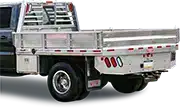
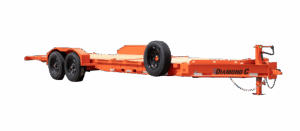



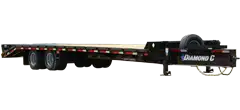
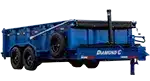

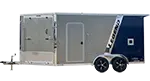
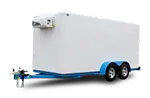
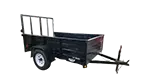

You’ve hauled enough loads to know the difference between a trailer that is properly matched to the job and one that becomes a repair project. H&H Trailers, manufactured in Clarinda, Iowa, offers a broad USA-built lineup that includes steel and aluminum utility trailers, open and enclosed car haulers, equipment trailers, tilt trailers, dump trailers, and deckover models. Spencer Trailers carries H&H, and the questions we hear most often are practical ones: “Which H&H line fits my load?” and “What should I expect from it after several Indiana winters?”
Those are the right questions. The answer depends on the specific model, certified GVWR, empty weight, deck dimensions, loading system, and options installed. Here is a straightforward look at the major H&H product categories and the current specifications buyers should compare.
The Powder Coat Difference
Before getting into specific models, the protective finish deserves attention. H&H does not describe every current steel trailer with one universal coating specification. Current steel car haulers and several tilt models list a premium powder coat finish, while some utility and industrial equipment models are described as having an industrial-grade polymer finish. The exact finish can therefore vary by model family, production year, and configuration, so it is worth confirming the build sheet for the trailer on the lot.
Powder coating is electrostatically applied and heat-cured, creating an even protective layer over properly prepared steel. H&H construction also varies by trailer category: utility and car-hauler models use combinations of tube and channel steel, industrial equipment trailers use heavier steel framing, and TOPLINE® equipment and deckover models use high-tensile I-beam construction where specified. No protective coating eliminates maintenance. Indiana road salt should be washed away regularly, chipped areas should be touched up promptly, and exposed fasteners, deck retainers, weld areas, and high-wear loading surfaces should be inspected before corrosion can spread beneath the finish.
H&H Utility Trailers
The H&H landscape and utility lineup covers one of the widest ranges of users. Current steel and aluminum offerings include rail-side, solid-side, wood-side, and ATV-oriented configurations. Depending on the series, bed widths run from approximately 60 to 82 inches, bed lengths range from 8 to 24 feet, and GVWRs range from 2,990 pounds on compact single-axle trailers to 14,000 pounds on the Heavy Duty Rail Side Utility Trailer – 14K. Between those ends are common 7,000-pound tandem models and a 9,900-pound heavy-duty rail-side configuration.
A few things that stand out on the current H&H utility line:
- Spring-assisted fold-flat rear ramp gates are standard on many steel rail-side and ATV models, while selected aluminum models use lightweight bi-fold aluminum ramps
- ATV-oriented configurations can provide convertible side rails for side loading in addition to the primary rear ramp
- Pressure-treated wood flooring is common on steel utility models, while all-aluminum models use corrosion-resistant aluminum construction and model-specific deck components
- LED lighting, safety chains, easy-lube hubs, tie-down points, and enclosed or sealed wiring harnesses are included on many current models, with exact equipment determined by series
The utility line works well because buyers can select the side style, axle arrangement, width, length, ramp, and GVWR that match the actual job. A 2,990-pound single-axle rail-side trailer can be a practical mower or household-hauling trailer, while a tandem 7,000-, 9,900-, or 14,000-pound model is a different class of equipment. Common service items such as lights, tires, bearings, brakes, and deck lumber can be serviced through a qualified trailer shop, but model-specific gates, fenders, wiring components, and structural parts should be ordered using the trailer’s VIN and build information.
H&H Aluminum Trailers
Steel is strong and economical, while aluminum reduces empty weight and does not develop red rust the way unprotected steel does. Aluminum can still oxidize, fatigue, or experience galvanic corrosion where dissimilar metals remain in contact, so it should not be treated as maintenance-free. Its main advantages are lower curb weight, strong resistance to road-salt corrosion, and the possibility of retaining more usable payload within the tow vehicle’s ratings.
H&H’s current aluminum offerings include rail-side, solid-side, wood-side, low-side, and ATV utility trailers, along with open aluminum car haulers and aluminum Speed Loader® tilt car haulers. Construction and decking vary by series, but current aluminum car haulers use an all-aluminum frame, an extruded aluminum plank dovetail, removable aluminum fenders, and integrated rub rails and stake pockets. Aluminum utility models commonly include wrapped tongue construction, aluminum ramps, LED lighting, sealed wiring, and aluminum wheels, although buyers should confirm which features are standard on the exact trailer.
The current open H&H Aluminum Car Hauler Trailer is 82 inches wide and is offered with bed lengths from 14 to 20 feet and GVWR choices of 7,000, 9,900, or 14,000 pounds, depending on length. The aluminum Speed Loader® tilt car hauler expands the range to 18 through 24 feet with GVWRs from 7,000 to 14,000 pounds. Those ratings do not automatically mean that every 14,000-pound trailer can carry a 14,000-pound vehicle. Available payload is the trailer’s certified GVWR minus its actual empty weight, installed options, tools, spare tire, winch, and other cargo. Vehicle length, tire placement, tongue weight, axle loading, door clearance, and the tow vehicle’s ratings must also fit.
H&H Equipment Trailers
Equipment trailers face a different kind of stress than general-purpose utility or car-hauler trailers. Skid steers, compact tractors, mini excavators, trenchers, and attachments concentrate substantial weight through relatively small tires or tracks. Loading also places temporary stress on the rear frame, ramps, suspension, coupler, jack, and tow vehicle, so the trailer must be selected by actual equipment weight and loading geometry rather than by appearance alone.
The current H&H equipment catalog spans several duty levels. The single-axle gravity-tilt line ranges from 6,000 to 9,900 pounds GVWR. Heavy-duty rail-side utility configurations are offered at 9,900 and 14,000 pounds. The primary Industrial Equipment Trailer and Super Deluxe Ramp Industrial Equipment Trailer families run from 14,000 to 16,000 pounds GVWR, while TOPLINE® I-Beam equipment and tilt models reach from approximately 15,400 to 22,000 pounds. Current 14,000-pound Industrial models use tandem 7,000-pound axles, and 16,000-pound versions use tandem 8,000-pound axles. Axle GAWR and trailer GVWR are separate ratings, so GVWR should always be read from the certification label rather than calculated only by adding the axle ratings.
Loading systems vary by series. Standard Industrial Equipment Trailers can include 5-foot spring-assisted stand-up skid-loader ramps, a dovetail, a 2-inch pressure-treated pine deck with board retainers, stake pockets, and slipper-spring suspension. Super Deluxe Ramp models use full-width fold-over ramps and a 4-foot self-cleaning dovetail. A dovetail and properly sized ramps reduce the approach and break-over angles, but the buyer still needs to measure the machine’s ground clearance, wheelbase, track width, attachment position, and rear overhang. Low-clearance equipment can still contact a trailer if the loading angle is too sharp or the trailer and tow vehicle are parked on uneven ground.
H&H Car Hauler Trailers
H&H serves vehicle transport with several distinct configurations rather than one universal car-hauler design. The lineup includes open steel car haulers, open aluminum car haulers, hydraulic Speed Loader® tilt trailers, full-width tilt configurations, and enclosed car haulers in the HH Series and TOPLINE® families. Current open steel models are 82 inches wide with 16- to 24-foot beds and 7,000- or 9,900-pound GVWRs. Standard equipment includes a 2-foot steel treadplate dovetail, slide-in fabricated steel ramps, pressure-treated wood decking, a set-back tongue jack, a tube bulkhead, stake pockets, heavy-duty fenders, and DOT-compliant lighting. Upgraded tie-down systems, winch plates, wheels, and alternative decking may be available as options.
A current 20-foot steel H&H car hauler is available at 7,000 pounds GVWR with tandem 3,500-pound axles or at 9,900 pounds GVWR with tandem 5,200-pound axles. Published base curb weights are approximately 2,230 pounds for the 7,000-pound version and 2,600 pounds for the 9,900-pound version, leaving about 4,770 or 7,300 pounds of theoretical payload before options and loose equipment are added. That difference matters with full-size pickups, heavy classic vehicles, electric vehicles, and modified off-road rigs. The correct choice must accommodate the vehicle’s verified scale weight while maintaining proper tongue weight and staying within the trailer, axle, tire, coupler, hitch, and tow-vehicle ratings.
H&H Tilt Trailers
Tilt trailers reduce the need to position and handle separate ramps. The deck lowers to create a shallow loading approach, the vehicle or machine is moved into position, and the deck returns to its transport position before being secured. H&H’s current tilt catalog includes hydraulic Speed Loader® car-hauler models, aluminum Speed Loader® models, gravity-tilt equipment trailers, single-axle gravity tilts, heavy-duty tilt trailers, full-width hydraulic tilts, power-tilt deckovers, and TOPLINE® I-Beam tilt trailers.
Full-tilt designs are useful when most of the deck needs to form the loading surface. A stationary front section is useful when the operator wants part of the trailer to remain level for an attachment, toolbox, or other cargo. Current tandem H&H Gravity Tilt Trailers are 82 inches wide, 16 to 20 feet long, and rated at 14,000 or 16,000 pounds GVWR. The available layouts include 16-foot full-tilt configurations and longer models with a 6-foot stationary front deck. Steel Speed Loader® car-hauler tilts cover a broader 7,000- to 16,000-pound range, while TOPLINE® I-Beam tilts extend from approximately 15,400 to 22,000 pounds.
The gravity-tilt and powered-hydraulic systems should not be treated as the same mechanism. H&H Gravity Tilt models use the load and deck balance to operate the tilt, with a cushion cylinder and stop valve controlling movement; they do not rely on the same 12-volt hydraulic-pump arrangement used by powered Speed Loader® models. Hydraulic Speed Loader® trailers provide push-button operation and commonly include an onboard charger. Current full-width configurations provide up to a 102-inch deck with drive-over fenders, while standard models commonly use an 82-inch deck. The correct system depends on the vehicle’s width, clearance, weight distribution, and how frequently the trailer will be loaded.
How H&H Compares on Build Quality
Spencer Trailers carries several manufacturers, including Diamond C, Liberty, Delco, Legend, and H&H. No manufacturer is the best match for every buyer. Diamond C’s premium FMAX, HDT, LPT, LPX, WDT, and DEC families occupy a highly configurable, heavy-duty segment, while Liberty, Delco, Legend, and H&H each cover different combinations of utility, equipment, dump, car-hauler, and enclosed-trailer needs. A useful comparison examines the exact trailer rather than relying only on the logo on the tongue.
Here is how current H&H construction and equipment should be described:
| Feature | H&H Approach |
|---|---|
| Frame material | Model-specific tube, channel, or I-beam steel construction; all-aluminum frames on designated aluminum models |
| Finish | Premium powder coat or industrial-grade polymer finish on current steel models, depending on the product family |
| Lighting | LED lighting with sealed or enclosed wiring harnesses on many current utility, car-hauler, equipment, and tilt models |
| Brakes | Electric brakes on current tandem car-hauler and equipment configurations; brake equipment on smaller single-axle trailers varies by rating and options |
| Ramp design | Fold-flat gates, bi-fold gates, slide-in ramps, stand-up ramps, full-width fold-over ramps, dovetails, gravity tilts, and powered hydraulic tilts depending on series |
H&H’s strongest argument is the breadth of its lineup. A buyer can move from a compact 2,990-pound utility trailer to a 7,000-pound car hauler, a 14,000- or 16,000-pound industrial equipment trailer, or a TOPLINE® model rated as high as 22,000 pounds without leaving the brand. Diamond C may be the better fit when a buyer wants a premium heavy-duty platform, specialized loading system, or a wider range of high-capacity options. Liberty and Delco can offer strong value in selected utility, dump, and equipment categories. The right comparison is GVWR, verified empty weight, usable payload, frame design, axle and tire ratings, deck dimensions, loading equipment, finish, warranty, and local parts support.
What to Ask Before You Buy
A few questions are worth answering before settling on a specific H&H trailer:
- What’s the heaviest single load you’ll carry? Start with a scale weight or reliable manufacturer operating weight, then add attachments, fuel, tools, spare parts, and anything else placed on the trailer. Payload equals the trailer’s certified GVWR minus its actual empty weight, not the advertised axle capacity minus a guessed trailer weight. The loaded trailer must also remain within each axle, tire, wheel, coupler, hitch, and tow-vehicle rating.
- Will you need brakes for your tow vehicle’s specs? Indiana Code 9-19-3-3 requires a trailer or semitrailer with a gross weight of at least 3,000 pounds, when operated on a highway, to have brakes that the driver can apply from the cab and that activate during an accidental breakaway. That generally means a compatible brake controller and a functioning breakaway system on applicable electric-brake trailers. Brake requirements are separate from CDL rules: a Class A CDL is generally triggered when the combination rating is 26,001 pounds or more and the towed unit is rated over 10,000 pounds. A trailer rating over 10,000 pounds by itself does not automatically create that CDL requirement. Indiana buyers generally have a 45-day penalty-free window to complete title and registration after purchase.
- Steel or aluminum? Aluminum reduces empty weight and resists road-salt corrosion, but it still needs inspection for oxidation, cracking, loose fasteners, and galvanic corrosion. Steel usually costs less and can be a practical choice for concentrated equipment loads and abrasive use, but damaged coating should be repaired quickly. Neither material should be overloaded, and neither eliminates the need to inspect welds, fasteners, suspension, brakes, tires, and decking.
- What’s the deck width you actually need? Many H&H open car haulers and equipment trailers use an 82-inch bed, while selected full-width trailers provide a 102-inch deck. Enclosed car haulers are commonly 8.5 feet wide overall. Measure the outside tire or track width, body width, mirror clearance, wheelbase, door-opening room, attachment width, and overall length. Also confirm whether the published width is the usable deck width, width between fenders, or overall trailer width.
Available at Spencer Trailers
Spencer Trailers carries H&H inventory at 291 West State Hwy 46 in Spencer, Indiana 47460. Inventory changes as trailers are sold and new units arrive, so the most reliable way to see what is available is to check current inventory online or call or text (812) 829-0226. Confirm the stock number before making a special trip, particularly when you need a specific GVWR, deck length, tilt system, axle configuration, or material.
Not sure which line fits your situation? Reach out directly with the load’s verified weight, dimensions, intended use, tow-vehicle year and configuration, hitch type, and the longest distance you expect to tow. Those details make it much easier to determine whether an H&H utility, car hauler, equipment trailer, or tilt trailer is the correct fit and whether a Diamond C, Delco, Liberty, or Legend configuration should also be considered.
And if you already own an H&H and are considering a larger or more specialized trailer, browse the full inventory to compare current deck widths, GVWRs, payload capacities, loading systems, and prices. Moving from a utility trailer to an equipment or car hauler is not simply a matter of buying a longer deck. The next trailer also has to match the load, tow vehicle, brake controller, hitch capacity, licensing requirements, and the way the equipment will be positioned and secured.


