








You’ve got a job to do and a budget that doesn’t have much room for error. So when a Texas-built trailer offers the capacity, dimensions, and working features your operation needs without automatically pushing you into the highest price tier, that gets your attention. That’s the Delco value proposition, and it is one Spencer Trailers is comfortable putting in front of contractors, farmers, property owners, and other buyers who expect a trailer to earn its keep.
Delco Trailers was founded in 2006 in Sumner, Texas, beginning in a 4,800-square-foot facility with a 24-foot bar-top livestock trailer. Today, Delco manufactures trailers at a much larger facility in Brookston, Texas. The current lineup extends well beyond a handful of basic work trailers, covering utility, equipment, tilt, flatbed, deckover, dump, roll-off, livestock, and enclosed configurations. Let’s look at the parts of the Delco lineup most relevant to buyers at Spencer Trailers and how to determine whether one fits your truck, payload, and day-to-day hauling needs.
Who Builds Delco and Why That Matters
Delco is a family-owned American trailer manufacturer with approximately two decades of production history. Its current Brookston facility uses CNC cutting and forming equipment, organized fabrication processes, quality-control inspections, and a multi-stage powder-coating system. Delco’s present finish process includes surface preparation, washing, drying, a zinc-rich powder primer, a powder topcoat, and final curing. Midnight Black is a common standard finish, with additional factory powder-coat colors available on many models.
That matters because Delco should not be evaluated as a lightly finished trailer assembled around a generic frame. Current models use different frame sections, axle packages, crossmember spacing, couplers, suspension systems, tires, ramps, and hydraulic systems according to the intended trailer class. A 7,000-lb utility trailer is not built on the same platform as a 14,000-lb equipment trailer, and a 14,000-lb gooseneck flatbed is not the same trailer as a 30,000-lb tandem-dual deckover. The certification label, factory specification sheet, and actual installed options determine what a particular trailer can legally and safely carry.
For buyers in the Midwest like those we serve here in Spencer, Indiana, Delco occupies a practical part of the market. It offers American-built steel trailers with a broad selection of work-focused configurations, while generally emphasizing value and straightforward equipment. That does not make every Delco directly interchangeable with a premium Diamond C model. It means buyers can compare a properly equipped Delco against other trailers in the same GVWR, length, width, hitch, axle, and loading-system class instead of shopping by brand name or advertised GVWR alone.
The Core Product Lines
Utility Trailers
Delco’s open utility lineup includes single-axle and tandem-axle models in several useful deck widths. Current U-series configurations include approximately 60-inch, 77-inch, and 83-inch-wide decks, with common lengths ranging from about 8 feet on compact single-axle trailers to 20 feet on larger tandem-axle models. Single-axle configurations are commonly found around the 3,000- to 3,500-lb class, while frequently purchased tandem models are rated around 7,000 lb GVWR. Always use the VIN certification label on the actual trailer as the final rating authority.
These trailers cover lawn mowers, zero-turns, ATVs, side-by-sides, compact equipment, landscaping tools, building supplies, and general property-maintenance loads. A narrower 60-inch trailer can be easier to store and maneuver, while a 77- or 83-inch deck gives wider machines more room. The correct width is not simply the width of the machine’s tires. You also need clearance around mower decks, attachments, side steps, tie-down points, and the rear gate or ramp opening.
A roughly 6-by-12-foot single-axle utility trailer remains a common choice for homeowners and small lawn-care operations because it is compact enough to store easily while providing meaningful deck space. It is not automatically the right answer for every buyer. A commercial zero-turn, multiple machines, bulk landscaping material, or a heavier side-by-side can use up a light utility trailer’s payload quickly. Payload equals the trailer’s GVWR minus its actual empty weight, not the number printed on the axle tag.
Frame construction also changes across the utility family. Current lighter Delco utility specifications may use an angle frame, while heavier configurations use larger structural members and tongue sections. Gates, split gates, ramps, side construction, spare tires, brake arrangements, and tie-down equipment can vary by model and dealer order. Confirm those features on the trailer in front of you rather than assuming every unit with the same deck dimensions is equipped alike.
Gooseneck Trailers
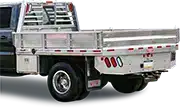
This is one of the broadest areas of the Delco lineup. Current gooseneck equipment, car-hauler, flatbed, and deckover offerings cover substantially more territory than a single 20,000- to 25,900-lb class. Depending on the series, Delco offers gooseneck configurations from approximately 14,000 lb GVWR through 30,000 lb GVWR, with deck lengths extending from the mid-teens on certain equipment models to approximately 44 feet on long equipment and flatbed configurations.
A gooseneck trailer connects to a ball mounted in the pickup bed, placing the coupling point over or near the truck’s rear axle. When the truck, hitch, trailer, and load are properly matched, this arrangement can provide better stability and maneuverability than a comparable heavy bumper-pull combination. It also consumes bed space, adds substantial pin weight to the truck, and requires enough cab-to-coupler and tailgate clearance for the intended turning angle.
Delco’s current 14,000-lb F1 flatbed, for example, is listed with a 12-inch I-beam frame and neck, two 7,000-lb electric-brake axles, 3-inch I-beam crossmembers on 16-inch centers, a channel outer frame, treated-pine flooring, and straight-deck loading with slide-in ramps. Heavier models change the frame, axle, tire, coupler, suspension, and running-gear package. Delco’s 30,000-lb-class tandem-dual flatbed is a materially different trailer, with heavier I-beam construction, tandem-dual running gear, 17.5-inch tire packages, and a coupler selected for the higher working class.
Deck length should be selected around the actual machine and its load balance. A 22- or 24-foot deck may accommodate many compact tractors, skid steers, mini excavators, and attachments, but physical fit is only one part of the calculation. The machine must be positioned so the trailer axles, tires, wheels, suspension, and truck remain within their ratings while maintaining appropriate pin weight. Buckets, brush cutters, forks, backhoes, booms, counterweights, and other attachments can change both total weight and balance.
If you’re comparing a Delco gooseneck with an H&H steel gooseneck or a Diamond C LPX Equipment Trailer, compare equivalent builds. Match the GVWR, empty weight, calculated payload, axle ratings, brake type, tire load range, frame design, deck width, usable deck length, ramp or tilt system, coupler, jacks, spare tire, warranty, and delivered price. Delco is often considered by value-focused buyers, while Diamond C’s premium LPX, HDT, DEC, and FMAX families provide engineered frame designs, Lippert axle packages, specialized loading systems, and broader option paths. The right choice depends on how frequently the trailer will work, what it will carry, and which features produce a real return for the owner.
Equipment Trailers
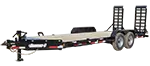
Delco’s bumper-pull equipment and car-hauler lineup is broader than a single 12,000- to 14,000-lb category. Current offerings include approximately 7,000-, 10,000-, 12,000-, 14,000-, and selected 14,000- to 16,000-lb classes. Available decks include between-the-fender and full-width configurations, with common lengths running from about 12 to 26 feet depending on the series. Delco also offers gooseneck equipment configurations for buyers who need additional deck length or prefer a bed-mounted hitch.
A current 14,000-lb, 83-inch-wide bumper-pull model can be configured with two 7,000-lb electric-brake axles, channel frame and tongue construction, crossmembers on 16-inch centers, treated-pine decking, and slide-in ramps. Wider 102-inch models may use an I-beam frame and drive-over fenders to create room for wider vehicles and equipment. These details matter more than a broad label such as “equipment trailer,” because a low car, zero-turn mower, skid steer, compact tractor, and mini excavator create very different loading and securement requirements.
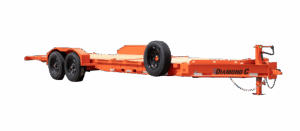
Do not assume every Delco equipment trailer includes a dovetail. Current configurations include straight decks with slide-in ramps as well as other loading arrangements, depending on the model and options. A dovetail can reduce the transition angle, but it also changes usable flat deck space and rear clearance. Slide-in ramps keep the deck open when stored, while fold-over ramps may be faster to deploy. Tilt models eliminate conventional ramps but introduce a different deck geometry, pivot point, hydraulic or gravity system, and loading procedure.
Published deck height by itself can also be misleading. Actual loading difficulty depends on deck height, ramp length, dovetail length, suspension compression, terrain, tire size, breakover angle, and the machine’s wheelbase and ground clearance. Rather than relying on a generic 20- or 22-inch claim, ask for the measured deck height and ramp angle of the exact trailer. When possible, load the intended machine or compare its approach, departure, and breakover specifications before purchasing.
Bumper-pull equipment trailers also place substantial tongue weight behind the truck’s rear axle. A properly loaded equipment trailer commonly transfers a meaningful percentage of its loaded weight to the hitch. That weight counts against the receiver, ball mount, hitch ball, truck payload, rear GAWR, tires, and suspension. A truck’s headline tow rating does not cancel a payload or rear-axle limitation.
Dump Trailers
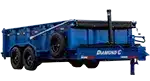
Delco’s current dump lineup spans compact bumper-pull models, wider contractor dumps, telescopic dump trailers, gooseneck dumps, and heavy tandem-dual configurations. The range begins around 7,000 lb GVWR and extends to approximately 22,990 lb GVWR on the heaviest tandem-dual models. Available bed lengths run from about 8 feet on compact dumps to 20 feet on larger gooseneck units, with common bed widths including approximately 60, 72, 83, and 96 inches depending on the series.
The compact 7,000-lb D1 is offered in 8- and 10-foot lengths with a 60-inch-wide body. The current D2 occupies the narrower contractor-dump category at approximately 12,000 lb GVWR and a 72-inch-wide, 12-foot body. Delco’s 83-inch D3 line moves into the 14,000-lb class with 12-, 14-, and 16-foot lengths. Current D3 specifications include two 7,000-lb electric-brake axles, an I-beam frame and tongue, a 10-gauge engineered bed, solid sides, a hydraulic cylinder lift, a three-way spreader gate, slide-in ramps, and a pull-back tarp.
Buyers who regularly handle dense material should also look at Delco’s telescopic bumper-pull and gooseneck dumps. Current D5 and D6 configurations use a multi-stage telescopic cylinder rather than treating every dump as the same basic hoist design. Telescopic cylinders package substantial lift travel into a compact collapsed length and can provide useful lifting geometry for contractor loads. Hoist selection does not override payload, however. Wet soil, stone, broken concrete, roofing material, and demolition debris can exceed a trailer’s payload long before the bed appears full.
Delco’s current dump specifications frequently include a pull-back tarp, spreader-style rear gate, and equipment ramps, but inventory can be ordered differently. Confirm whether the tarp is manual or powered, whether the rear gate supports the unloading method you need, how the ramps are stored and rated, and whether the hydraulic power unit includes the desired charger, remote, or solar-maintenance equipment. Also check bed-floor gauge, side height, crossmember construction, cylinder type, battery access, rear stabilizers, tie-down points, spare tire, and installed tire load range.
Dumping safely requires more than sufficient hydraulic power. The trailer should be level, connected to a suitable tow vehicle, clear of overhead wires and obstructions, and loaded so material does not bind on one side. Never raise a loaded bed on a severe side slope or stand beneath an elevated body without the manufacturer’s approved body-prop procedure. A dump trailer can be within GVWR and still become unstable if the material freezes, bridges, shifts, or unloads unevenly.
Quick Spec Reference
| Trailer Type | Typical GVWR Range | Common Deck Lengths | Hitch Type |
|---|---|---|---|
| Utility (single/tandem axle) | Approximately 3,000 – 7,000 lbs | 8 – 20 ft | Bumper pull |
| Equipment/Car Hauler | Approximately 7,000 – 16,000 lbs | 12 – 26 ft | Bumper pull |
| Gooseneck Flatbed/Equipment | Approximately 14,000 – 30,000 lbs | 16 – 44 ft | Gooseneck ball |
| Dump | Approximately 7,000 – 22,990 lbs | 8 – 20 ft | Bumper pull or gooseneck |
These ranges describe the broader current Delco families, not every possible combination. A model name, category description, or axle size should never replace the certification label on the completed trailer. GVWR, GAWR, tire ratings, empty weight, and installed options can change between configurations, and specifications are subject to manufacturer updates.
How Delco Compares to Other Brands We Carry
Spencer Trailers carries several brands, so the comparison question comes up constantly. The useful way to compare them is by matching actual trailers instead of assuming one brand is always cheaper, stronger, lighter, or better equipped. Here’s the honest breakdown:
- Delco vs. Diamond C: Diamond C’s premium lineup includes purpose-built models such as the LPX low-profile equipment trailer, HDT hydraulically dampened tilt, DEC deckover equipment trailer, LPT telescopic dump, and FMAX gooseneck flatbed family. These premium Diamond C models use Lippert axles as their standard axle platform and offer specialized loading systems such as MAX Ramps, XDR Ramps, and the X-Ramp where compatible. Diamond C also uses its DM Difference Maker multi-stage coating process and offers extensive frame, suspension, tire, brake, ramp, and hydraulic options. Delco can make sense for buyers who prioritize a straightforward Texas-built configuration and competitive out-the-door value, while Diamond C is often selected for premium engineering, loading features, option depth, and long-term commercial use. Compare equally equipped trailers before deciding how much the difference is worth.
- Delco vs. H&H: H&H is based in Clarinda, Iowa, and offers utility, equipment, tilt, deckover, dump, car-hauler, and enclosed trailers. Its steel equipment lineup includes conventional ramp, full-width, tilt, bumper-pull, and gooseneck designs across multiple GVWR classes. Delco and H&H overlap in several work-trailer categories, but frame construction, deck geometry, loading system, standard equipment, warranty, and inventory availability differ by model. For many Midwest buyers, the decision comes down to the exact unit available, its installed options, and the dealer support behind it.
- Delco vs. Liberty: Liberty builds utility, car-hauler, equipment, tilt, flatbed, roll-off, and dump trailers, including bumper-pull and gooseneck contractor configurations. Liberty is headquartered in Fillmore, Indiana, giving it a strong regional presence, while Delco is manufactured in Texas. Both belong in an open-trailer comparison when the deck size, GVWR, hoist, axle package, and price align. If you need an enclosed cargo trailer, Spencer Trailers can also compare dedicated enclosed offerings from brands such as Wells Cargo and Darkhorse Cargo instead of forcing an open-trailer comparison.
Common Questions About Delco
Are Delco trailers good quality for the price?
Delco offers legitimate American-built work trailers across light-, medium-, and heavy-duty classes. Current production includes CNC-processed steel components and a multi-stage powder-coat finish rather than a basic primer-and-liquid-paint system. Utility, flatbed, and dump trailers are currently backed by a two-year limited structural warranty against covered defects in materials and workmanship, while individual components may carry separate supplier coverage. Quality should still be judged on the exact model, weld and finish inspection, installed components, payload, and suitability for the job. A good price does not make an undersized trailer a good value.Can I tow a Delco gooseneck with a 3/4-ton truck?
Possibly, but the trailer’s GVWR alone does not answer the question. Some properly configured modern 3/4-ton trucks have substantial gooseneck ratings, while others are limited by payload, rear GAWR, tires, receiver or gooseneck-hitch rating, or the manufacturer’s gross combination rating. Use the truck’s VIN-specific towing guide or manufacturer lookup for maximum trailer weight and GCWR. Then use the certification label and payload label for GVWR, GAWR, and available payload. Include passengers, tools, auxiliary tanks, bed accessories, hitch hardware, and loaded pin weight in the calculation. A 20,000-lb-GVWR trailer does not have to weigh 20,000 lb on every trip, but the truck must remain within every applicable rating at the trailer’s actual loaded weight.Do Delco trailers hold their resale value?
There is no reliable universal ranking that applies to every trailer or market. Resale depends on local demand, model type, GVWR, deck size, condition, documented maintenance, tire age, brake condition, hydraulic condition, corrosion, modifications, and whether the specification still matches what working buyers need. A recognizable American-built trailer with a useful configuration and clean title is generally easier to market than an unidentified or poorly supported unit. Keeping the trailer structurally sound, preventing coating damage from spreading, and retaining purchase and maintenance records will usually matter more than broad brand claims.Will I need a CDL for a larger Delco trailer?
For commercial operation, a Class A CDL is generally triggered when the combination has a GCWR of at least 26,001 lb and the towed unit has a GVWR over 10,000 lb. The 26,001-lb threshold applies to the combination, not the trailer by itself. A trailer rated above 10,000 lb does not independently create a Class A CDL requirement when the combination remains below the threshold. Commercial use, actual weight, vehicle ratings, interstate operation, farm exemptions, and other exceptions can affect the answer, so operators should verify their specific situation with the Indiana BMV, FMCSA, and their insurance provider.What Indiana paperwork and taxes should I plan for?
Indiana buyers generally must apply for the certificate of title within 45 days after purchase or acquisition to avoid the late-title administrative penalty. Registration, declared trailer weight, plate type, sales tax, title fees, and other charges depend on the buyer and trailer. Indiana sales or use tax is generally 7% on a taxable trailer sale unless a specific exemption or applicable nonresident rule applies. As of July 1, 2026, the Indiana Auto Dealer Services Division states that it will not take enforcement action against documentation-preparation fees at or below $261.72; those fees must be handled in accordance with Indiana’s advertising and written-disclosure requirements. Ask for a complete out-the-door worksheet rather than comparing advertised trailer prices alone.Can a business deduct the cost of a Delco trailer?
A trailer purchased for qualifying business use may be eligible for depreciation deductions. Federal law restored a 100% additional first-year depreciation deduction for certain qualified property acquired and placed in service after January 19, 2025. Eligibility, business-use percentage, financing, basis, listed-property rules, recapture, Section 179 interaction, and the buyer’s tax situation can change the result. Treat this as a question for your tax professional, not as a guaranteed discount on every trailer purchase.
What to Ask Before You Buy
Before you pull the trigger on any Delco trailer, get specific answers to a few things:
- GVWR, empty weight, and real payload: Ask for the GVWR and the actual or documented empty weight of the completed trailer. Subtracting empty weight from GVWR gives an estimated payload, but dealer-installed options, spare tires, tarps, winches, ramps, batteries, toolboxes, and hydraulic accessories can reduce it. When payload is critical, weigh the empty trailer on a certified scale and retain the ticket.
- Axle rating vs. GVWR: Do not assume the combined axle ratings must always equal or exceed the trailer’s GVWR. Part of a properly loaded trailer’s weight is carried by the tow vehicle through tongue or pin weight, so a trailer can legitimately have a GVWR higher than the sum of its GAWRs. What matters is keeping the completed trailer below GVWR while keeping each axle, tire, wheel, suspension component, coupler, jack, hitch, and tow vehicle below its individual rating.
- Powder-coat condition: Current Delco trailers use a multi-stage powder-coat process. Inspect the actual unit for transport damage, chips, exposed edges, or areas affected by dealer-installed equipment. In Indiana’s road-salt environment, wash the frame and running gear regularly and repair coating damage before corrosion spreads beneath the surrounding finish.
- Brakes and breakaway equipment: Indiana law requires a trailer or semitrailer with a gross weight of at least 3,000 lb, when operated on a highway, to have brakes adequate to control, stop, and hold it. The driver must be able to apply the trailer brakes from the tow-vehicle cab, and the system must automatically apply the brakes in an accidental breakaway. For practical buying purposes, any trailer rated above 3,000 lb should be inspected for the correct brake system, charged breakaway battery, switch, cable, wiring, and a compatible in-cab controller. Also verify whether brakes are installed on every wheel required for the completed trailer.
- Ramp length, rating, and transition angle: Confirm that each ramp is rated for the equipment and that the machine’s tires or tracks distribute weight in a way the ramp supports. Check ramp width, spacing, storage location, spring assistance, dovetail transition, and the actual approach and breakover angles. A trailer can have enough payload but still be a poor loading match for a low-clearance or short-wheelbase machine.
- Truck, hitch, and pin or tongue capacity: Match the trailer to the truck’s VIN-specific tow rating, GCWR, GVWR, front and rear GAWR, payload, tires, wheels, hitch, ball, safety chains, electrical connector, and brake controller. For goosenecks, include hitch hardware and loaded pin weight in truck payload. For bumper pulls, confirm receiver and ball-mount ratings in both weight-carrying and weight-distributing configurations where applicable.
- Tires and wheels: Read the load range, load index, maximum pressure, manufacturing date, and wheel rating. The trailer’s capacity is limited by its lowest-rated critical component. Heavier 16-inch or 17.5-inch tires do not increase GVWR unless the manufacturer certifies the entire trailer for the higher rating.
- Frame and crossmember specification: Ask which structural members are used on the exact model and how far apart the crossmembers are. I-beam, channel, tube, and angle construction can all be appropriate when engineered for their intended load. The meaningful comparison is the complete design, material size, spacing, reinforcement, weld placement, and certified rating, not the name of one steel profile.
- Dump hoist and hydraulic system: For dump trailers, confirm whether the unit has a direct-cylinder, scissor-type, or telescopic arrangement; the number and capacity of batteries; charging equipment; controller type; hydraulic fluid specification; body-prop procedure; and recommended maintenance intervals. Match the hoist to material density and unloading conditions rather than choosing solely by advertised cylinder tonnage.
- Title, registration, and operating rules: Complete Indiana title paperwork within the 45-day window, register the trailer for the appropriate declared weight, and confirm whether your commercial combination crosses CDL, DOT-number, medical-card, inspection, hours-of-service, or apportioned-registration thresholds. Trailer ownership, registration, and driver-licensing rules are separate questions and should be checked independently.
- Complete delivered price: Ask for the trailer price, freight, preparation charges, documentation fee, sales tax, title and registration costs, credit-card or financing charges, and optional products in writing. Manufacturer MSRP, online advertised price, dealer inventory price, and final out-the-door price are not necessarily the same number.
Who Should Buy a Delco Trailer
The buyer who gets the most out of a Delco is someone who knows the load, understands the truck’s limits, and wants a practical American-built trailer without automatically paying for every premium option. That might be a landscaper adding a second tandem utility trailer, a property-maintenance company moving mowers and compact equipment, a farmer hauling tractors or attachments, a roofing crew using a dump trailer, or a contractor adding a roll-off system for debris and material handling.
Delco also suits buyers who want choices beyond one standard 14,000-lb trailer. A light utility customer may need a 60-inch single-axle model that stores beside a garage. Another buyer may require an 83-inch tandem utility. A skid-steer operator may need a 14,000-lb bumper-pull equipment trailer, while a farm or construction operation may be better served by a 20,000- to 30,000-lb gooseneck flatbed. The brand offers all of those general classes, but the buyer still has to select the correct one.
A Delco dump trailer can also be a sound fit when the body dimensions, payload, hoist, gate, tarp, and ramps match the work. A compact dump used for mulch and property cleanup has different requirements from a 14,000-lb contractor dump hauling gravel, and both are different from a tandem-dual gooseneck handling high-volume debris. Buying extra side height without calculating material density can create an easy path to overloading, so select the body around both volume and weight.
And if you’re the type who expects your equipment needs to grow, beginning with a properly sized Delco and later moving into a premium Diamond C LPX, Diamond C HDT, Diamond C DEC, or Diamond C FMAX can be a sensible progression. The key is not treating the first trailer as disposable. Buy enough payload, braking, tire, deck, and ramp capacity for the work you are doing now, maintain it correctly, and avoid modifications that compromise its certification or resale value.
Spencer Trailers carries Delco inventory at our lot in Spencer, Indiana. Browse current inventory online or call us at (812) 829-0226 to ask what’s in stock. Inventory specifications and pricing can change as trailers arrive and sell, so review the listing and the certification label on the actual unit. If you’re not sure which trailer class matches your truck and your load, reach out and we’ll walk through it with you. Bring the truck’s year, make, model, drivetrain, cab, bed, axle ratio, payload information, hitch rating, and the weights and dimensions of what you plan to haul. The wrong trailer, hitch, or tow vehicle costs more than the price difference, so it’s worth having the full conversation before you commit.


