




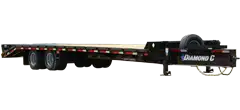

You’re running a hot-shot rig, and every pound built into the trailer is a pound that may reduce the freight you can legally carry. That payload equation is one of the main reasons Diamond C developed the FMAX series. The FMAX210 and FMAX212 are 102-inch-wide, tandem-dual-wheel deckover gooseneck trailers built around Diamond C’s U.S. patent-protected Engineered Beam frame system. Rather than using one conventional beam size across every trailer length, Diamond C engineers the frame for the specific model and configuration. The result is a high-capacity gooseneck designed to balance frame strength, empty weight, deck space, and long-distance durability.
What “Engineered Beam” Actually Means
Diamond C does not simply purchase standard I-beams and assemble the same frame under every FMAX. The company engineers and fabricates its own beams for each applicable trailer configuration. The beam web is cut and shaped in-house, and continuous one-piece flanges are welded to the top and bottom. On both the FMAX210 and FMAX212, the main frame is a 16-inch low-profile Engineered Beam, while the neck is a 12-inch curved Engineered Gooseneck. The curved neck distributes force through the structure instead of concentrating it at sharply welded corners.
The Fleetneck 2.0 construction uses Grade 100 material in the main-frame beam webs, while the redesigned neck web uses 10-gauge Grade 80 steel. Diamond C reports that the lighter Fleetneck 2.0 neck reduced weight by approximately 65 pounds compared with the previous neck design. The important point is not one isolated weight-saving number. It is that the main frame, neck, crossmembers, lace rail, deck, running gear, loading system, and selected options all contribute to the trailer’s final certified empty weight. Diamond C currently publishes an overall weight range of approximately 5,840 to 9,470 pounds for the FMAX210 and 6,250 to 12,060 pounds for the FMAX212. The exact weight of a 28-, 30-, or 32-foot trailer depends on its loading system, floor, suspension, jacks, tires, storage, hydraulic equipment, and other factory options. Always use the completed trailer’s weight label or an actual scale ticket when calculating available payload.
FMAX210 vs. FMAX212: The Differences That Matter
Both models share the 102-inch-wide deckover platform, 16-inch low-profile Engineered Beam main frame, 12-inch curved Engineered Gooseneck, tandem-dual-wheel layout, Lippert axles, all-steel radial tires, LED lighting, and a wide selection of loading configurations. The primary differences are the axle ratings, GVWR, available maximum length, and the weight of the completed build.
| Model | Axles | GVWR | Lengths Available |
|---|---|---|---|
| FMAX210 | 2 x 10,000 lb Lippert oil-bath axles | 25,000 lb | 20 ft to 40 ft |
| FMAX212 | 2 x 12,000 lb Lippert heavy-duty oil-bath axles | 25,900 lb | 20 ft to 44 ft |
The FMAX212 provides 900 pounds more GVWR than the FMAX210, but that number should never be considered by itself. The useful payload of either trailer is its certified GVWR minus the actual empty weight of the completed trailer. You must also stay within the individual axle ratings, tire and wheel ratings, coupler rating, hitch rating, truck payload, rear-axle rating, gross combined weight rating, and any applicable commercial operating limits. Because a portion of a properly distributed gooseneck trailer’s weight is transferred to the tow vehicle through the ball, the trailer’s GVWR can be higher than the combined axle ratings. That does not authorize loading either axle, the truck’s rear axle, or the hitch beyond its separate rating.
For hot-shot operators using an F-450, F-550, Ram 5500, or another properly equipped tow vehicle, the model badge alone does not determine whether the combination is legal or safe. Trucks with the same badge can have different wheelbases, bodies, curb weights, rear-axle ratings, hitch ratings, payload stickers, and GCWR figures. A 28- or 32-foot FMAX210 may provide an effective balance of deck space, maneuverability, and empty weight for one operation, while another operator may need the 12,000-pound Lippert axles and longer available configurations of the FMAX212. The correct choice starts with the weight and dimensions of the cargo, followed by the ratings of the exact truck and trailer being paired.
MAX Ramps: Not an Afterthought
Diamond C’s MAX Ramps are 44 inches wide and use 50 ksi steel ramp frames with four frame members per ramp. They are heavy-duty spring-assisted ramps designed to be raised and lowered from the deck or from the ground. The broad loading surface is useful for equipment with wide tires or tracks, and it gives the operator a more visible loading path when approaching the deck. On applicable FMAX configurations, the MAX Ramps are paired with a 60-inch self-cleaning dovetail.
Ramp width and structure matter, but safe loading still depends on more than the ramp design. The machine must be within the trailer’s available payload, its weight must be distributed correctly, and the tires or tracks must remain centered on the ramps during loading. Concentrated equipment such as backhoes and excavators may be better matched to Diamond C’s 24-inch-by-60-inch XDR Ramps, which allow open space between the ramps for knuckle and undercarriage clearance. The FMAX can also be configured with a 12-foot fully automatic hydraulic dovetail, depending on the selected model, length, and build. Each loading system serves a different type of work, so it is worth choosing the tail configuration around the equipment you actually load rather than treating the ramps as a cosmetic option.
Hot-Shot Use Case: Why the FMAX Wins
Hot-shot freight depends on payload efficiency, but the working number must be calculated from the completed trailer rather than a generic advertised weight. Based on Diamond C’s current published weight ranges, the theoretical payload range for the FMAX210 is approximately 15,530 to 19,160 pounds, while the corresponding range for the FMAX212 is approximately 13,840 to 19,650 pounds. Those broad figures cover multiple lengths and configurations. A specific trailer weighing between 7,000 and 8,000 pounds would leave approximately 17,000 to 18,000 pounds of rated payload under a 25,000-pound FMAX210 GVWR, or approximately 17,900 to 18,900 pounds under a 25,900-pound FMAX212 GVWR. Actual legal capacity may be lower if the truck, hitch, axles, tires, registration, roadway, or cargo-securement requirements impose a lower limit.
The FMAX210 and FMAX212 work well for hot-shot and heavy-equipment operations because the major design choices point in the same direction: a configuration-specific Engineered Beam frame, curved gooseneck, 102-inch deck, Lippert oil-bath axles, multiple loading systems, and factory options that let the buyer prioritize payload, equipment access, ride quality, or convenience.
The 102-inch deck width is also significant. Under federal rules, 102 inches is the standard maximum vehicle width permitted on the National Network without an oversize-width permit. Indiana likewise generally recognizes an 8-foot-6-inch maximum width for ordinary operation, subject to route restrictions and other requirements. The trailer deck being 102 inches wide does not allow cargo to extend beyond that width without checking permit requirements. Operators should also consider CDL rules before putting the trailer into service. In Indiana and under the federal Class A CDL framework, the usual threshold is a combination GVWR or GCWR of 26,001 pounds or more when the towed trailer has a GVWR greater than 10,000 pounds, unless a specific exemption applies. Both the FMAX210 and FMAX212 have trailer GVWRs above 10,000 pounds, so many commercial truck-and-FMAX combinations fall within Class A CDL territory.
Quick Answers: Common FMAX Questions
Can I run a fifth-wheel setup instead of a ball?
The current FMAX210 and FMAX212 are gooseneck trailers, and typical dealer-stock configurations use a 30,000-pound Curt Cushion gooseneck coupler for a 2-5/16-inch ball. Diamond C also lists a square adjustable kingpin adapter as a factory coupler option for operators using an appropriately rated fifth-wheel hitch. The coupler or adapter, hitch, ball or fifth wheel, mounting system, and truck must all be rated for the trailer’s actual loaded weight and pin weight. Do not assume that a pickup’s factory towing package automatically covers a 25,000- or 25,900-pound trailer. Verify the truck manufacturer’s towing guide, payload label, hitch documentation, rear-axle rating, and GCWR for the exact vehicle.
What’s the FMAX207 and where does it fit?
The FMAX207 is the lighter tandem-single-wheel member of the FMAX family. It has a 15,500-pound GVWR, two 7,000-pound Lippert axles, a 102-inch-wide deck, a 14-inch low-profile Engineered Beam frame, and a 12-inch curved Engineered Gooseneck. Current lengths run from 20 to 35 feet, with a published trailer-weight range of approximately 4,600 to 8,430 pounds depending on length and configuration. It is a practical option for farms, landscape contractors, construction crews, and equipment owners who want the deckover layout and Engineered Beam construction but do not require the tandem-dual-wheel running gear of the FMAX210 or FMAX212.
Does the FMAX212 come with hydraulic jacks?
Dual hydraulic jacks are available, but they are not the standard jack configuration. The current FMAX212 configurator lists dual 20,000-pound two-speed drop-leg jacks as standard, with dual 25,000-pound two-speed drop-leg jacks and dual 20,000-pound hydraulic jacks available as upgrades. Hydraulic jacks are especially useful when the trailer is connected and disconnected frequently, when the operator works alone, or when the trailer is equipped with a hydraulic dovetail and already has an onboard hydraulic and electrical system. Buyers should confirm the battery, charger, solar-charging, and remote-control options included with the exact hydraulic configuration.
How does the FMAX compare to a Diamond C LPX or HDT?
The LPX is a low-profile bumper-pull equipment trailer designed to place machinery between the fenders and provide a lower loading deck. Current LPX GVWR packages range from 15,500 to 24,000 pounds, with Lippert axle packages selected according to the GVWR. The standalone HDT is a low-profile, bumper-pull hydraulically dampened tilt equipment trailer with GVWR choices from 15,500 to 24,000 pounds. Its gravity-fed hydraulic tilt bed is intended for drive-on equipment loading without separate ramps. The FMAX is different: it is a 102-inch-wide deckover gooseneck platform that places the deck above the wheels, provides an unobstructed full-width cargo surface, and offers GVWRs from 15,500 pounds in the FMAX207 through as much as 40,000 pounds in heavier FMAX models. On dealer inventory listings, an FMAX equipped with a hydraulic dovetail may use an HDT configuration suffix, but it remains an FMAX gooseneck rather than the standalone bumper-pull HDT tilt model.
Options Worth Considering at the Order Stage
- Deck on the neck: Diamond C offers a deck-on-the-neck option that adds approximately 7 feet by 8 feet of elevated cargo space above the gooseneck. It can be useful for lighter freight, pallets, hay, tools, or other cargo that can be loaded and secured within the trailer’s weight and tie-down limits. Confirm the current attachment style, flooring, clearance-light package, spare-tire arrangement, and added empty weight when ordering.
- Spare tire: The current Fleetneck 2.0 design includes an under-frame spare mount with a cable-operated winch for raising and lowering the tire. The mount is standard, but the matching spare tire itself is an orderable item. Match the spare to the selected 16-inch or 17.5-inch tire and wheel package, and include the spare’s weight in the final payload calculation.
- Lighting and electrical equipment: Current FMAX configurations include all-LED road lighting, a reverse light, an automotive-style sealed wiring harness, and corrosion-protected modular connections. Optional bolt-on loading lights provide a pair of adjustable 2,000-lumen work lights for loading after dark. Extra clearance lights, a rear caution light, battery upgrades, chargers, and solar-maintenance systems are also available with applicable configurations.
- Electric-over-hydraulic disc brakes: The current configurators list electric drum brakes with ABS as the standard brake selection, while electric-over-hydraulic disc brakes are available on both the FMAX210 and FMAX212. Disc brakes can provide strong, repeatable braking for high-mileage and heavy-load applications, but the tow vehicle’s brake controller must support electric-over-hydraulic operation. Brake choice does not replace the need to remain within GVWR, GAWR, tire, wheel, hitch, and truck ratings.
Other order-stage decisions can have just as much effect on the finished trailer. The standard dual-wheel package uses 235/80R16 14-ply all-steel radial tires, while a 215/75R17.5 upgrade is available for operators who prioritize higher-mileage commercial service. Buyers can also choose treated lumber, oak, aluminum flooring, upgraded suspension, air ride on eligible configurations, slide tracks and ratchets, winch packages, extra storage, hydraulic loading systems, and aluminum outer wheels. Every added feature has a purpose, but it can also change the trailer’s empty weight, maintenance requirements, purchase price, and payload.
If you’re speccing an FMAX for the first time, do not order length by guesswork. A 28- or 32-foot trailer can be easier to maneuver, park, and back than a 40- or 44-foot build, while a longer trailer may be necessary for multiple machines, long freight, vehicles, pipe, lumber, or other dimensional loads. Remember that the FMAX210 is currently available through 40 feet, while the FMAX212 extends through 44 feet. Choose the shortest configuration that safely accommodates the cargo and loading system you need, while leaving room for realistic future work. Also account for total combination length, turning clearance, rear swing, parking access, registration, insurance, and the truck’s towing limits.
In Stock and Available at Spencer Trailers
We carry Diamond C trailers at our lot in Spencer, Indiana, including current FMAX210 and FMAX212 configurations with MAX Ramps and hydraulic dovetails. Inventory changes as trailers are sold and new units arrive, so the best way to see what’s available now is to check our current inventory or call or text us at (812) 829-0226. We’re located at 291 West State Hwy 46 in Spencer. You can inspect the deck width, Engineered Beam frame, curved neck, jacks, coupler, axle package, spare mount, flooring, ramps, hydraulic tail, and tie-down equipment before deciding which configuration fits your operation.
Not finding exactly what you want in stock? We can work with you on a factory order. Diamond C builds its trailers in Mt. Pleasant, Texas, and has manufactured open steel trailers since 1985. Current FMAX trailers use Lippert axles and receive Diamond C’s standard DM Difference Maker multi-stage coating system, which includes steel-shot blasting, a multi-stage wash and pretreatment process, force drying, zinc epoxy primer, a powder topcoat, and oven curing. FMAX factory choices are extensive, and ordering to spec can be the better approach when axle capacity, length, loading style, suspension, brakes, flooring, jacks, tires, storage, and empty weight directly affect your work. Reach out to the team and we’ll walk through the configuration together.
One question is worth answering before you order: are you sizing the trailer only for today’s heaviest load, or for the equipment and freight you reasonably expect to move over the next 18 months? Buying more trailer than the truck can legally control creates a different problem, while buying too little capacity can force an early replacement. Bring us the year, make, model, wheelbase, body configuration, payload label, hitch rating, axle ratings, and towing specifications for your truck, along with the actual weights and dimensions of your cargo. We can then help you compare the FMAX210 and FMAX212 using the numbers that matter instead of relying on model names alone.


