







Most people buying a trailer never think about the frame until something goes wrong. A cracked weld hundreds of miles from home, a main rail that has developed a permanent sag, or a deck that moves more than expected while loading a skid steer can quickly make frame construction the most important part of the trailer. The frame carries the deck, body, running gear, hitch loads and cargo, so its design affects payload, loading behavior, durability and the way stress moves through the entire trailer.
Diamond C developed its patented Engineered Beam Technology to improve on the common practice of building a trailer around standard rolled steel sections and then adding reinforcement wherever more capacity is needed. Diamond C designs and fabricates its own I-beam main rails in-house at its Mt. Pleasant, Texas, manufacturing operation. The original Fleetneck Engineered Beam debuted in 2017, received a U.S. patent in 2019, and was followed by Fleetneck Engineered Beam 2.0 in 2022. The 2.0 designation applies specifically to the updated FMAX Fleetneck frame and neck design, while related Engineered Beam Technology is also used on several current Diamond C equipment, dump, deck-over, pintle and step-deck models.
What Is the Engineered Beam, Actually?
Many light-duty utility trailers use channel-shaped main rails because channel is readily available, economical and appropriate when its size, bracing and load rating match the application. Conventional heavy equipment and gooseneck trailers are also commonly built with stock structural I-beams. The limitation is not that every stock channel or rolled I-beam is weak. The limitation is that a standard steel section has fixed dimensions and a fixed amount of material, even when a particular trailer needs more strength in one area and less material in another.
An I-shaped section is especially efficient under strong-axis bending because its upper and lower flanges place steel away from the neutral axis, where that steel can do more work resisting bending. The web keeps the flanges separated and carries much of the section’s shear load. That does not mean an I-beam is automatically superior under every kind of loading. Both I-sections and channels are open sections, and the torsional behavior of a trailer depends on the complete frame assembly, including beam depth, crossmembers, gussets, side rails, suspension mounts, neck geometry, weld details and the way the load is distributed.
Diamond C’s approach is to fabricate the main rail instead of being limited to a stock rolled profile. The web is cut and shaped for the intended trailer configuration, and continuous one-piece flanges are welded along the top and bottom. Depending on the model, Diamond C can alter beam height, contour, web material and reinforcement placement to suit the trailer’s length and weight class. Current FMAX beams are generally 14 to 18 inches tall, while compatible equipment and dump applications commonly use shallower Engineered Beam profiles appropriate for those trailers. Fleetneck Engineered Beam 2.0 added Grade 100 material for the main-frame webs, internal routing openings for wiring and cables, revised rib orientation near the neck, larger gusset flanges and full-height crossmembers. The updated neck uses 10-gauge Grade 80 web material and reduces neck weight by approximately 65 pounds while retaining the curved Engineered Neck configuration.
The Weight Trade-Off That Actually Makes Sense
More steel does not automatically create a better trailer. Adding thicker stock rails, fish plates and secondary reinforcement can increase capacity, but it also raises the trailer’s empty or tare weight. A purpose-built beam can instead place material where it contributes most to the required bending strength. A taller fabricated section can achieve a favorable section modulus without carrying the full weight of a comparably tall stock rolled beam from one end of the trailer to the other.
The current FMAX207 illustrates why buyers should compare complete specifications rather than focusing on beam size alone. It has a 15,500-pound GVWR, a 102-inch-wide deck, two 7,000-pound Lippert axles and a 14-inch Engineered Beam 2.0 frame. Diamond C lists lengths from 20 to 35 feet and a broad estimated weight range because length, loading system, flooring, storage, tires, jacks and other options materially change the finished trailer’s empty weight. Payload must therefore be calculated for the individual unit by subtracting its actual empty weight from the certified GVWR. The published weight of another FMAX207 configuration should not be used as the payload figure for the trailer sitting on the lot.
A lower tare weight can leave more of the trailer’s rated gross capacity available for cargo, but it never changes the limits of the axles, tires, wheels, brakes, coupler, hitch or tow vehicle. The truck’s payload rating, rear-axle rating, tire capacity, receiver or gooseneck rating and GCWR must all support the loaded combination. Indiana requires a trailer or semitrailer operated at a gross weight of at least 3,000 pounds to have brakes that can be applied from the tow vehicle and that activate automatically during a breakaway. For covered commercial operation, a Class A CDL is generally required when the combination has a GCWR of 26,001 pounds or more and the towed vehicle has a GVWR greater than 10,000 pounds, subject to applicable exemptions. A trailer’s GVWR by itself does not establish whether a particular pickup-and-trailer combination is legal.
Where Diamond C Uses It
Engineered Beam Technology is not used on every Diamond C trailer. It is concentrated in the heavier product families where long spans, concentrated equipment loads, high GVWR packages or deck-over construction make frame optimization especially valuable. Current applications include:
- FMAX Fleetneck Goosenecks, including the FMAX207, FMAX208, FMAX210, FMAX212, FMAX216, FMAX307, FMAX310 and FMAX312. These 102-inch-wide flatbed goosenecks use Engineered Beam 2.0 frames and curved Engineered Necks, with model-specific GVWRs ranging from approximately 15,500 pounds to as much as 40,000 pounds. Beam depth, axle count, axle capacity and loading equipment vary by model. Current premium FMAX configurations use Lippert axles, not a one-size-fits-all running-gear package.
- LPX and HDT Equipment Trailers, Diamond C’s heavy low-profile equipment and hydraulically dampened tilt lines. Current bumper-pull and gooseneck versions offer GVWR packages from 15,500 to 24,000 pounds. The standard 207 package uses two 7,000-pound Lippert axles, while higher packages may use 8,000-pound, 10,000-pound or triple 7,000-pound running gear. Engineered Beam availability depends on the selected GVWR package and trailer length; for example, higher LPX packages generally receive it on 22-foot-and-longer builds, while qualifying HDT builds generally receive it at 20 feet and longer.
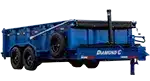
- LPT, DOD and WDT Dump Trailers, covering several different dump configurations. The LPT and LPT-GN are heavy-duty low-profile telescopic dumps rated from 15,500 to 24,000 pounds and use a three-stage telescopic cylinder, with Engineered Beam Technology included on qualifying higher-GVWR packages. The DOD deck-over dump uses an Engineered Beam main frame and a five-stage telescopic hoist in 14- and 16-foot lengths. The WDT is a 96-inch-wide dual-tandem gooseneck dump rated from 25,000 to 30,000 pounds, with a telescopic cylinder and Lippert axle packages.
- DEC Heavy-Duty Deck-Over Equipment Trailers, which provide a 102-inch-wide deck in lengths from 20 to 30 feet. Current specifications list GVWR packages from 15,500 to 23,000 pounds, beginning with two 7,000-pound Lippert axles and offering heavier axle packages. The DEC uses an Engineered Beam frame and can be ordered with slide-in ramps, heavy-duty flip-knee ramps or MAX Ramps, depending on the selected build.
- PX Pintle, SDX Step-Deck and Other Select Heavy Platforms, including the PX heavy pintle-hitch family and SDX step-deck trailers. Diamond C also identifies Engineered Beam applications on select multi-vehicle carrier configurations. These are separate model families with their own GVWRs, deck dimensions, hitch types and axle packages, so buyers should verify the current factory build sheet rather than treating “Engineered Beam” as a single universal specification.
FEA: Why Computer Optimization Matters
Finite element analysis is a long-established engineering method used in industries ranging from buildings and bridges to automobiles, aircraft and heavy equipment. Diamond C publishes stress-analysis comparisons for its Engineered Beam and Engineered Neck designs, including von Mises stress plots under defined test loads. Those visualizations help explain how an engineered structure distributes stress differently from a selected comparison frame, although they should be read as analyses of specific geometries and loading conditions rather than as proof that every competing frame behaves identically.
In a typical finite element model, the frame geometry is divided into many smaller mathematical elements. Material properties, supports, connections and expected loads are then assigned to the model. The software calculates displacement and stress under those assumptions, allowing engineers to identify areas where stress is concentrated, where a transition should be reshaped, where a gusset may be beneficial and where steel may be carrying little useful load. Welded connections, fatigue life and real-world impact loading require appropriate assumptions and additional validation; a computer model is a design tool, not a substitute for sound fabrication, physical testing, correct loading or ongoing inspection.
For a trailer buyer, the practical advantage is that the main rail, neck and related frame details can be developed as a system instead of being chosen only from a steel supplier’s catalog. That matters around the transition from the gooseneck to the main deck, suspension attachment areas, dovetail transitions, dump-body pivots and crossmember connections. Fleetneck 2.0’s revised neck support, full-height crossmembers, larger gusset flanges and controlled beam profile are examples of design changes intended to manage load paths without simply stacking more reinforcement onto a stock rail.
How It Compares to Channel-Frame Competitors
| Feature | Diamond C Engineered Beam 2.0 | Standard C-Channel Frame |
|---|---|---|
| Cross-section | Model-specific fabricated I-section with a shaped web and continuous one-piece upper and lower flanges | Commercially available open channel selected by depth, flange size, thickness and weight per foot |
| Design method | Beam geometry, steel grade and frame details are optimized for the applicable model and weight class | Typically based on a standard section combined with crossmembers, gussets and reinforcement appropriate to the intended rating |
| Bending efficiency | Tall beam geometry places flange material farther from the neutral axis, providing a favorable strength-to-weight relationship when properly designed | Can be entirely adequate for its rated application, but a shallow or lightly braced channel generally provides less strong-axis bending stiffness than a substantially deeper engineered section |
| Torsional resistance | Controlled by the complete frame, including crossmembers, gussets, neck, side structure and suspension attachments; an I-section remains an open section | Also controlled by the complete frame; the channel’s open, asymmetric profile can be more sensitive to eccentric loading if the surrounding structure is not properly designed |
| Typical use | FMAX goosenecks and qualifying heavy equipment, dump, deck-over, pintle and step-deck applications | Common on utility trailers and many light- or medium-duty equipment trailers where channel is properly sized for the rated load |
Channel construction is not inherently defective, and an Engineered Beam is not necessary for every hauling job. Diamond C’s 7,000-pound-GVWR GTU premium tandem utility trailer, for example, uses a 4-inch channel frame with two 3,500-pound axles because that construction suits its intended rating and use. The meaningful comparison is between complete trailers: certified GVWR, actual empty weight, frame depth, crossmember construction, axle and tire ratings, loading system, weld quality, coating, warranty and intended duty cycle.
A Quick Q&A
Does the Engineered Beam cost more?
Engineered Beam-equipped trailers are generally positioned in Diamond C’s premium and heavy-duty ranges, but there is no reliable universal surcharge that can be separated from the rest of the build. Price changes with model, length, GVWR package, hitch type, brakes, suspension, tires, flooring, jacks, ramps, hydraulic equipment and other options. Manufacturer suggested retail pricing can also change by model year and region. The accurate comparison is a current dealer quote for two similarly equipped trailers, followed by a review of payload, warranty, maintenance requirements and expected service life rather than an assumed fixed premium.
Can I weld on it myself if I need to add tie-down points?
Do not weld, drill, notch or heat an Engineered Beam without written guidance from Diamond C or an authorized dealer. Fleetneck 2.0 uses high-strength, relatively thin Grade 100 web material, and uncontrolled heat input can alter the heat-affected zone, create a stress concentration, damage the coating or affect structural and warranty coverage. Production welding procedures and filler-metal selection are developed for the factory joint design; knowing a general welding-wire classification is not enough to approve a field modification. Use the trailer’s factory rub rail, stake pockets, pipe spools, D-rings or approved bolt-on accessories, and have any structural alteration evaluated before work begins.
Does it affect trailer maintenance?
The fabricated I-section has horizontal flange surfaces where dirt, fertilizer residue, road salt and moisture can collect. Wash those areas regularly, especially after winter road use or exposure to corrosive material. Inspect the frame, neck transitions, suspension mounts, crossmember connections, ramps, dovetail and coating during routine service. Touch up chips before exposed steel begins to rust, but do not cover a suspected crack or structural deformation with paint. Axle lubrication, wheel-bearing service, brake adjustment, breakaway-battery testing, tire inflation and wheel-torque checks remain just as important as frame care.
What steel grade is the beam?
The answer depends on the model and generation. Diamond C states that Fleetneck Engineered Beam 2.0 uses 10-gauge Grade 100 material in its main-frame webs, while the updated Engineered Neck uses 10-gauge Grade 80 web material. Diamond C also describes other Engineered Beam applications as using steel rated at a minimum of 50 ksi or model-specific 50/100 ksi material. Those specifications should not be generalized to every flange, gusset, crossmember or older Engineered Beam trailer. Higher yield strength supports a lighter optimized design, but it does not authorize operation above the certified GVWR or any individual component rating.
What to Look for When Buying
If you are shopping Diamond C inventory at Spencer Trailers and considering an Engineered Beam-equipped model, confirm the specifications of the individual trailer rather than relying only on a model-family description:
- Read the federal certification/VIN label and factory build sheet. Confirm GVWR, GAWR, tire size and capacity, wheel rating, recommended inflation and the installed axle package. Do not assume that GVWR must equal the mathematical sum of the axle ratings. A properly designed trailer can have a GVWR higher than the combined GAWR because part of the loaded weight is carried vertically at the hitch, but neither axle may be loaded beyond its GAWR and the truck, hitch, tires and coupler must support their respective shares of the load.
- Confirm the hitch and coupler type, adjustment range and rating. A gooseneck trailer may use a 2-5/16-inch ball coupler, a heavier 3-inch ball package or another approved configuration depending on model and GVWR. Pintle trailers use a lunette-and-pintle connection, while some commercial configurations may use a kingpin adapter. Match the actual trailer connection to a correctly rated truck-mounted hitch; a ball size and a lunette-ring size are not interchangeable specifications.
- Check the main-rail specification and crossmember spacing shown on the build sheet. For example, the current FMAX207 uses 3-inch I-beam crossmembers on 16-inch centers as standard, with 12-inch centers offered as an upgrade. Other models use different crossmembers, spacing and deck structures. Closer spacing can improve local deck support for concentrated wheel or track loads, but flooring material, crossmember section, gussets and equipment placement also matter.
- Verify the finish as the DM Difference Maker Coating System. Diamond C’s current multi-stage powder-coating process includes abrasive blasting, washing and chemical pretreatment, force drying, a corrosion-resistant zinc epoxy primer, a powder topcoat and oven curing. It is more comprehensive than a single-stage spray finish, but it is not maintenance-free. Road debris can chip any coating, and salt, chemicals or trapped moisture should be removed promptly.
We carry Diamond C inventory at Spencer Trailers in Spencer, Indiana, including FMAX goosenecks and qualifying equipment and dump trailers with Engineered Beam Technology. Inventory, model-year specifications and factory options change, so call us at (812) 829-0226 before making the drive when you need a particular length, GVWR package, axle configuration, loading system, hitch style or hydraulic setup. We can verify the certification label and build details on the actual unit rather than quoting specifications from a differently equipped trailer.
And if you are deciding between a Diamond C Engineered Beam model and a lower-priced channel- or stock-I-beam trailer, compare the complete job requirement. Consider the equipment’s operating weight, attachments, load position, tongue or pin weight, annual mileage, road conditions, downtime cost and the capacity of the tow vehicle. Come talk to us and we will walk through the frame, axle package, payload calculation, hitch requirements and current pricing with real numbers from the trailers you are considering.


