


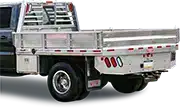
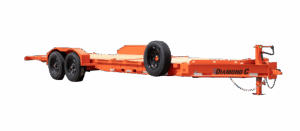


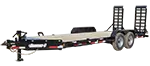


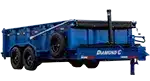


You just won a pallet of antique furniture, a 1970s muscle car, a pair of commercial mowers, and a riding floor scrubber, all in the same auction session. Now what? You have 48 hours to get everything off the lot. If you showed up with the wrong trailer, or no trailer at all, you may be making multiple trips, renting whatever is still available, paying storage or late-removal charges, and losing money on every run.
Auction buyers face a hauling problem that most people never think about: the load changes every single time. A furniture dealer needs something different than an equipment flipper, but plenty of auction regulars buy both. Getting the right trailer, or the right combination of trailers that you can use one at a time, is what separates buyers who protect their margins from buyers who break even after hauling costs. The right choice starts with actual cargo dimensions and weight, the trailer’s usable payload, and the tow vehicle’s ratings—not the trailer’s length or advertised GVWR alone.
Enclosed Trailers for Valuables and Mixed Merchandise
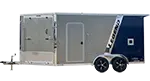
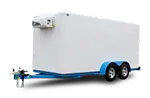
If you’re buying household contents, antiques, tools, electronics, boxed inventory, or anything that cannot get rained on, an enclosed cargo trailer is one of the most versatile choices. A 7×16 or 7×20 with a rear ramp door can provide enough floor space to secure furniture while still leaving room for carts, boxed merchandise, and palletized goods. Before buying, measure the tallest and widest items you commonly haul because the rear door opening is smaller than the trailer’s advertised exterior dimensions.
The Wells Cargo FastTrac and Darkhorse Cargo trailers are two solid options Spencer Trailers carries for this kind of buyer. The FastTrac is a steel-frame enclosed trailer with an aluminum or composite exterior, a one-piece aluminum roof, and model-specific floor, wall, and roof construction. Darkhorse configurations currently available through Spencer Trailers include tandem-axle 7×16 units with 7-foot interior heights, rear ramp doors, curbside access doors, electric brakes, recessed cargo-tracking options, and reinforced floor and wall framing. Exact specifications vary by the individual build, so the dealer’s build sheet should always control.
For GVWR, many tandem-axle 7×16 enclosed trailers are rated at 7,000 lbs with two 3,500 lb axles. Larger or heavier-duty 7.5-wide and 8.5-wide models may be configured at 9,990 lbs or higher. Trailer dimensions do not determine GVWR by themselves. A 7×20 can be built with different axle, tire, frame, coupler, and brake packages, so check the certification label rather than assuming its capacity from its length. Just as important, subtract the trailer’s actual empty weight, including installed options, from its GVWR to determine usable payload.
Key specs to ask about when shopping enclosed trailers for auction use:
- Clear interior and door-opening dimensions. A 6-foot-6-inch or 7-foot interior may be useful for tall furniture, but the rear opening height and width determine what will actually fit through the door.
- Rear ramp capacity and loading angle. Confirm that the ramp is rated for the heaviest cart, pallet jack, mower, appliance, or other wheeled item you plan to load. A cargo ramp that handles furniture dollies may not be appropriate for concentrated equipment loads.
- Rated tie-down locations. Ask where the D-rings or recessed track are attached, how each anchor is rated, and whether the system is suitable for the weight and direction of the expected load.
- Axle, tire, brake, and breakaway equipment. Tandem axles can provide more payload and stability, but capacity still depends on the complete trailer rating. In Indiana, trailers at 3,000 pounds gross weight or more must have adequate brakes, including a system that can be applied from the towing vehicle and a breakaway function.
- Side-door size and placement. A properly positioned side door lets you retrieve straps, boxes, and smaller merchandise without unloading everything or lowering the rear ramp.
The Wells Cargo lineup is worth a look here too. Buyers trying to reduce empty trailer weight can compare steel-frame FastTrac models with Wells Cargo’s all-aluminum Wagon SS configurations. An aluminum frame can reduce curb weight in some builds, but do not assume that every aluminum trailer automatically has more payload. Compare the actual certified empty weight, GVWR, axle ratings, floor construction, door rating, and installed options. The trailer that weighs less only provides more usable payload when the rest of the ratings support it.
Car Haulers for Vehicle Buyers
Vehicle auctions are their own world. If you flip cars, purchase salvage vehicles, or regularly buy rolling equipment, you need a trailer designed for vehicle loading and securement. Deck width, fender clearance, ramp angle, winch provisions, tire ratings, tie-down locations, and usable payload all matter. A trailer may be long enough for a vehicle and still be under-rated once the trailer’s empty weight is subtracted from GVWR.
The H&H 82×20 Steel Car Hauler is a practical single-vehicle option. Current 7,000 lb configurations use two 3,500 lb axles and have an approximate empty weight of 2,230 lbs before build-specific options, leaving roughly 4,770 lbs of payload. The current conventional car-hauler design includes a 2-foot steel treadplate dovetail and slide-in steel ramps that store under the deck. H&H also offers heavier 9,900 lb configurations with higher-rated tandem axles and greater payload for heavier vehicles. Always verify the certification label and actual scale weight because spare tires, winches, toolboxes, upgraded floors, and other options reduce available cargo capacity.
For buyers who regularly move heavier pickups, vans, or specialty vehicles, a longer deck does not automatically make a trailer suitable for two vehicles. A 22-foot or 24-foot bumper-pull trailer is generally a single-vehicle trailer with additional deck room, not a two-car transporter. Moving two vehicles typically requires a much longer, properly rated gooseneck or commercial vehicle-transport configuration. Diamond C’s current GTF single-car hauler is available in lengths from approximately 14 to 22 feet with GVWR packages from 7,000 to 9,890 lbs. Buyers who truly need more deck and capacity can evaluate an appropriately configured Diamond C FMAX Flatbed Max gooseneck, with current FMAX models ranging from roughly 15,500 to 40,000 lbs GVWR. The combined vehicle length, total cargo weight, trailer empty weight, pin weight, truck payload, hitch rating, axle ratings, and licensing requirements must all be checked before treating any trailer as a multi-vehicle solution.
A few things that matter specifically for auction vehicle hauling:
- Usable deck width and fender clearance. Measure the vehicle at the tires and body, not just the published track width. Removable or drive-over fenders can help with wider vehicles, but they are configuration-specific rather than standard on every car hauler.
- A properly engineered winch setup. Non-running salvage vehicles may require a rated winch plate, adequate winch capacity, appropriate battery and wiring, and a safe line-pull angle. A toolbox or front rail is not automatically suitable as a winch mount.
- Rated four-point securement. Confirm the rating and location of stake pockets, D-rings, rub rail, or other anchor points. Use vehicle-appropriate wheel, axle, or frame securement and inspect straps and hardware before every trip.
- A loading angle that fits the vehicle. A dovetail, longer ramps, or a tilt-deck design can reduce the approach angle for low-clearance cars. Measure bumper, splitter, exhaust, and break-over clearance instead of assuming every car will load on standard ramps.
And if you’re buying ATVs, side-by-sides, golf carts, or zero-turn mowers alongside cars, a properly configured car hauler can be highly versatile. Current H&H conventional car haulers use an approximately 82-inch-wide deck, while the Diamond C GTF is approximately 83 inches wide. That may be enough for many four-wheel machines, but check the machine’s overall tire width, fender clearance, ramp width, ramp rating, deck capacity, and securement points before loading. Some commercial mowers and side-by-sides are wider or heavier than they appear.
Equipment Movers for the Heavy Stuff
Skid steers, compact track loaders, mini excavators, riding mowers, compressors, generators, lifts, and industrial machinery require more than a trailer that is merely long enough. If you buy construction or industrial surplus at auction, you need a true equipment trailer with sufficient payload, concentrated-load support, properly rated ramps or a tilt system, adequate brakes, and tie-down points positioned for the machine being transported.
The Diamond C LPX Low Profile Extreme-Duty Equipment Trailer is one of the strongest bumper-pull options in this class. The current LPX family is available in approximately 16- to 30-foot lengths, 80- to 82-inch bed widths, and GVWR packages from 15,500 to 24,000 lbs. Standard axle equipment begins with tandem 7,000 lb Lippert axles, while higher-capacity packages can use tandem 8,000 lb, tandem 10,000 lb, or triple 7,000 lb Lippert axle configurations. Frame construction changes by length and capacity package, so buyers should compare the specific frame, crossmembers, suspension, tires, coupler, brakes, and deck option shown on the build sheet rather than relying on one generic LPX specification.
The LPX can be configured with spring-assisted loading systems such as Diamond C MAX Ramps or the full-width X-Ramp, depending on trailer width and package. Buyers who load frequently and want to avoid handling separate ramps should also compare the Diamond C HDT Hydraulically Dampened Tilt Equipment Trailer. The HDT uses a gravity-fed hydraulic dampening system to control the tilt bed and is currently offered in GVWR packages from 15,500 to 24,000 lbs. A tilt trailer can simplify loading low-clearance or tracked equipment, but deck angle, traction, machine weight distribution, and loaded tongue weight still need to be evaluated.
Pintle, bumper-pull, and gooseneck couplers each serve different tow-vehicle and fleet setups. Coupler choice should not be based on cargo weight alone. A properly configured bumper-pull LPX or HDT may handle many compact equipment loads, while a gooseneck can provide additional deck length, capacity, and stability when paired with a truck that has sufficient payload and an approved bed-mounted hitch. Pintle-hitch equipment trailers are commonly used in heavier commercial fleets, but the tow vehicle, receiver or pintle assembly, safety chains, brakes, tires, axles, and combination ratings must all match the trailer.
| Equipment Type | Typical Trailer GVWR Range | Recommended Trailer |
|---|---|---|
| Zero-turn mowers, golf carts, compact grounds equipment | 7,000–9,900 lbs | H&H car or equipment trailer, or Diamond C GTU/GTF, after confirming payload and ramp ratings |
| Compact skid steer, small compact track loader | 9,900–15,500 lbs, depending on machine weight | Heavy-duty H&H equipment or tilt trailer, or an appropriately rated Diamond C LPX/HDT |
| Mid-size skid steer, mini excavator, compact backhoe | 15,500–24,000 lbs, based on actual loaded weight | Diamond C LPX Low Profile or HDT Tilt with the correct axle, tire, frame, and ramp package |
| Large excavator, dozer, or full-size backhoe | Determined by actual machine and attachment weight | Professional lowboy, tractor-trailer, or properly engineered heavy gooseneck/pintle configuration |
These ranges are starting points, not substitutes for the machine’s operating weight. Buckets, forks, breakers, counterweights, fuel, attachments, spare parts, chains, binders, and trailer-mounted equipment all count toward the loaded weight. Ramp handling is also a real consideration when you load alone. Diamond C’s spring-assisted MAX Ramps and X-Ramp reduce manual handling, while an H&H or Diamond C tilt model can eliminate separate ramps altogether. The best system is the one that supports the machine’s weight, width, ground clearance, tire or track contact area, and loading technique without forcing the operator to improvise.
The Mixed Inventory Problem
Here’s the honest answer for buyers who go to general merchandise, estate, vehicle, and equipment auctions regularly: one trailer may not handle every purchase efficiently. You may eventually need two different trailers, or one trailer plus access to a second properly rated tow vehicle.
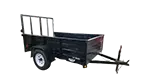
One practical option is owning a mid-size enclosed cargo trailer and a 16- to 20-foot open equipment or car trailer. The enclosed trailer handles furniture, electronics, tools, boxed inventory, and anything that cannot get wet or dirty. The open trailer handles vehicles, mowers, machinery, oversized merchandise, and items that are difficult to maneuver through an enclosed rear opening. Select one trailer for each auction based on the expected inventory, or send a second qualified driver and tow vehicle when both are genuinely needed. Do not assume that towing two trailers in a combination is permitted or appropriate simply because the truck has enough advertised power.
The other option is a larger enclosed trailer with a rear ramp that can serve as a general cargo hauler. An 8.5×20 or 8.5×24 tandem-axle enclosed trailer can move substantial mixed inventory, but GVWR varies by configuration. Some are rated at 9,990 lbs, while heavier models may use higher-capacity axle and frame packages. The important number is usable payload after subtracting the trailer’s empty weight and every installed option. The rear ramp rating, floor construction, tie-down ratings, axle placement, and cargo weight distribution must also be suitable for the load.
A large enclosed trailer can reduce the number of specialty trailers you need to own, but it will not automatically replace an equipment trailer. Concentrated wheel loads from compact machinery can exceed what a cargo trailer’s ramp or floor was designed to support, even when total cargo weight appears to be under GVWR. Likewise, a low-clearance car may not clear the ramp break-over angle, and a wide mower may not fit between the door cables or through the rear frame.
If you’re in Owen County or central Indiana and you’re trying to figure out what actually makes sense for your auction buying pattern, that’s exactly the kind of conversation the team at Spencer Trailers is set up for. Bring the year and configuration of your tow vehicle, photographs or model numbers for the heaviest items you buy, approximate trip distances, and information about whether you usually load alone. That produces a much more useful recommendation than choosing a trailer from one capacity number.
What to Ask Before You Buy
Buying a trailer for auction use is different from buying one for a single known job. The trailer has to accommodate changing cargo without exceeding the truck, hitch, axle, tire, brake, or licensing limits. A few questions worth asking yourself and your dealer:
- What are your truck’s configuration-specific ratings? Do not rely on a generic number for all 2500- or 3500-series pickups. Tow capacity can vary substantially by model year, engine, transmission, cab, bed length, axle ratio, drivetrain, hitch type, and installed equipment. Check the VIN-specific towing guide, door-jamb payload label, GCWR, front and rear GAWR, conventional or gooseneck rating, hitch rating, and tire ratings.
- What’s the payload, not just the GVWR? GVWR minus the trailer’s actual empty weight equals the maximum theoretical cargo capacity. A 7,000 lb GVWR trailer weighing 2,800 lbs leaves approximately 4,200 lbs before adding a spare tire, winch, battery, toolbox, straps, or other equipment. Ask whether the listed empty weight includes the options installed on the unit you are buying.
- Can the truck carry the tongue or pin weight? Trailer tow rating and truck payload are separate limits. Passengers, fuel, tools, bed cargo, hitch hardware, and trailer tongue or gooseneck pin weight all load the truck. A pickup can be under its advertised tow rating and still exceed its rear axle, tire, receiver, or payload rating.
- Do you need to load solo? Ramp length, ramp weight, loading angle, tilt operation, winch controls, door placement, deck height, and tie-down access can change the workload significantly. Test the loading system before buying whenever possible, especially if you expect to handle non-running vehicles or tracked equipment without help.
- Does the trailer have the required brakes and breakaway equipment? Indiana requires adequate brakes on a trailer with a gross weight of at least 3,000 lbs. The brakes must be controllable from the tow vehicle, and the trailer must be equipped so the brakes apply automatically if it separates. Confirm that the tow vehicle has a compatible, correctly adjusted brake controller.
- Will the combination affect your licensing or commercial compliance? A Class A CDL generally applies when a commercial combination has a GCWR or actual combined gross weight of 26,001 lbs or more and the trailer has a GVWR or actual gross weight over 10,000 lbs. A trailer over 10,000 lbs does not by itself create the 26,001 lb combination threshold. Other commercial rules can apply below the CDL threshold, particularly for business use or interstate operation, so verify your specific operation rather than relying on the trailer salesperson or an online forum.
- What is the complete out-the-door and ownership cost? Compare the purchase price with current local rental charges, mileage policies, deposits, availability, maintenance, insurance, financing, storage, and the cost of missed auction pickups. Indiana requires a newly acquired, unregistered vehicle or trailer to be titled and registered within 45 days to avoid late penalties. Ask for an itemized buyer’s order showing the trailer price, tax, title, registration, document preparation fee, and optional products. As of July 1, 2026, Indiana’s Auto Dealer Services Division published a document-preparation-fee enforcement threshold of $261.72, separate from government title, registration, and tax charges.
- Will the trailer be used in a qualifying business? Federal tax law restored 100% bonus depreciation for eligible property acquired and placed in service after January 19, 2025. A trailer used in a qualifying trade or business may be eligible, but business-use percentage, ownership, financing, placed-in-service timing, tax basis, depreciation elections, and recapture rules matter. Confirm treatment with a qualified tax professional rather than assuming the entire purchase is automatically deductible.
The best trailer for auction buying isn’t the one with the highest advertised capacity. It’s the one that fits what you actually buy, stays within every truck and trailer rating, can be loaded and secured safely, and doesn’t fight you every time the auctioneer gives you a removal deadline.
Spencer Trailers Has What You Need
Spencer Trailers at 291 West State Hwy 46 in Spencer, Indiana carries Diamond C, H&H, Wells Cargo, Darkhorse Cargo, and more, with new and used units regularly in stock. Diamond C has built trailers in Mt. Pleasant, Texas since 1985. Current premium Diamond C lines, including the LPX, HDT, FMAX, LPT, WDT, and DEC, use Lippert axles as standard and receive Diamond C’s DM Difference Maker multi-stage coating process. Specifications, options, payload, and pricing can change by model year and individual build, so compare the certification label and build sheet for the exact trailer on the lot.
If you want to see what’s available now, check the current inventory or browse recently sold trailers to get a feel for configurations and price ranges. Ready to talk specifics about your auction hauling setup? Reach out or call (812) 829-0226.
What types of auctions do you typically buy at? General estate, equipment, or vehicles? That one answer changes the entire trailer recommendation.


