


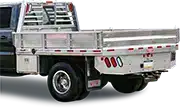
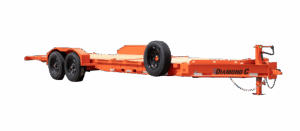







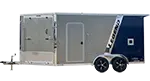
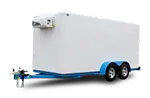


You’ve got two condensers, 30 feet of flex duct, a vacuum pump, recovery equipment, and a set of gauges riding in the back of your truck. The truck bed is full. Your apprentice is sitting sideways. Something has to change.
HVAC contractors are among the most demanding trailer buyers we work with, and for good reason. The load is bulky, awkward, valuable, and difficult to organize. Condensing units can suffer cabinet and coil damage when they move. Fins get crushed when equipment rubs against another load. Refrigerant cylinders, recovery machines, and vacuum pumps must remain secured. And flex duct that is not protected from weather and highway airflow can quickly become damaged or disappear altogether.
Getting the trailer right is not just about convenience. It is about protecting expensive equipment, controlling the load, reducing time spent packing and unpacking, and giving your crew a safer way to move equipment from the shop to the job site. Here’s what actually matters when you’re shopping for a cargo trailer as an HVAC contractor.
Why Enclosed Is the Serious Default
Some contractors make an open utility trailer work by using ratchet straps, tarps, storage boxes, and carefully planned loads. An open trailer can still be appropriate for oversized commercial equipment that will be loaded by forklift or lifted by crane. For day-to-day residential service, installation work, and light commercial changeouts, however, an enclosed cargo trailer is usually the more practical starting point.
A tarp cannot provide the same protection as a roof and enclosed walls. It can loosen, tear, collect water, or rub against delicate coil fins. An enclosed trailer keeps tools and equipment out of direct rain, road spray, dust, salt, and sunlight. It also gives you a lockable space for gauges, recovery machines, cordless tools, fittings, copper, electrical supplies, and other inventory that can represent several thousand dollars of value.
Enclosure does not replace proper cargo securement. A condenser can still slide or tip inside a closed trailer if it is not tied down. What the enclosure does provide is a controlled space where permanent tie-downs, shelving, cylinder racks, lighting, electrical outlets, and tool storage can be installed correctly. A clean trailer wrap also turns the trailer into a rolling advertisement and presents a more professional image than loose equipment covered by tarps.
The enclosed-trailer brands available through Spencer Trailers include Wells Cargo, Legend Manufacturing, Darkhorse Cargo, H&H, and United Trailers. Availability changes, and each manufacturer approaches framing, wall construction, axle packages, door openings, interior height, and optional equipment differently. Compare the actual unit and its VIN label rather than assuming that two trailers with the same advertised dimensions are built or rated the same way.
Size: Don’t Go Too Small and Don’t Overbuy
The most common sizing mistake is choosing a trailer based only on the largest condenser you expect to carry. A 24-inch-wide outdoor unit will physically fit inside many smaller trailers. The problem appears after you add shelving, refrigerant racks, a hand truck, extension ladders, recovery cylinders, flex duct, line-set covers, filters, fittings, and an aisle wide enough for a technician to move safely.
A 6×12 can be a useful service trailer for a solo technician who carries mostly tools, parts, and one compact unit at a time. It becomes crowded quickly when used as a full installation trailer. Single-axle 6×12 trailers may also have a GVWR around 2,990 pounds and a payload of little more than 1,000 pounds after the trailer’s empty weight is deducted. A tandem-axle 6.5×12 or 6.5×14 can provide substantially more capacity, but shelving and wall storage still reduce usable aisle width.
For many residential HVAC crews, a 7×16 enclosed cargo trailer is a sensible starting point. A current Darkhorse DHW 7×16 configuration, for example, uses dual 3,500-pound axles, electric brakes, a 7,000-pound GVWR, a rear ramp door with a transition flap, a side access door, a 7-foot interior height, a 3/4-inch engineered floor, and recessed wall track. With an approximate empty weight of 2,825 pounds, that particular configuration provides about 4,175 pounds of listed payload before dealer-installed accessories and cargo are added.
Heavier 7-wide trailers can also be ordered with higher GVWR packages, including 9,990-pound configurations from certain manufacturers. Do not assume that every 7×16 has 5,200-pound axles or a 9,990-pound GVWR. Many standard 7×16 trailers are 7,000-pound units with dual 3,500-pound axles. The model, axle rating, tire capacity, coupler rating, frame, suspension, and manufacturer-assigned GVWR all need to match.
If your crew routinely carries several outdoor units, large quantities of duct, multiple recovery cylinders, or commercial installation equipment, an 8.5×20 or 8.5×24 gives you more usable floor area and a wider rear opening. These sizes are available in several GVWR classes, commonly including 7,000, 9,990, 12,000, and 14,000 pounds, depending on the manufacturer and running-gear package. Higher axle capacity does not automatically mean the trailer’s legal GVWR equals the sum of the axle ratings; always use the GVWR shown on the certification label.
Before moving to an 8.5-foot-wide trailer, confirm more than the advertised tow rating of your truck. Check the truck’s GCWR, receiver rating, ball mount and hitch-ball ratings, rear-axle rating, tire ratings, payload capacity, and available capacity for tongue weight. HVAC shelving and cylinders are often installed toward the front, and too much front-loaded cargo can overload the truck’s rear axle even when the trailer remains under its GVWR.
Remember that nominal dimensions are not exact usable dimensions. Measure the width between wheel boxes, interior height, rear-door opening height and width, side-door opening, V-nose space, and the distance remaining after shelving is installed. A trailer advertised with a 7-foot interior can still have a lower rear-door opening, which may determine whether a tall piece of equipment will actually roll inside.
The Ramp Door: Your Most Important Spec
HVAC equipment varies widely in weight. A compact mini-split condenser may be manageable for two people, while a larger residential condensing unit, packaged unit, or commercial component may weigh several hundred pounds. Large rooftop equipment can weigh far more and is normally handled with purpose-built lifting equipment rather than rolled casually into a cargo trailer. The loading method should be decided before the trailer is ordered.
For crews using appliance dollies, hand trucks, carts, or a powered stair-climbing dolly, a full-width rear ramp door is usually the most useful configuration. A spring-assisted ramp reduces the effort required to raise and lower the door, while a ramp flap or transition flap helps wheels cross the gap between the ground and the main ramp surface. A beavertail or lower deck height can further reduce the loading angle.
Do not select a ramp based only on the trailer’s GVWR. Ramp-door capacity is a separate specification and can be affected by the ramp frame, hinges, cables or springs, floor construction, and how concentrated the load is under small wheels. Ask for the manufacturer’s ramp rating for the exact trailer being purchased. Do not drive a forklift onto a cargo-trailer ramp unless the manufacturer specifically rates the ramp and trailer for that loading method.
Opening dimensions matter just as much as ramp strength. Current Wells Cargo Road Force 8.5-wide specifications include an extra-wide rear ramp opening of approximately 94 inches on applicable configurations. The Legend Trailmaster Race Series uses an approximately 89-inch-wide rear ramp opening. A 7-wide Legend Cyclone STV has a narrower opening appropriate to its body width. Measure your widest cart, pallet, skid, and equipment base rather than relying on the trailer’s exterior width.
Ramp angle depends on deck height, ramp length, ground slope, tire size, axle configuration, beavertail design, and whether a transition flap is installed. A longer ramp can reduce the angle, but it also needs more clear space behind the trailer. Rear stabilizer jacks are valuable when a heavy cart crosses the ramp because they reduce movement at the hitch and help keep the trailer stable while parked. Chock the wheels and keep the trailer connected to the tow vehicle unless the manufacturer permits another loading procedure.
Barn doors are not automatically inferior. They may be a better choice when a forklift places equipment directly at the threshold, when the trailer backs tightly against a loading dock, or when there is not enough room to lower a ramp. For most residential HVAC crews rolling equipment by hand, however, a rear ramp is easier to use throughout the workday.
Side-door placement deserves equal attention. A curbside door near the front lets technicians reach hand tools, gauges, recovery equipment, and frequently used fittings without unloading the rear cargo area. Check the actual side-door width and height, the step arrangement, the lock hardware, and whether planned cabinets will block the opening. Many enclosed trailers can be ordered with wider side doors, additional doors, recessed steps, or bar locks, but availability is model-specific.
Securing Condensers and Heavy Equipment
Condensing units can shift, tip, and rotate if they are not secured correctly. The cabinet, service valves, electrical compartment, base pan, and coil fins can all be damaged by a unit that moves during braking or an evasive maneuver. An enclosed wall will stop equipment from leaving the trailer, but it will not prevent that equipment from striking tools, cylinders, shelving, or another condenser.
A practical setup combines structurally mounted D-rings or track, correctly rated straps, wheel or base restraints, and a clean non-slip loading surface. Many enclosed trailers use a 3/4-inch engineered wood floor over crossmembers spaced around 16 inches on center, but construction varies by model. Before installing anchors, cabinets, or cylinder brackets, identify the frame and crossmember locations. Fastening equipment only to a thin wall liner or unsupported section of flooring does not create a dependable tie-down point.
Rubber mats can add grip and help protect a condenser base, but they should be removable so the wood floor can be inspected and dried. Moisture trapped beneath permanent rubber can damage an engineered wood floor over time. Rubber coin flooring, commercial vinyl, aluminum tread plate, or extruded aluminum may be available on certain trailers, but each option has tradeoffs involving cost, weight, traction, cleaning, and repairability.
When comparing anchors, look for the working load limit, not only an advertised breaking strength. The working load limit of the strap, hook, anchor, track fitting, and mounting structure must all be considered, and the system is limited by its weakest component. Some current contractor-oriented enclosed trailers are equipped with 5,000-pound-rated D-rings, while other trailers use smaller anchors or offer tie-downs only as an option. Do not assume every recessed ring carries the same rating.
Four properly positioned tie points can create a balanced restraint pattern around one condenser, but the correct arrangement depends on the equipment and its approved lifting or securement points. Do not place straps across delicate coil fins, fan guards, tubing, or sheet-metal panels that can collapse. A skid, pallet, or load-spreading base may be needed when a unit has narrow feet that create concentrated loads on the floor.
Load placement is also part of securement. Keep heavy equipment low, balance the load from side to side, and maintain appropriate tongue weight without exceeding the tow vehicle’s payload or rear-axle rating. Do not place every cylinder, cabinet, and condenser against the front wall simply because that space is convenient. The finished trailer should be weighed in working condition so you know the actual axle and tongue loads.
For ductwork, a shelf system or overhead track can keep flex duct, line-set covers, drain pipe, and lightweight materials off the floor. Shelves should be attached to structural framing and designed with lips, doors, straps, or dividers that keep their contents contained during travel. Heavy compressors, refrigerant cylinders, and recovery machines belong in low, reinforced storage rather than on overhead shelves.
Compressed-gas and refrigerant cylinders require their own secure rack. Cylinders should be protected from impact, kept upright when required, secured against movement, and transported with valves closed and protective caps or guards in place when applicable. Follow the cylinder manufacturer’s instructions, the product safety data sheet, and current hazardous-material transportation requirements for the refrigerant and quantity being carried.
A Quick Comparison: Three Solid Options
| Trailer | Size | GVWR | Ramp Door | Best For |
|---|---|---|---|---|
| Darkhorse DHW enclosed cargo | 7×16 | 7,000 lbs | Rear ramp with transition flap on applicable builds | Residential service and installation crews needing a compact tandem-axle trailer |
| Wells Cargo Road Force | 8.5×20 | 7,000 or 9,990 lbs, depending on configuration | Spring-assisted rear ramp with extra-wide opening | Multiple residential units, bulky ductwork, and light commercial installation work |
| Legend Trailmaster Race Series | 8.5×24 | 7,000-14,000 lbs, depending on configuration | Rear ramp with approximately 89-inch opening | Larger crews, custom interiors, multiple units, and higher-volume light commercial work |
These are configuration examples, not a claim that every trailer carrying the same model name has identical specifications. Axles, GVWR, interior height, ramp construction, floor materials, wheels, tires, tie-downs, and electrical packages can change with the order. Confirm the VIN-specific build sheet and certification label before comparing payload or towing requirements.
Prices vary based on manufacturer, material, GVWR, interior height, ramp package, electrical work, shelving, flooring, wheels, tires, and current market conditions. Call us at (812) 829-0226 for current pricing and ask for an itemized out-the-door quote that identifies the trailer price, installed options, documentation charge, taxes, title, and registration costs.
Floor, Wall, and Ceiling Considerations for HVAC Work
Most steel-frame enclosed cargo trailers use prefinished aluminum exterior skin with engineered wood or plywood interior wall panels. All-aluminum trailers use different framing and skin systems, but they may still have engineered wood floors and wall liners. Do not confuse the exterior skin thickness with the strength of the interior wall or the structural frame behind it.
Wall-stud, roof-bow, and floor-crossmember spacing affects how easily shelves, cabinets, tracks, and equipment racks can be installed. Contractor-oriented trailers commonly use framing spaced around 16 inches on center, but that is not universal. Ask where the structural members are located and photograph them before the trailer is fully finished. This makes later installation work safer and prevents fasteners from being placed only through the liner.
A V-nose or V-front can provide useful space for a cabinet, electrical panel, spare tire, small workbench, or vertical tool storage. It does not always add a full advertised foot or two to the rectangular floor area. Manufacturers may list the straight box length separately from the V section, so compare floor plans and usable measurements rather than assuming every 7×16 V-nose has the same interior volume.
Interior height deserves attention. A standard 6-foot or 6-foot-6-inch interior may work for storage, but it becomes uncomfortable when a technician regularly enters the trailer, works at shelves, or moves tall equipment. An extra-height interior near 7 feet is usually more comfortable for an HVAC installation trailer. Check the rear-door and side-door opening heights separately because they can be several inches lower than the ceiling.
The ceiling may be unfinished unless a finished liner is ordered. If you plan to install lights, insulation, rooftop equipment, overhead storage, or an air conditioner, specify the reinforcement and wiring before the trailer is built. A finished ceiling can make the trailer brighter and easier to clean, but it also adds weight and can hide the framing needed for future modifications.
Ventilation needs to be treated as a safety and storage issue, not as a substitute for climate control. Passive wall vents and roof vents can promote air exchange, but they do not guarantee a safe cylinder temperature or keep the interior cool when a trailer is parked in direct sun. The HVAC industry is increasingly working with lower-GWP refrigerants such as R-32 and R-454B, which have different handling characteristics from older products. Follow the safety data sheet and equipment manufacturer’s requirements for each refrigerant, including ventilation, ignition-source control, cylinder securement, and temperature limits.
Do not leave cylinders loose or rely on a roof vent as the only safety measure. Keep them secured, inspect valves and caps, limit unnecessary heat exposure, and remove damaged or leaking cylinders from service according to approved procedures. The amount and type of refrigerant carried can also affect federal hazardous-material requirements, including training, shipping papers, markings, and placarding.
If the trailer includes shore power or a generator inlet, have the electrical system installed with correctly sized wiring, breakers, grounding, weather-resistant components, and protected cable routing. A portable combustion generator must be operated outdoors, away from doors, windows, and vents. It should never be run inside the enclosed trailer because of carbon-monoxide, heat, and fire hazards.
A Few Things Worth Asking Before You Buy
Q: Do I need a CDL to tow a large enclosed trailer?
A: Under the standard Class A CDL threshold, the combination must have a GCWR or actual combined weight of at least 26,001 pounds, and the towed unit must have a GVWR or actual weight exceeding 10,000 pounds. The 26,001-pound figure applies to the combination, not to the trailer by itself. A trailer with a 9,990-pound GVWR generally stays below the towed-unit portion of that Class A threshold, but you still need to verify the truck’s rating, actual weights, and any separate hazardous-material requirements. A CDL or endorsement can also be required when transporting material that must be placarded, regardless of the ordinary weight calculation.Q: Does a 14,000-pound trailer automatically require a CDL?
A: No. The trailer’s rating alone does not answer the question. A trailer rated over 10,000 pounds satisfies the towed-unit part of the Class A definition, but the combination must also reach the 26,001-pound GCWR or actual combined-weight threshold. For example, a 14,000-pound trailer paired with a truck whose rating keeps the full combination below 26,001 pounds does not meet the standard Class A weight threshold. The truck, hitch, and trailer must still be legally and safely rated for the load.Q: What brakes are required in Indiana?
A: Indiana law requires a trailer or semitrailer with a gross weight of at least 3,000 pounds to have brakes adequate to control, stop, and hold the trailer. The brakes must be controllable from the tow vehicle and must apply automatically if the trailer breaks away. Tandem-axle cargo trailers in the 7,000-pound and higher classes normally use electric brakes and a breakaway system, so the tow vehicle needs a compatible brake controller and properly wired connector.Q: Can I get a trailer with a generator receptacle?
A: Depending on the manufacturer and model, you may be able to order a 120-volt electrical package, shore-power inlet, generator inlet, interior outlets, lights, battery system, or preparation for an inverter. Confirm exactly what is included. A power inlet does not make it safe to operate a portable generator inside the trailer; the generator must remain outdoors while running.Q: What’s the payload on a 9,990-pound GVWR trailer?
A: Subtract the trailer’s actual empty or curb weight from its 9,990-pound GVWR. A trailer weighing 3,900 pounds has a theoretical payload of 6,090 pounds. A heavier trailer weighing 4,020 pounds has about 5,970 pounds before cargo is added. Shelving, cabinets, spare tires, batteries, electrical equipment, flooring, and dealer-installed accessories all reduce the remaining payload. Use the VIN-specific weight information and weigh the completed work trailer rather than relying on a generic brochure number.Q: Can I use all of the listed payload anywhere on the floor?
A: No. The total payload number does not override axle, tire, coupler, hitch, tongue-weight, floor, ramp, or point-load limits. A compact but heavy machine can overload a small section of the floor or ramp even though the trailer remains below its total GVWR. Distribute concentrated loads, place heavy items over structurally supported areas, and verify ramp and anchor ratings.Q: How should refrigerant cylinders be carried?
A: Use a dedicated rack or restraint system that keeps cylinders from tipping, rolling, or striking other cargo. Close valves, install protective caps or guards when applicable, and follow the cylinder label and safety data sheet. Different refrigerants have different classifications and handling requirements. Quantities carried for business can affect hazardous-material compliance, so contractor training and company procedures should be reviewed as refrigerants and regulations change.Q: How long do I have to title and register a trailer in Indiana?
A: Indiana buyers should apply for the title within 45 days of purchase to avoid an administrative penalty. Complete the title and registration process promptly rather than treating a temporary permit or dealer paperwork as permanent registration.Q: Is there a limit on an Indiana dealer’s documentation fee?
A: Indiana regulates documentation preparation fees. The Indiana Secretary of State’s published enforcement guidance set an amount of approximately $251.05 as of July 1, 2025. Because the figure can be adjusted, ask for the current fee and review the complete itemized purchase agreement rather than comparing trailers only by an advertised base price.Q: Can an HVAC business deduct the trailer purchase?
A: A trailer used in a qualifying trade or business may be eligible for depreciation, Section 179 treatment, or bonus depreciation, depending on the purchase, business use, placed-in-service date, and the taxpayer’s circumstances. Federal law restored permanent 100% bonus depreciation for qualifying property acquired and placed in service after January 19, 2025. That does not mean every buyer automatically receives a full deduction, so discuss eligibility, business-use percentage, basis, elections, and recordkeeping with a qualified tax professional.
Where to Start
If you’re in Owen County, the Bloomington area, or elsewhere in south-central Indiana, we have enclosed cargo trailers in stock at 291 West State Hwy 46 in Spencer. You can walk the lot, open the ramps, measure the doors, compare interior heights, and see how much space remains after wheel boxes and wall framing are taken into account. We also have a contact form if you want to ask about a specific size, GVWR, ramp, axle package, or custom contractor configuration before making the drive.
Bring measurements for your largest condenser, hand truck, recovery machine, cylinder rack, shelving layout, and longest pieces of duct or pipe. Also bring the year, make, model, engine, drivetrain, cab configuration, and bed length of the tow vehicle. That information helps us compare the trailer against the truck’s published ratings instead of guessing from the hitch receiver alone.
A well-built enclosed trailer can remain useful for many years when its roof seams, tires, brakes, bearings, breakaway battery, door hardware, ramp springs, lights, floor, and frame are inspected and maintained. Buying too small can force you to replace the trailer after only a few seasons. Buying more GVWR and length than the truck or crew can handle creates a different set of problems. The goal is not the biggest trailer on the lot; it is the smallest trailer that safely carries your real working load with enough room for the business to grow.
Get the size, payload, door opening, ramp, tie-downs, cylinder storage, and tow-vehicle match right the first time, and the trailer can earn its keep through protected equipment, cleaner organization, safer loading, and faster load-out times. What’s your current biggest headache when loading for an HVAC job?


