













You’re standing in a dealer lot, trailer hitch almost in hand, and someone says, “Check the VIN.” You nod. You pull out your phone. Then you stare at 17 characters that look like a random password and wonder what any of it means.
Trailer VINs are not random, but they also are not complete history reports. The VIN identifies the trailer and encodes information about its manufacturer, configuration, model year, assembly plant, and production sequence. It does not directly tell you whether the trailer was wrecked, flooded, stolen, rebuilt, or properly maintained. Those facts must be checked through titles, registrations, insurance records, state agencies, and physical inspection.
Once you understand the pattern, however, you can verify the VIN’s structure, identify the model-year code, confirm that the number on the trailer matches the paperwork, and recognize situations that need further investigation. This guide breaks it down position by position.
Why Bother Reading the VIN Yourself?
A decoder or vehicle-history service may give you a report. Reading the VIN yourself gives you the ability to catch obvious errors before you rely on that report. If you’re buying a used Diamond C, a Liberty trailer, or a Wells Cargo cargo unit, knowing how to inspect the VIN can help you determine:
- Which country or region and manufacturer are represented by the manufacturer identifier
- The trailer’s stated model year, which may differ from its calendar-year manufacture date
- Whether the VIN has the correct 17-character format and a valid check digit
- Whether the VIN on the certification label matches the title, registration, bill of sale, and other records
- Whether the manufacturer-specific descriptor characters are consistent with the trailer’s type, length, body, and axle configuration
- Whether the certification label appears original, permanently attached, and free from unexplained alteration
A mismatch does not automatically prove theft or fraud. It may result from a transcription mistake, a replacement certification label, a state-assigned VIN, or an error on older paperwork. But it is a serious warning sign that should be resolved before money changes hands.
The 17-Character Structure
Road trailers manufactured for sale in the United States and subject to federal VIN requirements use a standardized 17-character Vehicle Identification Number. The modern 17-character system dates to the 1981 model year, although older trailers, homemade trailers, certain imported trailers, and trailers carrying a state-assigned identification number may follow a different format.
Under 49 CFR Part 565, a VIN uses capital letters and numbers. There are no spaces, and the letters I, O, and Q are excluded because they can be confused with 1 and 0.
The VIN is commonly discussed as a WMI, VDS, and VIS, but the federal rule divides it into four functional sections:
| Section | Positions | Name | What It Tells You |
|---|---|---|---|
| WMI | 1–3 | World Manufacturer Identifier | Manufacturer, vehicle type, and country or regional assignment |
| VDS | 4–8 | Vehicle Descriptor Section | Manufacturer-coded trailer attributes such as type, body, length, and axle configuration |
| Check Digit | 9 | Mathematical Validation Character | Helps verify that the VIN was transcribed correctly |
| VIS | 10–17 | Vehicle Identifier Section | Model year, plant, manufacturer identifier information for some low-volume builders, and production sequence |
One important exception applies to low-volume manufacturers. Under the current federal rule, a low-volume manufacturer is one that produces fewer than 1,000 vehicles of a given type per year. For those manufacturers, position 3 is a 9, and positions 12 through 14 complete the manufacturer identifier. That means the first three characters are not always the manufacturer’s entire identifying code.
Positions 1–3: The WMI (Who Made It and Where)
The World Manufacturer Identifier begins with the first three characters. The characters work together; position 2 by itself is not a complete manufacturer code.
The first character identifies a geographic or country assignment. Within the North American WMI system, 1, 4, and 5 are associated with the United States, 2 with Canada, and 3 with Mexico. The remaining characters narrow the identifier to the manufacturer and vehicle type.
For a high-volume manufacturer, all three characters together identify the manufacturer and type of motor vehicle. For a low-volume manufacturer, position 3 is 9, and positions 12 through 14 must also be read before the complete manufacturer identifier is known.
SAE International coordinates WMI assignments for U.S. manufacturers under contract with NHTSA. A legitimate manufacturer is also required to submit information that allows NHTSA to decipher the VIN scheme used for its vehicles.
Diamond C Trailers has manufactured open steel trailers in Mt. Pleasant, Texas, since 1985. When checking a Diamond C VIN, do not rely on the first character alone to identify the brand. Read the complete manufacturer identifier and verify it through the manufacturer’s records or NHTSA’s manufacturer-reported VIN decoder.
The same rule applies to H&H, Legend, Wells Cargo, Liberty, Delco, and every other trailer brand. A U.S.-associated first character helps identify the WMI region, but the full code is what identifies the manufacturer.
Positions 4–8: The VDS (Type, Size, Axles, and Sometimes GVWR Class)
Positions 4 through 8 make up the manufacturer-coded Vehicle Descriptor Section. There is no single universal trailer-decoding key for these five characters. Each manufacturer establishes its own code and submits the deciphering information to NHTSA.
For trailers, 49 CFR Part 565 requires this section to make the following attributes decipherable:
- The make
- The type of trailer
- The body type
- The trailer length
- The axle configuration
A manufacturer may use one character for hitch or connection type, another for trailer category, another for length, and another for axle count. A different manufacturer may arrange those attributes in an entirely different order. You therefore cannot take the fifth character from one brand’s VIN guide and apply it to another brand.
Federal VIN rules do not require a trailer manufacturer to encode GVWR in positions 4 through 8. Some manufacturers voluntarily use an available character to represent a GVWR rating or weight range, but that character can be decoded only with the correct manufacturer’s VIN scheme.
When a manufacturer reports a GVWR classification to NHTSA, the current federal table uses these ranges:
- Class A: 3,000 lb GVWR or less
- Class B: 3,001–4,000 lb GVWR
- Class C: 4,001–5,000 lb GVWR
- Class D: 5,001–6,000 lb GVWR
- Class E: 6,001–7,000 lb GVWR
- Class F: 7,001–8,000 lb GVWR
- Class G: 8,001–9,000 lb GVWR
- Class H: 9,001–10,000 lb GVWR
- Class 3: 10,001–14,000 lb GVWR
- Class 4: 14,001–16,000 lb GVWR
- Class 5: 16,001–19,500 lb GVWR
- Class 6: 19,501–26,000 lb GVWR
- Class 7: 26,001–33,000 lb GVWR
- Class 8: 33,001 lb GVWR and above
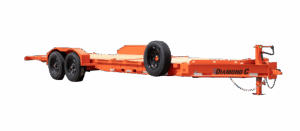
For example, the 7,000 lb GVWR Diamond C GTU falls within Class E. A 14,000 lb trailer falls within Class 3, while a 15,500 lb trailer falls within Class 4. Diamond C FMAX gooseneck flatbeds span several GVWR classes because the lineup ranges from approximately 15,500 lb through 40,000 lb, depending on the exact model and configuration.
Those classifications do not replace the trailer’s actual certified GVWR. Tow-vehicle compatibility, payload calculations, registration, brake requirements, and driver-license questions must be based on the ratings shown on the trailer certification label, the tow vehicle’s ratings, and the applicable law—not on a guessed VIN character.
Position 9: The Check Digit
Position 9 is a calculated character consisting of a number from 0 through 9 or the letter X. It does not describe the trailer. Its purpose is to help verify the accuracy of the other 16 characters.
The federal calculation assigns a numerical value to every VIN character. Each value is multiplied by a weight assigned to that position. The products are added together, and the total is divided by 11. The remainder determines the check digit. If the remainder is 10, position 9 is X.
Because the calculation uses every other VIN character, a single mistyped letter or number will often produce an invalid check digit. That makes position 9 useful for catching mistakes on advertisements, bills of sale, insurance documents, registrations, and titles.
An invalid check digit does not, by itself, prove that the physical VIN was altered. First compare the VIN character by character against the trailer. Distinguish carefully between similar characters such as 5 and S, 2 and Z, 8 and B, or 1 and L. Also determine whether the trailer carries an older, imported, homemade, reconstructed, or state-assigned identification number.
If a modern manufacturer-issued 17-character VIN still fails the calculation, pause the transaction. Have the manufacturer, dealer, state titling agency, or law enforcement inspection unit resolve the discrepancy before you buy the trailer.
Position 10: The Year Code (The One Everyone Gets Wrong)
Position 10 represents the model year, not the exact date the trailer left the assembly line. NHTSA defines model year as the year used by the manufacturer to designate a discrete vehicle model, regardless of the calendar year in which the individual vehicle was produced, provided that the production period under that model-year designation does not exceed 24 months.
The actual month and year in which assembly was completed should appear on the federal certification label. That date may not be identical to the model year represented by position 10.
Model-year codes repeat every 30 years. For trailers, the code alone may not distinguish the older cycle from the newer cycle. You must use the trailer’s age, certification date, title history, manufacturer records, and overall construction to identify the correct decade.
| Code | 1980–2009 Cycle | 2010–2039 Cycle |
|---|---|---|
| A | 1980 | 2010 |
| B | 1981 | 2011 |
| C | 1982 | 2012 |
| D | 1983 | 2013 |
| E | 1984 | 2014 |
| F | 1985 | 2015 |
| G | 1986 | 2016 |
| H | 1987 | 2017 |
| J | 1988 | 2018 |
| K | 1989 | 2019 |
| L | 1990 | 2020 |
| M | 1991 | 2021 |
| N | 1992 | 2022 |
| P | 1993 | 2023 |
| R | 1994 | 2024 |
| S | 1995 | 2025 |
| T | 1996 | 2026 |
| V | 1997 | 2027 |
| W | 1998 | 2028 |
| X | 1999 | 2029 |
| Y | 2000 | 2030 |
| 1 | 2001 | 2031 |
| 2 | 2002 | 2032 |
| 3 | 2003 | 2033 |
| 4 | 2004 | 2034 |
| 5 | 2005 | 2035 |
| 6 | 2006 | 2036 |
| 7 | 2007 | 2037 |
| 8 | 2008 | 2038 |
| 9 | 2009 | 2039 |
On a clearly modern trailer, K normally indicates the 2019 model year, R indicates 2024, S indicates 2025, and T indicates 2026. On an older trailer, those same letters could mean 1989, 1994, 1995, and 1996.
If a seller advertises a trailer as a 2025 model and position 10 is M, the VIN points to the 2021 or 1991 cycle—not 2025. That discrepancy must be resolved through the certification label, title, and manufacturer before the purchase proceeds. Do not accept an explanation that the model-year character represents the month, axle rating, or production day; position 10 is reserved for the model year.
Position 11: The Assembly Plant
Position 11 identifies the plant of manufacture. Under the federal VIN definition, that means the plant where the manufacturer affixes the VIN. It does not necessarily describe every facility that produced a frame, axle, body panel, or other component.
The plant character is manufacturer-specific. Diamond C, Legend Manufacturing, Wells Cargo, H&H, and other builders establish and report their own codes. The same letter can represent one location for one manufacturer and an entirely different location for another.
This character can be useful during warranty research, recall work, production-record searches, and parts identification. It may help the manufacturer narrow the trailer to a particular facility or production system, but it must be interpreted with the correct manufacturer’s decoding information.
Positions 12–17: The Sequential Serial Number
Positions 12 through 17 serve different purposes depending on whether the trailer was produced by a high-volume or low-volume manufacturer.
For a high-volume manufacturer—one producing at least 1,000 vehicles of a given type each year—positions 12 through 17 represent the production number sequentially assigned by the manufacturer. The sequence may contain letters and numbers, although federal rules require the last four VIN characters to be numeric for trailers.
For a low-volume manufacturer, positions 12 through 14 complete the manufacturer identifier. Only positions 15 through 17 represent the sequentially assigned production number. A 9 in position 3 is the clue that the VIN uses this extended manufacturer-identifier format.
The entire 17-character VIN, rather than the final six characters by themselves, is what uniquely identifies the trailer. Current federal rules prohibit two vehicles subject to the applicable standards and manufactured within the specified 60-year VIN period from having identical VINs.
When buying used, compare all 17 characters against the title, registration, bill of sale, insurance paperwork, lien release, manufacturer’s invoice, and any previous service records. Check each character individually. A seller may accidentally transpose two digits, but the error still needs to be corrected before ownership is transferred.
If the trailer has a rebuilt, salvage, or state-assigned title, review the supporting inspection and title documents carefully. Do not assume that an apparently correct final serial sequence proves that the complete VIN plate is original.
Where to Find the VIN on a Trailer
Federal VIN rules require the VIN to appear clearly and indelibly on a part of the trailer that is not designed to be removed except for repair, or on a separate plate or label permanently affixed to such a part.
A separate federal certification rule, 49 CFR 567.4, requires the trailer’s certification label to be placed on the forward half of the left side so it can be read from outside without moving any part of the trailer. That certification label includes the VIN along with the manufacturer, month and year of manufacture, GVWR, GAWR, vehicle type, and federal conformity statement.
In practical terms, begin your search in these areas:
- The forward left side of the tongue: On many bumper-pull trailers, the certification label is attached to the driver’s-side portion of the A-frame tongue.
- The left front frame rail: Some manufacturers attach the certification label to the forward main rail or stamp a secondary VIN into the frame.
- The coupler area: The label may be located close to the coupler support, jack mount, or forward crossmember, provided it remains on the forward half of the left side.
On gooseneck trailers, including Diamond C flatbed, dump, tilt, and equipment trailers, inspect the left side of the gooseneck structure and the forward left frame area. The exact placement can vary by model year, trailer design, and label configuration.
On enclosed cargo trailers from manufacturers such as Wells Cargo, Darkhorse Cargo, Legend, or United, inspect the forward left exterior wall, lower frame rail, and tongue area. A manufacturer may also place secondary identification or production labels inside the trailer, but the exterior federal certification label is the primary label to compare with the title.
Do not rely on a photo from the seller. Read the VIN directly from the trailer and compare it with the original ownership document before paying.
Inspect the label and the surrounding material. Warning signs include fresh mismatched rivets, screws where permanent rivets would normally be expected, grinding marks, unusual welds, a label mounted over another label, paint covering the edges, damaged adhesive patterns, or a stamped number that appears shallower or differently spaced than the surrounding characters.
A replacement label is not automatically improper. Manufacturers sometimes issue replacement labels after damage, a recall, or a verified labeling error. A legitimate replacement should be supported by manufacturer or regulatory documentation and should match the trailer and ownership records exactly.
A Quick Decode Example
Take this fictional but mathematically valid example VIN: 5ACU202A1TM123456. The WMI and descriptor meanings are illustrative only and are not intended to represent an actual manufacturer’s coding scheme.
5AC = Illustrative three-character U.S. manufacturer identifier
U202A = Manufacturer-specific trailer attributes in positions 4–8
1 = Check digit in position 9
T = 2026 model-year code in the current cycle
M = Manufacturer-specific assembly-plant code
123456 = Sequential production number, assuming a high-volume manufacturer
The check digit in that example is 1 because the assigned values and position weights for the other 16 characters produce a remainder of 1 when divided by 11.
From the structure alone, you can identify a U.S.-associated WMI, validate the check digit, and read the current-cycle model year as 2026. You cannot determine the trailer’s accident history, title status, exact GVWR, or precise model from that generic example without the manufacturer’s decoding information and external records.
That distinction matters: a VIN is an identification key. It is not the history database itself.
Does the VIN Tell You GVWR?
Not necessarily. Federal VIN requirements for trailers specify make, trailer type, body type, length, and axle configuration in the descriptor section. They do not require the exact GVWR to be encoded in the VIN.
A manufacturer may voluntarily encode a GVWR class or weight band in positions 4 through 8. When it does, the code must be interpreted with that manufacturer’s submitted decoding scheme. The same character may mean an entirely different weight range in another brand’s VIN.
The legally important rating is printed on the federal certification label. That label should show:
- The trailer manufacturer’s name
- The month and year of manufacture
- The complete VIN
- The Gross Vehicle Weight Rating, or GVWR
- The Gross Axle Weight Rating, or GAWR, for each axle or axle group
- The trailer vehicle-type classification
- The federal safety-conformity statement
For example, a Diamond C GTU is rated at 7,000 lb GVWR and uses dual 3,500 lb axles, but those ratings should be verified on the individual trailer’s certification label. A 14,000 lb equipment trailer falls within federal Class 3, while a Diamond C FMAX, LPT, LPX, or HDT may fall into a higher class depending on the exact model and ordered configuration.
Do not calculate payload by adding the axle ratings and assuming the result is the GVWR. The manufacturer’s certified GVWR controls, and usable payload is generally the certified GVWR minus the trailer’s actual empty weight and any installed equipment or accessories.
If a manufacturer-specific VIN decoder reports a weight class that conflicts with the certification label, contact the manufacturer before using or purchasing the trailer. If the manufacturer’s VIN scheme does not encode GVWR at all, the absence of a weight-class result is not a defect.
When to Run a Full VIN Report
Reading the VIN yourself handles structural checks, but a used-trailer purchase requires more than decoding. Run every available check, especially on a high-value equipment trailer, dump trailer, gooseneck, enclosed cargo trailer, or unit offered without clear ownership history.
Start with NHTSA’s public VIN decoder. It displays information submitted by the manufacturer, which may include the manufacturer, trailer type, body type, length, axle configuration, plant, and other coded attributes. Decoder coverage varies, particularly with older or low-volume manufacturers, so an incomplete result does not automatically mean the VIN is invalid.
You can also enter the VIN in NHTSA’s recall search to check for open safety recalls associated with the trailer. A valid decode or a lack of recalls does not verify ownership or guarantee that the trailer has never been damaged.
NICB’s VINCheck is a useful free screening tool for records of unrecovered theft and salvage reported by participating insurers. Its coverage is limited to participating data sources, and NICB states that it is not a comprehensive vehicle-history report. A clean result should never replace a title review or physical inspection.
Do not assume that a car-style NMVTIS report will provide complete trailer history. Federal NMVTIS materials generally exclude trailers and semitrailers from the system’s required vehicle population, although a state or private provider may hold additional records. Before paying for a commercial report, confirm that the service accepts trailer VINs and ask exactly which title, insurance, auction, theft, and salvage sources it checks.
For a used trailer, your due-diligence process should include:
- Comparing the physical VIN with the original title or certificate of origin
- Verifying that the seller’s name matches the ownership document
- Obtaining a properly executed lien release when a lien appears on the title
- Checking for salvage, rebuilt, flood, assembled, or state-assigned title brands
- Reviewing the most recent registration and any available prior title records
- Confirming the VIN and specifications with the manufacturer when the decoder result is incomplete
- Having the trailer inspected by a qualified dealer, repair facility, or appropriate authority when tampering is suspected
At Spencer Trailers, new trailers from Diamond C, Liberty, H&H, Legend, Darkhorse Cargo, Wells Cargo, and Delco are supplied with the applicable manufacturer paperwork, certification labeling, and Manufacturer’s Certificate or Statement of Origin needed for titling. The state issues the title; a new trailer does not leave the factory with a previously issued consumer title.
Indiana purchasers generally have 45 days from the purchase date to complete the title and registration process without a late-title penalty. Keep the bill of sale, dealer paperwork, certificate of origin or assigned title, and any lien documents together, and verify that the VIN is identical on every page.
When you’re shopping the private market or checking a used unit anywhere, knowing how to read and inspect the VIN is the first move—not the last one. See what’s currently available on our trailer inventory page, or browse recently sold trailers to get a feel for what models move in your area.
Got a VIN you can’t decode or a used trailer you want a second opinion on? Call us at (812) 829-0226 or stop by 291 West State Hwy 46 in Spencer. We’re happy to take a look.


