



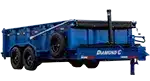

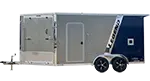
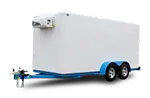
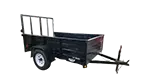

You’re standing in front of two trailers. Both are 83 inches wide. Both have tandem axles. The price difference is $1,400. The dealer says one has “upgraded axles.” You nod, but the description does not tell you whether the upgrade adds usable payload, changes the suspension, includes larger brakes and tires, or raises the trailer’s certified GVWR.
Axle ratings are one of those specifications people often skip because they sound dry and technical. But get this wrong and you may overload the trailer, choose components poorly suited to your workload, or pay for capacity you cannot legally or practically use. None of those is a good outcome.
Here’s what the numbers actually mean, where the common axle classes appear, how suspension and brake choices affect the package, and how to match a trailer’s complete rating to what you’re actually hauling.
What the Rating Number Means
When a trailer is listed with a 7,000-lb axle, that number normally refers to the axle manufacturer’s Gross Axle Weight Rating, or GAWR, for one complete axle assembly when it is properly installed and used with compatible wheels, tires, hubs, brakes, suspension components, and mounting hardware. Two 7k axles provide a combined axle rating of 14,000 lbs. That does not automatically make the trailer’s GVWR 14,000 lbs, and it does not mean the complete trailer can carry 14,000 lbs of cargo.
GVWR, or Gross Vehicle Weight Rating, is assigned by the completed-trailer manufacturer and appears on the trailer’s certification label. It is the maximum permitted weight of the loaded trailer itself, including the trailer’s empty weight, cargo, permanently installed equipment, fluids, batteries, spare tires, tools, and accessories. Payload is therefore calculated from the trailer’s actual empty weight and GVWR, not from the axle ratings alone.
The manufacturer considers the entire system when assigning GVWR: axles, suspension, wheels, tires, brakes, frame, tongue or gooseneck structure, coupler, safety equipment, and other load-bearing components. Part of a properly loaded trailer’s weight is also carried at the hitch as tongue or pin weight rather than resting on the axles. For that reason, a trailer’s certified GVWR can sometimes be higher than the sum of its axle GAWRs, provided the design accounts for the required hitch-supported load. In other cases, GVWR may be lower than the combined axle rating because another component or the manufacturer’s chosen certification package is the limiting factor.
So when you compare trailers, look at the GVWR, each axle’s GAWR, tire and wheel ratings, empty weight, and calculated payload. Those numbers tell different parts of the story. The certification label and the manufacturer’s documentation control; adding the axle ratings together is not a substitute for reading the trailer’s stated GVWR.
The Common Axle Ratings and Where They Show Up
3,500-lb Axles (3.5k)
These are common workhorses in the utility, landscape, car-hauler, and enclosed-trailer markets. A single 3.5k axle may be installed beneath a trailer with a GVWR around 3,000 to 3,500 lbs, while two 3.5k axles are commonly used on trailers certified near 7,000 lbs. The precise GVWR still depends on the complete trailer design and certification label.
You’ll find 3.5k axles on many 5×10 and 6×12 utility trailers, lighter enclosed trailers, car haulers, and other moderate-duty builds. Diamond C’s current GTU premium tandem-axle utility trailer, for example, has a 7,000-lb GVWR, two 3,500-lb Lippert axles, and a 4-inch channel frame. Diamond C also uses Lippert 3.5k drop axles as the standard tandem configuration on its GTF car hauler.
Axles in this class can be ordered with or without brakes depending on the application and manufacturer, but the completed trailer must comply with the law where it is operated. In Indiana, a trailer over 3,000 lbs GVWR must be equipped with brakes that satisfy state requirements. Buyers should therefore inspect the certification label and brake equipment rather than assume that every 3.5k axle package is configured the same way.
5,200-lb Axles (5.2k)
The 5.2k axle occupies a useful middle position between light utility components and heavier 6k or 7k hardware. Two 5.2k axles provide 10,400 lbs of combined GAWR, although the completed trailer may be certified at a lower GVWR such as 9,990 lbs. This class has historically been popular on medium-duty equipment trailers, car haulers, and enclosed trailers where buyers want more wheel, bearing, spindle, and brake capacity than a 3.5k package provides.
A 9,990-lb rating is sometimes chosen for product-positioning, registration, operating, or customer-use considerations, but it should not be described as a universal CDL exemption. Under the federal Class A CDL threshold, a combination generally enters Class A territory when its GCWR or applicable combined weight is at least 26,001 lbs and the towed unit’s GVWR or applicable weight exceeds 10,000 lbs. A trailer exceeding 10,000 lbs by itself does not trigger a Class A CDL when the combination remains below 26,001 lbs. Commercial use, actual weight, vehicle ratings, state rules, endorsements, and applicable exceptions must still be evaluated.
Current Diamond C configurations vary by model and are not limited to 5.2k axles in this capacity range. For example, the current MDT medium-duty telescopic dump uses two 6,000-lb Lippert drop axles while carrying a 9,890-lb GVWR. That illustrates why shoppers should compare the complete factory package rather than infer the axle rating from the GVWR or model category.
7,000-lb Axles (7k)
This is a widely used heavy-duty axle class. Two 7k axles provide 14,000 lbs of combined GAWR, but current trailers using that running gear may carry certified GVWRs above or below that figure depending on hitch-supported weight and the ratings of the complete trailer. The traditional 14,000-lb equipment trailer remains common, while some current premium models use tandem 7k axles in a 14,900- or 15,500-lb GVWR package engineered around appropriate hitch load.
Diamond C’s premium lines use Lippert axles as standard. Current LPT heavy-duty telescopic dump, LPX low-profile extreme-duty equipment, and HDT hydraulically dampened tilt equipment trailers begin with two 7,000-lb Lippert axles and are offered in multiple GVWR packages. Depending on the model, buyers may be able to move to tandem 8k, tandem 10k, or triple-7k configurations as part of a complete factory-engineered upgrade.
At this weight class, buyers should expect appropriately rated brakes, hubs, tires, wheels, springs, equalizers, hangers, and frame components. Electric drum brakes are common on 7k running gear, but the exact brake and lubrication package depends on the model and options. A heavier axle typically has a larger tube, spindle, bearings, hubs, brakes, and suspension than a 3.5k axle, but those physical differences are not a substitute for reading the component tags and factory specifications.
8,000-lb Axles (8k)
An 8k axle is a meaningful step up in capacity and component size. Two 8k axles provide 16,000 lbs of combined GAWR. Depending on the trailer’s engineered hitch load and complete component package, a tandem-8k build may carry a certified GVWR above 16,000 lbs. Diamond C, for example, offers 18,000-lb GVWR packages on selected LPT, LPX, and HDT configurations using two 8,000-lb axles with corresponding frame, tire, wheel, and running-gear upgrades.
Eight-thousand-pound axles commonly use heavier hubs, bearings, brakes, wheels, tires, and suspension components than 7k axles. Many use eight-lug hubs, but lug count alone does not establish capacity: 7k and 8k packages can both use eight-lug patterns, and wheel, hub, stud, tire, and brake specifications still vary. Some Diamond C 8k upgrade packages include oil-bath hubs and 17.5-inch tire-and-wheel equipment, while exact equipment depends on the trailer model and ordered package.
If you’re moving excavators, large compact track loaders, or heavily accessorized skid steers regularly, an 8k package may provide useful operating margin. The decision still starts with the machine’s actual transport weight, including attachments, buckets, fuel, chains, binders, and anything else carried on the trailer. That complete loaded weight must remain within the trailer’s payload, GVWR, GAWR, tire, wheel, hitch, and tow-vehicle limits.
10,000-lb Axles (10k)
These axles are designed for demanding equipment and commercial trailer applications. Two 10k axles provide 20,000 lbs of combined GAWR. They appear on heavy equipment trailers, goosenecks, deck-over trailers, dumps, and other builds intended to carry loads beyond the practical range of tandem 7k or 8k running gear.
Diamond C offers 10k Lippert axle packages on several current heavy-duty models. Depending on the specific trailer, the package may use oil-bath hubs, electric drum brakes, or torsion suspension and may require upgraded 17.5-inch tires, wheels, frame members, and coupler equipment. Current examples include optional tandem-10k packages for selected LPT, LPX, HDT, and deck-over equipment configurations. Diamond C’s FMAX310 uses three 10,000-lb Lippert axles, demonstrating that the same nominal axle class can also appear in triple-axle commercial configurations.
At this level, the axle tube, spindle, bearings, hub, brake assembly, suspension, wheel, and tire package are substantially heavier than light-duty running gear. Ten-thousand-pound axles may be built for single-wheel or dual-wheel applications, so the rating alone does not tell you the wheel arrangement or bolt pattern. These are not upgrades to select from the axle number alone. Your equipment weight, loading pattern, duty cycle, deck configuration, hitch load, tow vehicle, tire package, and applicable licensing requirements should drive the decision.
Axle Brand, Parts Support, and the Complete Package
No single axle brand is standard across the entire North American trailer market. Major suppliers manufacture different product families, and trailer builders choose them according to design, availability, warranty, and service needs. What matters to the owner is that the axle is correctly rated, properly matched to the suspension and brakes, supported with identifiable parts, and installed as part of a certified trailer package.
Diamond C states that it uses Lippert axles on all Diamond C trailers, including its premium FMAX, HDT, LPT, LPX, WDT, and DEC lines. That is the correct standard specification to use when discussing a current Diamond C build. Lippert supplies spring, torsion, and heavy-duty axle systems in multiple capacities, allowing Diamond C to engineer different GVWR and suspension packages around the intended model and workload.
Dexter is also a major North American axle manufacturer and is used by many other trailer brands. Dexter’s Torflex product is a familiar torsion-axle system, while AL-KO and other suppliers serve additional market segments. Brand recognition can help with documentation and parts sourcing, but it does not make two axles with the same headline rating interchangeable. Spindle dimensions, bearing combinations, hub-and-drum assemblies, brake size, flange pattern, suspension geometry, track width, spring-center spacing, wheel offset, lubrication system, and serial-number-specific components all matter.
When comparing trailers at Spencer Trailers, verify the axle manufacturer and rating shown in the current build sheet or on the installed component rather than relying on a general assumption about the trailer industry. For replacement parts, use the axle identification tag, serial number, trailer VIN, and exact component measurements. A compatible brake magnet, bearing, seal, hub, or drum must be selected for the actual axle package.
Spring Suspension vs. Torsion Suspension
This question comes up constantly, and the honest answer is that both systems can work well. The right choice depends on the trailer design, axle rating, load profile, deck-height goals, road conditions, maintenance expectations, and how the trailer will be used.
Leaf Spring Suspension
Leaf-spring suspension has been standard on trailers for decades. The axle is connected to the frame through hangers and steel spring assemblies. When the wheel encounters a bump, the spring flexes and allows controlled axle movement. The system is proven, serviceable, and supported by widely available springs, equalizers, shackles, bolts, and bushings.
On many tandem- and triple-axle trailers, an equalizer links adjacent leaf-spring assemblies and helps distribute changing loads as the wheels travel over uneven surfaces. It does not erase every axle-load difference, and the trailer still must be loaded correctly, but it provides mechanical load sharing that independent torsion axles generally do not. That is valuable on job sites, approaches, uneven pavement, and other surfaces where one axle may rise relative to another.
Slipper springs are common on heavier equipment, dump, and gooseneck trailers, while double-eye systems are found in many lighter applications. The exact spring count or style varies by axle and manufacturer. Diamond C’s published suspension information identifies different Lippert leaf-spring arrangements across its axle classes, including heavier slipper-spring systems for many 5.2k through 8k applications and specialized adjustable heavy-duty suspension on certain 16k-axle models.
Leaf-spring systems do require inspection and maintenance. Worn bushings, loose or elongated hanger holes, damaged equalizers, cracked springs, loose U-bolts, and incorrect axle alignment can affect tire wear and handling. Their advantage is that many of these components can be inspected and replaced without replacing the complete axle.
Torsion Suspension
Torsion axles mount to the trailer structure without an external leaf-spring pack. In a common rubber-torsion design, the trailing arm rotates against rubber cords contained within the axle housing. The compressed rubber provides spring action and damping. Different manufacturers use their own designs and trade names, but the basic goal is a compact, independently acting suspension.
Each wheel responds substantially independently on a torsion setup. That can provide a smooth, quiet ride on pavement and permits packaging advantages such as a lower deck height. Torsion axles are common on enclosed trailers, car haulers, specialty trailers, and some heavy equipment tilts. Diamond C also offers 10k torsion axle configurations on selected HDT and related heavy-duty equipment models, so torsion suspension is not limited to lightweight cargo trailers.
The tradeoff is that tandem torsion axles do not mechanically equalize load in the same way as a linked leaf-spring system. On uneven ground or a sharp transition, one axle can temporarily carry a larger share of the load. Installation angle, frame stiffness, axle alignment, tire loading, and the trailer’s operating environment therefore matter. If the internal rubber suspension deteriorates or the spindle or arm assembly is damaged, service may require replacement of the axle or a major axle assembly rather than a simple spring or equalizer repair.
Torsion is not automatically superior to leaf suspension, and leaf suspension is not automatically rough or outdated. The trailer manufacturer must engineer the axle, mounting structure, frame, brakes, tires, and GVWR as a system. Choose according to the specific trailer and workload rather than treating suspension type as a universal quality ranking.
| Feature | Leaf Spring | Torsion |
|---|---|---|
| Ride quality on pavement | Good when correctly specified and maintained | Often smoother and quieter |
| Uneven terrain | Mechanical load sharing is useful on tandem setups | Independent movement, but no mechanical equalizer |
| Load equalization on tandem trailers | Yes, when equipped with a linked equalizer system | Generally no |
| Routine component replacement | Springs, shackles, bushings, and equalizers are serviceable | Fewer exposed moving parts, but major repairs may require axle replacement |
| Deck-height flexibility | Depends on spring and axle arrangement | Can support compact, lower-profile packaging |
| Common applications | Equipment, utility, dump, and gooseneck trailers | Enclosed, car-hauler, specialty, and selected equipment trailers |
Matching Axle Rating to Your Load
The basic payload calculation is straightforward: subtract the trailer’s actual empty weight from its GVWR. Then compare that available payload with everything you plan to place in or on the trailer. The cargo calculation must include attachments, spare buckets, implements, pallets, fuel, water, batteries, toolboxes, chains, binders, tarps, and permanently added equipment. Published empty weights may be estimates or ranges, so a certified scale weight is the best basis when the final configuration matters.
Next, confirm that no individual limit is exceeded. The loaded trailer must stay within its GVWR, each axle must remain within its GAWR, and the tires and wheels on each axle must have adequate ratings at the specified pressure. The coupler, hitch ball or gooseneck ball, safety chains, jack, and tow vehicle must also be properly rated. The truck must remain within its GVWR, rear-axle rating, tire ratings, payload allowance, hitch limits, towing capacity, and GCWR.
Load placement matters because GVWR compliance does not guarantee correct axle loading or hitch weight. Too much cargo behind the axle group can reduce tongue weight and increase sway risk. Too much weight forward can overload the hitch, truck’s rear axle, or truck tires even while the trailer axles remain under their ratings. Use the trailer manufacturer’s loading guidance and verify axle and hitch weights on scales when hauling close to any limit.
There is also a duty-cycle conversation worth having. Operating close to the trailer’s maximum rating on nearly every trip creates a different maintenance demand than occasional maximum loading. Choosing a properly engineered higher-capacity package can provide heavier brakes, bearings, tires, wheels, suspension, and frame equipment, but the extra axle capacity only helps when the entire trailer receives the corresponding factory upgrades. Installing higher-rated axles under an existing trailer does not automatically increase the certified GVWR.
Brakes matter here too. In Indiana, trailers over 3,000 lbs GVWR require compliant brakes under IC 9-19-3-3. Brake requirements can differ when traveling in other states, and commercial operations may also be subject to federal motor-carrier regulations. On a multi-axle trailer, use the factory-specified brake configuration and verify that every installed brake is functional. Inspect the controller, wiring, connectors, grounds, magnets or hydraulic components, shoes, drums or rotors, breakaway switch, breakaway battery, and adjustment before towing.
A brake controller does not increase the trailer’s rating, and neither do weight-distribution equipment or air-assist devices on the truck. Those components may improve control or manage load transfer when correctly selected, but none permits operation beyond the manufacturer’s GVWR, GAWR, hitch, tire, or tow-vehicle limits.
A Quick Word on Upgrade Options
Several manufacturers offer factory axle and GVWR upgrades at the time of order. Diamond C, for example, offers multiple capacity packages on many current models. The LPT, LPX, and HDT can be configured with combinations such as tandem 7k, tandem 8k, tandem 10k, or triple 7k axles, depending on model, length, and selected GVWR. FMAX configurations extend into still heavier Lippert running gear, including 10k, 12k, and 16k axle applications on the appropriate models.
A legitimate capacity upgrade is more than an axle swap. Depending on the package, it may include a different frame or Engineered Beam structure, suspension, coupler, brakes, hubs, tires, wheels, fenders, neck or tongue reinforcement, and other components. It may also change deck height, curb weight, payload, wheel arrangement, maintenance requirements, and licensing considerations. The only dependable way to know what the upgrade adds is to compare the current factory package descriptions and certification ratings for the exact model and VIN.
Upgrade pricing changes with the model, axle package, tire-and-wheel selection, frame requirements, and manufacturer pricing. A fixed estimate such as a few hundred dollars is not reliable across tandem-7k, tandem-8k, tandem-10k, and heavier commercial packages. Ask for a written quote that identifies the model, GVWR, axle configuration, suspension type, brakes, hub lubrication, tire size and load range, wheels, frame changes, and estimated empty weight.
If you’re shopping used, look for the manufacturer’s certification label and the axle identification tag. Lippert and other axle manufacturers use identifying information that can help determine the axle model, capacity, and replacement components. Tags can be painted over, damaged, or difficult to read, so record the complete trailer VIN and axle serial information before ordering parts. Do not identify an axle solely by counting wheel studs, measuring the tube from a distance, or relying on the seller’s description.
Also confirm that the axle presently under the trailer is the axle installed and certified by the manufacturer. A previous owner may have replaced an axle, changed suspension components, installed tires with inadequate capacity, or mixed hubs and brakes. When the history is uncertain, have a qualified trailer service technician inspect the running gear, frame, welds, brake equipment, coupler, and certification information. The lower rating of any limiting component still governs.
Finally, remember that choosing a trailer above 10,000 lbs GVWR does not by itself create the federal Class A CDL threshold. For a combination vehicle, the relevant Class A test generally requires a GCWR or applicable combined weight of at least 26,001 lbs and a towed unit exceeding 10,000 lbs GVWR or applicable weight. Commercial status, actual operating weight, hazardous materials, passenger use, farm or recreational exceptions, and state-specific rules can change the analysis, so operators should verify their exact combination and use case before towing.
Have questions about axle ratings on a specific model, or want to know which trailers in our current stock are built with 7k, 8k, 10k, or heavier axle packages? Contact the Spencer Trailers team directly at (812) 829-0226. Or browse the current inventory and compare the capacity range you need. Knowing the axle rating, certified GVWR, empty weight, payload, brakes, tires, suspension, and tow-vehicle limits before you buy is one of the things that separates a smart trailer purchase from an expensive lesson.