







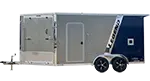



You’re shopping for a trailer and one listing says “tare weight: 3,840 lbs.” Someone else calls the trailer’s curb weight 3,900 lbs, while the dealer says its empty weight is around 3,800 lbs. Same trailer, three slightly different numbers. Which one should you use when figuring out how much cargo you can actually haul?
This confusion trips up buyers constantly, and it is more than a terminology problem. Manufacturers and dealers do not always use “tare,” “curb,” “dry,” and “empty” in exactly the same way. Use an incomplete base weight and you may overestimate payload, exceed the trailer’s GVWR, overload an axle or tire, or put more tongue or pin weight on the tow vehicle than its ratings allow.
What “Tare Weight” Actually Means
Tare weight generally means the weight of an empty trailer without cargo. In freight calculations, tare is subtracted from the trailer’s loaded gross weight to determine the net weight of the cargo. For a manufactured trailer, the published number may represent a standard base configuration, an estimated production weight, or the completed unit as it left the factory. It does not automatically mean that every available factory option, dealer-installed accessory, or customer-added item has been excluded.
That distinction matters when reading a Diamond C Trailers specification page. Diamond C publishes weight ranges because FMAX gooseneck flatbeds are available in multiple models, lengths, axle packages, ramp configurations, and GVWRs. Current FMAX models span approximately 15,500 to 40,000 lbs GVWR, depending on the model and selected package, and use Lippert axles. A 40-foot FMAX therefore does not have one universal empty weight. Its actual weight depends on whether it is an FMAX208, FMAX210, FMAX212, FMAX216, or another available configuration, along with its deck, frame, axle, suspension, tire, toolbox, ramp, and other selections.
Options can change the completed weight substantially. Spare tires and carriers, upgraded jacks, hydraulic systems, toolboxes, winches, additional tie-downs, MAX Ramps, XDR Ramps, X-Ramp configurations, decking choices, stake sides, and heavier axle or tire packages all consume part of the trailer’s available payload. Some of those items may be installed at the Diamond C factory, while others may be added by a dealer or owner. The only dependable way to know what a particular trailer weighs today is to identify its exact build and, when payload margins are tight, weigh it.
Curb Weight: The Closest to Real-World
Curb weight is commonly understood as the empty weight of a vehicle in ready-to-use condition. The term is standardized more consistently for motor vehicles than for non-powered trailers, so trailer buyers should not assume that every manufacturer uses it identically. A dealer may use “curb weight” to mean the trailer as equipped on the lot, including installed options, a spare tire, battery, hydraulic fluid, and permanently carried equipment, but excluding cargo and removable personal gear.
For most trailers, the empty weight of the specific, fully equipped unit is the best number for day-to-day payload planning. If you buy an H&H Steel Low-Pro Tilt equipped with a spare tire, toolbox, winch, or additional tie-down hardware, those items remain part of the trailer’s weight. They cannot also be counted as available cargo capacity.
Here is the basic formula:
Trailer GVWR minus the trailer’s actual empty, as-equipped weight = maximum theoretical cargo capacity.
GVWR, or Gross Vehicle Weight Rating, is the maximum loaded weight assigned to that specific trailer by its manufacturer. It includes the trailer itself, installed equipment, fluids, tools, cargo, and every other item carried by the trailer. The GVWR shown on the trailer’s federal certification or VIN label controls over a generic advertisement or a specification for a different configuration.
The result of that subtraction is a theoretical maximum because other ratings may reduce what you can safely carry. The loaded trailer must also remain within each axle’s GAWR, each tire and wheel rating, the coupler or gooseneck rating, the hitch rating, the tow vehicle’s ratings, and any applicable road or bridge weight limits. Cargo dimensions, position, and securement requirements may also make a trailer unsuitable before its calculated payload is exhausted.
Empty Weight: Where Manufacturer Specs Meet Dealer Additions
Some manufacturers use “empty weight,” “tare weight,” “dry weight,” or “unit weight” interchangeably. Others publish an approximate base-model weight that may not include optional equipment. There is no safe assumption that two brochures—or even two differently equipped units of the same model—were weighed on the same basis.
Liberty Trailers, Wells Cargo, and Legend Manufacturing offer trailers with numerous size, material, axle, door, ramp, interior, and accessory choices. An enclosed trailer’s side door, rear ramp, interior lining, roof height, ventilation, electrical package, e-track, cabinets, spare tire, or upgraded running gear can change its empty weight. An aluminum trailer may be lighter than a comparably sized steel trailer, but construction material alone does not establish the weight or payload of a specific unit. Always use the completed trailer’s label, build information, and verified weight rather than relying on a broad brand-level assumption.
The safest move is to ask whether the listed weight is an estimate, a base-model figure, or the weight of the specific VIN. If the available capacity will be close to your intended load, obtain a scale ticket. Public truck scales, grain elevators, quarries, landfills, and other certified scales may be able to weigh the combination. Pricing varies by location and can change, so confirm the current fee before arriving.
When using a platform scale, remember that part of the trailer’s weight is transferred through the tongue or gooseneck to the tow vehicle. Adding only the trailer-axle reading does not give the trailer’s complete weight. One practical method is to weigh the tow vehicle and trailer together, then obtain a comparable tow-vehicle-only weight with the same occupants, fuel, tools, and other contents. The difference is the trailer’s total actual weight. Follow the scale operator’s directions and keep the loading conditions consistent between weighs.
Why This Matters for Payload (And Your Safety)
Suppose you are considering a Delco 14,000 lb GVWR tandem-axle equipment trailer. For illustration, assume a listing gives its empty weight as 4,200 lbs, but the particular unit weighs 4,650 lbs after its installed toolbox, spare tire, winch, battery, and other equipment are included. That 450-lb difference must come out of the payload.
Using the verified 4,650-lb empty weight, the maximum theoretical cargo capacity is 9,350 lbs, not 9,800 lbs. A machine weighing 9,600 lbs would put the trailer’s total weight at approximately 14,250 lbs before adding chains, binders, attachments, fuel cans, or other cargo. That would exceed a 14,000-lb GVWR even if the frame and running gear showed no immediate signs of distress. Manufacturer ratings are limits, not targets to exceed temporarily.
An overloaded trailer can increase stopping distance, heat tires and bearings, reduce component life, alter handling, and contribute to loss of control. Following a crash or roadside inspection, investigators may consider the certification label, scale weights, component ratings, loading, maintenance, and cargo securement. Insurance coverage depends on the policy and circumstances, so buyers should not assume that being only slightly over a rating is harmless or that a particular claim outcome is guaranteed.
The same issue applies to lighter trailers. A Darkhorse Cargo 7×16 enclosed trailer can be built in different configurations, and its payload cannot be determined accurately from exterior dimensions alone. A higher-GVWR package may involve different axles, tires, wheels, coupler, frame components, or brakes, but the exact equipment must be verified on that unit’s certification label and build sheet. If a 9,990-lb GVWR trailer actually weighs 3,000 lbs empty, its theoretical cargo capacity is 6,990 lbs. If it weighs 2,800 lbs, the calculation becomes 7,190 lbs. Neither number should be substituted for a verified weight.
Accessories and travel equipment add up quickly: a spare tire, batteries, cabinets, generator, fuel, water, tools, recovery gear, helmets, coolers, and tie-down equipment may consume hundreds of pounds. The operating weight of a side-by-side or compact machine can also exceed a published base weight after fuel, cab components, tracks, attachments, guards, or other accessories are installed.
Axle Ratings Add Another Layer
GVWR is not the only limit. Each axle has a Gross Axle Weight Rating, or GAWR, and the tires and wheels have their own load ratings. The trailer must stay within all of them. Two axles rated at 7,000 lbs each provide 14,000 lbs of combined axle rating, but that fact alone does not establish the trailer’s GVWR or payload.
On some trailers, GVWR is higher than the combined axle ratings because the design anticipates that part of the loaded weight will be carried vertically by the tow vehicle through the tongue or gooseneck. For example, a trailer with two 7,000-lb axles may legitimately have a manufacturer-assigned GVWR above 14,000 lbs when its frame, coupler, tires, wheels, brakes, and other components are designed and certified for that configuration. That does not authorize either axle to exceed its individual GAWR.
The opposite issue can occur as well: the nominal sum of the axle ratings may be higher than the trailer’s assigned GVWR. In that situation, the lower GVWR remains the maximum total loaded trailer rating. Axle capacity cannot be added to the certification-label GVWR to create extra payload.
This principle applies to Wells Cargo trailers, H&H steel flatbeds, and every other trailer brand. Check the certification label, the GAWR for each axle, and the ratings molded or marked on the tires. Also confirm that replacement tires and wheels meet the required capacity and that tire pressures are maintained according to the applicable trailer or tire information label.
Check both the total and the distribution. A trailer can be below GVWR while one axle, one side, or the tow vehicle’s rear axle is overloaded because the cargo is positioned poorly. Individual wheel-position scales provide the best detail, but separate axle-group readings are still more useful than total weight alone.
A Quick Reference: How the Terms Stack Up
| Term | What It Includes | Best Used For |
|---|---|---|
| Tare Weight | Empty trailer weight under the manufacturer’s or scale operator’s stated definition; verify whether options are included | Net cargo calculations and preliminary comparisons |
| Curb Weight | Usually the empty trailer in ready-to-use condition, including installed equipment and required fluids; usage varies | Payload planning when it applies to the specific completed unit |
| Empty Weight | Trailer without cargo; may be an estimate, base-model weight, or actual as-equipped weight | Payload calculations only after the definition and configuration are verified |
| GVWR | Maximum rated total weight of the trailer and everything on or in it | Determining the trailer’s rated loaded limit and registration classification |
| GAWR | Maximum weight permitted on an individual axle system | Checking load distribution and preventing axle overload |
How to Figure Out Your Real Payload Before You Buy
Ask the dealer these questions before you sign anything:
- What is the GVWR shown on the certification label of this specific VIN?
- What are the GAWR, tire, wheel, coupler, and jack ratings for this configuration?
- Is the advertised empty weight a base estimate or the weight of this completed unit?
- What factory, dealer, or aftermarket options are included in that weight?
- Can you provide a build sheet, verified as-equipped weight, or scale ticket?
Bring accurate information about what you intend to haul. For equipment, use the machine’s actual operating weight with its fuel, cab, bucket, forks, tracks, counterweights, and attachments—not just a stripped base-model figure. Add the weight of chains, binders, straps, blocking, tools, and every other item that will ride on the trailer. Confirm that the cargo fits between the fenders or on the deck and that suitable rated securement points are available.
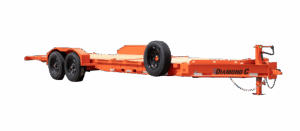
At Spencer Trailers, we can pull the specifications for a unit on the lot and walk you through the payload calculation before you commit. Diamond C models vary significantly by configuration: an FMAX flatbed gooseneck, LPT telescopic dump, LPX equipment trailer, or HDT hydraulically dampened tilt trailer may be offered with different lengths and GVWR packages. Current premium Diamond C lines use Lippert axles and the DM Difference Maker multi-stage coating system, but the exact axle rating, brake type, tire package, frame, and empty weight must still be confirmed for the individual trailer.
You can browse what we currently have in stock at our full inventory. If you see something that looks close but you are not sure it fits your payload needs, the fastest answer is a phone call: (812) 829-0226. We would rather work through the numbers before purchase than have you discover at the jobsite that the machine, attachment, or tow vehicle combination does not have enough capacity.
Capacity also affects licensing and equipment requirements. In Indiana, trailers with a GVWR above 3,000 lbs must be equipped with brakes as required by IC 9-19-3-3. A trailer over 10,000 lbs GVWR does not by itself automatically require a Class A CDL. Under the federal Class A threshold, the relevant combination is a GCWR or actual gross combination weight of at least 26,001 lbs, whichever applies under the rule, with a towed unit having a GVWR or actual gross vehicle weight over 10,000 lbs. Commercial use, interstate operation, actual weights, endorsements, exemptions, and state-specific rules can affect the analysis, so operators should verify their circumstances rather than relying only on the trailer’s advertised payload.
One More Thing About Tongue Weight
Payload capacity is only half the equation. Even when the trailer is below GVWR, poor fore-and-aft or side-to-side distribution can cause sway, unstable braking, insufficient steering control, or overloaded axles and tires. For a conventional bumper-pull trailer, a common starting guideline is approximately 10 to 15 percent of the loaded trailer weight on the hitch, provided the trailer manufacturer specifies a compatible range. For a loaded 14,000-lb bumper-pull trailer, that guideline would equal about 1,400 to 2,100 lbs of tongue weight.
That example is not a universal prescription. Gooseneck and fifth-wheel trailers generally place a larger percentage of their loaded weight on the tow vehicle than bumper-pull trailers. Follow the trailer and tow-vehicle manufacturers’ instructions for the specific combination. Tongue or pin weight counts against the tow vehicle’s payload and can overload its rear GAWR even when the trailer itself remains below GVWR.
Your receiver, ball mount, hitch ball, coupler, safety chains, gooseneck hitch, and any weight-distributing equipment must each be rated for the application. The tow vehicle must remain within its GVWR, front and rear GAWRs, GCWR, maximum trailer-weight rating, and maximum tongue or pin-weight rating. Use the ratings for the vehicle’s exact VIN, drivetrain, wheelbase, cab, bed, and installed towing equipment rather than a maximum figure from a general advertisement.
Got a specific hauling job coming up and you are not sure which trailer fits? Reach out to us directly and tell us what you are moving. We will help match the cargo dimensions and actual operating weight to an appropriately rated trailer, then review the numbers so you can make an informed, safe, and legally compliant choice from day one.
And if you are curious what we have helped other customers find, check out our recently sold trailers to get a feel for what is moving and in what configurations.


