









You’re standing at the dealer lot, reading a trailer certification label, and you see two ratings that look closely related. GVWR: 15,500 lbs. GAWR: 7,000 lbs for each axle. Many buyers glance at the first number and move on. That can be a costly mistake because gross trailer weight and axle loading are separate limits.
A trailer can remain below its GVWR while overloading one axle, its tires, or another component. It can also exceed GVWR even though neither trailer axle is carrying its full GAWR because part of the loaded trailer weight is supported at the hitch. Understanding the distinction is not merely paperwork. It is essential to choosing, loading, and towing a trailer safely.
What GVWR Actually Means
GVWR stands for Gross Vehicle Weight Rating. It is the maximum loaded weight assigned to the trailer by its manufacturer. That loaded weight includes the trailer itself plus its cargo and permanently or temporarily carried equipment, such as spare tires, ramps, batteries, hydraulic equipment, toolboxes, chains, straps, pallet forks, attachments, and materials.
Payload is therefore not the same as GVWR. A useful starting calculation is:
Estimated payload capacity = GVWR minus the trailer’s actual empty weight
For example, if a particular trailer has a 15,500-lb GVWR and weighs 3,500 lbs in its delivered configuration, the mathematical difference is approximately 12,000 lbs. That does not automatically mean every 12,000-lb load is suitable. The loaded trailer must also remain within each axle’s GAWR, every tire and wheel rating, the coupler rating, the hitch rating, and the tow vehicle’s limits. The actual empty weight can also differ from a published base weight because length, ramps, spare tires, upgraded axles, hydraulic components, toolboxes, and other options add weight.
GVWR is assigned by the manufacturer and appears on the federal certification label near the VIN. It reflects the trailer as a complete vehicle rather than one component considered in isolation. Frame construction, running gear, tires, wheels, suspension, brakes, coupler, safety systems, and the intended distribution of weight all influence the final rating. Owners should use the rating printed on the certification label for their specific trailer rather than relying on an advertisement, an old brochure, or the rating of a similar-looking unit.
Exceeding GVWR places the trailer outside its certified maximum loaded rating. Installing heavier tires, wheels, springs, or axles later does not by itself change the manufacturer-assigned GVWR.
What GAWR Actually Means
GAWR stands for Gross Axle Weight Rating. It is the maximum load-carrying capacity assigned by the vehicle manufacturer to a single axle system. The rating applies to the axle system as installed, including the axle, suspension, brakes, wheels, and tires associated with it. The lowest-rated relevant component can restrict how much weight that axle system can safely carry.
On a tandem-axle trailer, the certification label identifies the GAWR for each axle, normally in order from front to rear. The ratings are often identical, such as 7,000 lbs for the forward axle and 7,000 lbs for the rear axle, but owners should never assume they are identical without checking the label.
A tandem utility trailer may, for example, use two 3,500-lb axle systems. That gives a combined axle-system rating of 7,000 lbs, but it does not establish the trailer’s GVWR by itself. Depending on the trailer’s complete design and certification, its GVWR may be equal to, lower than, or in some configurations higher than the combined GAWR because the hitch supports part of the loaded trailer weight. The certification label is the controlling source for both figures.
GAWR is a per-axle-system limit. Adding the axle ratings together can help describe the running gear, but that total is not a substitute for GVWR and does not determine allowable payload on its own.
Why They’re Both Necessary (and Why One Isn’t Enough)
Picture an equipment trailer carrying a compact track loader. The combination may be below the trailer’s GVWR, yet the machine may be positioned so that one trailer axle carries substantially more weight than the other. If the scale shows 7,400 lbs on an axle with a 7,000-lb GAWR, that axle system is overloaded even though the trailer’s total loaded weight may remain below GVWR.
The reverse situation is also possible. Because part of the trailer’s weight is carried through the coupler or gooseneck hitch, both trailer axles can remain below their individual GAWR while the trailer’s total loaded weight exceeds GVWR. That is why checking only the sum of the trailer axle scale readings can be misleading. The hitch-supported portion of the trailer’s weight must also be considered.
The consequences of exceeding GAWR or overloading an associated component can include:
- Tire heat buildup, tread separation, or sidewall failure
- Wheel, hub, spindle, or bearing damage
- Leaf-spring, equalizer, torsion-axle, or suspension damage
- Reduced braking performance and excessive brake heat
- Uneven tire loading and accelerated tire wear
- Loss of ground clearance or tire-to-deck interference
- Frame and hanger stress around the suspension mounting points
Those risks remain even when a receipt, estimate, or equipment brochure suggests the cargo should fit within the trailer’s advertised payload. Actual loaded weights and their distribution determine what each component must carry.
How the Numbers Stack Up Across Common Trailers
| Trailer | GVWR | GAWR (per axle) | Axles |
|---|---|---|---|
| Representative Light-Duty Single-Axle Utility | Varies by certification | Commonly 2,990-3,500 lbs | 1 |
| Diamond C GTU Premium Tandem-Axle Utility | 7,000 lbs | 3,500 lbs | 2 |
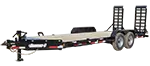
| Diamond C LPX 207 Equipment Trailer | 15,500 lbs on current configurations | 7,000 lbs | 2 Lippert axles |
| Diamond C LPX 208 Equipment Trailer | 18,000 lbs | 8,000 lbs | 2 axles |
| Diamond C LPX 307 Equipment Trailer | 24,000 lbs | 7,000 lbs | 3 axles |
These examples show why multiplying GAWR by the number of axles does not necessarily reproduce GVWR. On a properly loaded trailer, the tow vehicle supports part of the trailer’s loaded weight through the hitch. Current Diamond C LPX configurations range from 15,500 to 24,000 lbs GVWR and use Lippert axles as standard on the premium line, with axle packages varying by configuration. Specifications and available packages can change, so the certification label and build information for the individual VIN always take priority.
On a single-axle trailer, GVWR and GAWR may look similar, but they are not automatically the same. The axle carries most of the loaded trailer weight while the hitch carries the tongue weight. The manufacturer may also assign a GVWR based on another limiting component. The distinction therefore matters on single-, tandem-, and triple-axle trailers alike.
Load Distribution Is the Practical Problem
Most trailer owners think about weight in terms of one question: “Is it too heavy?” A better set of questions is: “What is the total loaded trailer weight, how much is carried at the hitch, and how much is carried by each axle?”
For many conventional bumper-pull trailers, approximately 10-15% of the loaded trailer weight on the tongue is a commonly used starting range for stable loading. It is not a universal permission or substitute for the trailer and tow vehicle manufacturers’ instructions. Trailer design, cargo type, hitch equipment, speed, and vehicle requirements can call for a different target.
Too little tongue weight can make a trailer unstable and prone to sway. Excessive tongue weight can overload the trailer coupler, ball mount, receiver, weight-distribution hitch, tow vehicle rear axle, suspension, or tires. Moving a heavy machine too far forward can also affect how the tandem suspension shares weight, but the only reliable way to know the resulting loads is to weigh the complete combination.
Gooseneck trailers generally place a greater percentage of their loaded weight on the truck than bumper-pull trailers because the hitch is positioned over or slightly ahead of the rear axle. A figure near 20-25% is often used as a planning range for gooseneck pin weight, but the correct loading target depends on the trailer manufacturer’s guidance and the ratings of the truck, hitch, tires, wheels, and rear axle. A higher hitch percentage is not automatically safe merely because the hitch is in the bed.
On tandem-axle trailers, equalizers or torsion suspensions help distribute weight, but they cannot correct every loading problem. Trailer attitude matters. A trailer towed significantly nose-high or nose-low can place disproportionate weight on one axle, particularly with some torsion-axle arrangements. Tire pressure, spring condition, suspension geometry, road grade, braking, and cargo placement can also change axle loading.
Consider a 15,500-lb GVWR LPX 207 equipped with two 7,000-lb Lippert axles. Its two GAWR figures total 14,000 lbs, not 15,500 lbs. That configuration relies on an appropriate portion of the loaded trailer weight being supported at the hitch. The goal is not to place 7,750 lbs on each axle. Doing so would exceed both 7,000-lb GAWR limits even though the axle readings add up to the trailer’s GVWR.
This is why equipment trailers provide multiple tie-down locations and enough deck length to adjust cargo position. The tie-downs secure the load after the correct position has been established; they do not make an improperly distributed load acceptable.
The best measurement is a scale ticket that separates the tow vehicle’s steer axle, drive axle, and trailer axle group. For more detailed diagnosis, individual wheel-position or axle readings can reveal side-to-side and front-to-rear imbalances that a single total cannot show. Weigh the truck by itself and then the complete loaded combination when you need to calculate actual trailer weight and hitch load accurately.
The Legal Side
Commercial enforcement can involve several different weight standards. At a scale or roadside inspection, officers may record steer-, drive-, and trailer-axle-group weights separately. They can compare those readings with applicable federal and state axle, axle-group, tire, bridge-formula, registered-weight, and vehicle-rating requirements. Being legal on gross combination weight does not automatically make every axle or component legal.
Manufacturer ratings and highway weight limits answer different questions. A roadway may legally permit more weight on an axle group than the vehicle is designed and certified to carry. In that situation, the lower equipment rating still matters. Conversely, a high-GAWR axle does not authorize a vehicle to exceed a lower statutory axle or bridge limit.
Private use does not create a blanket exemption from vehicle ratings or Indiana equipment laws. Commercial-motor-vehicle status also is not determined solely by whether a trailer is above or below 26,000 lbs. In interstate commerce, federal safety rules can apply to combinations with a GVWR, GCWR, gross vehicle weight, or gross combination weight above 10,000 lbs, subject to the rule involved and any applicable exceptions.
The 26,001-lb threshold is particularly important for CDL classification, but it is often misunderstood. A Class A CDL is generally implicated when the combination has a GCWR of 26,001 lbs or more and the towed vehicle has a GVWR over 10,000 lbs, unless an exemption applies. A trailer over 10,000 lbs by itself does not trigger a Class A CDL when the combination’s GCWR remains below 26,001 lbs. Actual operation, vehicle ratings, cargo, commercial use, hazardous materials, and state or federal exemptions should all be reviewed for the specific trip.
Indiana also requires brakes on trailers and semitrailers with a gross weight of at least 3,000 lbs under IC 9-19-3-3. That requirement is separate from GVWR and GAWR calculations. The towing vehicle must have a properly installed and functioning brake controller when the trailer uses controllable electric brakes, and the complete braking system must be maintained for the actual load.
Insurance coverage and warranty decisions depend on policy language, warranty terms, maintenance, modifications, and the facts of a loss. Overloading is not automatically handled identically by every insurer or manufacturer, but scale records, component ratings, cargo weight, and loading practices can become important evidence after a crash or mechanical failure. The practical answer is to remain within every applicable rating rather than assuming one number provides protection.
A Quick Q&A
Can I exceed GAWR if I’m still under GVWR?
No. GVWR and each GAWR apply independently. A trailer can be legal under its total rating while one axle system, tire, or wheel is overloaded. Reposition the cargo, correct the trailer attitude, reduce the load, or use equipment with more suitable ratings.
What if I add a heavier axle to increase capacity?
A replacement axle may have a higher component rating, but an owner-installed axle swap does not automatically increase the trailer manufacturer’s GVWR. The original frame, suspension attachments, coupler, safety chains, brakes, tires, wheels, and other components retain their limits. Changing a certified rating is not accomplished by installing a part or changing the number on a registration document.
Where do I find my trailer’s GAWR?
Look at the federal certification label near the VIN. It should list GVWR and the GAWR for each axle, identified from front to rear. The owner’s documentation or manufacturer may provide additional component information. Markings on an axle tag identify the axle component, but they do not replace the completed trailer’s certification label. If the label is missing, damaged, or unreadable, contact the manufacturer or an authorized dealer with the VIN rather than estimating from hub size or wheel-bolt pattern.
Does tongue weight count toward GAWR?
Tongue or pin weight is carried through the hitch and therefore is not included in the weight measured under the trailer axles. It still forms part of the trailer’s total loaded weight for GVWR purposes. It also adds load to the tow vehicle and must fit within the hitch, receiver or gooseneck system, tow vehicle payload, rear GAWR, tire, wheel, and GVWR limits. Hitch leverage can change how the tow vehicle’s axle loads shift, so tongue weight does not always appear as an equal pound-for-pound increase on the rear axle alone.
Can I calculate trailer weight by adding the trailer axle scale readings?
Not by themselves. Those readings omit the portion supported by the hitch. A reliable calculation compares the tow vehicle’s axle weights with and without the trailer attached, using consistent loading conditions. The loaded trailer’s approximate total weight is its axle weight plus the weight it transfers to the tow vehicle.
Does the payload number in an advertisement apply to every trailer of that model?
Not necessarily. Published payload is often based on a representative or base configuration. Trailer length, axle package, ramps, spare tires, decking, hydraulic equipment, toolboxes, and other options affect empty weight. Use the actual completed trailer weight and its VIN-specific certification label when planning a load.
Choosing a Trailer With the Right Ratings for Your Load
If you haul compact track loaders, mini excavators, forklifts, vehicles, loaded pallets, or other equipment with concentrated weight, choose a trailer that provides adequate GVWR, axle capacity, deck length, tire capacity, and hitch-load margin. The equipment’s operating weight must include buckets, attachments, fuel, fluids, counterweights, tracks, forks, tools, and anything carried with it. A machine’s model name or nominal class is not an accurate substitute for its actual transport weight.
Current Diamond C LPX equipment trailers offer multiple heavy-duty configurations. The LPX 207 uses two 7,000-lb Lippert axles and carries a current published GVWR of 15,500 lbs. Higher packages can use two 8,000-lb axles, two 10,000-lb axles, or three 7,000-lb axles, with the GVWR and supporting equipment configured for the package. The correct choice depends on payload, cargo concentration, deck length, truck capacity, hitch type, licensing implications, and how frequently the trailer will operate near its limits.
A gooseneck such as a properly configured Diamond C FMAX can provide additional deck space and heavier available ratings, but it also places substantial pin weight on the truck. The truck must have enough payload, rear-axle, tire, wheel, hitch, GVWR, and GCWR capacity. A heavier trailer rating cannot compensate for an undersized tow vehicle.
Loads that appear evenly distributed also require careful calculation. Lumber, round bales, pallets, and bulk material may spread across the deck or dump body, but total cargo density can exceed expectations quickly. Bulk materials should be estimated by measured volume and verified weight rather than by appearance. Wet soil, aggregate, demolition debris, and firewood can vary significantly in density.
GVWR may become the first limit reached with a well-distributed load, but GAWR never becomes optional. Trailer attitude, uneven loading, side-to-side concentration, and changing cargo conditions can still overload an axle, wheel, or tire. Dump trailers require particular care because material can settle unevenly, shift during travel, or remain concentrated toward one end of the body.
Build in practical margin for the way the trailer will actually be used. Ratings are maximum limits, not recommended everyday targets. Operating below them provides room for uncertain cargo weights, added tools, changing fuel or attachment loads, and scale variation. It can also reduce heat and wear, although proper maintenance and inflation remain essential at every load level.
Before buying, compare all of the following:
- The trailer’s VIN-specific GVWR and individual GAWR figures
- Actual trailer empty weight with installed options
- Real cargo weight, including attachments and carried equipment
- Expected tongue or pin weight
- Axle, tire, wheel, suspension, coupler, and hitch ratings
- Tow vehicle GVWR, rear GAWR, payload, tire ratings, and GCWR
- Brake-controller compatibility and required braking equipment
- Commercial-use, registration, insurance, and CDL requirements
Not sure what ratings you actually need for the work you’re doing? Talk to us at Spencer Trailers before you buy. We’ve seen plenty of buyers complete the basic GVWR calculation without accounting for hitch weight, axle distribution, trailer options, or the truck’s rear-axle capacity. Getting those numbers right before the purchase is far less expensive than replacing damaged tires or running gear after an overloaded trip. Browse the current inventory and we can review the certification information and current specifications for the exact trailer you’re considering, so GVWR, GAWR, payload, hitch load, and tow-vehicle capacity are all part of the decision.


