












You pull up to the dealer, sign the paperwork, and drive away with your first trailer. Everything feels fine until another driver notices that the safety chains are not crossed, the coupler latch is not secured, or the trailer tires are visibly low. Towing mistakes are often easy to overlook while the rig is parked, but they can become serious once speed, braking forces, curves, wind, and shifting cargo enter the picture.
Here are the ten mistakes we see most often from new towers, plus exactly what to check and what to do instead.
1. Overloading the Trailer or the Tow Vehicle
This is the big one. Every trailer has a Gross Vehicle Weight Rating (GVWR), which is the maximum allowable weight of the trailer and everything carried on it. The tow vehicle also has its own GVWR, Gross Axle Weight Ratings (GAWR), Gross Combined Weight Rating (GCWR), payload limit, maximum trailer rating, and hitch limits. Exceeding any applicable rating can overload tires, wheels, axles, suspension, brakes, the receiver hitch, or the tow vehicle itself. It can also increase stopping distance, reduce stability, and overheat the powertrain.
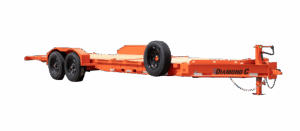
For example, the current Diamond C GTU premium tandem-axle utility trailer is available in 14- to 20-foot lengths and has a 7,000-lb GVWR, an 83-inch bed width, and two 3,500-lb Lippert brake axles. That does not mean it can carry 7,000 lbs of cargo. Payload is calculated by subtracting the trailer’s actual empty weight, plus permanently installed options and equipment, from its GVWR. The certification label and the weight of the specific trailer are more reliable than a generic brochure estimate.
A pickup advertised with an 8,500-lb maximum tow rating may still run out of payload or rear-axle capacity first. Trailer tongue weight, the hitch and ball mount, passengers, tools, fuel, cargo in the truck bed, and accessories all consume available capacity. Published maximum tow ratings may also apply only to particular engines, axle ratios, cab configurations, drivetrains, wheelbases, and factory towing packages.
The fix: check the truck’s certification label, owner’s manual, towing guide, receiver label, and the trailer’s VIN or certification label before loading. Confirm GVWR, GAWR, GCWR, payload, maximum loaded trailer weight, tongue-weight limits, tire capacities, and hitch-component ratings. Then weigh the loaded truck and trailer at a certified scale, ideally obtaining separate steer-axle, drive-axle, and trailer-axle weights. The complete rig must remain within every applicable rating, not merely the advertised tow rating.
2. Using the Wrong Ball Size
Trailer couplers commonly use 1-7/8-inch, 2-inch, or 2-5/16-inch hitch balls. A smaller ball can appear to fit inside a larger coupler, but the coupler may not capture it securely. It can separate when the rig crosses a dip, turns, or encounters a sudden load. Hitch-ball sizes are not interchangeable.
Check the size and rating stamped or marked on the trailer coupler, and match the ball to that exact size. Then verify the ratings of the ball, ball mount, receiver, hitch pin, coupler, and any weight-distribution equipment. Ball capacity cannot be determined from diameter alone; the shank size, material, installation, and manufacturer’s stamped rating all matter. The towing system is limited by its lowest-rated component.
Install the ball using the manufacturer’s specified hardware and torque. Do not use improvised washers, a ball with an undersized shank, or a reducer arrangement that the ball-mount manufacturer has not approved. The ball mount must also provide the correct rise or drop so the loaded trailer runs approximately level.
After coupling on level ground, fully close the coupler latch and install its safety pin or approved lock. Chock the trailer wheels and use the tongue jack to raise the coupled tongue slightly. The rear of the tow vehicle should begin to rise without the coupler separating from the ball. Lower the jack fully before departure and confirm that it is retracted and secured.
3. Skipping the Brake Controller (or Setting It Wrong)
Indiana law requires brakes on trailers over 3,000 lbs GVWR under IC 9-19-3-3. A trailer equipped with electric brakes needs a compatible, correctly installed brake controller in the tow vehicle. Plugging a braked trailer into a seven-way connector does not automatically guarantee that the brakes are receiving a proper control signal.
A proportional controller such as the Tekonsha Prodigy P3 uses an inertial sensor to respond to tow-vehicle deceleration and apply the trailer brakes accordingly. A time-delayed controller increases output according to a preset time-and-gain schedule. Integrated factory controllers may communicate with the tow vehicle’s braking and stability systems. Whatever type is used, it must be compatible with the trailer’s brake system and installed according to both the controller and vehicle manufacturers’ instructions.
The gain setting matters. Too little output allows the trailer to push the tow vehicle and makes the truck perform too much of the braking. Excessive output can make the trailer brakes grab or lock, particularly on loose, wet, or icy pavement. Boost and brake-type settings must also be selected correctly when the controller provides them.
Follow the controller manufacturer’s adjustment procedure on a dry, level, traffic-free surface. Many proportional-controller procedures use the manual control during a test at approximately 25 mph, followed by small gain adjustments until braking is firm without wheel lockup. Do not rely on a generic setting for every load. Recheck the adjustment when trailer weight, road conditions, or brake condition changes.
Test the brakes before entering traffic. The manual control should apply the trailer brakes independently, and the controller should not display wiring or connection faults. A controller cannot compensate for worn shoes, contaminated brake linings, poor grounds, incorrect brake adjustment, damaged wiring, weak voltage, or defective magnets.
4. Forgetting to Cross the Safety Chains
Safety chains provide a secondary connection if the coupler separates or another hitch component fails. If they are too long, attached to an unsuitable point, damaged, or allowed to drag, they may not control the trailer effectively after a separation.
For a conventional bumper-pull trailer, cross the chains beneath the coupler in an X pattern unless the trailer or hitch manufacturer specifies a different approved arrangement. Properly crossed and adjusted chains can help support the tongue and limit its contact with the pavement. Leave enough slack for full turns and suspension movement, but not enough for the chains to drag or become caught on road obstacles.
Attach each hook to a manufacturer-designated safety-chain loop on the receiver or tow vehicle. Do not attach both chains to the removable ball mount, wrap them around the hitch ball, or connect them to thin bumper trim, plastic components, or unapproved brackets. Make sure hooks cannot bounce free; use the supplied retainers or rated connecting hardware as intended.
Inspect the chains, hooks, welds, and attachment points for deformation, deep wear, cracked links, corrosion, and dragging damage. The chain assemblies and attachment system must have adequate capacity for the trailer. Commercial combinations are also subject to federal coupling-device requirements, while state requirements govern many non-commercial towing situations.
5. Ignoring Tongue Weight
For many conventional bumper-pull trailers, a useful target is approximately 10 to 15 percent of the trailer’s actual loaded weight on the hitch. The correct figure can vary by trailer type and manufacturer, so the trailer and tow-vehicle instructions take priority. Gooseneck and fifth-wheel trailers generally place a higher percentage of their loaded weight on the tow vehicle and should not be evaluated using a bumper-pull guideline.
Too little tongue weight can make a bumper-pull trailer vulnerable to sway. Excessive tongue weight can overload the receiver, hitch, rear axle, suspension, or tires and can remove too much load from the tow vehicle’s front axle. Neither condition is corrected by staying below the trailer’s GVWR alone.
A 5,000-lb loaded conventional trailer may require roughly 500 to 750 lbs of tongue weight if its manufacturer specifies the common 10-to-15-percent range. Measure rather than guess. Suitable methods include a properly rated tongue-weight scale or a public-scale calculation using repeat weighings. Make sure the scale and supporting equipment can safely handle the expected load.
Position cargo to achieve the specified tongue weight while keeping the trailer level and remaining within the trailer GVWR, each GAWR, tire and wheel ratings, hitch ratings, and the truck’s payload and axle ratings. Place dense cargo low, distribute it from side to side, and secure it against movement. Do not simply push every heavy item forward; that can create excessive tongue weight or overload the front portion of the trailer.
6. Running With Trailer Lights That Don’t Work
Trailer connectors are exposed to moisture, dirt, road salt, and repeated plugging and unplugging. Corroded contacts, damaged wires, poor grounds, blown fuses, failed lamps, and loose plugs can eliminate running lights, brake lights, turn signals, or clearance lamps. Lighting failures make the trailer difficult to see and prevent other drivers from understanding what the rig is doing.
Connect the plug securely and perform a complete light check before every trip. Confirm tail and running lights, brake lights, left and right turn signals, clearance and identification lamps where fitted, and the license-plate lamp. Hazard lights can help with part of the inspection, but they do not prove that the brake-light and running-light circuits work. Use a helper, reflections, a camera, or a trailer-light test feature if the tow vehicle provides one.
If a circuit fails, inspect the connector, cable, junction box, fuses, bulbs or LED assemblies, and ground connections. A corroded frame ground is common, but it is not the only possible cause. Clean ground points to bare metal where required, use appropriate terminals and fasteners, protect the finished connection against corrosion, and route wiring away from sharp edges, heat, and suspension movement. Do not tow until required lighting and signaling equipment works correctly.
7. Not Checking Tire Pressure on the Trailer
Trailer tires frequently use higher cold inflation pressures than passenger-car tires, but pressure varies with tire size, load range, trailer design, and wheel rating. Some ST205/75R15 tires specify 50 PSI cold, while other versions of the same nominal size may require a different pressure. Inflating every trailer tire to 50 PSI, or reducing it to a familiar passenger-car setting such as 32 PSI, can both be wrong.
Use the cold inflation pressure specified on the trailer’s tire-information or certification label and follow the trailer and tire manufacturers’ instructions. The pressure molded on the tire sidewall is associated with the tire’s rated load and is not a universal inflation recommendation for every trailer. Never exceed the limits of the tire, wheel, rim, or valve stem.
ST tires are engineered specifically for trailer service. Do not substitute passenger-car, light-truck, or differently rated tires merely because the physical size appears similar. Replacement tires should meet the trailer manufacturer’s specifications for type, size, construction, load range or capacity, and speed capability. ST tires should be replaced with suitable ST tires unless the trailer manufacturer has expressly approved another fitment.
Check every tire, including the spare, with an accurate gauge while cold, normally before driving or after the trailer has been parked long enough for the tires to cool. Inspect tread, sidewalls, valve stems, wheel condition, lug-nut security, abnormal wear, cuts, bulges, cracking, and embedded objects. Confirm the tire’s marked speed capability and never exceed the lowest applicable speed limit imposed by the tires, trailer, tow vehicle, road, weather, or law.
8. Forgetting to Remove the Coupler Lock or Hitch Pin Cover
Storage locks are useful when a trailer is parked, but they must be removed before coupling. A lock body installed inside or beneath the coupler can prevent the hitch ball from seating fully even when the latch appears to move. Trying to tow with the coupler resting on a lock or other obstruction can allow the trailer to separate as soon as the load changes.
Receiver covers must also be removed before installing the ball mount. Insert the correct ball mount completely, align the pin holes, install a properly rated hitch pin or approved locking pin, and secure its retaining clip or lock. Never substitute an ordinary bolt unless the hitch manufacturer specifically approves it for that use.
After coupling, look beneath and around the coupler rather than checking only the handle. Confirm that the ball is fully seated, the latch mechanism has captured it, the safety pin is installed, the tongue jack is raised, wheel chocks are removed at the appropriate time, and no storage lock, tool, block, or cover remains in the hitch area. A written pre-departure routine prevents this simple mistake from being overlooked during a rushed hookup.
9. Towing Without a Weight Distribution Hitch When You Need One
A receiver can have different ratings for weight-carrying and weight-distributing operation. However, there is no universal 5,000-lb trailer or 500-lb tongue-weight threshold that applies to every half-ton pickup and hitch. Requirements and limits vary by vehicle, receiver, wheelbase, trailer, hitch design, and model year. Read the tow vehicle’s owner’s manual, towing guide, receiver label, and the weight-distribution system instructions.
A properly selected and adjusted weight-distribution hitch uses spring bars to redistribute some of the load imposed at the hitch among the tow vehicle’s axles and the trailer axles. It can restore an appropriate amount of load to the tow vehicle’s front axle and improve steering and braking response when the vehicle manufacturer permits or requires its use. Integrated sway-control designs, including products such as the Equal-i-zer 4-Point Sway Control and Andersen Weight Distribution Hitch, add their own methods of resisting unwanted trailer yaw, but they do not increase the trailer, truck, axle, tire, or receiver ratings.
A weight-distribution hitch must be sized for the trailer’s actual loaded tongue weight and any cargo carried behind the tow vehicle’s rear axle. It must also be installed and adjusted according to the hitch and vehicle manufacturers’ procedures. Too much spring-bar tension can create poor handling or excessive component loads, just as too little tension can leave the front axle inadequately loaded.
Do not assume every trailer can use weight distribution. Some trailer frames, couplers, surge-brake systems, and specialized tongue designs have restrictions. Confirm compatibility before installation. Air springs, helper springs, and heavier rear shocks may reduce visible squat, but they do not redistribute hitch load to the front axle and do not raise the vehicle’s certified payload, axle, or towing ratings.
10. Driving at Highway Speeds Without Adjusting Your Following Distance
A loaded trailer increases the mass and overall length of the combination. Even with properly functioning trailer brakes, stopping performance can change with total weight, brake adjustment, tire grip, pavement, grade, weather, brake temperature, and how quickly the driver reacts. A truck that stops confidently by itself will not necessarily stop the same way with several thousand pounds behind it.
Do not treat one second per 10 feet as a universal private-towing rule. That formula comes from commercial-vehicle following-distance requirements and includes additional distance at speeds above 40 mph. For ordinary towing, maintain a generous time gap that gives you room to recognize a hazard, brake progressively, and stop without forcing the trailer out of line. Five to six seconds is a sensible starting point in favorable conditions for many towing combinations, with substantially more space needed in rain, darkness, congestion, wind, on loose surfaces, and on downgrades.
Choose a fixed roadside object. When the vehicle ahead passes it, count the seconds until the front of your truck reaches the same point. If another driver enters the gap, ease off and rebuild it. Look well beyond the vehicle immediately ahead so you can respond early rather than making an abrupt stop.
Use a speed that remains within the posted limit and the ratings of the trailer, tires, and tow vehicle, while also accounting for load and conditions. Near maximum capacity, on grades, in crosswinds, or on wet pavement, a meaningfully lower speed may be necessary. Avoid abrupt steering, leave extra room for turns and lane changes, downshift or use an approved tow-haul strategy on grades, and never ride the brakes on a long descent.
A Quick Pre-Departure Checklist
| Check | What to Look For |
|---|---|
| Ball size match | Coupler marking matches ball size exactly; every hitch component has adequate rated capacity |
| Coupler latched | Ball fully seated, latch closed, safety pin or approved lock installed, tongue-jack lift test passes |
| Safety chains | Crossed beneath a bumper-pull coupler where specified, attached to approved loops, enough turning slack, no ground contact |
| Breakaway cable | Pin fully seated; cable attached independently to a secure tow-vehicle point, not looped around the safety chains or removable ball mount |
| Lights | Running, brake, left turn, right turn, clearance, identification, and license-plate lights confirmed as applicable |
| Tire pressure | All trailer tires and the spare checked cold against the trailer label and manufacturer instructions |
| Wheels and tires | No cuts, bulges, cracking, abnormal wear, loose fasteners, wheel damage, or unsuitable replacements |
| Load balance | Specified tongue weight achieved; cargo distributed without exceeding GVWR, GAWR, tire, hitch, or tow-vehicle limits |
| Cargo securement | Load restrained with properly rated equipment; doors, gates, ramps, jacks, and loose accessories secured |
| Brake controller | Correct brake type and gain selected, connection confirmed, manual-control test and low-speed test completed |
| Truck and trailer ratings | Loaded combination remains within tow rating, payload, GVWR, GCWR, GAWR, hitch, tire, and wheel limits |
Ready to Get the Right Trailer for Your Rig?
Most of these mistakes are easier to avoid when the trailer is specified correctly from the start. A 7,000-lb GVWR utility trailer is not automatically a safe match for a truck rated to tow 5,000 lbs, even if the trailer will sometimes be lightly loaded. The actual loaded trailer weight must remain within the truck’s limit, but the complete setup must also satisfy payload, axle, GCWR, hitch, tire, brake, and manufacturer requirements. No checklist or weight-distribution hitch can increase the ratings assigned by the manufacturers.
Getting the match right between the tow vehicle, trailer, hitch equipment, cargo, and intended use is where the conversation starts. Bring the truck’s year, make, model, drivetrain, cab and bed configuration, engine, axle ratio, towing package information, receiver ratings, payload label, and the expected cargo weight. Those details allow the entire combination to be evaluated instead of relying on a headline tow-capacity number.
Browse our current inventory to see what’s in stock in Spencer, Indiana, or reach out to the team at (812) 829-0226 with your truck specifications and what you’re planning to haul. We’ll help you identify an appropriately rated trailer, hitch type, ball size, electrical connection, and brake-control setup before you leave the lot. What are you planning to pull?


