








A skid steer weighing 8,000 pounds does not forgive mistakes on a ramp. The load shifts, the trailer rocks, and a sudden steering correction can put a tire or track near the edge of the loading surface. The good news is that loading a skid steer correctly is not complicated. It requires a level setup, a trailer with enough actual payload capacity, deliberate machine control, and a securement system matched to the machine.
This guide walks through the full process: approach angle, direction of travel up the ramp, attachment position, loading-surface traction, weight distribution, and the four-chain tie-down pattern commonly used to keep skid steers and compact track loaders secure at highway speed.
Keep the Heavy End Uphill
The most important rule when climbing or descending a loading incline is to keep the machine’s heavy end uphill. For an unloaded skid steer with an empty bucket, the engine and counterweight normally make the rear of the machine heavier. That generally means backing up the ramp and driving forward down it.
That is not a substitute for the machine manufacturer’s instructions. Attachments, material in the bucket, optional counterweights, and differences between skid steers and compact track loaders can change the machine’s balance. A loader carrying material may be front-heavy, in which case the loaded attachment is normally kept uphill. Read the operator’s manual for the exact machine and attachment before loading.
For the typical transport situation—an empty bucket or attachment carried low—backing up the incline keeps the rear-heavy end pointed uphill. Align the machine squarely with the ramps before beginning the climb. Do not turn on the ramp, approach diagonally, or attempt to correct poor alignment after one tire or track has already started climbing.
Travel in the lowest practical speed range and use smooth, gradual control inputs. There is no universal safe loading speed expressed in miles per hour because ramp angle, traction, machine controls, and site conditions vary. The correct pace is slow enough that you can stop immediately without jerking, spinning the tires or tracks, or making a sharp steering correction.
Make sure the tow vehicle and trailer cannot move as the machine climbs. Park on firm, level ground, straighten the truck and trailer, apply the tow vehicle’s parking brake, place the transmission in park or the appropriate gear, and chock the trailer wheels. If the trailer has loading stabilizer legs, rear support jacks, or a manufacturer’s prescribed loading position, deploy them according to the trailer manual.
Bucket Position: Low and Controlled
Before approaching the ramp, lower the bucket or other attachment as close to the ground as practical while maintaining enough clearance to avoid catching the ramp, dovetail, deck edge, or ground. Keep the loader arms lowered throughout the climb. Do not travel up the loading surface with the arms raised.
A raised attachment raises the machine’s center of gravity and reduces stability. It can also obstruct visibility and magnify the effect of abrupt acceleration, braking, or steering. The exact clearance required depends on the attachment, trailer transition, and machine geometry, so watch the cutting edge, quick-attach plate, hydraulic hoses, and lowest points of the attachment as the machine crosses each breakover point.
Once the skid steer is correctly positioned on the deck, lower the attachment completely onto the trailer. Relieve hydraulic pressure as directed by the operator’s manual, set the parking brake, place the controls in neutral, shut down the engine, and remove the key. Engage any required control lock or hydraulic lockout before exiting.
The lowered attachment must also be secured for transport when necessary. Under 49 CFR 393.130, accessory equipment such as hydraulic shovels must be completely lowered and secured. A bucket, grapple, broom, trencher, or set of pallet forks must not be allowed to bounce, pivot, open, or shift independently during travel.
Choosing the Right Trailer
Not every trailer is appropriate for skid steer transport. Start with the machine’s actual transport weight, not its rated operating capacity. Include the loader, fuel, counterweights, bucket or other attachment, removable tools, spare attachments, chains, binders, and anything else carried on the trailer.
Next, calculate the trailer’s available payload by subtracting its actual empty weight and all trailer-mounted or carried equipment from its GVWR. A 14,000-pound-GVWR trailer does not provide a 14,000-pound payload. Depending on its construction and options, the trailer itself may consume several thousand pounds of that rating.
For reference, Bobcat lists the non-current S740 skid-steer loader at approximately 8,794 pounds operating weight, although individual configurations can differ. Bobcat lists the non-current T870 compact track loader at approximately 12,925 pounds operating weight. Those published operating weights still may not include every attachment, option, or item being transported, so verify the identification plate and current manual for the specific machine.
A suitable combination must remain within every applicable limit: trailer GVWR, trailer GAWR, individual tire and wheel ratings, coupler or gooseneck rating, safety-chain rating, hitch rating, tow vehicle payload, rear-axle rating, GCWR, and the tow rating assigned to the truck’s exact configuration. The lowest applicable rating controls.
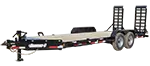
Diamond C’s LPX is a low-profile extreme-duty bumper-pull equipment trailer offered in current configurations from 15,500 to 24,000 pounds GVWR. Depending on configuration, its bed is approximately 80 to 82 inches wide. Current LPX builds use Lippert axles, with axle packages selected according to the trailer’s ordered GVWR. The LPX uses loading ramps rather than a tilting deck, and available loading systems include MAX Ramps and the X-Ramp package on compatible configurations.
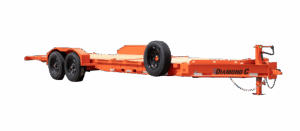
For operators who prefer a tilting loading surface, Diamond C’s HDT is the current low-profile hydraulically dampened tilt equipment trailer, with GVWR configurations from 15,500 to 24,000 pounds. Its gravity-fed tilt bed uses a hydraulic dampening system to control deck movement. H&H also offers current gravity-tilt equipment trailers with 82-inch bed widths and GVWR configurations in the 14,000- to 16,000-pound range.
For a machine as heavy as a T870, the trailer choice must be based on calculated payload rather than model family alone. A heavier LPX, HDT, DEC, or appropriately configured FMAX gooseneck may provide the necessary capacity, but the ordered GVWR, empty weight, deck dimensions, axle package, hitch type, and tow vehicle must all be verified. An 82-inch-wide machine also requires careful confirmation of clearance between the fenders and at the ramps.
If you are unsure which trailer fits your machine, browse the Spencer Trailers inventory or call us at (812) 829-0226. We can match the machine’s verified transport weight and dimensions to a specific trailer configuration and help compare that combination with your tow vehicle’s ratings.
Ramp Grip: Surface and Setup
Ramp grip matters more than most people realize until a tire spins or a rubber track begins sliding sideways. Inspect the entire loading path before the machine touches the trailer.
- Dovetail and loading angle: A lower approach angle generally makes loading easier, but the acceptable angle depends on machine stability, traction, ground clearance, and the manufacturer’s instructions. Use only the ramps, extensions, tilt controls, and support equipment approved for that trailer. Never improvise extensions with loose lumber, blocks, or unsupported metal.
- Ramp capacity and engagement: Verify that the ramps are rated for the machine and that they are fully seated, pinned, or latched in their loading position. Both ramps must rest evenly on firm ground. Confirm that ramp spacing matches the machine’s tire or track centers and leaves adequate margin on both sides.
- Surface condition: Remove mud, snow, ice, oil, gravel, wet leaves, and other contamination from the ramps, tilt deck, and machine tires or tracks. Diamond plate alone does not guarantee traction, particularly when wet. Use only traction products that are rated for equipment loading and will remain securely in place.
- Ground under the trailer: Set up on firm, level ground with the truck and trailer aligned. Soft shoulders, mud, depressions, or a sharply crowned road can leave one ramp unsupported or cause the trailer to lean. Chock the wheels and use the trailer’s loading supports when equipped.
- Track versus tire machines: Rubber tracks can slide on wet or contaminated steel, while muddy tires can spin on either steel or wood. Neither undercarriage type should be assumed to have adequate grip. If traction is questionable, stop and correct the surface condition before loading.
- Surrounding area: Keep bystanders away from the trailer, ramps, pinch points, and the machine’s travel path. Do not allow anyone to stand beside the ramps to guide the operator. Use a trained spotter positioned where the operator can see the spotter without placing that person in the machine’s path.
4-Point Chain Tie-Down: The Right Setup
Once the machine is on the deck, position it to produce the correct hitch load while staying within the trailer axle, tire, hitch, and tow vehicle ratings. Do not rely on a rule such as placing the engine directly over the trailer axles. Machine geometry and trailer axle placement vary, so verify the finished weight distribution with a suitable scale.
For heavy equipment or machinery weighing 10,000 pounds or more, 49 CFR 393.130 requires a minimum of four tiedowns. The tiedowns must restrain lateral, forward, rearward, and vertical movement and must be attached as close as practical to the front and rear or to mounting points specifically designed for securement.
Equipment below 10,000 pounds may be secured under the general cargo rules or may use the heavy-equipment method. A four-point arrangement remains a strong, straightforward practice for a skid steer even when the machine is slightly below the federal 10,000-pound threshold. Commercial operators must follow all regulations applicable to their operation, and every operator should follow the machine and trailer manufacturers’ securement instructions.
Here is the correct 4-point pattern:
- Front left: Connect a properly rated chain from the trailer’s left-front anchor to the machine’s left-front designated transport tie-down point. Route it so that it contributes forward, lateral, and downward restraint without contacting a tire, track, hose, cylinder, or sharp unprotected edge.
- Front right: Secure the corresponding right-front transport point to a rated right-front trailer anchor. The front pair should work together to resist rearward and sideways movement while providing vertical restraint.
- Rear left: Connect the trailer’s left-rear anchor to the machine’s left-rear designated transport point. Position the chain so that it cannot slip into the tire, track, exhaust, hydraulic components, or bodywork.
- Rear right: Secure the corresponding right-rear point to a rated right-rear trailer anchor. The rear pair should work with the front pair to prevent forward, rearward, lateral, and vertical movement.
Use only designated transport tie-down points identified by the machine manufacturer. Do not attach a chain to a loader arm, hydraulic cylinder, step, grab handle, axle component, or other structure unless the manufacturer specifically identifies it as a securement point. Loader arms and hydraulic components can be damaged and may not provide an approved load path.
The required aggregate working load limit of the tiedowns must equal at least one-half of the secured cargo’s weight. The calculation is not always a simple total of the numbers stamped on the chains. Under 49 CFR 393.106, a direct tiedown running from a trailer anchor to a cargo anchor contributes one-half of that tiedown’s WLL to the aggregate calculation.
For example, four identical direct chains securing a 9,000-pound skid steer must provide at least 4,500 pounds of aggregate WLL. If each direct tiedown has a 2,250-pound WLL, each contributes 1,125 pounds, and four contribute the required 4,500 pounds. Properly marked 5/16-inch Grade 70 transport chain is commonly rated at 4,700 pounds WLL, giving considerably more capacity when every component and anchor is rated accordingly.
The WLL of a complete tiedown assembly is limited by its weakest component. Chain, hooks, connectors, binders, trailer anchors, and machine attachment points must all be compatible and adequately rated. An unmarked, damaged, stretched, cracked, bent, excessively worn, or improperly repaired component must not be used. Do not use ordinary hardware-store chain or substitute ratchet straps without confirming that the complete system complies with the applicable rules and manufacturer instructions.
Use a suitable lever or ratchet binder and secure the binder handle so it cannot open during travel. Remove slack without over-tightening the chain or damaging the machine. After securement, the loader must not be able to roll, slide, pivot, or bounce under normal transport forces.
A Quick Tie-Down Reference
| Chain Size | Grade | Typical Marked WLL | Aggregate WLL with Four Direct Tiedowns |
|---|---|---|---|
| 5/16 inch | Grade 70 | 4,700 lbs WLL | 9,400 lbs aggregate |
| 3/8 inch | Grade 70 | 6,600 lbs WLL | 13,200 lbs aggregate |
| 1/2 inch | Grade 70 | 11,300 lbs WLL | 22,600 lbs aggregate |
These are commonly published Grade 70 chain ratings, but the marking on the actual chain and the rating of every other component control. The aggregate figures shown assume four separate direct tiedowns, each running from one trailer anchor to one machine anchor and therefore contributing one-half of its WLL under 49 CFR 393.106. They are not trailer payload ratings or blanket approvals for machines of a particular weight.
Federal cargo-securement requirements also call for lowered accessory equipment to be secured. If the bucket or attachment can move independently of the loader, secure it using an additional rated tiedown or the method specified by its manufacturer. An attachment chain does not replace any of the four tiedowns required for a machine weighing 10,000 pounds or more.
Before You Pull Out
Walk around the complete truck-and-trailer combination before moving. Check all four machine tiedowns, the attachment securement, binder locks, ramp latches, tilt-deck lock, coupler or gooseneck connection, safety chains, breakaway cable, jack, tires, wheels, lights, reflectors, license plate, and electric-brake connection. Make sure no chain end, hose, tool, or attachment component can drag, swing, or contact a tire.
Confirm that the bucket, grapple, pallet forks, or other attachment is fully lowered and secure. Close and secure grapple jaws or other moving parts as directed by the manufacturer. Remove loose debris that could fall or blow from the machine or trailer.
Verify weight distribution instead of judging it only by how much the truck squats. A conventional bumper-pull trailer commonly needs approximately 10 to 15% of its loaded trailer weight on the hitch, while a gooseneck commonly carries a higher percentage on the truck. The trailer manufacturer, hitch manufacturer, and tow vehicle instructions control. Too little hitch weight can promote sway; too much can overload the hitch, receiver, truck payload, tires, or rear axle.
Use a scale whenever possible to confirm the loaded trailer weight, individual trailer axle loads, tow vehicle axle loads, and hitch or pin weight. Moving the skid steer only a few inches can materially change those figures. Never correct excessive hitch weight by moving the machine so far rearward that the trailer becomes unstable or the rear axle group is overloaded.
Recheck the securement shortly after beginning the trip in a safe stopping location. For commercial motor vehicle operation subject to 49 CFR 392.9, cargo and securement devices must be inspected within the first 50 miles, then reexamined when the driver changes duty status, after three hours of driving, or after 150 miles, whichever occurs first. Any chain or binder that has settled must be safely retensioned.
Tilt Deck vs. Ramp Deck: Which Is Easier
If you haul equipment regularly, a tilt-deck trailer can simplify loading by replacing separate ramps with a deck that pivots toward the ground. A properly designed tilt deck usually provides a smooth loading transition, and a hydraulic dampening or cushion system controls how quickly the bed moves. It does not eliminate the need for clean traction surfaces, correct machine orientation, level ground, or careful weight distribution.
Diamond C’s current HDT is the appropriate low-profile hydraulically dampened tilt model for this comparison. It is available in 82-inch-wide configurations and GVWR packages from 15,500 through 24,000 pounds. H&H’s current Gravity Tilt Trailer is offered with an 82-inch bed, 16- to 20-foot bed lengths, and 14,000- to 16,000-pound GVWR configurations. Exact payload depends on the selected model, length, options, and actual empty weight.
A ramp-equipped trailer such as the Diamond C LPX can be more convenient for mixed cargo because the full deck remains level during loading and unloading. It may also provide greater flexibility when carrying pallets, building materials, attachments, or multiple smaller machines. The tradeoff is that the operator must correctly set, space, support, and latch the ramps.
A tilt deck is often easier for a dedicated skid-steer or compact-track-loader route, especially when the machine has limited ground clearance. A ramp deck may be the better tool when cargo flexibility matters more. Neither design is automatically suitable based only on its advertised GVWR; usable payload, deck width, axle ratings, loading capacity, hitch requirements, and the tow vehicle must still match the exact machine.
Spencer Trailers carries both configurations. If you want to see what’s currently on the lot, check the full inventory here. If you have a specific machine you’re trying to haul and want a recommendation, reach out directly and we’ll point you toward the right trailer for the job.
What’s your current setup? If you’re hauling a skid steer on a landscape trailer or a flatbed that was not selected for that machine, verify the trailer’s GVWR, actual payload, axle and tire ratings, ramp capacity, deck width, tie-down anchors, hitch load, and tow vehicle limits before the next trip. A trailer can look large enough while still being overloaded or improperly equipped for the machine sitting on it.


