







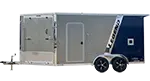
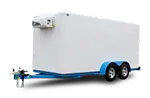
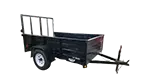

Imagine this: you are 40 miles from home, pulling a loaded enclosed trailer, and you approach a railroad bridge with a posted clearance of 12 feet 8 inches. Your combination measures 13 feet even at its highest point. You cannot safely continue, backing up may be difficult, and traffic is beginning to stack up behind you. Situations like this can happen to experienced haulers when loaded height and bridge clearance are not checked during route planning.
Tall-load hauling is manageable, but it requires a checklist mindset before the wheels start turning. You need to know the combination’s actual loaded height, verify every part of the route, understand who controls each road, and obtain the correct permit when the vehicle or nondivisible load exceeds Indiana’s legal dimensions.
The 13’6″ Standard and Why It Matters
Indiana’s maximum legal vehicle height is generally 13 feet 6 inches (13’6″) unless a lower clearance is posted. The 13’6″ limit is a state rule, not a universal federal height limit. Federal law does not establish one nationwide maximum vehicle height; states set their own limits. Indiana operators must therefore treat 13’6″ as the legal ceiling for ordinary, unpermitted travel while also obeying every lower posted clearance along the route.
Many Interstate and major highway structures provide clearance for ordinary legal-height commercial traffic, but not every road you may travel has 13’6″ of usable clearance. State highways, county roads, municipal streets, private entrances, construction zones, and older railroad underpasses can have lower clearances. A route can also change because of resurfacing, construction, temporary traffic control, snow or ice accumulation, utility work, or lane-specific differences beneath a structure.
A marked clearance must never be treated as permission to pass merely because your measured height appears equal to the number on the sign. Posted clearances may incorporate a safety allowance, but sign conventions and measurement practices are not identical in every jurisdiction. Clearance can also vary across lanes or from the center of an arched structure to its edges. If the available space is close to your loaded height, stop in a safe location and verify the route with the responsible road authority.
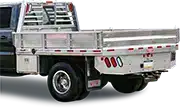
So what is the actual height of your trailer? The manufacturer’s exterior-height figure is only a starting point. Enclosed-trailer height varies with the frame, axle configuration, suspension, tire size, coupler setup, roof shape, interior height, and installed equipment. Roof vents, air conditioners, racks, antennas, ladder systems, and cargo extending above the roofline can become the highest point. A gooseneck flatbed may have a relatively low deck when empty, yet exceed 13’6″ after a large excavator, telehandler, agricultural machine, or other tall piece of equipment is loaded.
Do not estimate exterior height by adding a nominal interior height to an assumed floor height. Two trailers with the same interior-height option may have materially different overall heights. Consult the dimensional information for the exact trailer and then physically measure the fully loaded, connected combination.
How to Check Your Route Before You Leave
The single best move you can make is to plan the route around your measured loaded height, not merely the trailer’s advertised dimensions. Route planning should account for height, width, overall length, gross weight, axle weights, turning space, construction restrictions, and the roads on which your vehicle is legally permitted to operate.
- Indiana’s oversize/overweight permitting system is operated by the Indiana Department of Revenue’s Motor Carrier Services division. It is the proper starting point for obtaining and routing an Indiana oversize or overweight permit. A permit-generated route must be followed exactly, including any specified entry points, exits, restrictions, and local-road connections.
- INDOT’s Bridge Clearance Map can help identify reported clearances on Interstates, U.S. highways, and Indiana state routes. It does not cover every county road or city street, and it should not replace current signs, permit routing, or approval from the authority responsible for a local road.
- Google Maps and Apple Maps can help you examine the general route and identify visible underpasses, rail corridors, sharp turns, or narrow streets. Consumer navigation apps are not authoritative commercial-vehicle clearance tools and should never be relied upon to determine whether a tall or permitted load will fit.
- Commercial truck-routing software or a truck-specific GPS can screen a route using entered dimensions and vehicle restrictions. The data must be current, the correct vehicle profile must be selected, and every warning and posted restriction must still be obeyed. No routing app overrides a sign or an Indiana permit.
- Contact county and municipal road authorities before using local roads, particularly when the route includes an underpass, construction area, narrow intersection, or bridge not shown on the state clearance map. For a permitted oversize movement, obtain any separate local authorization that the city or county requires.
Downtown districts and older rail corridors deserve special attention. A street may appear suitable on a map while containing a low structure, restricted turn, one-way segment, weight-limited bridge, or inadequate space for a long combination. Review the complete route in advance, including the final approach to the delivery site and a safe contingency route.
Trailer Height by Type: A Quick Reference
| Trailer Type | Height Considerations | Notes |
|---|---|---|
| Standard Enclosed Cargo | Varies by exact model and configuration | Interior height is not exterior height; include roof vents, air conditioners, racks, and other accessories |
| Extra-Height Enclosed Cargo | Higher than a comparable standard-roof model | Verify the manufacturer’s overall-height specification and measure the connected trailer |
| Gooseneck Flatbed (unloaded) | Deck height varies by model, tires, suspension, and loading angle | Empty deck height does not determine the height of the loaded combination |
| Loaded Equipment Trailer | Determined by the trailer and the equipment’s highest point | Check booms, cabs, exhaust stacks, folded attachments, and securement position |
| Livestock / Horse Trailer | Varies by body style and equipment | Roof vents, air conditioners, racks, antennas, and other accessories may be the highest point |
These categories are intentionally not assigned universal height ranges because nominal trailer type and interior height do not establish actual exterior height. Even units from the same manufacturer can differ by axle package, tire size, suspension, roof profile, optional equipment, and coupler adjustment. Use the VIN-specific certification and dimensional information where available, then confirm the finished combination with a physical measurement.
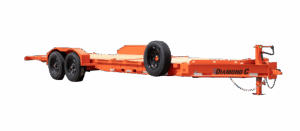
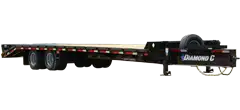
The gooseneck flatbed category is where operators can easily underestimate total loaded height. Diamond C FMAX gooseneck flatbeds are available in multiple configurations and GVWR classes, but GVWR does not tell you how tall a machine will sit on the deck. A large excavator or telehandler on an FMAX can exceed Indiana’s 13’6″ legal height even when the trailer itself is properly rated for the weight. Payload capacity, axle ratings, tire and wheel ratings, hitch limits, cargo height, and applicable permit requirements must each be checked independently.
When You Need a Permit
Indiana generally requires an oversize or overweight permit before operating a vehicle or load that exceeds 13’6″ in height, 8’6″ in width, 40 feet in length for a single vehicle, or 80,000 pounds gross vehicle weight, subject to applicable axle, axle-group, and federal bridge-formula limits. Indiana’s published guidance also identifies a 53-foot limit for a loaded semitrailer in a tractor-semitrailer combination connected by a fifth wheel. Other combination-length rules and statutory exceptions depend on the vehicle type, connection, highway, and operation, so the correct limit should be confirmed for the actual combination rather than reduced to one universal number.
An oversize or overweight permit is generally intended for a nondivisible vehicle or load. If cargo can reasonably be divided, repositioned, folded, lowered, or transported in separate legal loads, a permit may not be available merely for convenience. The operator should confirm eligibility with Indiana Motor Carrier Services before dispatching the load.
Indiana permits are issued through the Indiana Department of Revenue, Motor Carrier Services, using the Indiana Oversize/Overweight Permitting System. INDOT maintains and controls state highway infrastructure and provides bridge and restriction information, but it is not the agency that issues the ordinary state oversize/overweight permit. Single-trip and various longer-duration permit types are available for qualifying operations, with eligibility, fees, routing, and conditions determined by the specific vehicle and load.
A state permit ordinarily governs travel on the state-controlled route identified in the permit. It does not automatically authorize movement over every county road, municipal street, toll-road facility, or private property segment. When the trip begins or ends off the state system, the operator is responsible for securing any required local permission and confirming that the connecting roads and structures can safely accommodate the load.
The permit may specify:
- The authorized route, which may differ substantially from the route suggested by a consumer navigation app
- Travel-day, travel-hour, daylight, holiday, weather, or traffic restrictions
- Required signs, flags, lights, escort vehicles, or other warning equipment
- Maximum gross weight and permitted axle or axle-group weights
- Speed limits, bridge-crossing instructions, lane requirements, or other route-specific conditions
Do not assume your usual route is authorized simply because you have traveled it before. Permit approval is based on the dimensions, weight, axle spacing, configuration, origin, destination, and proposed route submitted for that movement. A permit for one vehicle or load does not automatically cover another configuration, and permits must be carried and used according to their stated terms.
Remember that a permit authorizes movement under specified conditions; it does not guarantee physical clearance or transfer responsibility to the state. The driver and carrier remain responsible for confirming the vehicle and load dimensions, obeying signs, monitoring changing conditions, and stopping when safe passage is uncertain.
Practical Tips From Experienced Haulers
A few practices matter in the real world and deserve a place beside the official requirements:
Measure the load before leaving the yard, not after reaching a restriction. Load and secure the cargo in its transport position, connect the tow vehicle, place the combination on firm and reasonably level ground, and measure vertically from the ground to the highest point. Check more than one location if the roof, machine, or load is irregular. A professional height pole or measuring device is safer and more reliable than estimating by eye.
Measure in the exact travel configuration. Hitch height affects trailer pitch. Suspension deflection and tire condition also affect the result. Verify that booms, buckets, ramps, doors, antennas, exhaust components, and folding structures are in their intended transport positions. Confirm that nothing can rise, unfold, or shift after departure.
Build a conservative clearance margin into ordinary route planning. A route that provides only a fraction of an inch beyond the measured height leaves no practical tolerance for measurement error, pavement variation, suspension movement, lane crown, resurfacing, snow, or debris. A three-inch planning margin is a useful minimum operating practice, not a legal rule and not a substitute for a permit when the combination exceeds 13’6″. More clearance may be appropriate for uncertain or uneven locations.
Treat posted clearance signs as mandatory restrictions. Never assume that a posted height is inaccurate in your favor, and never proceed based solely on another driver’s report. Slow early enough to read warning signs, remain in the lane specified by any signage, and stop in a safe place if your measured height is too close to the available clearance.
Look beyond the bridge itself. The safest detour must also accommodate the combination’s width, weight, length, turning radius, and trailer off-tracking. A road without a low bridge may still contain a weight-restricted structure, narrow lane, steep grade, railroad crossing with limited ground clearance, overhead utility, work-zone restriction, or intersection that the rig cannot negotiate safely.
Pay particular attention to older railroad underpasses. Indiana’s bridge-clearance studies recognize low-clearance structures and vehicle strikes as an ongoing safety problem. State bridge data can help on INDOT-maintained highways, but city and county structures require direct local verification. If the route goes beneath a railroad structure, identify its exact location and controlling road authority before committing the rig.
Recheck the route immediately before departure. Construction, crashes, emergency closures, pavement work, and temporary restrictions can invalidate a route that was acceptable when the job was booked. Permitted operators should review the permit and current restrictions before moving and should contact the permitting authority rather than improvising an unauthorized detour.
What Happens If You Get It Wrong
Hitting a low bridge can cause catastrophic damage to cargo, the trailer, the tow vehicle, and the structure. It can close a highway or railroad, expose the operator and carrier to substantial claims, require emergency inspection and repair, and injure the driver, passengers, workers, rail passengers, or nearby motorists. Even a strike that appears minor can compromise the bridge or dislodge cargo, so the scene must be treated as a serious incident.
Insurance treatment depends on the policy, endorsements, facts of the loss, and compliance with laws and permit conditions. Coverage should never be assumed. A carrier may investigate the measured load height, posted signs, driver conduct, route selection, permit status, securement, and whether the vehicle was being operated within the policy’s terms. Operators hauling tall or permitted loads should discuss physical-damage, cargo, liability, and oversize-operation coverage with a qualified insurance professional before accepting the job.
If contact occurs or is suspected, stop safely, activate warning devices, and contact law enforcement or emergency services as appropriate. Do not continue beneath or away from the structure if doing so could worsen the damage or endanger traffic. A railroad bridge strike may also require immediate notification to the railroad so train movements can be stopped until the structure is inspected.
If you discover mid-route that the planned road has a clearance problem, stop before entering the restricted area and move only as directed by law enforcement or the responsible road authority. Do not back a trailer into live traffic without proper traffic control. For a permitted load, contact Indiana Motor Carrier Services or the appropriate authority before deviating from the authorized route.
There is no penalty for choosing a safer route before reaching a restriction. There can be enormous cost in trying to squeeze beneath a structure when the available clearance is uncertain.
Planning Starts at the Dealer
When you are buying or ordering a trailer for work involving tall cargo, discuss height at the dealer level. At Spencer Trailers, the team can help review the published dimensions and configuration of a unit in stock, whether you are considering a Wells Cargo enclosed trailer, an H&H flatbed, or a Diamond C FMAX gooseneck flatbed. Because options, tires, suspension, coupler adjustment, accessories, and cargo all affect operating height, the final loaded combination must still be measured before travel.
Height is only one part of matching a trailer to the job. The trailer’s GVWR, empty weight, available payload, GAWR, tire and wheel capacities, coupler rating, deck dimensions, load distribution, brake equipment, and the tow vehicle’s ratings must also support the planned cargo. Never select a trailer by a general model-family rating alone; confirm the certification label and specifications of the exact unit.
Browse current inventory at spencertrailers.com/all-inventory or stop by at 291 West State Hwy 46, Spencer, IN. If you have a height-sensitive application in mind, contact the team through the contact page or call (812) 829-0226. Bring the dimensions and transport weight of the equipment you expect to haul so the team can help you compare suitable trailer configurations before routing becomes an issue.
The best time to think about clearance is before loading the trailer, before accepting the job, and before arriving at a 12’8″ railroad bridge with a 13-foot load. Confirm the exact trailer, measure the connected and secured load, check every road authority on the route, obtain the proper permit when required, and review current restrictions immediately before departure. Careful planning protects the cargo, the equipment, the infrastructure, and everyone sharing the road.


