


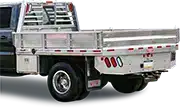










You’ve got a trailer lined up and a truck in the driveway. You figure, how hard can it be? You’ve driven a truck your whole life. Then you try to back the trailer into a parking spot for the first time and quickly understand that towing is its own skill set. The physics are different. The awareness required is different. And the consequences of getting it wrong, from a tire failure at highway speed to a jackknife on a wet ramp, are real.
This guide covers the fundamentals without fluff: hitch classes, weight ratings, mirrors, braking, turning, backing, and the checks that should happen before every trip. Learn these principles, practice at low speed, and you’ll build the habits needed to tow safely and confidently.
Start With the Hitch: Class Matters More Than You Think
Not all receiver hitches are the same. A hitch’s class gives you a general indication of its intended capacity, but class alone does not establish how much your particular truck can tow. The receiver, ball mount, hitch ball, coupler, safety-chain attachments, weight-distribution equipment, tow vehicle, and trailer each have their own ratings. The lowest applicable rating controls the setup.
| Hitch Class | Common Gross Trailer Weight Range | Common Tongue Weight Range | Common Ball Size |
|---|---|---|---|
| Class I | Up to approximately 2,000 lbs | Up to approximately 200 lbs | 1-7/8″ or 2″ |
| Class II | Up to approximately 3,500 lbs | Up to approximately 350 lbs | 1-7/8″ or 2″ |
| Class III | Commonly up to 5,000-8,000 lbs | Commonly up to 500-800 lbs | 2″ or 2-5/16″ |
| Class IV | Commonly up to 10,000-12,000 lbs | Commonly up to 1,000-1,200 lbs | 2″ or 2-5/16″ |
| Class V | Commonly up to 18,000-20,000 lbs | Commonly up to 1,800-2,000 lbs | 2-5/16″ or pintle-type connection |
These are common industry ranges, not universal limits. Receiver manufacturers may assign different weight-carrying and weight-distributing ratings to products within the same class. Some heavy-duty receivers also use 2.5-inch or 3-inch receiver openings. Always read the rating label on the installed receiver and the markings on the ball mount and hitch ball instead of relying on appearance or class alone.
Many half-ton trucks, including versions of the F-150, Ram 1500, and Silverado 1500, can be equipped with substantial receiver hitches. Three-quarter-ton and one-ton trucks generally offer higher-capacity receiver, gooseneck, or fifth-wheel towing configurations. That does not mean every truck with the same badge has the same limit. Engine, axle ratio, cab, bed, drivetrain, factory towing package, tires, wheels, and installed equipment can all affect the rating.
Check the coupler and hitch-ball size as well. A trailer equipped with a 2-5/16″ coupler must be connected to a properly rated 2-5/16″ ball. A smaller ball can allow the coupler to separate even if the latch appears to close. Match the connection type, ball diameter, shank size, and weight rating exactly.
GVWR, GTW, and Tongue Weight: The Three Numbers You Can’t Ignore
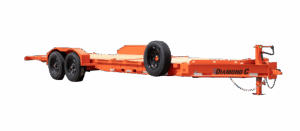
GVWR (Gross Vehicle Weight Rating) is the maximum allowable total weight of the trailer and everything carried on or in it. A Diamond C GTU utility trailer with a 7,000 lb GVWR, for example, must not weigh more than 7,000 lbs when loaded. The GTU uses two 3,500 lb axles and a 4″ channel frame, but usable payload is still determined by subtracting the trailer’s actual empty weight, including installed options, from its GVWR. Never assume payload equals the combined axle ratings.
GTW (Gross Trailer Weight) is what the trailer actually weighs in its current loaded condition. It includes the trailer, cargo, options, tools, spare tires, fuel, attachments, and anything else being transported. Confirm it on a certified scale whenever the load is heavy or close to a rating. The total must remain within the trailer’s GVWR, while the weight carried by each axle must remain within that axle’s GAWR and the tires’ load capacities.
Tongue weight is the downward load the trailer places on the hitch. For a conventional bumper-pull trailer, a common starting target is approximately 10 to 15 percent of loaded trailer weight, subject to the trailer and tow-vehicle manufacturers’ instructions. A 6,000 lb loaded bumper-pull trailer may therefore need roughly 600 to 900 lbs of tongue weight. Gooseneck and fifth-wheel trailers generally place a larger percentage of their loaded weight on the truck, often approximately 15 to 25 percent, so the truck’s payload and rear-axle limits become especially important.
Too little tongue weight can contribute to trailer sway. Too much can overload the receiver, rear axle, tires, suspension, or truck payload rating while unloading the steering axle. Do not try to correct an overloaded combination merely by moving cargo. Reduce the load if any GVWR, GAWR, tire, hitch, payload, or combined-weight limit would be exceeded.
Place cargo so the loaded trailer has the manufacturer-recommended tongue weight. Heavy equipment is commonly positioned over and somewhat ahead of the trailer axle group, but the correct location depends on the machine’s center of gravity and the trailer design. Secure the load only after measuring or otherwise confirming the balance. Never load solely by how level the trailer appears.
Quick check before every trip: Know the trailer’s GVWR and loaded weight. Check the tow rating, payload capacity, GCWR, receiver rating, and axle ratings for your truck’s exact configuration. Account for passengers, tools, hitch equipment, and cargo in the truck because all of them consume payload.
Weight ratings can also affect licensing and commercial-operation requirements. A standard Indiana Class A CDL weight threshold generally applies when a combination has a GCWR of 26,001 lbs or more and the towed vehicle has a GVWR above 10,000 lbs. A trailer exceeding 10,000 lbs by itself does not automatically trigger that weight-based Class A CDL requirement when the combination rating remains below 26,001 lbs. Separate rules can apply to commercial operations, hazardous materials, passenger transportation, and interstate commerce, so business users should verify all applicable state and federal requirements.
Mirrors: You Are Blind Without Them
Factory mirrors may provide adequate coverage with a narrow trailer, but a wide utility, equipment, dump, or enclosed trailer can block the view through the truck’s interior mirror and create large blind areas beside the trailer. Do not assume the factory mirrors are sufficient simply because the trailer is technically no wider than the truck with its mirrors extended.
Indiana requires a motor vehicle whose construction or load obstructs the driver’s rearward view to have a mirror positioned to reflect a view of the highway for at least 200 feet behind the vehicle. Properly fitted towing mirrors can provide the necessary view along both sides of the trailer. Clip-on extensions may work for occasional towing when they attach securely and do not vibrate excessively. Truck-specific extendable towing mirrors are usually a better choice for frequent use.
Set your mirrors before you move. Check that you can see:
- The rear corner and a useful section of the side of the trailer in each mirror
- The adjacent lanes and areas into which the trailer could move during a turn
- The roadway for at least 200 feet behind the combination, as Indiana law requires when the normal rearward view is obstructed
You may not be able to see every trailer tire continuously without changing your viewing angle, and no mirror arrangement eliminates every blind spot. Adjust the mirrors to minimize blind areas, look well ahead, signal early, and avoid lingering beside other vehicles. A properly positioned rear-view camera can help, but it supplements rather than replaces legally adequate mirrors and direct observation.
Braking: Everything Takes Longer Now
A loaded trailer adds mass and can substantially increase stopping distance. The exact increase cannot be reduced to one universal number because it depends on speed, total weight, brake condition, controller adjustment, tires, pavement, grade, weather, and driver reaction. The practical lesson is simple: leave considerably more room than you would when driving the truck by itself.
Under Indiana Code 9-19-3-3, a trailer or semitrailer with a gross weight of at least 3,000 lbs must have brakes adequate to control, stop, and hold it. The brakes must be operable by the driver from the tow-vehicle cab and arranged to apply automatically if the trailer accidentally separates. That means a compliant breakaway system is not an optional substitute for a brake controller; it is a separate emergency system.
Trailers with electric brakes require a compatible brake controller in the tow vehicle. Many late-model trucks have an integrated controller, while proportional aftermarket controllers such as the Tekonsha P3 remain available for properly compatible vehicles and trailers. The controller should be installed and adjusted according to its instructions. Hydraulic surge brakes, frequently found on boat trailers, operate through compression at the coupler and do not use a conventional electric-brake controller, although the system must still be compatible with the tow vehicle and trailer application.
Before entering traffic, connect the trailer on level ground and test the brake operation at low speed in a safe, open area. Follow the controller manufacturer’s setup procedure rather than relying on a fixed gain number. The trailer should contribute smooth braking without locking its wheels or pushing the tow vehicle. Recheck the adjustment when trailer weight or road conditions change.
Inspect the breakaway switch, cable, battery, wiring, connectors, and brake components regularly. Attach the breakaway cable to a secure point on the tow vehicle that is independent of the safety chains, and route it so it will not drag, snag, or pull the pin during a normal turn. Do not wrap it around the hitch ball.
On the road, use at least a four-second following interval in good conditions and add substantially more space in rain, snow, traffic, darkness, or on grades. Slow before curves and descents. Select an appropriate lower gear before a long downgrade and use engine braking as the vehicle manufacturer recommends. Do not ride the service brakes continuously, because excessive heat can reduce braking effectiveness.
Turning: Your Trailer Does Not Follow Your Path
When a tow vehicle turns, its rear wheels follow a path inside the front wheels. The trailer’s wheels generally track farther inside still, a behavior called off-tracking. Trailer length, axle position, hitch location, and turn angle all affect how far the trailer cuts toward the curb, island, signpost, or vehicle beside you.
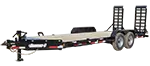
A long Diamond C LPX equipment trailer, for example, needs more attention to wheel placement than the truck by itself. The LPX is a low-profile, extreme-duty equipment-trailer line offered in multiple configurations and ratings beginning around the 14,900-15,500 lb range. Its exact dimensions and GVWR depend on the selected model and options, but any long equipment trailer can clip a curb or obstacle if the driver turns too early.
The fix is to approach slowly, pull far enough forward, and make a controlled turn while staying within your lawful lane. Watch the inside trailer wheels and the trailer’s outside rear corner in the mirrors. Do not swing blindly into an adjacent lane, and do not assume other drivers understand why you are setting up wide.
Right turns are often more difficult than left turns because the available space is tighter and the trailer can move toward a curb, pole, pedestrian, or vehicle in the passenger-side blind area. Signal early, reduce speed, and wait if another road user enters the space you need. Practice in a large, unobstructed lot before attempting congested streets, fuel islands, gates, or loading docks.
Backing Up: The Skill That Takes the Most Practice
Backing a trailer feels counterintuitive at first. An initial steering input moves the rear of the trailer in the opposite direction from the top of the steering wheel. New towers often wait too long to correct, make a large steering input, and then chase the trailer from side to side until the truck and trailer approach a jackknife angle.
Here’s the method that works:
- Use the bottom of the steering wheel as your guide. Place one hand at the bottom of the wheel. Move that hand left to guide the trailer left, or right to guide the trailer right. Straighten the truck’s wheels as the trailer begins following the intended path.
- Use small inputs. Make a correction, pause long enough to see its effect, and then unwind the steering. Large or rapid corrections can create a severe angle quickly.
- Scan both mirrors. Do not stare at only one side. Watch the trailer’s path, tires, roofline, rear corners, and surrounding clearance. If available, use a spotter positioned where the driver can see the spotter clearly.
- Go at walking speed. Keep your foot ready to brake. The slower you move, the more time you have to recognize and correct a developing problem.
- Get out and look. Stop, secure the vehicle, and inspect the area whenever clearance is uncertain. Cameras help but can distort distance and cannot show every overhead or side hazard.
- If the angle gets bad, pull forward and reset. A pull-up is a normal backing maneuver. Continuing while visibility or alignment deteriorates is what creates damage.
Single-axle trailers, especially short ones, usually respond more quickly to steering changes. Longer tandem-axle trailers often react more slowly, but they require more room and have larger corner-swing and off-tracking areas. Neither design is automatically easy in every situation. Practice with the actual trailer while it is lightly loaded, in an open area free of people, vehicles, curbs, and overhead obstructions.
A Few Other First-Trip Checkpoints
Before you pull onto the highway, run through this list:
- Safety chains: Use chains or cables with adequate ratings and approved attachment points. For a bumper-pull trailer, crossing them beneath the coupler can help support the tongue after a separation, provided the trailer and hitch manufacturers permit that routing. Leave enough slack for full turns but not enough to drag.
- Coupler locked: Lower the coupler fully onto the correct ball, close the latch, and install the required pin or lock. Use the tongue jack to raise the coupled connection slightly and confirm that the coupler remains securely attached before retracting the jack completely.
- Gooseneck connection: If towing a gooseneck, verify that the coupler is seated and locked on the correctly rated ball, the safety chains are attached to approved anchors, the breakaway cable is separate, and the jack legs are fully raised and secured.
- Lights: Check running lights, brake lights, turn signals, hazard flashers, side markers, and license-plate illumination. Have a helper watch from behind or use a safe testing method before entering traffic.
- Brakes and breakaway system: Confirm controller response and inspect the breakaway battery and switch. Do not tow with a pulled breakaway pin, because doing so can overheat or damage the trailer brakes.
- Tire pressure: Check every truck and trailer tire while cold and inflate it to the pressure specified for the vehicle, trailer, tire, and load. Inspect for cracking, bulges, cuts, embedded objects, abnormal wear, and inadequate load or speed ratings.
- Wheels and hubs: Torque lug nuts to the trailer manufacturer’s specification using the proper sequence, and recheck them at the prescribed intervals, especially on a new trailer or after wheel service. Inspect hubs for leakage, looseness, or unusual heat.
- Load secured: Use properly rated tie-downs and attachment points suitable for the cargo. Prevent forward, rearward, lateral, and vertical movement. Recheck securement shortly after departure and during the trip.
- Rear overhang: In Indiana, a load extending four feet or more beyond the rear of the trailer must display a red flag or cloth at least 12 inches square during the applicable daylight period. During the lighting period, it requires a red light or lantern at the extreme rear that is visible from at least 500 feet to the sides and rear. Overall length and permit rules still apply.
- Jack, ramps, doors, and accessories: Fully raise and secure the jack. Lock ramps, gates, dump bodies, tilt decks, toolboxes, doors, spare tires, and loose accessories in their travel positions.
Weight Distribution Hitches for Heavier Loads
A weight-distribution hitch uses spring bars and a compatible hitch head to transfer part of the load imposed at the rear of the tow vehicle toward the tow vehicle’s front axle and the trailer axles. It can improve front-axle load restoration, steering feel, braking balance, ride attitude, and headlight aim when the system is required, permitted, correctly sized, and properly adjusted.
There is no universal rule that every trailer above 6,000 lbs requires weight distribution. The tow-vehicle owner’s manual and receiver label determine when a weight-distributing setup is required and how much trailer and tongue weight the vehicle can handle in weight-carrying and weight-distributing modes. Some vehicles require weight distribution above a specified loaded trailer weight, while others impose different limits or prohibit certain equipment.
Visible rear sag can indicate excessive tongue weight, an overloaded truck, incorrect cargo placement, or a need for an approved weight-distribution system. A weight-distribution hitch does not increase the truck’s GVWR, GCWR, payload, rear GAWR, receiver rating, or tire capacity. It also cannot make an overloaded or poorly balanced trailer safe. Measure the actual weights and correct any overload first.
Choose a system whose operating range matches the trailer’s measured loaded tongue weight, including cargo carried behind the tow vehicle’s rear axle when the manufacturer requires it to be considered. Follow the hitch and vehicle manufacturers’ setup procedures for ball height, head angle, spring-bar tension, front-axle load restoration, frame attachment, and lubrication. If the trailer has surge brakes, confirm that the selected system is specifically compatible with them. Sway-control equipment can be useful, but it is not a cure for insufficient tongue weight, overloading, worn components, poor tire condition, or excessive speed.
At Spencer Trailers, we can help match you to a trailer that fits your truck’s actual ratings and intended load. Whether you’re considering a utility trailer, flatbed, or cargo trailer in our current inventory, bring the truck’s configuration information and an honest estimate of everything you need to carry. We can help you compare trailer GVWR, empty weight, estimated payload, hitch requirements, and connection type before you drive off the lot.
Questions about what your specific truck can handle? Reach out to the team at Spencer Trailers and we’ll help you identify the ratings that matter. We’re at 291 West State Hwy 46 in Spencer, Indiana, and reachable at (812) 829-0226. No pressure, just practical advice before you buy.
If you’re still deciding on trailer type, take a look at what’s moved off our lot recently to get a feel for the utility, equipment, dump, flatbed, and cargo trailers buyers in this area use. Compare the trailer’s design with your cargo, loading method, tow vehicle, storage space, and typical route rather than choosing by GVWR alone.
The first trip always feels a little awkward. The second one is easier. By the tenth, towing begins to feel like another skill you have developed. The key is starting with a correctly matched combination, checking it carefully, and leaving yourself enough time and space to make safe decisions.


