








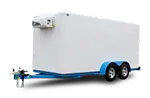


You back the dump trailer up to the pile, press the control, and nothing happens. The bed will not lift, the pump may click once, or the motor may turn too slowly to build hydraulic pressure. A discharged battery is one of the first things to check, but it is not the only possible cause. Loose terminals, a poor ground, damaged cables, a tripped circuit breaker, a failed solenoid, remote-control wiring, low hydraulic fluid, or a pump problem can produce similar symptoms. Starting with the battery and high-current connections is still smart because those checks are fast, inexpensive, and responsible for a large share of no-lift complaints.
Most self-contained dump-trailer hydraulic systems use a dedicated 12-volt battery to operate a DC hydraulic power unit. The battery supplies the high current needed by the electric motor, which turns the hydraulic pump and sends fluid to the cylinder that raises the bed. If battery voltage collapses under load, the motor slows, hydraulic flow falls, and the bed may stall. Diamond C has also warned that operating a hydraulic power unit with an undercharged battery can contribute to excessive current demand and damaged starter-solenoid contacts. Charge and test the battery before replacing hydraulic components, and never work beneath a raised dump body unless it is secured with the manufacturer-approved body prop or safety support.
What Kind of Battery Your Dump Trailer Actually Needs
Use the battery size and chemistry specified for the trailer’s actual hydraulic system, charger, battery tray, and cable arrangement. Current Diamond C dump-trailer configurations commonly specify a Group 27 Series deep-cycle battery with a 110-volt, 5-amp onboard charger. H&H equipment varies by model; for example, current H&H Industrial Dump configurations list a deep-cycle battery, 12-volt hydraulic pump, and 10-amp onboard charger. Check the trailer’s build sheet, owner’s information, charger label, and battery-box dimensions rather than assuming every dump trailer uses the same battery. Group 27 and Group 31 describe standardized case dimensions, not a guaranteed amp-hour capacity or battery chemistry.
A conventional automotive starting battery is optimized to deliver a short burst of cranking current and then receive an immediate recharge from an alternator. A dump-trailer battery must also deliver a strong surge, but it may remain under load throughout a complete lift and may perform several cycles before it is recharged. That combination usually makes a marine/RV deep-cycle or suitable dual-purpose battery a better match than a basic starting battery. Even a deep-cycle lead-acid battery lasts longer when it is kept near full charge and is not routinely discharged to extreme depths. Repeatedly leaving it at 50 percent charge or lower will shorten its useful life.
There is no universal 100 amp-hour minimum for every hydraulic dump trailer. Many Group 27 marine/RV batteries are rated in roughly the 80-to-100 Ah range, while Group 31 batteries commonly provide more reserve capacity. Battery manufacturers may also emphasize reserve capacity, cold-cranking amps, or marine-cranking amps instead of amp-hours. More capacity can be helpful when making repeated lifts, but a larger battery is not automatically better if it does not fit the hold-down, has the wrong terminal arrangement, or cannot be properly recharged by the existing system. Match the original specification first. Consider a Group 31 only when the tray, cables, charger, and trailer manufacturer support it.
AGM batteries can be a useful upgrade because they are nonspillable when installed and charged correctly, tolerate vibration well, require no watering, and generally have low self-discharge. They still need a charger with an AGM-compatible profile, and their enclosure must not be made completely airtight because pressure-relief valves can vent gas during abnormal charging. LiFePO4 batteries are another option on systems specifically designed for them; Diamond C currently offers a lithium battery upgrade on certain dump-trailer configurations. A lithium replacement must have a battery-management system rated for the hydraulic motor’s high surge current, a compatible charger, suitable tow-vehicle charging protection, and low-temperature charging safeguards.
A dump-trailer hydraulic motor draws far more current than lights, brakes, or ordinary accessories. Actual current varies with the motor, pump displacement, hydraulic pressure, cable length, temperature, and load. It can rise sharply as the bed approaches maximum pressure or the pump is held against the relief valve. That is why a battery can show an acceptable open-circuit voltage and still fail during a lift. A sulfated battery, damaged internal connection, undersized cable, loose terminal, or corroded ground can allow the voltage to collapse as soon as the pump starts. Measure voltage directly at the battery posts while operating the pump, then compare it with voltage at the motor terminals to separate a weak battery from excessive cable loss.
Charging the Right Way
A trailer battery may receive power while towing only when the tow vehicle’s seven-way connector has an active 12-volt auxiliary circuit and a sound ground connection. Some trucks require a fuse, relay, software setting, or running engine before that circuit becomes active. Even when it works, the factory charge wire is usually better at maintaining a reasonably charged trailer battery than recovering one that is deeply discharged. The long wire run, connector resistance, and relatively small conductor size can reduce charging voltage and current by the time power reaches the trailer. Do not assume an hour of driving has restored a battery after several heavy dump cycles.
Use the trailer’s onboard charger when equipped, or connect a dedicated smart charger that supports the battery’s chemistry and capacity. Current Diamond C dump-trailer specifications commonly include a 5-amp onboard charger, while some current H&H hydraulic models use a 10-amp onboard charger. A quality external 5-to-10-amp smart charger is also practical for Group 27 and Group 31 lead-acid batteries. Units from manufacturers such as NOCO and Battery Tender offer separate flooded, AGM, and lithium charging modes on selected models. Choose the correct mode instead of relying on the charger to identify the chemistry automatically. A charger fault light can identify some problems, but it is not a substitute for a proper battery test.
Charging time depends on how many amp-hours were removed, the charger’s actual output, battery temperature, condition, and the time spent in the absorption stage. Replacing a 50 Ah deficit with a 10-amp charger requires about five hours in theory, but a lead-acid battery does not accept the full rated current all the way to 100 percent. Six to eight hours or longer is more realistic. A 5-amp onboard charger may require 12 hours or more for the same recovery. Let the charger complete bulk, absorption, and maintenance stages rather than unplugging it as soon as the voltage rises. Charge in a ventilated area, keep sparks and flames away, and never attempt to charge a frozen or visibly damaged battery.
For extended storage, use a true automatic maintainer rather than an old-style unregulated trickle charger. Flooded deep-cycle batteries can self-discharge several percent per month, with the rate increasing as temperature rises or the battery ages. AGM batteries commonly self-discharge more slowly, but wireless receivers, breakaway circuits, charger electronics, and other connected accessories can drain either type faster than natural self-discharge alone. Check the battery at least monthly during storage until you understand the trailer’s actual drain. Leaving a lead-acid battery partially discharged encourages sulfation, which reduces available plate area and may become irreversible. A small factory solar panel can help maintain charge in good sunlight, but a low-wattage system is not a replacement for a charger when the battery is significantly discharged.
Winter Storage
Cold weather slows the chemical reaction inside a battery and reduces the current and capacity available to operate the hydraulic motor. As a general rule, a lead-acid battery may provide around 80 percent of its room-temperature capacity near 32 degrees Fahrenheit and roughly 50 to 60 percent near 0 degrees, depending on battery design and discharge rate. At the same time, cold hydraulic fluid creates additional resistance in the pump and hoses. A marginal battery that lifts normally in September may struggle during an Indiana cold snap even though no component has suddenly failed.
For long winter storage, remove a lead-acid battery when practical and keep it in a cool, dry, ventilated location protected from freezing and excessive heat. Connect it to an approved automatic maintainer or charge and inspect it at intervals recommended by the battery manufacturer. If the battery remains on the trailer, clean and fully charge it, turn off accessories, and disconnect the negative cable to eliminate unintended drain. Remember that some hydraulic trailers use the hoist battery to power the emergency breakaway brakes. Reconnect the battery, fully charge it, and test the breakaway system before towing. An insulating cover may reduce rapid temperature swings, but insulation alone does not generate heat or compensate for a discharged battery.
State of charge has a major effect on the freezing point of a flooded lead-acid battery. A fully charged battery may resist freezing until temperatures are around 75 degrees below zero Fahrenheit, while a severely discharged battery can freeze at approximately 15 degrees above zero. The exact point varies with electrolyte concentration and battery condition, but the lesson is straightforward: keep the battery charged. If you suspect a battery has frozen, do not operate or charge it. Move it to a safe location, allow it to thaw naturally, and inspect the case for bulging, cracks, leaks, or terminal damage before testing or replacement.
When spring arrives, inspect the case, hold-down, cables, fuse or circuit breaker, and charger before operating the bed. Fully charge a lead-acid battery, disconnect the charger, and allow the battery to rest before judging open-circuit voltage. A healthy, fully charged flooded battery commonly rests around 12.6 to 12.8 volts, while many AGM batteries rest slightly higher. Readings taken immediately after charging may be artificially high because of surface charge. Voltage alone shows approximate state of charge, not usable capacity, so follow it with a load or conductance test. LiFePO4 batteries have a much flatter voltage curve, making a simple resting-voltage reading less useful for estimating their remaining capacity.
Terminal and Cable Maintenance
Corrosion on the battery terminals is one of the most common and most ignored electrical problems on work trailers. White, gray, or blue-green buildup around the posts and cable ends increases resistance. The hydraulic pump may click, run slowly, stop partway through a lift, or work intermittently as the trailer moves. Because the motor draws such high current, resistance that appears insignificant during a no-load voltage check can create a substantial voltage drop during operation. Corrosion may also develop inside a crimped cable lug where it is not immediately visible.
Wear eye protection and gloves before cleaning a lead-acid battery, and keep flames, cigarettes, and sparks away from the battery box. Turn off the charger and all trailer accessories. Disconnect the negative cable first, then the positive cable. A mixture of baking soda and water can be used on the outside of a flooded battery and its cable ends to neutralize acid residue, but do not allow the mixture to enter the vent caps or cells. Scrub the posts and contact surfaces, rinse carefully, and dry everything completely. Reconnect the positive cable first and the negative cable last. Tighten to the battery or trailer manufacturer’s specification, then apply terminal protectant over the completed connection rather than between the electrical contact surfaces.
Inspect the full length of the positive and negative cables at the same time. Look for cracked insulation, flattened sections, burned areas, loose crimp lugs, green corrosion under the insulation, and cables that have rubbed against the frame or pump box. Check the direct battery-to-motor ground connection because a weak ground can produce the same symptoms as a weak battery. The cable ends should not move by hand after tightening, but overtightening can damage a lead post or strip a stud. If the pump is slow, perform a voltage-drop test across the positive cable and then across the ground path while the motor is running. A large difference between battery-post voltage and motor-terminal voltage points to a cable or connection problem.
On many Diamond C and H&H dump trailers, the battery and hydraulic power unit are mounted in a tongue box near the coupler. The box is intended to protect the components from road spray, weather, theft, and impact, but it should not be assumed to be completely watertight or airtight. Check that the lid closes securely, the battery hold-down is tight, drain openings are clear, charger cords are protected, and water cannot remain around the battery or pump. Keep metal tools away from the positive terminal and frame at the same time. A tool that bridges the positive post to grounded metal can cause an immediate short circuit, severe burns, fire, or battery damage.
Load Testing and Knowing When to Replace
A resting-voltage check mainly tells you the battery’s approximate state of charge. It does not prove the battery can operate the hydraulic motor. Fully charge the battery before testing, and test directly at its posts. For a lead-acid battery with a published CCA rating, one recognized procedure applies a load equal to half the CCA rating for 15 seconds. At approximately 70 degrees Fahrenheit, voltage should generally remain at or above 9.6 volts, with temperature correction required in colder conditions. That test must not be applied as a universal rule to every battery chemistry. A reserve-capacity or controlled discharge test is more informative for a true deep-cycle battery, while a LiFePO4 battery requires a test compatible with its BMS and manufacturer specifications.
Many battery retailers and service shops can perform a conductance or load test, although the exact service and fee vary by location. Tell the technician the battery is used for a high-current hydraulic power unit and provide its chemistry, group size, CCA or MCA rating, and amp-hour or reserve-capacity rating. A typical lead-acid work-trailer battery may last roughly three to five years, but service life can be much shorter when it is repeatedly left discharged, exposed to high summer heat, overcharged, frozen, or operated through corroded connections. Record the installation date and maintenance history. If the lift becomes sluggish, charge and test the battery and cables before assuming the hydraulic pump has worn out.
| Battery Type | Typical Capacity | Self-Discharge/Month | Cold Tolerance | Maintenance |
|---|---|---|---|---|
| Flooded Lead-Acid | About 80-110+ Ah in common Group 27/31 sizes | Often 3-15%, depending on temperature, age, and design | Output falls in cold; discharged batteries can freeze | Check electrolyte as directed; add distilled water only |
| AGM (Group 27/31) | About 85-105+ Ah, depending on model | Generally low, often less than 3% | Good when charged, but available output still falls in cold | No watering; use an AGM-compatible charger |
| Lithium (LiFePO4) | 100 Ah is common; high-current BMS rating is critical | Low, but BMS standby draw varies | Good discharge performance; charging may be blocked below 32F | Use a lithium-compatible charger and follow BMS limits |
A Quick Q&A
Can I use a car battery in a dump trailer? A starting battery may operate the pump temporarily, but it is not the preferred replacement when the trailer manufacturer specifies a deep-cycle battery. Repeated hydraulic cycles can discharge a starting battery more deeply than its plate design is intended to tolerate, shortening its life. Use the specified voltage, group size, terminal layout, and battery type. Never install a battery that cannot be securely restrained, and do not reverse polarity. If an AGM or lithium upgrade is being considered, confirm that the onboard charger and tow-vehicle charge circuit are compatible before making the change.
Do I need a bigger battery if I’m lifting heavier loads? Not automatically. A larger battery can provide more reserve for repeated lifts, but it does not increase the trailer’s legal payload, GVWR, hydraulic pressure rating, cylinder capacity, or structural limit. A heavily loaded bed requires more hydraulic pressure, which increases demand on the motor and exposes weak batteries and connections. The correct solution is a fully charged battery of the specified type, low-resistance cables, proper hydraulic fluid, and a load within the trailer’s ratings. Moving to a Group 31 or lithium battery should be based on manufacturer approval, available space, charger output, duty cycle, and high-current capability, not payload alone.
My lift is slow. Is it the battery? Low voltage is common, but it is only one possibility. Measure voltage directly across the battery posts while the pump operates. If battery voltage drops sharply, fully charge and retest the battery. If voltage remains acceptable at the posts but is substantially lower at the motor, inspect the cables, terminals, solenoid, circuit protection, and ground. If the electrical system checks out, look for cold or incorrect hydraulic fluid, low fluid level, a restricted reservoir breather, damaged hoses, a sticking valve, a worn pump, an overloaded bed, or a cylinder problem. Stop operating the control if the motor stalls, cables become hot, or the pump remains against the relief valve.
Where to Start
If you are buying a new dump trailer from our inventory, ask which battery, charger, and hydraulic system are installed on that specific unit. Current Diamond C dump-trailer configurations commonly use a Group 27 Series deep-cycle battery with a 110-volt, 5-amp charger, with lithium and low-wattage solar-maintenance options available on selected builds. Current H&H specifications vary, and some hydraulic models include a deep-cycle battery with a 10-amp onboard charger. For an older trailer, begin by checking the battery label, installation date, cable condition, charger operation, and rested voltage. A lead-acid reading below 12.4 volts indicates the battery needs charging; it does not, by itself, prove the battery has reached the end of its life.
We carry dump trailers from Diamond C and H&H in Spencer, Indiana, and we’re happy to talk through battery specifications, onboard charging, cable condition, or what to inspect when a hydraulic bed is not performing correctly. You can also reach us at (812) 829-0226 before buying a replacement battery or replacing hydraulic components unnecessarily. Bring the trailer model, VIN, existing battery information, and a description of what the pump does when you press the control. A correct diagnosis may require only a charge or cable repair, while operators who need more capacity, faster turnaround between cycles, or a different trailer configuration can compare newer units designed for their actual workload.


