






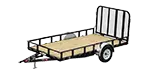

You’re loading a skid steer with about 10 inches of ground clearance onto a standard flat-deck trailer when you hear it: that gut-punch scrape of the bucket, undercarriage, or machine belly contacting the ramp-to-deck transition. The machine stops moving, the tires or tracks lose traction, and now you’re looking for blocks, longer ramps, or a safer loading location. This is exactly the problem a properly designed beavertail trailer helps solve.
The beavertail, also commonly called a dovetail, is not a gimmick or a feature reserved for one narrow type of work. For contractors, landscapers, farmers, rental companies, and equipment owners who regularly load machines with limited approach or breakover clearance, it can be the difference between a controlled loading process and fighting the same steep transition every time the trailer is used.
What the Beavertail Actually Does
A beavertail is the sloped section built into the rear of a trailer deck. Instead of the main deck ending abruptly at full deck height and relying entirely on ramps to bridge the distance to the ground, the rear portion angles downward. The loading ramps then connect to the lower end of that slope. This spreads the climb across two transitions: the ramp-to-beavertail transition and the beavertail-to-main-deck transition.
That distinction matters because a machine can contact a trailer in more than one place. A low front attachment can catch near the bottom of a steep ramp, while a long-wheelbase machine can high-center where the ramp meets the deck. A beavertail does not change the height of the trailer’s main deck, but it reduces the abruptness of the upper transition and places the ramp hinge closer to the ground.
On a conventional flat deck, a five-foot ramp may still create a steep climb when the trailer has a relatively high deck. The exact angle depends on the trailer’s axle configuration, tire size, suspension position, ramp length, ground conditions, and whether the trailer is empty or loaded. Rather than relying on one generic ramp-angle number, compare the complete loading path with the machine’s approach angle, departure angle, wheelbase, undercarriage clearance, and attachment position.
Fixed beavertails commonly occupy approximately the final two to four feet of the stated bed length, although the exact length and drop vary by manufacturer and loading system. On the current Diamond C LPX equipment trailer, the standard extra-wide HD flip-knee ramp configuration is paired with a 24-inch dove, while the optional MAX Ramps use a longer 36-inch self-cleaning dove. Those are two different loading geometries on the same trailer family, which is why the ramp and tail configuration should be evaluated together rather than treating every beavertail as identical. :contentReference[oaicite:0]{index=0}
Dovetail vs. Beavertail: Is There a Difference?
In everyday trailer-industry use, “dovetail” and “beavertail” usually refer to the same basic feature: a fixed rear portion of the deck that slopes toward the ground. One word does not automatically mean the tail is hinged, powered, or removable. Manufacturers and dealers may prefer one term over the other, but the terms are regularly used interchangeably in equipment-trailer listings.
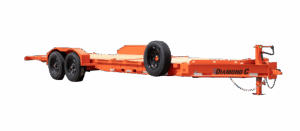
A hydraulic dovetail is a more specific design. It is a powered rear deck section that rotates down for loading and returns to a transport position. Some hydraulic dovetails can also carry equipment when raised and locked, subject to the manufacturer’s load and securement requirements. A tilt trailer is another distinct solution: instead of using a short rear tail and separate ramps, a large portion of the deck pivots to form the loading surface.
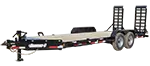
Diamond C’s 22-foot LPX equipment trailer, for example, is a bumper-pull, low-profile equipment trailer available with fixed-dove ramp systems. Current LPX configurations use an 80- or 82-inch bed between the fenders, with an optional 102-inch maximum-width package on applicable builds. Depending on model year and GVWR package, the entry rating is approximately 14,900 or 15,500 lb, with heavier configurations extending to 24,000 lb. Standard axles on Diamond C’s premium LPX line are Lippert axles, with axle count and capacity changing as the GVWR package increases. :contentReference[oaicite:1]{index=1}
Flat Deck vs. Beavertail: Pick the Right Tool
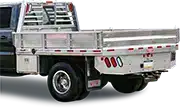
Flat decks are not inferior to beavertails. They are the right choice for different loads. The useful comparison is not which design looks more heavy-duty, but which deck geometry fits the cargo you actually move.
| Feature | Flat Deck | Beavertail |
|---|---|---|
| Deck height | Deck remains at the same height from front to rear; height varies widely between low-profile and deckover models | Main deck remains at normal height, but the rear section slopes lower toward the ramp hinge |
| Full usable deck length | Entire stated bed can provide a level loading surface | Stated bed length often includes the sloped tail, reducing the amount of completely flat deck |
| Low-clearance loading | May require longer ramps, blocking, or a tilt system to control the transition | Improves ramp-to-deck breakover geometry, although machine fit still must be verified |
| Flatness for lumber/pipe | Better for long, rigid, palletized, or uniformly supported material loads | Long rigid material may need proper blocking and support over the sloped section |
| Best for | Lumber, steel, pipe, pallets, containers, and equipment that tolerates a steeper transition | Skid steers, compact track loaders, mini excavators, tractors, mowers, and other equipment sensitive to loading angle |
If you’re hauling dimensional lumber, pipe, steel beams, pallets, or fabricated material, a true flat deck is often cleaner. Every foot of the bed can support the load on the same plane, making it easier to distribute weight, place blocking, and use stake pockets, rub rails, or other securement points correctly. A fixed beavertail can still carry material, but the sloped rear zone may require cribbing or additional support to prevent long pieces from bridging unsupported space.
For equipment hauling, the decision should not be based on a blanket rule such as “under 10,000 lb” or “under 14 inches of clearance.” Two machines with the same operating weight can have completely different loading behavior because of wheelbase, track length, attachment position, tire size, and undercarriage design. A short skid steer may climb a transition that causes a longer compact tractor or mini excavator to high-center.
If your machine has previously scraped at the ramp hinge, pushed the ramps away, lost traction during the climb, or required improvised blocking, a beavertail or tilt trailer deserves serious consideration. The correct choice still depends on the trailer’s actual ramp system, deck height, payload, bed width, tie-down layout, and compatibility with the tow vehicle.
What to Look for in a Beavertail Trailer
Deck Height
A lower deck generally makes equipment easier to load, but lower is not automatically better in every situation. A very low trailer can have less clearance beneath the frame, toolbox, jack, or rear tail. That can create problems when crossing crowned roads, entering steep driveways, or operating on uneven jobsites. The goal is to find a useful balance between a low loading surface and enough trailer ground clearance for the places where it will actually be used.
Diamond C’s LPX Low Profile Equipment Trailer uses a low-profile frame and drop-axle configuration to keep the loading surface between the fenders. Current configurations are offered in lengths from 16 to 30 feet and in GVWR packages from approximately 14,900/15,500 lb through 24,000 lb. Straight axles are available on applicable builds and raise both deck height and ground clearance by approximately four inches, which may be useful for operators who regularly cross rough terrain or steep entrances. :contentReference[oaicite:2]{index=2}
H&H’s current Industrial Equipment Trailer takes a different approach. It combines a fixed dovetail with five-foot spring-assist skid-loader ramps and is offered in current bumper-pull configurations rated at 14,000 or 16,000 lb, depending on axle package. That makes it important to compare actual specifications rather than assuming every low-loading equipment trailer shares the same deck height, tail length, frame, or GVWR. :contentReference[oaicite:3]{index=3}
Deck height should be confirmed on the exact trailer being purchased. Axle style, tires, suspension, floor material, GVWR package, and optional maximum-width components can all affect the final dimensions. When clearance is close, bring the machine measurements to the dealer and, whenever practical, perform a controlled loading test on firm, level ground.
Ramp Design
Ramp length is important, but it is only one part of a safe ramp system. Compare ramp width, rated capacity, hinge construction, spring assistance, traction surface, support feet, knee design, spacing adjustability, and how securely the ramps lock for transport. The trailer’s GVWR does not automatically tell you how much concentrated weight each individual ramp can support.
Current LPX standard ramps are extra-wide, spring-assisted HD flip-knee ramps measuring approximately 24 by 60 inches and paired with a 24-inch dove with cleats. Optional MAX Ramps are 37 inches wide, use multiple high-strength steel ramp-frame members, and are paired with a 36-inch self-cleaning dove. The full-width X-Ramp is designed for compatible 102-inch maximum-width LPX configurations and measures approximately 92.5 inches wide by 44.25 inches long. Availability depends on trailer length, axle configuration, and width package. :contentReference[oaicite:4]{index=4}
Do not select a trailer from an advertised ramp-angle claim alone. The real angle changes with tire size, axle position, suspension compression, tongue height, and the surface supporting the ramp feet. Soft soil can allow the ramp ends to sink, increasing the upper breakover angle and putting unexpected stress on the ramps. Load on a firm, level surface whenever practical, chock the tow vehicle and trailer, and keep the trailer connected to a properly rated tow vehicle unless the manufacturer specifically provides a different loading procedure.
GVWR and Axle Rating
GVWR is the maximum permitted loaded weight of the trailer, including the trailer itself, equipment, attachments, chains, binders, spare tires, toolboxes, winches, fuel carried on the trailer, and any other cargo. Payload is not the same as GVWR. The basic calculation is the trailer’s certified GVWR minus its actual empty or curb weight as equipped.
For example, a 14,000 lb GVWR trailer weighing 3,200 lb would have a theoretical payload of 10,800 lb before adding dealer-installed accessories or cargo. A longer trailer, heavier flooring, drive-over fenders, a winch, spare tires, larger ramps, or additional toolboxes can reduce that number. Use the certification label and the actual as-built weight whenever possible instead of relying on a generic online estimate.
Diamond C’s LPX and HDT premium lines use Lippert axles as standard equipment. Current LPX GVWR packages include tandem and triple-axle arrangements, with axle ratings increasing for the heavier packages. Do not determine legal payload by adding the axle ratings yourself. The manufacturer’s certified GVWR, tire ratings, coupler rating, frame configuration, and certification label control the trailer’s rating. :contentReference[oaicite:5]{index=5}
The tow vehicle must also be rated for the complete combination. Check the truck’s GCWR, maximum trailer rating, receiver or gooseneck rating, rear-axle rating, tire capacity, allowable payload, and hitch-weight limit. A trailer may have enough payload for the machine while still being too heavy for the truck, receiver, hitch ball, or available rear-axle capacity.
Indiana requires braking equipment on trailers in this weight class, including brakes controllable from the tow vehicle and a breakaway system. For CDL classification in a commercial operation, the key Class A threshold is a gross combination weight rating of 26,001 lb or more when the trailer being towed has a GVWR greater than 10,000 lb. A trailer rating over 10,000 lb does not by itself mean every driver automatically needs a CDL; the rated combination and the nature of the operation must be evaluated together. :contentReference[oaicite:6]{index=6}
Need a ramp-free loading option? Diamond C’s HDT is a low-profile, hydraulically dampened tilt equipment trailer offered in current GVWR configurations from approximately 15,500 to 24,000 lb. Its standard system is a gravity-fed tilt deck controlled by a hydraulic dampening cylinder and valve. Powered tilt and Pro Tilt configurations are available for operators who need powered control or the ability to switch between gravity and powered operation. It can simplify loading, but the machine must still fit the trailer’s certified payload, bed width, deck length, weight-distribution limits, and tie-down layout. :contentReference[oaicite:7]{index=7}
Steel Gauge and Frame
Equipment trailers take concentrated loads, twisting forces, repeated ramp impacts, and point loading from tires, tracks, stabilizers, and attachments. Frame depth by itself is not a complete measure of strength. Compare the beam section and weight, steel specification, tongue integration, crossmember design, crossmember spacing, suspension hangers, ramp structure, weld quality, and whether the frame was engineered for that specific GVWR and length.
On current LPX configurations, the standard frame is an 8-inch, 10 lb-per-foot I-beam design, with heavier 8-inch, 15 lb-per-foot material and Diamond C Engineered Beam Technology used on applicable higher-GVWR and longer configurations. Standard crossmembers are 3-inch I-beams on 16-inch centers, with 12-inch spacing available on applicable builds. That is more meaningful than applying a blanket rule that every equipment trailer must have a certain beam depth. :contentReference[oaicite:8]{index=8}
The current LPX floor is 2-inch treated lumber as standard, installed after the frame has been coated so the structure beneath the boards is not left unfinished. A 3/16-inch diamond-plate floor is available on compatible configurations. Wood provides useful traction and is replaceable after years of equipment use, while steel flooring can handle different wear patterns but may be more slippery when wet or muddy. The right floor depends on whether you haul rubber tires, steel tracks, pallets, attachments, or mixed cargo.
Diamond C finishes the LPX and HDT with its DM Difference Maker multi-stage coating system rather than relying on a basic single-pass paint process. Even with a durable coating, equipment trailers should be washed after exposure to road salt, fertilizer, mud, and corrosive debris, and any damaged coating should be repaired before corrosion spreads under the surrounding finish. :contentReference[oaicite:9]{index=9}
A Practical Scenario
Say you’re a landscaper in Owen County running a Bobcat S650 skid-steer loader and a Toro Dingo or similar compact utility loader. Bobcat currently lists the Classic S650 at approximately 7,901 lb operating weight, but the actual transport weight can change with the bucket, forks, auger, tracks, counterweights, fuel, mud, and other installed equipment. Different Dingo models also vary considerably, so the exact model and attachment package must be weighed or verified from its identification plate and manual. :contentReference[oaicite:10]{index=10}
A 7,000 lb GVWR single-axle trailer is not suitable for an approximately 7,900 lb skid steer because the machine alone exceeds the trailer’s entire gross rating before the trailer’s own weight is considered. A 14,000 lb tandem-axle equipment trailer may provide enough payload for the S650 by itself, depending on the trailer’s curb weight and the machine’s attachment package, but that does not mean it can automatically carry the S650 and compact utility loader together.
For one machine at a time, an LPX in the approximately 14,900/15,500 lb entry range may provide workable capacity with more useful loading geometry than a high flat deck. If the plan is to transport both machines, carry heavy attachments, or leave room for future equipment, an 18,000 or 20,000 lb configuration may be the more appropriate starting point. The truck and hitch must be upgraded accordingly; additional trailer capacity is not useful when the tow vehicle cannot legally or safely control the combination.
The beavertail and ramp system address the loading problem, but jobsite conditions still matter. On soft ground, place the ramp feet on a firm supporting surface so they do not sink. Avoid loading across the side slope of a driveway, keep bystanders away from the loading path, lower attachments, travel slowly, and position the machine so the trailer maintains appropriate tongue weight without exceeding the truck’s rear-axle or hitch limits.
Current LPX pricing is no longer accurately represented by an old $7,500 to $9,000 estimate. Current 2026 inventory places LPX trailers in the low five figures and upward, with price increasing for additional length, higher GVWR packages, MAX Ramps, the X-Ramp, maximum-width equipment, heavier tires, upgraded brakes, flooring, and other options. Live inventory should always be checked because manufacturer pricing, freight, options, and dealer availability change. :contentReference[oaicite:11]{index=11}
Compare that investment with the ongoing cost of damaged ramps, scraped undercarriages, unsafe blocking, lost time, premature tire or track wear, and the risk of a machine slipping during a steep climb. For a contractor loading several times a week, correct trailer geometry can save time on every job while reducing unnecessary strain on the equipment and operator.
What Spencer Trailers Carries
At our lot at 291 West State Hwy 46 in Spencer, we carry equipment, tilt, deckover, utility, and gooseneck trailers from Diamond C, H&H, and other established manufacturers. Inventory changes continuously, but available loading solutions may include Diamond C LPX trailers with fixed doves and HD flip-knee, MAX Ramp, or X-Ramp configurations; HDT hydraulically dampened tilt trailers; DEC deckover equipment trailers; and FMAX goosenecks with MAX Ramps or hydraulic dovetails. Diamond C trailers are built in Mt. Pleasant, Texas, where the company has manufactured trailers since 1985. :contentReference[oaicite:12]{index=12}
The available capacity range extends from lighter utility and car-hauler configurations through H&H industrial equipment trailers and Diamond C LPX and HDT models rated into the 20,000 lb-plus class. For heavier work, Diamond C FMAX gooseneck configurations extend as high as 40,000 lb GVWR. The right option depends on much more than the number printed in an advertisement, so we compare the certification label, empty weight, payload, axle package, brakes, bed width, flat-deck length, dove length, ramp design, hitch requirements, and tow-vehicle limits side by side.
Browse our current trailer stock at spencertrailers.com/all-inventory, or check recently sold trailers to get a feel for the configurations and price ranges customers have been choosing. And if you want to talk through exactly which trailer fits your equipment, reach out to us directly or call (812) 829-0226. Bring the year, make, model, operating weight, overall width, wheelbase or track length, attachment weights, and the specifications for your tow vehicle. We will help match the machine to a trailer that has the correct capacity and loading geometry. :contentReference[oaicite:13]{index=13}
The question isn’t really “flat deck or beavertail?” It’s “what are you loading, how does it approach the trailer, and what truck is pulling it?” Answer those questions honestly, and the correct trailer choice becomes obvious much faster.


