







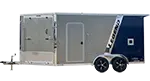
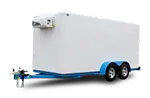

You’ve got a car to move. Maybe it’s a project truck you bought two counties over, you’re a small dealer moving inventory between lots, or you just picked up a classic car you do not want driven 400 miles on the highway. The question is not simply whether you need a trailer. The real question is which trailer has the payload, deck dimensions, loading angle, tie-down system, and towing requirements that fit the vehicle and the way you plan to use it.
Auto transport trailers and car carriers get lumped together all the time, but the differences matter when you are the one buying, towing, loading, and maintaining the equipment. Get the choice wrong and you may end up paying for far more trailer than you need, overloading the tow vehicle, scraping a low car during loading, or making two trips when a properly matched multi-car carrier could have handled the work in one.
Single Car Haulers: Built for One Job Done Well
A single-car hauler is usually either a fixed-deck open trailer with a dovetail and removable ramps or a tilt-deck trailer that lowers the rear of the deck for loading. A fixed-deck car hauler is the simpler and generally less expensive design. A tilt model costs more but can reduce the approach angle, eliminate the need to position separate ramps, and make it easier to load vehicles with limited ground clearance.
Not every single-car hauler is a tilt trailer, and not every tilt trailer is suitable for a low sports car. Deck height, dovetail length, ramp length, breakover angle, fender clearance, and the distance between the fenders all matter. A vehicle can fit within the trailer’s published length and payload while still having tires that are too wide, a wheelbase that places the doors beside fixed fenders, or a front overhang that contacts the deck before the tires reach the ramps.
Current open single-car haulers commonly fall between 16 and 22 feet long, although certain H&H models extend to 24 feet. Typical ratings are 7,000 or approximately 9,900 lb GVWR. H&H’s steel Car Hauler lineup includes 82-inch-wide models from 16 to 24 feet, with 7,000 lb and 9,900 lb configurations depending on length. Its standard steel car hauler uses a 2-foot treadplate dovetail and slide-in ramps rather than a tilting deck. H&H’s separate Aluminum Speed Loader tilt line uses a 12-volt hydraulic system and is offered from 18 to 24 feet with ratings from 7,000 to 14,000 lb.
Diamond C’s current dedicated single-car model is the GTF. It is an 83-inch-wide bumper-pull trailer offered in lengths from 14 to 22 feet and GVWR configurations from 7,000 to 9,890 lb. Standard axle equipment is a pair of 3,500 lb Lippert drop axles, with heavier Lippert axle equipment available on upgraded configurations. The GTF uses a 6-inch I-beam tongue and frame, a formed rub-rail tie-down system, four 360-degree D-rings, a dovetail, and rear loading ramps. Diamond C builds these trailers in Mt. Pleasant, Texas, and finishes them with its DM Difference Maker multi-stage powder-coating system.
Liberty also offers straightforward fixed-deck single-car haulers. Its current LC models are available in 18- and 20-foot lengths with an 83-inch bed width. The 7,000 lb version uses dual 3,500 lb electric-brake axles, while the heavier version is rated at 9,990 lb and uses dual 5,200 lb electric-brake axles. Standard features include a 2-foot dovetail, 5-foot slide-out ramps, removable fenders, a treated wood deck, and tie-down pockets along the sides.
GVWR is not the same as payload. Payload is the trailer’s GVWR minus the trailer’s actual empty weight and any permanently installed equipment. A 7,000 lb steel car hauler that weighs roughly 1,900 to 2,300 lb may leave only about 4,700 to 5,100 lb for the vehicle, straps, winch, spare tire, and other cargo. That is enough for many passenger cars, but it may not be enough for a full-size pickup, large SUV, electric vehicle, or heavily modified off-road rig. Check the vehicle’s real curb weight and leave a reasonable margin instead of planning to operate continuously at the trailer’s absolute limit.
The tow-vehicle requirement is equally important. A trailer carrying a 4,000 lb car may be well below its own GVWR while still exceeding the truck’s receiver rating, rear-axle rating, payload rating, gross combination weight rating, or allowable tongue weight. A properly configured half-ton pickup can tow many 7,000 lb car-hauler combinations, but that statement does not apply to every cab, engine, axle ratio, wheelbase, hitch, or option package. Use the ratings for the exact truck, not a manufacturer’s advertised maximum for the strongest configuration in the model line.
For a bumper-pull car hauler, tongue weight commonly uses a meaningful portion of the truck’s available payload. Passengers, tools, a bed-mounted fuel tank, and other cargo reduce the payload left for the trailer. The truck also needs a correctly rated receiver, hitch ball or coupler connection, safety chains, breakaway system, and functioning brake controller. Indiana requires a trailer or semitrailer weighing at least 3,000 lb on the highway to have brakes that the driver can apply from the cab, along with automatic brake application if the trailer breaks away.
Multi-Car Wedge Trailers: Two Cars, One Trip
Step up to a purpose-built two-car carrier and the dimensions, weight distribution, hitch load, and operating requirements change quickly. Many two-car trailers use one long open deck with an inclined or wedge-shaped profile so two vehicles can be positioned in tandem. Other designs use a raised front platform, an adjustable upper section, or a combination of fixed and hydraulic components. The loading sequence depends on the design, so it is important to understand which vehicle loads first, where each axle sits, and how the trailer maintains proper hitch weight with one or two vehicles aboard.
A common two-car configuration is a 32- to 40-foot gooseneck or long bumper-pull trailer in the 14,000 to 16,000 lb GVWR range. Current specialty-manufacturer examples include 14,000 lb gooseneck carriers with overall deck lengths from approximately 32 to 40 feet and 15,000 lb bumper-pull carriers around 36 feet long. Heavier two-car versions are also available at 21,000 lb GVWR or above. The correct capacity depends on the combined vehicle weights, the empty weight of the trailer, axle ratings, tire capacities, deck layout, and hitch load.
A 14,000 lb two-car gooseneck can weigh more than 5,000 lb empty, leaving less than 9,000 lb of rated payload before options and cargo are added. That may be enough for two compact or midsize cars, but it can be inadequate for two heavy SUVs, trucks, electric vehicles, or combinations that include a full-size pickup. A longer deck does not automatically mean more payload. Always calculate the combined actual weight of both vehicles and compare it with the trailer’s rated payload rather than simply counting parking spaces.
There is no reliable rule that every two-car trailer can be handled by any three-quarter-ton pickup. Some properly equipped three-quarter-ton trucks have enough towing capacity, but payload, rear-axle capacity, receiver or gooseneck rating, and hitch weight can become the limiting factors before the advertised tow rating does. A one-ton truck is frequently the more practical match, and a dual-rear-wheel model may be appropriate when the trailer is long, the hitch load is high, or the operation involves frequent commercial hauling. The final answer must come from the ratings of the exact truck and trailer combination.
At Spencer Trailers, the relevant Diamond C choices include the GTF single-car hauler, the LPX low-profile equipment trailer, the HDT hydraulically dampened tilt equipment trailer, and the FMAX Flatbed Max gooseneck platform. LPX and HDT configurations currently range from 15,500 to 24,000 lb GVWR, while FMAX models cover a much broader range that can extend to 40,000 lb depending on the specific model and axle package. These platforms can transport appropriately sized vehicles when the payload, deck width, loading system, tire position, and tie-down arrangement all fit the job. Purpose-built two- and three-car transporters remain a separate specialty category designed around carrying multiple vehicles in tandem or on multiple deck levels.
Liberty’s current car-hauler lineup is focused on single-vehicle 7,000 and 9,990 lb models. Its longer and heavier equipment or flatbed trailers may suit specialized vehicle loads, but the loading layout still has to be evaluated vehicle by vehicle. For multi-car work, wheel-stop placement, over-the-tire strap compatibility, winch access, loading order, vehicle overhang, and the ability to secure each vehicle independently are more important than a general claim that a long trailer can hold two cars.
Open vs. Enclosed: The Trade-Off Nobody Talks About Honestly
Open car haulers are what most private owners, repair shops, contractors, and small dealers use. They cost less to buy, generally weigh less, are easier to inspect before departure, and provide direct access to the vehicle’s tires and tie-down points. They are also easier to load in many tight spaces because there are no sidewalls or roof restricting door clearance. The disadvantages are exposure to rain, snow, road spray, salt, dust, insects, tree debris, and stones thrown by traffic.
For a project car going 60 miles across Indiana, an open trailer may be completely reasonable. For a freshly restored classic, a show vehicle with delicate paint, or a new performance car being delivered to a customer, the risk calculation changes. An open trailer can be equipped with a front rock guard or air deflector, but those additions do not provide the full environmental protection of an enclosed trailer.
An enclosed auto trailer protects the vehicle from direct road spray, weather, airborne debris, and unwanted attention while parked. It also provides lockable space for straps, tools, spare parts, tires, and detailing supplies. That protection is valuable, but an enclosed trailer is not a substitute for proper insurance. Cargo coverage, stated-value or agreed-value vehicle coverage, commercial auto insurance, and any required motor-carrier coverage must still match the operation.
Wells Cargo’s current auto-trailer lineup includes the Road Force Auto and Road Force V-Front Auto. These are 8.5-foot-wide enclosed trailers with rear ramp doors, tandem axles, electric brakes, and model-dependent ratings that include 7,000 and 10,400 lb GVWR configurations. Nominal lengths include single-car-friendly sizes around 16 and 20 feet, but the exact interior length, rear opening, platform height, width between wheel boxes, payload, and door package must be checked for the specific model.
United also builds enclosed car and race trailers, including Classic, Premier, and Super Hauler configurations. Current United offerings include 8.5-foot-wide bumper-pull, gooseneck, tandem-axle, and triple-axle trailers in a wide range of lengths. Depending on the series, available equipment can include a rear ramp with a beavertail, D-rings, steel unibody construction, torsion axles, a spare-tire compartment, interior wall and ceiling liners, cabinets, winches, escape-door provisions, and upgraded electrical systems.
The major trade-offs are empty weight, frontal area, tongue weight, cost, and loading clearance. An enclosed trailer creates more aerodynamic drag than an open car hauler and can noticeably increase fuel use, especially at interstate speeds or in a crosswind. It may also require a heavier tow vehicle even when its GVWR appears similar to an open trailer because the enclosure consumes more of the trailer’s rated capacity before the car is loaded.
Interior width is only the beginning. Measure the vehicle at the mirrors, tires, body, and open doors. Confirm the rear ramp opening, the width between wheel boxes, interior height, ramp-door rating, transition flap, beavertail, and escape-door location. A car can fit inside but still trap the driver because the door cannot open past the trailer’s wheel box. Low cars may also need a longer ramp extension or a reduced breakover angle where the ramp meets the floor.
For an occasional hobbyist moving an ordinary vehicle, a quality open hauler often provides the best value. For professional transport, race support, long-distance delivery, or high-value vehicles, the security and environmental protection of an enclosed unit may justify the added purchase price, operating cost, and tow-vehicle requirement.
Dealer Transport: The Volume Problem
Small dealers and auction buyers face a specific version of this decision. When you are moving four to six vehicles a week between lots or from auctions, a single-car hauler can create too many deadhead miles and repeated loading cycles. A properly matched two-car or three-car carrier can reduce the number of trips, but it also introduces higher equipment costs, more complicated loading, larger turning requirements, and additional commercial compliance responsibilities.
Do not assume that carrying two cars automatically cuts fuel and labor costs exactly in half. The larger trailer weighs more, creates more drag, takes longer to load and inspect, may require a heavier truck, and can increase tire, brake, insurance, maintenance, and licensing costs. The financial advantage comes from calculating the true cost per vehicle moved, including driver time, empty miles, auction waiting time, tolls, maintenance, depreciation, and the number of trips the trailer can realistically complete.
Three-car wedge carriers vary substantially, but a current specialist configuration may be approximately 50 feet long with a 21,000 lb GVWR and triple axles. Other three-car designs use different lengths, deck levels, axle packages, and ratings. At this size, a one-ton dual-rear-wheel pickup may be the starting point for some configurations, while heavier carriers may call for a medium-duty truck. Overall combination length, turning radius, bridge and roadway restrictions, parking space, axle loading, and state-specific vehicle-transporter rules must all be considered.
For commercial dealer transport, the CDL threshold must be calculated from the combination, not from the trailer alone. A Class A CDL is generally required when the vehicle combination has a gross combination weight rating or actual gross combination weight of 26,001 lb or more, whichever is greater, and the towed unit has a GVWR or actual gross vehicle weight greater than 10,000 lb. A trailer rated above 10,000 lb does not by itself trigger a Class A CDL when the combination remains below 26,001 lb.
A 21,000 lb GVWR trailer paired with a heavy-duty pickup will normally place the rated combination above 26,001 lb, so a commercial operator should expect Class A CDL requirements unless a specific lawful exemption applies. The CDL line is not the only compliance threshold. Commercial transport may also involve USDOT registration, medical qualification, vehicle inspections, hours-of-service rules, recordkeeping, operating authority, commercial insurance, and cargo coverage depending on whether the work is intrastate or interstate and whether vehicles are transported for compensation or in furtherance of a business.
For a dealer moving two ordinary cars at a time, a 14,000 to 16,000 lb two-car carrier may offer a practical balance, but it should not be chosen solely because it can physically fit two vehicles. Start with the heaviest realistic pair of vehicles, subtract the trailer’s empty weight from its GVWR, calculate expected hitch load, and confirm that the truck remains within its payload, rear-axle, tire, hitch, towing, and gross-combination ratings.
Specs That Actually Matter at the Lot
| Trailer Type | Typical GVWR | Deck Length | Tow-Vehicle Guidance |
|---|---|---|---|
| Single-car open hauler (fixed deck or tilt) | 7,000–9,990 lb; some tilt models reach 14,000 lb | 16–24 ft | Properly configured truck rated for the loaded trailer, tongue weight, hitch, and combined weight |
| Two-car wedge or long-deck carrier | Commonly 14,000–16,000 lb; heavier versions exceed 20,000 lb | Approximately 32–40 ft | Heavy-duty pickup matched to hitch load and GCWR; a one-ton is frequently the practical choice |
| Enclosed single-car hauler | Commonly 7,000–10,400 lb | Approximately 16–24 ft | Depends heavily on empty weight, frontal area, tongue weight, payload, and the exact tow-vehicle configuration |
| Three-car carrier | Commonly around 21,000 lb or higher | Often 40–50+ ft, depending on deck design | Properly rated one-ton dually or medium-duty truck, with commercial licensing and compliance reviewed |
Those ranges are useful for comparison, but they are not substitutes for the certification labels and weight tickets for the actual equipment. The most important numbers are the trailer’s GVWR, unloaded vehicle weight, calculated payload, axle ratings, tire and wheel ratings, coupler rating, deck width, width between fenders, usable deck length, ramp capacity, and the tow vehicle’s payload, receiver or gooseneck rating, rear gross axle weight rating, and GCWR.
What the Loading Experience Actually Looks Like
One thing a basic specification table does not capture is the frustration of loading a low-clearance vehicle on the wrong trailer. A fixed-deck trailer with short ramps can create three separate clearance problems: the front bumper can contact the ramps, the center of the vehicle can high-center at the transition between the ramp and deck, and the exhaust or rear bumper can drag as the rear tires climb.
A longer ramp helps the initial approach angle, while a dovetail reduces the transition at the back of the deck. A low-profile tilt trailer can improve both, but the exact tilt angle and transition still matter. For extremely low cars, owners sometimes need approved ramp extensions, race ramps, wood blocking, or a trailer specifically equipped with a longer transition. Any added ramp or blocking must be stable, load-rated, and positioned so it cannot slide during loading.
H&H’s current steel Car Hauler uses a fixed deck, 2-foot treadplate dovetail, and slide-in ramps. Its Aluminum Speed Loader is a different loading system that uses a 12-volt hydraulic pump with push-button control to tilt the deck. The Speed Loader is available in standard and low-profile configurations, with removable fenders that can improve access to the vehicle after loading. That is useful when the car’s doors align with the trailer fenders or when an operator needs more room to install wheel straps.
Diamond C’s GTF uses a fixed deck with available 60-inch rear slide-in ramps and a 24-inch diamond-plate dovetail. Its formed rub rail and 360-degree D-rings provide multiple securement options, but the operator still needs correctly rated straps and an attachment method appropriate for the vehicle. Over-the-tire straps are often preferred because they secure the vehicle at the tires without placing force on suspension or body components, provided the trailer has compatible anchor points and the straps do not contact sharp edges.
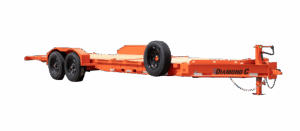
Heavier equipment tilt trailers, including Diamond C’s HDT, solve a different problem. The HDT is a hydraulically dampened, low-profile equipment trailer offered from 16 to 28 feet and 15,500 to 24,000 lb GVWR. It is useful for heavy equipment and vehicle applications that need more payload, but its higher rating and empty weight require a substantially more capable tow vehicle than a conventional 7,000 or 9,900 lb car hauler.
For enclosed trailers from United or Wells Cargo, the rear ramp door forms most or all of the rear opening. You need enough clear space behind the trailer to lower the door fully and align the vehicle before loading. The required space varies by model and ramp length, so crowded lots, narrow driveways, sloped pavement, curbs, and overhead clearance can all affect whether an enclosed trailer is practical at a particular location.
Loading should take place on firm, level ground whenever possible. Chock the trailer and tow vehicle, keep bystanders clear, use a spotter when visibility is limited, and confirm that rear stabilizers are deployed if the trailer manufacturer requires them. A winch is valuable for non-running vehicles, but its rated pulling capacity, battery, cable or synthetic line, attachment point, and fairlead must be matched to the load. Never use a light-duty utility winch or an improvised body attachment to pull a disabled vehicle onto the trailer.
After loading, verify tongue or pin weight and axle placement. A car positioned too far rearward can create insufficient tongue weight and severe sway. A car placed too far forward can overload the truck’s receiver, rear axle, tires, or payload capacity. With a multi-car carrier, the loading order and final position of both vehicles are essential because moving one vehicle several feet can significantly change hitch load.
A Quick Reality Check on Price vs. Use
Current pricing is much more varied than a single open-versus-enclosed estimate suggests. Trailer length, GVWR, steel versus aluminum construction, fixed deck versus hydraulic tilt, axle and tire upgrades, removable or drive-over fenders, winch packages, spare tires, tie-down systems, and dealer freight all affect the final number.
As a current 2026 inventory snapshot, Spencer Trailers has listed Liberty 7,000 lb single-car haulers at approximately $4,750 to $4,900, with a 9,990 lb version around $5,650. Diamond C GTF 9,890 lb single-car haulers have been listed around $8,300 to $8,900 depending on length and equipment. These examples show why it is misleading to assign one universal price to every open car hauler. Prices, discounts, freight, availability, and model-year programs can change, so the current inventory listing or written quote should control.
Current H&H hydraulic tilt inventory provides another useful comparison. Spencer’s 2026 listings have included 7,000 lb electric-over-hydraulic tilt models around $7,700 to $8,400, 9,900 lb versions around $8,700 to $8,900, and 14,000 lb models around $11,250 to $11,450. The higher price buys a different loading system and, in the heavier configurations, more payload capacity. It does not automatically make the trailer the best choice for every vehicle.
If you are moving your own cars a few times a year, a fixed-deck 7,000 or 9,900 lb open hauler may cover the work at the lowest ownership cost. A hydraulic tilt can be worth the premium when you regularly load low cars, non-running vehicles, or equipment that makes separate ramps inconvenient. Long service life depends on maintenance rather than a guaranteed number of years. Wheel bearings, brakes, breakaway battery, tires, deck boards, ramps, coupler, wiring, safety chains, welds, and coating all need periodic inspection and service.
If you are hauling for income or moving dealer inventory regularly, a two-car carrier can reduce trip count and improve capacity utilization. Current purpose-built two-car trailers generally cost more than a basic single-car hauler, and pricing can range from around $10,000 for certain basic 14,000 to 15,000 lb configurations into substantially higher figures as GVWR, length, hydraulic equipment, winches, drive-over fenders, tires, and tie-down systems are added. The right comparison is not simply trailer price. It is total operating cost per vehicle delivered.
Enclosed trailers from Wells Cargo or United make sense when weather protection, security, presentation, and cargo value justify the premium. A properly equipped enclosed trailer can be an important protection tool for a collector car, race car, or customer delivery, but it should be budgeted together with the heavier tow requirement, added fuel use, commercial insurance if applicable, storage space, and maintenance of the ramp door, roof, seals, walls, and electrical system.
Before You Buy
The decision tree starts with three questions: What vehicle or combination of vehicles are you moving, how often will you move them, and what tow vehicle do you already own? From there, write down the real vehicle weight, wheelbase, tire width, overall width, ground clearance, front and rear overhang, and whether the vehicle runs under its own power. Those measurements narrow the choices far more accurately than shopping by trailer length alone.
Next, verify the trailer’s certified GVWR, empty weight, payload, axle ratings, tire ratings, bed width, width between fenders, ramp or tilt capacity, and securement points. For an enclosed trailer, add the rear-door opening, interior height, width between wheel boxes, ramp angle, door clearance, and escape-door location. For a multi-car carrier, calculate the heaviest realistic pair or group of vehicles rather than the lightest combination you expect to haul.
Finally, match the trailer to the exact truck. Confirm towing capacity, payload, GCWR, rear-axle rating, tire ratings, receiver or gooseneck rating, brake-controller compatibility, and expected tongue or pin weight. Do not buy more trailer than the truck can control, and do not buy less payload or deck space than the workload requires. If the combination will be used commercially, determine the licensing, USDOT, insurance, inspection, and operating requirements before putting it into service.
We’re at 291 West State Hwy 46 in Spencer, Indiana. We carry H&H, Diamond C, Liberty, United, Wells Cargo, and other trailer options, and we can walk through which configuration fits your vehicle, tow ratings, loading needs, and expected use before you commit. Browse current inventory here or reach us at (812) 829-0226 to discuss the options before you make the trip.
The right auto transport trailer is not automatically the fanciest one, the longest one, or the cheapest one. It is the trailer that provides enough real payload, fits the vehicle’s dimensions, loads without damage, gives you reliable tie-down points, stays within every truck and hitch rating, and holds up through the number of trips you actually plan to make. Start with those requirements, and the correct category becomes much easier to identify.


