







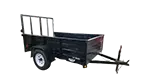

You pull up to a job site with four tons of gravel, a tight deadline, and no time to shovel. That single moment is why the dump trailer exists. But choose the wrong trailer and you may give up useful payload, overload the tow vehicle, damage the dump body, or discover that the hydraulic system is poorly matched to the material you move. The right dump trailer starts with three essentials: a properly rated hoist, a body and frame built for the way you load it, and a GVWR that leaves enough real payload after the trailer’s empty weight and installed options are deducted. The tow vehicle, hitch, brakes, tires, battery system, side height, and rear gate matter just as much once the trailer goes to work.
Scissor Hoist vs. Telescopic Hoist: Pick the Right One
Scissor and telescopic hoists are two of the most common dump-trailer lift designs, but they are not the only hydraulic arrangements on the market. Some trailers use a direct-push single cylinder, dual cylinders, or other engineered linkages. More important, one hoist style is not automatically stronger than another. Actual performance depends on the cylinder size and pressure, mounting geometry, frame reinforcement, dump-body length, rated load, dump angle, pump output, and how the load is distributed. Compare the manufacturer’s complete trailer rating rather than choosing by hoist name alone.
Scissor Hoist
A scissor hoist mounts beneath the dump body and uses a hydraulic cylinder to drive a pivoting steel linkage. That linkage changes the cylinder’s motion into lift and can provide useful leverage through the dumping cycle when it is correctly engineered. The compact underbody layout can protect much of the mechanism and keep the front of the dump body clear. A properly rated scissor system can handle dirt, gravel, demolition debris, and other dense materials, but the word “scissor” by itself does not establish tonnage capacity.
The tradeoffs are additional pins, bushings, pivot points, and grease locations, along with concentrated loads where the hoist transfers force into the frame and body. Dump angle also varies by design; a scissor hoist is not always shallower, and a telescopic hoist is not always steeper. Inspect the rated capacity, frame structure, maintenance points, and published dump angle. Regardless of hoist style, dump only on firm, reasonably level ground, keep the trailer aligned with the tow vehicle, open or set the rear gate correctly, check overhead clearance, and never stand beside or beneath a raised body unless the manufacturer’s body-prop or safety-lock procedure is fully engaged.
Telescopic Hoist
A telescopic hoist uses a multi-stage hydraulic cylinder, commonly mounted near the front of the dump body, that extends in sections as the bed rises. Because the largest-diameter stage normally extends first, the cylinder develops its greatest available force near the beginning of the lift, when the loaded body demands the most leverage. The direct front-mount layout also reduces the number of linkage pivots and can transfer lifting force into the front structure efficiently. Current Diamond C telescopic dump models, including the LPT, are designed around a 45-degree dump angle rather than an unsupported “50 degrees or more” claim.
Telescopic systems are not merely a low-cost alternative; they appear on premium heavy-duty trailers as well as smaller models. Cost and empty weight depend on the complete cylinder, pump, reservoir, battery, frame, and body package. They work especially well when the trailer is loaded evenly and operated within its ratings, but no hoist can safely compensate for an overloaded nose, material frozen to one side, a closed tailgate, weak battery voltage, or a trailer parked across a slope. Keep the load centered, stop if the body twists or rises unevenly, and lower it immediately if the trailer becomes unstable.
GVWR: The Number That Actually Matters
GVWR, or Gross Vehicle Weight Rating, is the manufacturer’s maximum rated total weight for the trailer and everything carried on or in it. Usable payload is not the axle rating and it is not the advertised GVWR by itself. Start with the trailer’s GVWR and subtract its actual empty weight as equipped, including the tarp, spare tire, ramps, battery, hydraulic fluid, side extensions, toolboxes, and other installed options. For example, a 14,000-lb GVWR trailer that weighs 4,200 lb ready to tow has a theoretical payload of about 9,800 lb. The VIN certification label, tire ratings, coupler or gooseneck rating, safety chains, jack, axle and suspension ratings, and tow-vehicle limits still apply. Never assume that adding the axle ratings gives you permission to load beyond the trailer manufacturer’s stated GVWR.
A quick rule of thumb for material density is useful, but supplier weights and scale tickets are more reliable because moisture, compaction, aggregate size, and soil composition can change the result dramatically:
- Dry loose soil: roughly 1,800 to 2,400 lb per cubic yard
- Crushed stone or gravel: roughly 2,400 to 3,000 lb per cubic yard
- Wet sand: roughly 2,800 to 3,400 lb per cubic yard
- Mulch: roughly 400 to 1,000 lb per cubic yard depending on material and moisture
A nominal 7-by-14-foot body with 24-inch sides has about 7.3 cubic yards of geometric volume before allowing for sloped loads, rounded corners, the front bulkhead, and freeboard. An 82-inch-wide by 14-foot Diamond C body at the same side height is about 7.1 cubic yards. Raising the sides increases volume, not legal payload. Seven cubic yards of gravel can easily weigh roughly 17,000 to 21,000 lb, so a dense load may put the trailer over its rating while the body still looks far from full. That is why a 9,890- or 9,990-lb class trailer can be excellent for lighter material and smaller jobs but is not interchangeable with a 15,500-, 18,000-, 23,000-, or 24,000-lb heavy-duty configuration. For repeat work, weigh the truck and loaded trailer by axle and keep the scale ticket as your real-world loading reference.
Steel Gauge: The Part Nobody Talks About Until It Fails
Gauge describes nominal sheet-steel thickness, and a lower gauge number generally means thicker steel. Dump bodies commonly use different thicknesses by model and duty class, so do not assume that the floor and sides are always the same gauge. Diamond C’s current small-to-medium dump bodies use 12-gauge construction in standard configurations, while the heavy-duty LPT uses a 10-gauge body as standard and offers a 7-gauge body upgrade. Delco’s current D3 specifications list a 10-gauge engineered bed. The right choice depends not only on payload but also on bucket drop height, rock size, abrasion, point loading, skid-steer use, crossmember spacing, and how often the trailer is loaded.
Here is the practical thickness comparison using common U.S. sheet-steel gauge values; actual mill tolerances and product specifications should still be confirmed with the manufacturer:
| Gauge | Thickness (in.) | Common Use |
|---|---|---|
| 7-gauge | 0.1793″ | Premium heavy-duty dump-body upgrades and severe impact or abrasion service |
| 10-gauge | 0.1345″ | Heavy-duty contractor dump bodies and equipment-loading applications |
| 12-gauge | 0.1046″ | Light-to-medium dump bodies, landscaping, property, and general hauling |
| 14-gauge | 0.0747″ | Lighter sheet components where severe floor impact is not expected |
If you regularly load broken concrete, large stone, scrap, or material from a high bucket, floor and side thickness deserve close attention. Still, gauge is only one part of durability. Crossmember design, frame section, body reinforcements, weld quality, hoist mounting, corrosion protection, rear-gate structure, loading technique, and maintenance all affect service life. A thick floor can still bend if it is poorly supported or repeatedly struck by concentrated loads, while a correctly supported body can perform well for years when it is loaded within its design.
Diamond C Dumps: The Contractor’s Standard
Diamond C is a family-owned U.S. trailer manufacturer founded in 1985 and based in Mount Pleasant, Texas. Its current dump lineup ranges from the 6,000-lb GVWR GST single-axle telescopic dump through medium-duty models and into the heavy-duty LPT, DOD, and larger commercial configurations. Diamond C’s premium lines use Lippert axles as standard equipment, with the axle count, capacity, suspension, brakes, wheels, and tires changing by GVWR package. The company also uses its DM Difference Maker multi-stage powder-coating system, which includes steel-shot blasting, a multi-stage wash and preparation process, primer, topcoat, and controlled curing rather than a basic spray-paint finish.
Diamond C LPT (Heavy Duty Low Profile Telescopic Dump)
The LPT is Diamond C’s heavy-duty low-profile telescopic dump. Current factory specifications list bumper-pull GVWR packages from 15,500 to 24,000 lb, 12-, 14-, and 16-foot lengths, an approximately 81- to 82-inch bed width, a three-stage telescopic cylinder, and a 45-degree dump angle. The standard axle package uses two 7,000-lb Lippert axles, with available packages using three 7,000-lb, two 8,000-lb, or two 10,000-lb Lippert axles as the trailer’s GVWR, frame, suspension, tires, coupler, and brake equipment are upgraded together. Gooseneck LPT configurations are also available for buyers whose tow vehicle and work favor an in-bed connection. The LPT’s standard heavy-duty dump body is 10-gauge, with a 7-gauge body upgrade available for severe-duty use. Standard heavy-duty sides are 24 inches, with taller side configurations and board-bracket options available by build. Current published LPT empty weights span roughly 4,440 to 6,930 lb across lengths, hitch styles, GVWR packages, and options, so there is no single accurate “7×14 LPT tare weight.” Payload must be calculated from the specific trailer’s GVWR and as-equipped weight. Current features can include a three-way rear gate with hold-back system, long-arm tarp system, high-flow KTI hydraulic pump, heavy-duty tongue storage, rear stabilizer options, ramp packages, solar maintenance charging, and hydraulic-jack options. Availability and standard-versus-optional status should be verified on the exact stock unit or build sheet.
Diamond C Heavy-Duty Dump Options
Buyers who need more width or a different loading layout should also look beyond the low-profile LPT. The current Diamond C DOD deck-over dump is offered in 14- and 16-foot lengths with a 96-inch-wide body, 15,500- to 23,000-lb GVWR packages, a telescopic hoist, a 45-degree dump angle, and Lippert axle packages that scale from dual 7,000-lb axles to heavier 8,000- and 10,000-lb configurations. Its deck-over design and assisted fold-down sides solve a different problem than the low-profile LPT. For repeated skid-steer loading, demolition, large rock, or excavator-bucket work, choose the body gauge, ramp and rear-stabilizer package, D-rings, GVWR, and hitch style as a complete system. A higher rating does not make careless impact loading harmless, but the correct heavy-duty body and frame provide a much better starting point than trying to upgrade an underspecified trailer after damage occurs.
We carry Diamond C inventory at Spencer Trailers and can order configurations to spec. Browse current dump trailer inventory here.
Delco Dump Trailers: The Value-Focused Option
Delco builds trailers in Brookston, Texas, and its current dump lineup covers several distinct duty levels rather than one generic tandem dump. The D1 is a 7,000-lb GVWR single-axle model; the D2 is a narrower 12,000-lb bumper-pull; the D3 is an 83-inch-wide 14,000-lb bumper-pull in 12-, 14-, and 16-foot lengths; and the D5 adds a telescopic lift in 14,000- and 16,000-lb configurations. Heavier gooseneck, triple-axle, tandem-dual, and roll-off models are also available. Current Delco specifications show electric brakes, powder coating, a three-way spreader gate, pull-back tarp, and slide-in rear ramps as standard on its dump range, while exact frame, axle, side, cylinder, tire, spare, and jack specifications vary by series.
For a common value comparison, the current D314 is an 83-inch-wide by 14-foot bumper-pull with a 14,000-lb GVWR, an 8-inch by 13-lb I-beam frame and tongue, dual 7,000-lb electric-brake spring axles, 24-inch solid sides, a 10-gauge engineered bed, a 5-inch hydraulic cylinder, a three-way spreader gate, pull-back tarp, four D-rings, and 6-foot slide-in ramps. That is a legitimate working specification for property owners, landscapers, and contractors who can stay within its payload and loading limits. It should not be treated as a direct feature-for-feature equivalent to an LPT simply because both may be about 14 feet long: the current Diamond C LPT starts at a higher GVWR and uses a different telescopic, frame, body, axle, finish, and option package. Compare current quotes, as-equipped empty weight, included equipment, warranty, local parts support, and intended duty cycle instead of relying on a blanket claim that one brand is always a fixed amount cheaper.
A Few Questions Worth Asking Before You Buy
What’s your tow vehicle’s payload and hitch rating? Do not match a trailer to the truck using the advertised maximum tow rating alone. Confirm the truck’s GVWR, GCWR, rear GAWR, available payload, receiver or gooseneck rating, ball and coupler rating, tire capacity, brake-controller compatibility, and the expected loaded tongue or pin weight. A bumper-pull dump uses a properly rated receiver, mount, and ball; heavier contractor dumps commonly use a 2-5/16-inch coupler, but the exact size and rating must be verified. A gooseneck uses a rated in-bed gooseneck ball and structure, not a fifth-wheel hitch unless a specifically approved adapter system is involved. For commercial-license planning, a trailer over 10,000 lb GVWR does not by itself create the standard Class A CDL threshold. The usual Class A trigger is a combination GCWR or GCW of at least 26,001 lb with a towed unit over 10,000 lb GVWR or GVW, subject to the vehicle’s use and applicable state and federal exceptions.
Do you need a tarp kit? In Indiana, the legal requirement is that a vehicle’s contents may not drip, sift, leak, or otherwise escape onto the highway. A correctly sized and secured mesh or solid tarp is the practical way to contain gravel, dirt, mulch, demolition debris, and similar material, and commercial operations may also be subject to federal cargo-securement rules. Do not assume that low side height or a partially filled bed makes an uncovered loose load acceptable. Check the exact trailer because the current Diamond C LPT and Delco dump configurations may include different manual, long-arm, or powered tarp arrangements.
Single axle or tandem? A single-axle dump such as the 6,000-lb GVWR Diamond C GST is lighter, compact, and maneuverable for smaller jobs. Tandem axles generally improve load distribution and stability and are used on higher-capacity dumps, but axle count alone does not determine payload or legal rating. In Indiana, a trailer or semitrailer at 3,000 lb gross weight or more must have brakes adequate to control, stop, and hold it, controllable from the tow vehicle, with automatic application in a breakaway; new trailers sold in Indiana for highway use must generally have service brakes on all wheels once they are in this weight class. After purchase, Indiana residents should also complete title and registration within the state’s 45-day window to avoid administrative penalties.
Battery vs. Hydraulic Power Pack
On a typical dump trailer, the battery and hydraulic power pack are not competing choices. The dedicated 12V battery supplies an electric motor that turns the hydraulic pump, while the power-pack assembly includes the motor, pump, reservoir, valves, wiring, controls, and hydraulic plumbing. Battery capacity, cable size, terminal condition, grounds, pump flow, relief setting, fluid level, and cylinder condition all affect lift performance. A weak battery may run the lights normally yet drop too far in voltage when the pump draws several hundred amps. The tow vehicle’s 7-way auxiliary circuit and a small solar panel are usually maintenance-charging aids, not substitutes for fully recharging a deeply discharged battery after repeated dump cycles.
Frequent-cycle users may benefit from a larger approved battery, dual-battery option, higher-output charging connection, solar maintenance system, or factory high-flow pump package, depending on the trailer. PTO or engine-driven hydraulics can make sense for specialized trucks with a wet kit, but 12V electric-over-hydraulic remains the normal standalone dump-trailer system. Keep the battery charged, terminals protected, wiring tight, hydraulic fluid at the specified level, and the remote stored dry. Never troubleshoot leaks or work under a raised body without lowering it or engaging the manufacturer-approved body prop or safety lock; hydraulic pressure alone is not a safe support.
Side Options: Standard Sides, High Sides, and Combo Sides
Side height should follow material density, not the idea that more volume is always better. A current Diamond C LPT commonly starts with 24-inch heavy-duty sides, while the smaller GST, GDT, and MDT use lower standard sides in many configurations and can be ordered with taller options. The DOD uses a wide deck-over body with assisted fold-down sides, and the current Delco D3 uses 24-inch solid sides. Taller steel sides or properly installed board extensions are useful for mulch, brush, leaves, and bulky debris, but they make it easier to overload the trailer with soil, gravel, sand, roofing, or demolition material. Board brackets and side extensions increase containment volume; they are not automatically rated as structural cargo-securement points.
Also compare the rear gate before buying. A barn-door arrangement is convenient for bulky debris and equipment access, while a three-way spreader gate can open conventionally or meter aggregate through a lower opening when set and secured correctly. Current Diamond C LPT and Delco D3 configurations use three-way gate designs, though latch, hold-back, and spread-control details differ. If you plan to load equipment, verify that the ramps, rear stabilizer legs, gate opening, floor, D-rings, and trailer payload are all rated for the machine and attachment. A ramp package does not increase GVWR, and loading a skid steer without the correct stabilizer procedure can unload the tongue or lift the rear of the tow vehicle.
What We’d Recommend for Most Owen County Buyers
For a property owner, landscaper, or contractor who wants a value-focused 14-foot bumper-pull and whose truck, hitch, payload needs, and material weights fit a 14,000-lb GVWR, the Delco D314 is a sensible model to compare. Its current 10-gauge bed, I-beam frame, dual 7,000-lb electric-brake axles, 24-inch sides, tarp, three-way gate, and ramps form a useful standard package. For daily heavy material work, higher payload requirements, repeated machine loading, larger rock, or buyers who want a premium telescopic design with higher-GVWR choices, start with the Diamond C LPT and select the exact 15,500- to 24,000-lb package, body gauge, hitch style, ramps, stabilizers, tarp, tires, and charging equipment around the job. The best recommendation may change after one scale ticket, because dense material reaches the weight limit long before a high-sided body reaches its volume limit.
If you’re unsure where you fall, come by the lot at 291 West State Hwy 46 in Spencer or call us at (812) 829-0226. We’ll talk through what you’re actually hauling, how it is loaded, how often you dump, what truck and hitch you are using, and which body, gate, hoist, axle package, and GVWR make sense. You can also reach us online here. The goal is a trailer that is properly matched on paper, works safely under load, and still has the payload and durability you need after every option is installed.
And if you want to see what’s moved recently to get a sense of what other buyers in the area are choosing, check the recently-sold page. Recently sold units can show which lengths, GVWR packages, hitch styles, tarp systems, and options are popular locally, but always compare the full build sheet because two trailers with the same model family and bed length can have very different ratings, empty weights, axles, tires, and payload capacities.


