





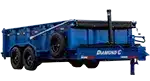

You’ve got a 30,000-pound excavator to move. Or multiple skid steers and attachments. Or a low-clearance machine that your current trailer cannot carry without exceeding its payload, axle, tire, coupler, or tow-vehicle limits. At that point, “standard” trailers stop being an option, and the conversation shifts to what is actually engineered, rated, and legally suitable for the job.
A machine weighing 30,000 pounds deserves particular caution. A trailer with a 40,000 lb GVWR does not automatically provide 40,000 pounds of payload because the trailer’s own empty weight must be deducted. Depending on deck length, loading system, flooring, suspension, and other equipment, even a 40K gooseneck may or may not have enough payload for that machine. Some loads in this range belong on a commercial lowboy or tractor-trailer combination rather than behind a pickup.
Heavy-duty trailers over $20,000 are a different category, but price alone does not determine capability. Steel grade, beam geometry, axle and suspension packages, tires, brakes, coupler rating, deck length, loading angle, and actual empty weight all matter. Those engineering decisions determine whether the complete truck-and-trailer combination can move the equipment safely and legally.
Here’s a straightforward breakdown of the best heavy-duty trailers in the $20,000-and-up range, what specifications actually matter, and which current models stand out.
Why $20,000 Is the Real Starting Line
The $20,000 mark is a practical shopping threshold, not a technical or legal dividing line. Some 15,500 to 24,000 lb GVWR equipment trailers sell below $20,000, while a lower-GVWR trailer equipped with a long deck, hydraulic dovetail, powered jacks, premium flooring, upgraded brakes, or other options can exceed it. Two trailers with similar prices can have very different payloads and intended uses.
Below that price point, buyers often find tandem-axle equipment trailers in the 14,000 to 20,000 lb GVWR range. Those can be excellent choices for compact track loaders, mini excavators, tractors, and utility work, provided the machine, attachments, fuel, chains, and other cargo remain within the trailer’s actual payload rating. Once equipment approaches 20,000 pounds, however, the available payload of the trailer becomes more important than the number printed in the model description.
In the current Diamond C lineup, the FMAX gooseneck family spans from 15,500 lb to 40,000 lb GVWR. Heavy configurations include the 25,000 lb FMAX210, 25,900 lb FMAX212, 30,000 lb FMAX310, and FMAX312 and FMAX216 packages reaching as high as 40,000 lb GVWR. These models use Lippert axles and purpose-engineered frame, suspension, tire, brake, and coupler packages matched to their respective ratings.
At this level, you’ll find tandem-dual and triple-dual configurations, MAX Ramps, XDR Ramps, 12-foot hydraulic dovetails, electric-over-hydraulic disc brakes, hydraulic jacks, and air-ride suspension on eligible models and lengths. Diamond C FMAX frames use 14-inch to 18-inch Engineered Beam construction depending on the model and package. The important distinction is not simply that the steel is larger; it is that the frame, neck, axle system, and loading equipment are engineered as a complete trailer.
Diamond C FMAX, The Heavy-Hitter for Most Buyers
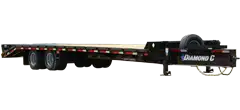
The Diamond C FMAX is a family of deck-over gooseneck flatbed trailers rather than one trailer with a single capacity. Current models include the FMAX207, FMAX208, FMAX210, FMAX212, FMAX216, FMAX307, FMAX310, and FMAX312, along with select Super Single and hotshot configurations. GVWR ranges from 15,500 lb on the FMAX207 to as much as 40,000 lb on properly configured FMAX312 and FMAX216 models.
Loading systems vary by model, length, and GVWR package. Available choices include 44-inch-wide MAX Ramps, 24-inch by 60-inch XDR Ramps, a straight deck with 96-inch rear slide-in ramps, and a fully automatic 12-foot hydraulic dovetail with an approximately 12.5-degree approach angle. XDR Ramps are particularly useful for concentrated machines such as excavators and backhoes when clearance is needed between the ramps. The hydraulic dovetail is the better choice when a long, gradual approach angle and full-width loading surface are priorities.
What separates the FMAX from conventional goosenecks is its Fleetneck Engineered Beam construction. Depending on the model, the main frame is approximately 14 to 18 inches tall, with a curved engineered gooseneck and frame geometry designed to improve the strength-to-weight ratio. The current Fleetneck 2.0 design uses high-strength materials, including Grade 100 main-frame beam webs on applicable models, rather than relying only on heavier conventional stock beams.
The deck is 102 inches wide and sits above the tires, making the FMAX useful for equipment, pallets, building materials, hay, and other wide loads. Diamond C describes the deck as low-profile within the deck-over category, but it remains a deck-over gooseneck. Buyers hauling machines with extremely limited ground clearance should pay close attention to the selected dovetail or ramp angle rather than assuming every FMAX configuration will load the same way.
The FMAX family crosses the $20,000 line at several points. Current manufacturer-listed base MSRPs include approximately $23,204 for the FMAX210, $27,201 for the FMAX212, $28,857 for the FMAX310, $35,130 for the FMAX312, and $33,088 for the FMAX216. These are base manufacturer suggested prices, not guaranteed dealer sale prices. Deck length, hydraulic dovetail equipment, a 40K GVWR package, air ride, hydraulic jacks, upgraded brakes, flooring, tires, wheels, freight, taxes, title, and registration can materially change the final price.
FMAX Key Specs at a Glance
| Feature | Detail |
|---|---|
| Model range | FMAX207, FMAX208, FMAX210, FMAX212, FMAX216, FMAX307, FMAX310, and FMAX312, plus select Super Single and hotshot configurations |
| GVWR range | 15,500 lb to 40,000 lb, depending on model and factory package |
| Main frame | Approximately 14″ to 18″ Engineered Beam construction, depending on model, length, and GVWR package |
| Axles | Lippert axles; available ratings range from 7,000 lb to 16,000 lb per axle depending on model |
| Loading systems | MAX Ramps, XDR Ramps, 12′ hydraulic dovetail, or straight deck with 96″ slide-in ramps, subject to model and length availability |
| Deck | 102″ wide deck-over platform with lengths from approximately 20′ to 44′, depending on model |
| Flooring | 2″ treated lumber standard on current gooseneck models, with select oak, Blackwood, aluminum, and steel options |
| Brakes | Electric drum brake packages, including ABS on current configurations, with electric-over-hydraulic options on eligible models; FMAX216 uses hydraulic disc brakes with its 16K axle package |
| Coating | DM Difference Maker multi-stage coating system |
HDT Tilt Trailers, When Ramps Aren’t Enough
Some equipment is difficult to load over conventional ramps. Machines with low ground clearance, long wheelbases, steel tracks, heavy rear attachments, or unusual weight distribution can high-center or shift abruptly while crossing a short dovetail. That’s where a properly selected tilt trailer earns its place.
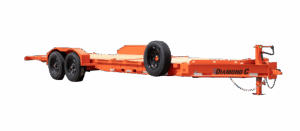
The Diamond C HDT (Hydraulically Dampened Tilt) is a low-profile bumper-pull equipment trailer with a hydraulically dampened gravity-tilt deck. The standard system does not use a powered hydraulic cylinder to force the deck through every movement. Instead, the deck tilts under gravity while a hydraulic cylinder and adjustable valve control its movement. The operator unlatches the deck, lowers the tail, loads the machine, and allows the deck to return in a controlled manner.
For customers who need powered operation, Diamond C also offers electric-hydraulic powered tilt and Pro Tilt on eligible configurations. Pro Tilt allows the operator to switch between gravity tilt and power tilt, which can be useful when loading multiple pieces of equipment, dealing with uneven weight distribution, or operating on terrain where a gravity-only deck is less convenient.
The current HDT range covers approximately 15,500 to 24,000 lb GVWR, with lengths from 16 to 28 feet and bed widths of approximately 80 to 82 inches. Standard configurations use two 7,000 lb Lippert axles. Depending on the selected package, upgrades can include three 7K axles, two 8K torsion axles, or two 10K torsion axles. Published trailer weights range from approximately 2,300 to 5,830 pounds, so actual payload changes substantially with length and equipment.
The HDT does not use the same frame specification at every GVWR. The standard trailer begins with an 8-inch I-beam frame, while higher-GVWR packages can include heavier I-beam construction or Diamond C Engineered Beam Technology on eligible 20-foot-and-longer configurations. Buyers should verify the exact frame, axle, brake, tire, coupler, and deck package on the individual trailer rather than treating every HDT as identical.
Pricing also varies more than a single range suggests. The manufacturer currently lists a base MSRP of approximately $12,734 for the bumper-pull HDT and approximately $15,813 for the HDT-GN gooseneck version. Higher-GVWR packages, powered tilt, Pro Tilt, electric-over-hydraulic disc brakes, premium flooring, upgraded tires, heavy fenders, additional storage, and other equipment can move the final price toward or beyond $20,000.
The HDT is an excellent fit for many compact and midsize machines, but its suitability must be determined from the specific trailer’s payload. Subtract the trailer’s as-built empty weight from its certified GVWR, then account for every bucket, attachment, fuel load, tool, chain, and accessory carried on the deck. The tow vehicle’s receiver, hitch, axle, tire, payload, towing, and gross-combination ratings must also support the loaded combination.
Gooseneck Equipment Trailers, The 30,000 to 40,000 lb Range
For serious heavy hauling, a properly matched gooseneck can offer better stability and weight distribution than a comparable bumper-pull trailer. The hitch places vertical tongue or pin load in the truck bed near the rear axle instead of at a receiver behind the bumper. That does not automatically make every gooseneck suitable for more weight, but it supports the heavier truck, hitch, frame, and trailer combinations used in this category.
Within the Diamond C FMAX lineup, the FMAX310 uses three 10,000 lb Lippert axles and carries a 30,000 lb GVWR. The FMAX312 uses three 12,000 lb Lippert axles and is offered at 30,000 lb GVWR with an available 40,000 lb package. The FMAX216 uses two 16,000 lb Lippert axles with hydraulic disc brakes and can be configured at 25,900, 30,000, or 40,000 lb GVWR.
These examples also show why axle-rating arithmetic is not enough to determine trailer GVWR. Part of a gooseneck trailer’s loaded weight is carried through the hitch by the tow vehicle. A trailer’s legal rating is established by the manufacturer as a complete system and shown on its certification label. Buyers should never create their own GVWR by simply multiplying the axle rating by the number of axles.
The 40K packages on current FMAX312 and FMAX216 configurations include additional frame and neck provisions and a 3-inch-ball, 40,000 lb adjustable coupler. A 2-5/16-inch coupler should not be assumed to support a 40K trailer. The truck-mounted ball, hitch structure, safety chains, tires, axles, suspension, brakes, and towing ratings must all be appropriate for the trailer’s certified capacity.
Heavy FMAX models are offered with MAX Ramps, XDR Ramps, a straight deck, or a 12-foot hydraulic dovetail, depending on model and length. Air-ride suspension with a front lift axle is available on select longer configurations, but it is not offered with every deck length or loading system. Availability must be confirmed when the trailer is ordered.
Manufacturer-listed base MSRP currently starts around $28,857 for the 30,000 lb FMAX310, approximately $35,130 for the FMAX312, and approximately $33,088 for the FMAX216. A 40K package, hydraulic dovetail, air ride, hydraulic jacks, premium flooring, upgraded wheels, winch equipment, and storage can push a completed build well beyond the base price. Request an itemized quote for the exact configuration rather than comparing a base MSRP with a fully equipped dealer unit.
What to Look For in a Gooseneck at This Price Point
- Certified GVWR and axle package: Confirm the manufacturer’s certification label, individual GAWR figures, suspension, wheel, tire, and brake specifications. Current Diamond C examples include two 10K axles on the 25,000 lb FMAX210, two 12K axles on the 25,900 lb FMAX212, three 10K axles on the 30,000 lb FMAX310, three 12K axles on the FMAX312, and two 16K axles on the FMAX216.
- Coupler type and rating: Match the trailer coupler to the truck’s hitch and ball. Heavy conventional FMAX packages use appropriately rated gooseneck couplers, while 40K packages require the corresponding 3-inch, 40K-rated setup. Do not assume that a gooseneck coupler can be flipped or converted for fifth-wheel use unless the manufacturer specifically supplies and rates that equipment.
- Deck width: A 102-inch deck is standard across the FMAX lineup and corresponds to the maximum commercial-vehicle width generally permitted on the National Network without an overwidth permit. Equipment or cargo extending beyond the legal width can require permits, route restrictions, flags, lighting, escorts, or other compliance measures.
- Ramp or dovetail: MAX Ramps provide a wide loading surface, while XDR Ramps leave useful clearance between the ramps for concentrated equipment. A 12-foot hydraulic dovetail provides a full-width loading surface and a lower approach angle. A straight deck with slide-in ramps can reduce hydraulic complexity when the equipment has sufficient clearance.
- Actual payload: GVWR is not payload. Obtain the trailer’s as-built empty weight and subtract it from the certified GVWR. Longer decks, hydraulic dovetails, steel floors, air ride, toolboxes, winches, spare tires, and hydraulic jacks all consume payload.
- Brakes and controller compatibility: Verify the brake type on the exact trailer and confirm that the truck’s brake controller supports it. Electric-over-hydraulic brakes may require a compatible factory controller or an appropriate aftermarket unit.
Heavy Gooseneck Equipment Trailers, One Spec Worth Knowing
The single most important specification is usable payload, not advertised GVWR. For example, the current FMAX210 has a published empty-weight range of approximately 5,840 to 9,470 pounds across available lengths and loading systems. The FMAX312 has a published range of approximately 8,330 to 13,080 pounds. A longer hydraulic-dovetail trailer can therefore have thousands of pounds less payload than a shorter ramp-equipped trailer carrying the same GVWR.
Use the exact weight of the unit being purchased whenever possible. Start with the trailer’s certification label and manufacturer build information, then confirm the real empty weight on a certified scale after permanent accessories are installed. The calculation should include spare tires, winches, chains, binders, toolboxes, hydraulic equipment, and anything else that travels with the trailer.
Current heavy-duty Diamond C goosenecks use 102-inch-wide decks, Lippert axles, Engineered Beam frames, curved engineered necks, and 2-inch treated lumber flooring as the standard floor on most configurations. Tire size and load range are package-dependent. Current models use heavy all-steel radial tires, with 17.5-inch, 16-ply or 18-ply packages available or standard on certain higher-capacity models. A single tire size should not be assumed across the entire FMAX family.
These trailers are finished with Diamond C’s DM Difference Maker multi-stage coating system and are built in Mt. Pleasant, Texas. Diamond C has manufactured trailers in the United States since 1985. As with the chassis specifications, flooring, coating, wheels, suspension, and loading equipment should be confirmed on the individual unit because factory options can change the final build substantially.
For contractors moving mini excavators, large compact track loaders, tractors, or multiple machines regularly, a 25,000 to 40,000 lb GVWR FMAX can be a realistic solution when the payload and tow-vehicle ratings work. It should not be described as a non-CDL setup by default. In ordinary commercial operation, a Class A CDL is triggered when the combination has a GCWR of 26,001 pounds or more and the towed trailer has a GVWR over 10,000 pounds. A heavy FMAX paired with a properly rated truck will normally cross those thresholds. Limited exemptions may apply to certain farm, military, emergency, recreational, or strictly non-business operations, but they are not blanket exemptions for contractors.
A Quick Q&A on Spec Decisions
Do I need a CDL to haul a 35,000 lb GVWR trailer?
For ordinary commercial hauling, a Class A CDL will generally be required. The federal and Indiana Class A threshold applies when the combination’s GCWR is 26,001 pounds or more and the towed unit’s GVWR is more than 10,000 pounds. A trailer rated at 35,000 pounds already exceeds the trailer portion of that test, and adding any suitable tow vehicle places the rated combination above 26,001 pounds. Do not assume that carrying a lighter load eliminates the CDL requirement when the vehicle ratings trigger it. Verify any claimed farm or other exemption before relying on it.Is a triple-axle or four-axle trailer better?
Axle count alone does not establish quality, payload, or suitability. Current Diamond C FMAX trailers reach 30,000 to 40,000 lb GVWR with either three 10K or 12K axles or two 16K axles, depending on the model. Additional axles can improve load distribution, but they also add tires, hubs, brakes, maintenance points, turning scrub, and resistance during tight maneuvering. Compare certified GVWR, payload, GAWR, suspension design, tire ratings, deck length, tongue load, and intended route rather than assuming more axles are automatically better.How does the Diamond C FMAX compare to a Big Tex 22GN?
The current Big Tex 22GN is a tandem-dual gooseneck with a 23,900 lb GVWR, two 10,000 lb axles, a 102-inch deck, and available lengths from approximately 20 to 40 feet. That places it closest to specific FMAX models such as the 25,000 lb FMAX210 or 25,900 lb FMAX212, not to the entire FMAX family. The FMAX lineup continues through 30,000 and 40,000 lb configurations. Compare the exact deck length, empty weight, payload, frame, brakes, suspension, tires, coupler, ramps or dovetail, flooring, warranty, and current out-the-door price on the two actual trailers.
What You’re Actually Paying For Above $20,000
The price difference between a conventional equipment trailer and a premium heavy-duty build is not explained by one larger beam. On current FMAX models, the frame may use 14-inch to 18-inch Engineered Beam construction, while axle packages range from 7,000 to 16,000 pounds per axle. Higher-capacity models add appropriately rated suspension, tires, wheels, brakes, couplers, safety chains, jacks, crossmembers, and neck reinforcement.
Crossmember specification matters as much as spacing. Depending on the model, current FMAX configurations can use 3-inch I-beam crossmembers on 16-inch centers, with tighter spacing available on certain builds. Buyers hauling steel-tracked machines or equipment with concentrated point loads should consider how the tracks contact the floor and crossmembers instead of judging the deck only by its overall payload.
Brake systems also differ by package. Electric drum brakes remain appropriate on many heavy trailers and are offered with ABS on current Diamond C configurations. Electric-over-hydraulic disc brakes are available on eligible models, while the FMAX216’s 16K axle package uses hydraulic disc brakes. Disc brakes can provide strong, consistent braking for frequent heavy use, but they require a compatible controller, hydraulic actuator, battery system, wiring, fluid, hoses, rotors, calipers, and regular inspection.
The loading equipment can account for a substantial share of the final cost. MAX Ramps and XDR Ramps use spring assistance but avoid the pump, battery, cylinder, hoses, and controls associated with a hydraulic dovetail. A hydraulic dovetail provides a long, controlled loading surface and can be worth the added cost for low-clearance machines or daily loading, but it also introduces components that must be maintained.
Hydraulic systems are not “buy it and forget it” equipment. Owners should inspect the reservoir level, fluid condition, cylinders, hoses, fittings, seals, pivot points, wiring, remote controls, battery, charger, and emergency operation procedure. Hydraulic jacks and air-ride systems introduce their own maintenance schedules. Wheel-bearing service, brake adjustment or inspection, tire pressure, lug torque, breakaway-battery testing, deck fasteners, safety chains, coupler adjustment, and structural inspections remain essential regardless of price.
Indiana requires brakes on trailers over 3,000 lb GVWR under IC 9-19-3-3. Every trailer discussed here is far beyond that threshold, but the presence of brakes does not guarantee that the complete system is working properly. The tow vehicle needs the correct brake controller, electrical connection, breakaway system, hitch rating, and adequate braking capability for the loaded combination.
Indiana residents must also title and register a newly acquired, unregistered vehicle within 45 days of purchase or acquisition to avoid an administrative penalty. Manufacturer MSRP and advertised trailer prices may exclude sales tax, title, registration, freight, optional equipment, and other disclosed charges, so compare itemized out-the-door totals rather than headline prices alone.
For qualifying business purchases, federal tax law restored 100% bonus depreciation for eligible qualified property acquired and placed in service after January 19, 2025. Eligibility depends on the property, acquisition date, business use, placed-in-service date, and the taxpayer’s circumstances. A trailer purchase should be reviewed with a qualified tax professional rather than treated as an automatic deduction or a reason to buy more capacity than the business needs.
For contractors, farmers, rental operations, and equipment dealers moving heavy machinery regularly, the alternative to a properly specified trailer is not always a cheaper trailer. It can be reduced payload, overloaded tires or axles, inadequate braking, an incompatible tow vehicle, damaged equipment, roadside downtime, citations, or significant liability after a crash.
Where to See These Trailers In Person
Spencer Trailers carries Diamond C trailers and can source heavy-duty configurations including FMAX goosenecks, HDT tilt trailers, LPX equipment trailers, LPT dumps, and other current Diamond C models. If you’re comparing a 25K FMAX210, a 25.9K FMAX212, a 30K triple-axle FMAX310, or a 40K-capable FMAX312 or FMAX216, reviewing the actual build sheet is faster and safer than relying on a model name alone.
Pricing can change with model year, factory options, freight, inventory status, and manufacturer updates. A ramp-equipped FMAX and a hydraulic-dovetail FMAX with the same GVWR may differ substantially in empty weight, payload, loading angle, maintenance requirements, and price. Spencer Trailers can help compare those details using the equipment weight, dimensions, track width, ground clearance, attachment list, and tow-vehicle specifications.
You can browse current inventory at spencertrailers.com/all-inventory/ or check out recently sold trailers to see the deck lengths, loading systems, axle packages, and options buyers are choosing. Because inventory and prices change, confirm that a listed trailer is still available before traveling. Or call or text the shop directly at (812) 829-0226, located at 291 West State Hwy 46, Spencer, IN 47460.
If you’re still deciding between a tandem-dual gooseneck, a triple-axle FMAX, a hydraulic-dovetail configuration, or a heavy tilt trailer, bring the machine’s operating weight and transport dimensions to the conversation. Include every bucket, blade, counterweight, attachment, fuel load, and accessory that will travel with it, along with the truck’s door-jamb ratings and hitch information. The right answer depends on the complete loaded combination, not just the trailer’s advertised GVWR. Reach out here and we’ll help you match the trailer to the job instead of guessing at spec sheets.


