











You back your truck up, lower the coupler onto the hitch ball, and hear that familiar thunk. But when you retract the jack, the rear of the truck squats hard and the front end rises. That can mean the trailer has too much tongue weight, but it can also mean the tongue weight is within the normal percentage range and still exceeds the tow vehicle’s available payload, rear-axle rating, receiver rating, or maximum tongue-load limit.
Fortunately, most load-distribution problems can be corrected before you leave the driveway. The key is to measure the fully loaded trailer, compare the results with every applicable rating, and reposition the cargo rather than relying on appearance or guesswork. Heavy commercial trailers or difficult combinations may require a certified vehicle scale or help from a qualified trailer dealer, but the underlying calculations are straightforward.
What Tongue Weight Actually Is
Tongue weight (TW) is the downward force a conventional bumper-pull trailer applies to the hitch through its coupler. Think of the trailer as a lever supported by its axle or axle group. Cargo placed ahead of the axle-group center generally increases tongue weight, while cargo moved behind that point generally decreases it. The trailer’s own frame, toolbox, spare tire, ramps, batteries, fuel, and permanently mounted equipment also contribute to the final balance.
For most conventional bumper-pull trailers, the usual target is 10 to 15 percent of the trailer’s actual loaded weight, also called gross trailer weight or GTW. GTW means the trailer and everything in it as it will be towed, not merely the cargo weight and not the trailer’s GVWR. A trailer that weighs 6,000 lbs fully loaded would generally need about 600 to 900 lbs of tongue weight. Some specialized trailers, including certain boat trailers, may have a different manufacturer-specified range, so the trailer and tow-vehicle manuals always take priority.
Calculate the percentage by dividing measured tongue weight by the trailer’s measured loaded weight and multiplying by 100. For example, 720 lbs of tongue weight on a 6,000-lb loaded trailer equals 12 percent. That percentage may be appropriate for the trailer, but the 720 lbs still counts against the truck’s payload and must remain within the receiver, ball mount, hitch ball, rear-axle, tire, and vehicle limits.
Too little tongue weight can allow a trailer to become unstable and more susceptible to sway. Too much can overload the hitch or tow vehicle, compress the rear suspension, remove load from the front axle, reduce steering response, alter braking balance, and aim the headlights upward. Both conditions are dangerous. The objective is not simply to make the truck look level; it is to keep the trailer stable while staying below every applicable weight rating.
How to Measure Tongue Weight
You have several measurement options. Whichever method you use, load the trailer exactly as it will travel, including tools, spare tires, fuel, attachments, coolers, and other equipment. Park on firm, level ground, chock the trailer wheels, and hold the coupler at approximately the same height it will have when the trailer is level and connected to the truck.
Tongue Weight Scale
A dedicated tongue-weight scale is the most direct option for many bumper-pull trailers. Place the scale beneath the coupler at the hitch-ball contact point, not several inches behind it beneath the tongue jack unless the scale manufacturer provides a correction procedure. Lower the coupler onto the scale until the trailer’s tongue is fully supported, confirm that the trailer is approximately level, and read the load.
Tongue-weight scales are available in different capacities, including models suitable for light utility trailers and heavier equipment trailers. Select a scale whose rated capacity exceeds the expected tongue weight. A scale that is too small can be damaged or give an unusable reading. Ball mounts with an integrated load gauge can also provide useful information when they are properly rated and used according to their instructions.
If the trailer normally uses a weight-distribution hitch, release the spring-bar tension before measuring the trailer’s raw tongue weight. A weight-distribution system changes how the load is carried by the truck and trailer axles, but it does not eliminate the trailer’s actual tongue weight.
Bathroom Scale and Board Method
A bathroom scale can work for a light trailer if the expected tongue weight is safely below the scale’s capacity. Place the scale directly beneath the coupler at normal towing height and use a stable support arrangement that keeps the scale level. Do not place an ordinary household scale under a load that could exceed its rating.
For a heavier tongue, a properly constructed lever can reduce the force applied to the scale. One common arrangement uses a rigid board supported by two round pipes placed three feet apart, with one pipe on the scale and the other on a solid block of equal height. Position the coupler on the board one foot from the solid-block support and two feet from the scale. In that arrangement, the tongue weight is approximately three times the scale reading. Account for the board’s tare weight, use materials strong enough for the load, chock the wheels, and keep hands and feet away from the setup while lowering the trailer.
This method is inexpensive, but it is only as dependable as the measurements, scale capacity, board strength, support spacing, and stability of the arrangement. For a heavy equipment trailer, a purpose-built tongue scale or vehicle scale is the safer choice.
Weigh Station or CAT Scale
For heavier bumper-pull trailers, a multi-platform vehicle scale provides the best overall picture because it shows the truck’s steer axle, truck’s rear axle, trailer axles, and total combination weight. Position the steer axle on the first platform, the truck’s rear axle on the second, and the trailer axles on the third.
To determine raw tongue weight, first weigh the loaded truck and trailer while coupled, with any weight-distribution spring bars released. Record the steer-axle and rear-axle readings. Then disconnect the trailer and weigh the truck alone with the same driver, passengers, cargo, hitch equipment, and approximately the same fuel level. Add the truck’s steer and rear axle weights for each ticket. The increase in the truck’s total axle weight while the trailer is connected is the trailer’s approximate tongue weight.
For example, if the truck’s two axles total 7,200 lbs by themselves and 7,950 lbs with the trailer connected and the weight-distribution bars released, the tongue weight is approximately 750 lbs. Add that 750 lbs to the trailer-axle scale reading to calculate the trailer’s total loaded weight. If the trailer axles weigh 5,250 lbs, the loaded trailer weighs approximately 6,000 lbs and the tongue-weight percentage is 12.5 percent.
A third weigh with the weight-distribution system engaged can show how the spring bars redistribute load among the front axle, rear axle, and trailer axles. Set the system according to the tow-vehicle and hitch manufacturers’ front-axle restoration instructions rather than trying to make the truck perfectly level by appearance alone. CAT Scale’s posted standard pricing in 2026 is $15.25 for a first weigh and $5.25 for an eligible reweigh at the same location within 24 hours, although pricing and policies can change.
Watch the Truck
The truck’s stance is useful as a warning sign, but it is not a tongue-weight measurement. There is no universal rule that one or two inches of rear squat equals a particular tongue-weight percentage. Suspension design, wheelbase, spring rate, bed cargo, air suspension, and the location of the receiver behind the rear axle all affect how much the body moves.
Measure the front and rear fender heights before and after hitching on level ground. A noticeably rising front end, heavily compressed rear suspension, overloaded-looking tires, or a trailer that sits nose-high should stop you from towing until the setup is checked. A truck can squat even when the trailer has a correct 10-to-15-percent tongue-weight ratio if the truck lacks enough payload or rear-axle capacity. Conversely, a stiff heavy-duty truck may show little visible squat while the trailer still has an unsafe tongue-weight percentage.
Why Loads Shift Too Far Forward
The most common cause is loading style. Operators often place lumber, equipment, ATVs, toolboxes, pallets, or attachments against the front rail because that position looks secure and leaves open deck space behind the cargo. The load may not slide, but placing its center of gravity far ahead of the axle group gives it substantial leverage over the coupler.
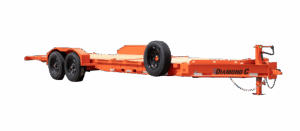
Consider a 14-ft Diamond C GTU Premium Tandem Axle Utility Trailer. The current GTU has a 7,000-lb GVWR, an 83-inch bed, a 4-inch channel frame, and two 3,500-lb Lippert brake axles. Its usable payload is not automatically 7,000 lbs; payload equals the 7,000-lb GVWR minus the trailer’s actual empty weight and installed options. Loading a 500-lb ATV near the front rail and placing another 200 lbs of tools, chains, and equipment in the tongue box or front deck area can increase tongue weight substantially. The exact increase depends on the cargo’s center of gravity and the distance between the coupler and axle-group center, so it must be measured rather than estimated from the cargo weight alone.
Car haulers have the same issue. On a 20-ft car hauler, there is no universal rule requiring the front wheels of the vehicle to sit ahead of, directly over, or behind the trailer’s axle centerline. A front-engine sedan, a rear-engine sports car, a pickup, and a stripped race car can produce very different tongue weights even when their tires occupy the same positions on the deck. Load the vehicle in the direction permitted by the trailer and vehicle manufacturers, secure it temporarily, measure the tongue weight, and adjust its position in small increments until the loaded trailer falls within the specified range.
Redistributing the Load
The usual correction for excessive tongue-weight percentage is to move existing cargo rearward, but the adjustment must be controlled. Moving too far can create insufficient tongue weight, overload the trailer axles, or place too much weight behind the axle group. Do not use the rear edge of the deck as a target. Use the scale reading, tongue-weight percentage, axle weights, and component ratings as the targets.
Step 1: Know Your Axle Position
The center of a single axle, or the midpoint of a tandem or triple axle group, is the approximate fulcrum for basic load calculations. Measure the horizontal distance from the coupler to that axle-group center. Weight ahead of the center generally adds tongue load, and weight behind it generally subtracts tongue load.
A useful approximation is: change in tongue weight equals cargo weight multiplied by the distance the cargo is moved, divided by the coupler-to-axle distance. Use the same units for both distances. The formula assumes a rigid, level trailer and is intended for planning, not as a replacement for weighing.
Do not relocate axles, modify suspension hangers, or alter the trailer frame to correct a loading problem. Axle placement is engineered for that trailer’s intended weight distribution. Structural modifications should only be performed with authorization from the trailer manufacturer and by a qualified facility.
Step 2: Identify Your Heavy Items
Focus on the items that contribute the most leverage. A skid steer, compact tractor, vehicle, pallet of block, or large attachment usually has a much greater effect than a few hand tools. Keep heavy cargo low, centered from side to side, and near the axle group while maintaining adequate tongue weight.
With machinery, consider the complete center of gravity rather than using the tire or track position as the only reference. A skid steer’s engine, counterweight, bucket, forks, mower deck, or other attachment can shift its balance significantly. Move the machine a small distance, remeasure, and repeat. A six-inch adjustment may be enough on one trailer, while another combination may need more. There is no safe universal instruction to move every machine a fixed number of inches.
Also check permanently carried items. A steel tongue box, spare tire, generator, battery bank, fuel tank, winch, or stack of chains mounted at the front adds tongue weight on every trip. Relocating those components may require manufacturer approval because the new mounting location must be structurally suitable and must not interfere with wiring, hydraulics, brakes, lighting, or suspension travel.
Step 3: Reweigh or Re-check
Do not rely on how the combination looks after moving the cargo. Measure the tongue weight again and, when possible, recheck the individual axle weights. Confirm that the trailer remains below its GVWR, each axle remains below its GAWR, the tires are within their load ratings at the required inflation pressure, and the truck remains within its GVWR, rear GAWR, payload, GCWR, and hitch limits.
For a simplified example, suppose a 1,000-lb item is on a trailer with 12 feet between the coupler and axle-group center. Moving that item one foot rearward changes tongue weight by approximately 83 lbs: 1,000 multiplied by 1, divided by 12. In an ideal static calculation, the change is approximately linear. Moving the same item two feet would change tongue weight by approximately 167 lbs, provided the item remains on the deck and no other conditions change.
If you add or remove cargo rather than merely repositioning it, recalculate both the tongue weight and the trailer’s total loaded weight. The percentage can change even when the scale’s tongue-weight reading appears similar.
Step 4: Secure Everything
Once the load is properly positioned, it must remain there. Use chains, binders, straps, wheel nets, or other tiedowns with adequate working-load limits, and connect them to designated anchor points. Wheel chocks can assist during loading and tie-down, but chocks alone are not cargo securement.
Machinery and vehicles normally require securement that prevents forward, rearward, sideways, and vertical movement. Buckets, booms, ramps, or other attachments may require separate restraint. Inspect tiedowns for cuts, abrasion, bent hardware, damaged hooks, and proper tension before departure. Stop after the first few miles and periodically during the trip to verify that the cargo has not settled or shifted.
A moving load changes the trailer’s balance while you are driving. That can create sudden sway, overload a tiedown, or transfer weight away from the tongue without giving the driver much warning. Correct static tongue weight only remains correct when the cargo stays in its measured position.
Weight Distribution Hitches: When You Need One
There is no universal 750-lb tongue-weight threshold at which every combination needs a weight-distribution hitch. Use one when the tow-vehicle manufacturer requires it, when the receiver has a separate weight-distributing rating that must be used for the trailer’s weight, or when the approved setup needs front-axle load restoration. Some vehicles require weight distribution above a specified trailer weight or tongue load, while others prohibit or limit its use.
A traditional weight-distribution hitch uses spring bars to apply leverage between the tow vehicle and trailer. That leverage transfers some load from the truck’s rear axle to the truck’s front axle and the trailer axles. Proper adjustment can restore steering response, braking balance, headlight aim, and stability, but it does not make the trailer’s physical tongue weight disappear.
Systems such as the Equal-i-zer 4-Point Sway Control Hitch and Andersen Weight Distribution Hitch are offered in multiple configurations. Select the exact part number by the trailer’s measured loaded weight, measured tongue weight, coupler height, frame dimensions, receiver size, and tow-vehicle requirements. A system rated too low can be overloaded, while spring bars that are much stiffer than necessary can produce a harsh ride and excessive stress. Installation cost varies by hitch type, shank, ball, frame brackets, setup labor, and whether additional receiver or trailer-frame work is required.
Confirm compatibility before installation. Some trailer frames, surge-brake couplers, pole tongues, hydraulic lines, battery boxes, toolboxes, or other equipment may limit which systems can be used. Follow the trailer, tow-vehicle, receiver, and weight-distribution-hitch instructions together.
A weight-distribution hitch does not increase the tow vehicle’s GVWR, payload, rear GAWR, GCWR, maximum trailer rating, or maximum permitted tongue load. It also does not increase the ratings of the receiver, ball mount, hitch ball, coupler, safety chains, trailer frame, axles, wheels, or tires. If any component is overloaded, weight distribution is not a workaround.
Tongue Weight Ratings You Actually Need to Know
| Component | Rating or Limit to Verify | Notes |
|---|---|---|
| Tow vehicle | GVWR, payload, rear GAWR, GCWR, maximum trailer weight, and maximum tongue load | Tongue weight, passengers, cargo, accessories, and hitch equipment all use truck payload |
| Receiver hitch | Maximum GTW and TW in weight-carrying and, when approved, weight-distributing modes | Use the limits printed on the receiver label and the tow-vehicle manufacturer’s limits |
| Ball mount, hitch ball, and coupler | Gross trailer and vertical-load ratings for each individual component | Use the correct ball diameter, shank size, coupler adjustment, and fastener torque |
| Trailer, axles, wheels, and tires | GVWR, GAWR, wheel ratings, tire load capacity, and actual loaded axle weight | Payload equals GVWR minus the trailer’s actual empty weight, including installed options |
| Gooseneck or fifth-wheel hitch | Gross trailer rating, vertical or pin-weight rating, mounting-system rating, and truck rear-axle capacity | The bed hitch, puck system, rails, brackets, truck frame, tires, and vehicle limits must all be adequate |
The lowest-rated part of the complete towing system sets the limit. A receiver rated for 2,000 lbs of tongue weight does not allow the truck to carry 2,000 lbs if the vehicle has less available payload, a lower maximum tongue-load specification, or insufficient rear-axle capacity.
The certification label on the driver’s door or door jamb provides important GVWR and GAWR information, and the tire-and-loading label identifies the vehicle’s occupant-and-cargo limit. Those labels do not necessarily provide the truck’s complete towing configuration or maximum tongue-load rating. Check the owner’s manual, current manufacturer towing guide, receiver label, and vehicle-specific equipment before loading.
A Quick Q&A on Common Tongue Weight Questions
Can I add weight to the back of the trailer to reduce tongue weight? Moving existing cargo rearward can reduce excessive tongue weight, but adding unnecessary ballast is usually the wrong solution. Ballast increases the trailer’s total weight and consumes payload, axle capacity, tire capacity, and tow-vehicle capacity. Reposition the actual load whenever possible, move it in small increments, and remeasure. Never place so much weight behind the axle group that the trailer drops below its specified tongue-weight range.
Does trailer length change how sensitive tongue weight is? The important measurement is the distance from the coupler to the axle-group center. For the same cargo weight and the same one-foot movement, a trailer with a shorter coupler-to-axle distance experiences a larger tongue-weight change than a trailer with a longer distance. A long deck can still produce a very large change because it may allow cargo to be positioned much farther ahead of or behind the axle group. Use the load-leverage calculation as an estimate and verify the result with a scale.
My truck has air bags or a leveling kit. Does that help? Air springs, helper springs, and add-a-leaf kits can reduce visible squat and may improve ride quality when they are correctly installed and operated. They do not reduce the trailer’s tongue weight, restore load to the front axle in the same way as an approved weight-distribution hitch, or increase the truck’s GVWR, payload, rear GAWR, GCWR, or tow rating. A front leveling lift can also change receiver height, making it especially important to select the correct ball-mount rise or drop so the trailer tows level. Trucks with automatic load-leveling suspension may have a specific procedure for setting up a weight-distribution hitch.
What about gooseneck trailers? The downward force is commonly called gooseneck hitch weight or pin weight rather than conventional tongue weight. Many truck-manufacturer guides use a range of approximately 15 to 25 percent of loaded trailer weight for gooseneck and fifth-wheel combinations, although the correct target depends on the trailer and tow vehicle. Because the hitch ball is mounted over or slightly ahead of the truck’s rear axle, a gooseneck generally unloads the front axle less than a bumper-pull trailer carrying the same vertical load. However, rear GAWR, tire capacity, payload, bed-hitch rating, mounting-system rating, and truck GVWR often become the limiting factors. Verify gooseneck weight with individual truck and trailer axle readings on a suitable vehicle scale.
Get the Load Right Before You Leave the Driveway
A few minutes spent measuring before you leave is worth far more than an hour of tense highway driving with a trailer that feels unstable or a truck that is overloaded. Check the loaded trailer weight, tongue-weight percentage, truck axle loads, trailer axle loads, tire pressures, hitch ratings, and securement before every substantially different load.
If you are not sure which trailer best matches your equipment, tow vehicle, and typical cargo position, browse the current inventory at Spencer Trailers. We carry Diamond C, H&H, Liberty, and other trailer lines in a range of utility, car-hauler, equipment, dump, tilt, and gooseneck configurations. The right choice depends on more than GVWR; deck length, axle placement, empty weight, payload, hitch type, loading method, and the tow vehicle’s ratings all matter.
Got a specific load you are trying to balance? Reach out to us directly at (812) 829-0226. Have the trailer model, loaded cargo weight, cargo position, tow-vehicle year and configuration, and any available scale readings ready. Tongue-weight questions are much easier and less expensive to solve before the combination reaches the road.


