





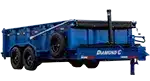


You back a standard equipment trailer up to a machine and immediately face the same familiar problems: the ramps are steeper than the machine likes, the bucket or blade approaches the deck at an awkward angle, and the undercarriage threatens to drag at the transition. If you load compact equipment several times a week, repeatedly positioning, lifting, and storing ramps also consumes time. The Diamond C HDT is designed to make that process faster and more controlled by replacing conventional loading ramps with a low-profile tilting deck.
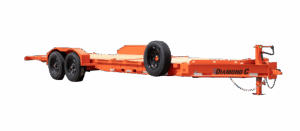
HDT stands for Hydraulically Dampened Tilt. In its standard configuration, the HDT is a gravity-tilt equipment trailer rather than a powered hydraulic dovetail. After the mechanical bed latch is released and the hydraulic flow-control valve is opened, the deck pivots downward until the rear of the trailer contacts firm, load-bearing ground. The hydraulic dampening system regulates how quickly the bed moves so it does not drop or return abruptly. As the machine travels forward across the pivot point, its weight brings the deck back to the transport position, where the operator closes the valve and verifies that the bed latch is fully engaged.
How the Hydraulic System Actually Works
The standard HDT does not require a 12-volt hydraulic pump or an onboard battery to perform its normal gravity-tilt cycle. It uses a refillable hydraulic dampening system with a cylinder, reservoir, hoses, and an adjustable speed-control valve. The hydraulic circuit controls the rate of movement while gravity and the weight of the equipment move the deck. That distinction matters because there is no electric pump to operate during a standard loading cycle and no deeply discharged tilt battery to stop the trailer from functioning.
Diamond C also offers powered configurations for operators who need more control. The Electric/Hydraulic Powered Tilt option raises and lowers the deck with a hydraulic power unit, while the Pro Tilt system allows the operator to switch between gravity-tilt and powered operation. Pro Tilt is especially useful when loading multiple machines, handling loads that do not naturally balance across the pivot, or positioning a long-wheelbase vehicle. Powered configurations use an onboard battery and charging equipment, and available controls can include a wireless remote. The truck’s 7-way charge circuit may help maintain the trailer battery during normal use, but it should not be treated as a fast charger for a severely discharged battery.
The exact loading angle depends on the HDT package, trailer length, stationary-deck configuration, tire and axle package, and the surface under the rear of the trailer. Representative HDT configurations produce a gradual approach in the low-teens rather than the abrupt transition created by short loading ramps, but buyers should verify the dimensional drawing for the exact trailer being ordered. Full-bed tilt is available on shorter configurations, while longer trailers may use a split deck with a stationary front section. A split deck still provides a long loading surface, but it creates a transition at the front of the tilting section that should be checked against the wheelbase and ground clearance of the machine.
Once the deck has returned to level, the mechanical transport latch must be positively engaged before towing. The HDT carries no loose loading ramps in its standard tilt configuration, so there are no ramp extensions hanging behind the trailer or separate ramps to lift and store. The latch, pivot assembly, hydraulic cylinder, reservoir, and flow-control valve should still be inspected before every trip. A hydraulically dampened deck is convenient, but it does not eliminate the need for a complete pre-trip inspection.
Diamond C HDT Models and Specs
Diamond C currently offers several HDT axle and GVWR packages. The model identity is determined by the running-gear package rather than the deck length alone, so a trailer should be identified as an HDT207, HDT208, HDT210, or HDT307 instead of being described only as a “20-foot HDT.” Available lengths, widths, frames, tires, couplers, and stationary-deck layouts vary by package and production configuration.
| Model | GVWR | Deck Length | Main Frame |
|---|---|---|---|
| HDT207 | 15,500 lb | 16–28 ft, with full-bed or split-deck layouts depending on length | 8-inch I-beam construction; exact section varies by length and build |
| HDT208 | 18,000 lb | 16–28 ft, configuration-dependent | 8-inch, 15-lb I-beam package; Engineered Beam Technology on applicable 20-ft-and-longer builds |
| HDT210 | 23,000 lb | 20–28 ft | Engineered Beam Technology |
| HDT307 | 24,000 lb | 22–28 ft | Engineered Beam Technology |
The HDT207 uses tandem 7,000-pound Lippert axles. The HDT208 steps up to tandem 8,000-pound Lippert oil-bath torsion brake axles, the HDT210 uses tandem 10,000-pound Lippert oil-bath torsion brake axles, and the HDT307 uses three 7,000-pound Lippert torsion brake axles. The sum of the axle ratings does not necessarily equal the trailer’s GVWR because a properly distributed portion of the loaded trailer weight is carried through the hitch. That does not permit an operator to exceed any axle, tire, wheel, coupler, hitch, tow-vehicle, or gross vehicle weight rating.
Current HDT configurations use electric brakes, with electric-over-hydraulic disc brakes available on qualifying packages. For 2026 production, Lippert trailer ABS is standard on specified 8,000-pound and triple-7,000-pound axle packages, optional on certain 7,000-pound axle packages, and subject to production availability on other configurations. Buyers should confirm ABS equipment by checking the trailer’s VIN-specific build sheet rather than assuming that every trailer on a dealer’s lot has the same braking technology. In Indiana, a trailer with a gross weight of at least 3,000 pounds must have brakes that can be controlled from the towing vehicle and an automatic breakaway system. Every HDT configuration is well above that threshold.
Coupler equipment also changes with the package. HDT207 configurations commonly use an adjustable-channel 2-5/16-inch Demco EZ-Latch coupler rated for the applicable trailer package. Higher-GVWR HDTs use appropriately rated flat-mount 2-5/16-inch couplers, with a pintle ring available when the towing operation requires one. A pintle connection should be selected because it matches the tow vehicle, application, and required rating, not simply because the trailer is heavier.
Current HDT beds are generally 80 or 82 inches wide depending on the selected package and length. A 2-inch treated-lumber floor is standard on typical builds. Available alternatives may include oak, Blackwood lumber, or a steel diamond-plate floor on compatible powered-tilt configurations. Steel flooring adds substantial weight and changes the way tracked equipment interacts with the deck, so it should be selected for a specific operating need rather than solely for appearance.
The trailer is protected by Diamond C’s DM Difference Maker coating process. It is a multi-stage system that includes steel-shot blasting, cleaning and pretreatment, force drying, zinc-rich epoxy primer powder, a powder topcoat, and final curing. Like any coating, it should still be inspected after contact with buckets, blades, tracks, chains, and road debris. Promptly treating damaged areas helps prevent corrosion from spreading beneath the surrounding finish.
Who Actually Needs This
Not every equipment owner needs a tilt trailer. A Diamond C LPX with its fixed deck, dovetail, and properly selected ramp system may be the better value for machines that have adequate ground clearance and are normally loaded on a firm, level surface. The LPX is not a light-duty entry model; it is a low-profile, extreme-duty equipment trailer offered in many of the same GVWR classes as the HDT. Its principal difference is the loading method rather than a simple good-better-best ranking.
The HDT becomes particularly useful for compact track loaders, mini excavators, compact dozers, trenchers, pavers, scissor lifts, rollers, low-clearance vehicles, and other equipment that does not transition comfortably over short ramps. A long tilt surface can reduce the severity of the approach and departure transitions, but machine compatibility still depends on ground clearance, track or wheelbase length, attachment position, and weight distribution. The machine should be tested on the selected trailer configuration whenever possible.
Rental companies, excavation contractors, landscapers, utility crews, and equipment owners who load at several sites each week often benefit most from the HDT. The operator does not have to lift and position a pair of heavy ramps each time, and there are no separate ramps to leave behind. The loading site still matters. The rear of the tilt bed must contact firm, stable ground, and the tow vehicle and trailer should be positioned as straight and level as practical. Deep mud, loose fill, steep side slopes, or soft shoulders can allow the tail to sink or the trailer to shift during loading.
A Note on Gravity Tilt, Powered Tilt, and Pro Tilt
The standard HDT uses gravity to move the deck and hydraulic pressure to dampen that movement. The Powered Tilt option uses an electric hydraulic power unit to move the deck, while Pro Tilt provides both gravity and powered modes. Gravity tilt is mechanically simpler and is effective when a single machine can move the deck predictably as it crosses the pivot. Powered control is more useful for off-center loads, multiple pieces of equipment, long vehicles, steel-floor configurations, or situations where the operator needs to hold and position the bed independently of the cargo. Powered systems add a battery, pump, wiring, charger, and additional maintenance points. Hydraulic fluid condition, fluid level, hose condition, cylinder seals, electrical connections, and battery state should be checked regularly. Cold temperatures can also affect hydraulic response, so the fluid specified by Diamond C should be used rather than assuming that every hydraulic oil will perform the same way.
How the HDT Compares to Other Diamond C Equipment Trailers
Diamond C’s equipment lineup is organized around different loading and towing needs. The LPX is a low-profile, extreme-duty bumper-pull equipment trailer with a fixed deck and ramp loading. Depending on configuration, buyers can select systems such as heavy-duty flip-knee ramps, MAX Ramps, or slide-in ramps. The HDT remains a bumper-pull trailer but replaces the conventional ramp-loading process with a hydraulically dampened tilting deck. Operators who prefer a gooseneck connection can consider the HDT-GN, while the wider HXD is designed around a 102-inch-wide gravity-tilt deck with drive-over fenders.
The FMAX name identifies Diamond C’s Flatbed Max gooseneck flatbed family. FMAX trailers provide a 102-inch-wide deck, gooseneck towing, longer available decks, and GVWR packages extending substantially beyond the HDT range. Depending on the FMAX model and build, loading may be handled with MAX Ramps, XDR Ramps, or a powered hydraulic dovetail. The FMAX is therefore not simply a heavier version of the HDT. It is a different platform for operators who need a gooseneck flatbed, wider deck, greater length, or higher gross capacity.
For a single compact machine that benefits from a low approach angle, the HDT may be easier to use than a higher-capacity flatbed that still requires ramps. For multiple machines, attachments, long cargo, or equipment that exceeds the bumper-pull HDT’s ratings, an LPX, HDT-GN, HXD, or FMAX configuration may be more appropriate. The correct choice depends on the actual machine dimensions and scale weight, the tow vehicle’s ratings, the desired hitch type, and the way the trailer will be loaded in the field.
Diamond C has manufactured trailers in Mt. Pleasant, Texas, since 1985. Spencer Trailers carries Diamond C inventory, including equipment-category trailers built for a range of commercial and private uses. You can browse current units at the full inventory page or call (812) 829-0226 to ask specifically about HDT availability, production packages, and pricing. Inventory and factory specifications can change, so the VIN-specific build sheet should be reviewed before making a towing or payload decision.
Options Worth Considering
Diamond C offers several HDT choices that can materially change how the trailer performs. The best options are the ones that solve a specific loading, towing, or maintenance problem:
- Pro Tilt or Powered Tilt: Standard gravity tilt is appropriate for many single-machine loads. Pro Tilt or the fully powered configuration is worth considering when the load may not naturally balance across the pivot, when several pieces of equipment share the deck, or when controlled bed positioning is important. Powered systems include additional hydraulic and electrical components that must be maintained.
- Hydraulic jack: A correctly rated two-speed drop-leg jack is standard on typical HDT builds. Available Lippert hydraulic jack packages can reduce manual effort when the trailer is connected and disconnected frequently. The jack option should be matched to the trailer package and expected loaded tongue weight.
- Spare tire and mount: A factory spare mount and matching tire are practical additions for a commercial equipment trailer. The spare must match the wheel, bolt pattern, load range, diameter, and tire specification of the running gear. Its pressure and condition should be included in every pre-trip inspection.
- Pacesetter package: On compatible 20-foot-and-longer trailers, the Pacesetter package combines work-oriented upgrades such as heavier diamond-plate fenders, a larger side step, closer crossmember spacing, and a fork holder. These features add weight and cost, but they can be worthwhile for frequent jobsite use.
- Loading and securement equipment: Available 2,000-lumen loading lights, additional 5/8-inch D-rings, winch provisions, closer crossmember spacing, and flooring upgrades should be selected around the cargo. Standard LED road lighting, stake pockets, the rub rail, and the supplied tie-down points still need to be inspected and used within their ratings.
The HDT already includes useful standard equipment, including a heavy-duty V-tongue lid that creates protected storage, LED road lights, a rub rail with stake pockets, treated-lumber flooring, and multiple D-ring tie-downs on typical builds. Verify every item on the order sheet because package content can change. Avoid configuring the trailer from a generic checklist: a stationary front deck changes the usable tilt length, steel flooring may require powered tilt, larger running gear changes deck height and tire requirements, and every option reduces the remaining cargo allowance by its installed weight.
Real Payload Numbers
GVWR is the maximum allowable loaded trailer weight, not the amount of equipment that can be placed on the deck. Cargo capacity is determined by subtracting the trailer’s actual empty weight from its GVWR. Diamond C’s April 2025 estimated base-weight chart lists a 20-foot HDT207 at approximately 3,230 pounds before many options. Subtracting that estimate from the 15,500-pound GVWR produces a theoretical cargo allowance of about 12,270 pounds. A 22-foot HDT207 is estimated at approximately 3,410 pounds, leaving about 12,090 pounds before added options. The certification label and a certified scale are more authoritative than a brochure estimate because flooring, stationary-deck length, spare tires, powered tilt, hydraulic jacks, winches, fenders, batteries, and other equipment all change the empty weight.
For context, a current Kubota SVL75-3 compact track loader has a published operating weight of approximately 8,135 to 8,631 pounds depending on cab configuration. The machine’s actual transported weight can differ because of buckets, grapples, forks, mulchers, track choices, fuel, tools, guarding, and other attachments. A loader that fits comfortably within the HDT207’s arithmetic cargo allowance may still overload a truck’s rear axle, receiver, hitch, or payload rating if tongue weight is not accounted for correctly.
Moving up in GVWR increases potential cargo capacity, but the heavier frame and running gear also increase trailer weight. Diamond C’s estimated chart lists a 22-by-82-inch HDT208 at approximately 4,160 pounds, which produces an arithmetic cargo allowance of about 13,840 pounds at an 18,000-pound GVWR. A 24-foot HDT210 is estimated at approximately 4,390 pounds, leaving roughly 18,610 pounds at a 23,000-pound GVWR. A 24-foot HDT307 is estimated at approximately 4,550 pounds, leaving roughly 19,450 pounds at a 24,000-pound GVWR. Those calculations are starting points only. The load must also remain within each axle, tire, wheel, coupler, hitch, truck GVWR, rear-axle rating, and combined rating.
Trailer GVWR also should not be confused with the commercial driver’s license threshold. Under the federal and Indiana Class A CDL framework, a trailer rated above 10,000 pounds does not trigger a Class A CDL by itself. The Class A threshold generally applies when the combination has a GCWR or gross combination weight of at least 26,001 pounds and the towed unit has a GVWR or gross weight above 10,000 pounds, subject to applicable exemptions and the nature of the operation. Because HDT trailers range from 15,500 to 24,000 pounds GVWR, many truck-and-HDT combinations can cross the 26,001-pound combined threshold even though the trailer rating alone is not the complete test. Commercial operations may also be subject to registration, medical qualification, USDOT, inspection, hours-of-service, or other requirements below the CDL threshold.
Always calculate the complete combination before buying. Obtain the machine’s real transported weight, the trailer’s actual empty weight, the expected tongue weight, and the truck’s door-label ratings. Confirm that the hitch and receiver are rated for the loaded trailer and the expected tongue weight. Buying a trailer with sufficient GVWR does not make an underrated tow vehicle, receiver, ball mount, pintle hook, or tire legal or safe.
What to Check Before You Buy
A few items should be confirmed on every new or used HDT, even when two trailers appear nearly identical:
- Certification label and build sheet. Verify the model package, GVWR, GAWR, axle manufacturer, axle count, tire size, tire load rating, wheel rating, coupler rating, deck width, floor material, and full-bed or split-deck layout. Current premium HDT configurations use Lippert running gear, but the VIN-specific documentation should control every towing and maintenance decision.
- Hydraulic dampening components. Inspect the reservoir, valve, cylinder body, rod, hoses, fittings, pivot points, and mounting hardware. Look for damaged hoses, loose fittings, bent components, contaminated fluid, corrosion, or persistent wetness around a seal. A light film and an active leak are not the same condition, so questionable areas should be cleaned and cycled before the trailer is accepted.
- Brakes and electrical equipment. Test the truck brake controller, 7-way connector, running lights, stop and turn lights, breakaway switch, breakaway battery, and brakes on every equipped axle. If the trailer has Lippert ABS, confirm the ABS indicator and available diagnostic functions. Powered Tilt and Pro Tilt builds also require testing the hydraulic pump, wireless remote, onboard battery, charger, wiring, and any solar-maintenance equipment.
- Bed latch, pivot, deck, and structure. Cycle the trailer through a complete loading and return sequence on firm, level ground. The deck should move at a controlled rate, return without binding, and latch positively in the transport position. Inspect the hinge and pivot area, crossmembers, frame, welds, flooring, fenders, tie-down points, tires, and wheel fasteners. Never work beneath a raised tilt bed unless it is secured using the manufacturer-approved support procedure.
For eligible 2026-and-later trailers, Diamond C’s Warranty 2.0 provides a six-year limited structural warranty and a two-year comprehensive limited warranty, subject to the written terms, exclusions, maintenance obligations, registration requirements, and component-specific coverage. Earlier trailers may have different warranty terms, so warranty eligibility should be confirmed by serial number rather than assumed from the date of purchase. A warranty also does not replace the delivery inspection: the dealer should demonstrate the tilt cycle, latch operation, breakaway system, lights, brakes, jack, and any powered accessories before the trailer leaves the lot.
Pricing and What to Expect
As of August 2026, Diamond C lists a base HDT manufacturer’s suggested retail price of approximately $12,734 before taxes, title, registration, license fees, dealer charges, freight, and optional equipment. Actual HDT pricing varies substantially with deck length, GVWR package, full-bed or split-deck configuration, Pro Tilt, Powered Tilt, hydraulic jacks, flooring, brake upgrades, tires, spare equipment, Pacesetter features, and worksite accessories. Recent 2026 Spencer Trailers inventory examples have placed HDT207 configurations in roughly the mid-$12,000 range, while an 18,000-pound HDT208 Pacesetter configuration has been listed around the upper-$17,000 range. Those are time-specific inventory examples rather than guaranteed prices.
Used HDT value depends more on the exact package and condition than on age alone. Inspect the frame, axle alignment, tires, brakes, pivot, latch, hydraulic components, deck, wiring, battery equipment, and maintenance history before comparing prices. A functioning deck that merely moves up and down is not enough; it should move at a controlled rate, latch correctly, remain within structural alignment, and have no unresolved hydraulic or electrical faults.
Indiana buyers should also account for sales tax, title, registration, and any properly disclosed dealer charges. A newly acquired vehicle or trailer generally must be titled and registered within Indiana’s 45-day penalty-free window; waiting beyond that period can result in an administrative penalty. Business buyers may also want to discuss depreciation with a qualified tax professional. Federal law restored a 100 percent special depreciation allowance for certain qualifying property acquired and placed in service after January 19, 2025, but qualification depends on factors such as business use, tax basis, acquisition circumstances, placed-in-service date, and applicable recapture rules. It is a tax treatment, not an automatic discount or cash rebate on every trailer purchase.
For current pricing at Spencer Trailers, call or visit the dealership at 291 West State Hwy 46 in Spencer, Indiana. You can also reach the team through the contact page to ask about current stock, incoming trailers, axle packages, powered-tilt availability, and factory ordering timelines. Before purchasing, request the complete build sheet and verify the trailer against the equipment, tow vehicle, hitch, licensing requirements, and intended commercial use.
The HDT is not the right trailer for every load, but it directly addresses the problems created by steep ramps, repeated ramp handling, and low-clearance equipment. Its defining feature is a hydraulically dampened tilting deck, with powered and dual-mode tilt systems available for more demanding loading situations. See what Diamond C equipment trailers are available now and compare the actual HDT package, dimensions, payload, and tilt configuration with the equipment you haul.


