


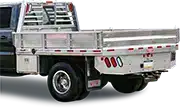
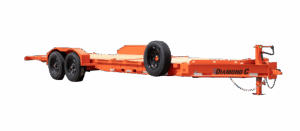



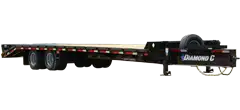
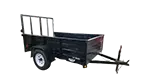

You’re moving a 9,000-pound round baler across the county, coordinating a sale-barn run for 40 feeder calves in properly sized loads, or cleaning out a hog confinement with a skid steer and a dump trailer. Every one of those jobs demands something different from your trailer. Buy the wrong one and you’re either short on payload, routinely over the trailer’s GVWR, exceeding the truck’s ratings, or dragging something that does not match the hitch, deck, ramps, or braking system. Farmers make this mistake more often than most people think.
Here’s what actually works for farm and ranch use, broken down by job. Throughout this guide, remember that GVWR is the maximum rated weight of the loaded trailer, not the amount of cargo it can carry. Usable payload is the trailer’s GVWR minus its actual empty weight, including installed options, spare tires, ramps, batteries, tarps, toolboxes, and anything else carried on the trailer. The certification label and the manufacturer’s build sheet for the individual trailer always control.
Gooseneck Flatbeds and Equipment Trailers
If you run any kind of heavy equipment, a gooseneck is often the practical choice. A 7,000-pound-GVWR bumper-pull utility trailer can be a good match for a zero-turn mower, compact attachment, or other light load. But when you’re moving a skid steer, a larger tractor, a heavy baler, or several implements at once, you need enough trailer payload, deck space, hitch capacity, and truck capacity to handle the complete combination.
Diamond C’s FMAX is the company’s true Flatbed Max gooseneck line. Current FMAX configurations range from the 15,500-pound-GVWR FMAX207 through tandem-dual and triple-axle models reaching 40,000 pounds GVWR. Deck lengths, axle packages, empty weights, frames, tires, brakes, couplers, and loading systems vary substantially by model. Diamond C’s premium lines use Lippert axles as standard, with axle sizes and wheel-end packages selected for each FMAX configuration. The FMAX207, for example, uses tandem 7,000-pound Lippert axles, while heavier FMAX versions use larger or additional Lippert axles. :contentReference[oaicite:0]{index=0}
For equipment that benefits from a lower deck between the fenders, the Diamond C LPX-GN is the Low Profile Extreme Duty gooseneck equipment trailer. It is not the same kind of trailer as a full-width deck-over FMAX. The LPX-GN provides an 80- to 82-inch bed between the fenders and is currently offered from 15,500 to 24,000 pounds GVWR. The bumper-pull LPX covers that same general GVWR range and is available in lengths from 16 to 30 feet, with tandem 7,000-pound Lippert axles standard and heavier axle packages available by configuration. :contentReference[oaicite:1]{index=1}
The low-profile deck is the detail that matters most for many tractors, skid steers, mini excavators, and farm implements. Keeping the deck between the tires lowers the loading surface and usually reduces the ramp angle compared with a deck-over trailer. That can make loading easier for equipment with limited ground clearance and can help keep the loaded center of gravity lower. Actual deck height depends on the axle package, suspension, tire size, frame, and trailer configuration, so do not rely on a generic deck-height number when cab, ROPS, barn-door, or overhead clearance is tight. Measure the machine and compare it with the dimensional drawing for the exact trailer.
Deck width matters too. An LPX or LPX-GN works well when the machine fits between the fenders. If the tractor’s rear tires, duals, mower deck, header, or implement exceed the usable bed width, a 102-inch deck-over such as the FMAX or Diamond C DEC may be the correct layout. The DEC is a heavy-duty bumper-pull or pintle deck-over equipment trailer with a 102-inch bed, lengths from 20 to 30 feet, and current GVWR packages from 15,500 to 23,000 pounds. Its standard axle package also uses Lippert axles. :contentReference[oaicite:2]{index=2}
For operators loading alone, the tail configuration can be worth as much as another capacity upgrade. FMAX loading choices vary by model and may include spring-assisted MAX Ramps, XDR Ramps for concentrated equipment such as backhoes and excavators, a straight deck with slide-in ramps, or a 12-foot hydraulic dovetail. The hydraulic dovetail provides a gradual approach and powered operation, but it adds weight, cost, hydraulics, and maintenance. MAX Ramps provide a wide loading surface, while XDR Ramps leave space between the ramps for equipment geometry that requires it. Choose the system around the machines you actually own rather than ordering the most expensive option automatically. :contentReference[oaicite:3]{index=3}
Do not assume a higher axle rating by itself increases legal payload. GVWR is established by the manufacturer after considering the frame, axles, suspension, tires, wheels, coupler, safety chains, brakes, and other components as a complete system. Likewise, a 30,000- or 40,000-pound FMAX requires a truck, hitch, ball, and driver qualification that are appropriate for that combination. A trailer’s rating does not override the tow vehicle’s GVWR, rear-axle rating, GCWR, hitch rating, or payload limit.
Diamond C trailers are built in Mt. Pleasant, Texas, where the family-owned company has operated since it was founded in 1985. Current Diamond C steel trailers use the company’s multi-stage DM Difference Maker coating system. That finish helps with long-term corrosion protection, but farm trailers still need routine washing, touch-up of damaged coating, deck inspection, wheel-end service, and cleaning around fertilizer, manure, road salt, and other corrosive material. :contentReference[oaicite:4]{index=4}
Browse our full trailer inventory to see current gooseneck and equipment-trailer availability.
Livestock Trailers
Livestock trailers are the one category where cutting corners can cost you quickly. A poorly matched trailer stresses animals, increases the chance of slipping or trampling, complicates sorting, and can eventually cause an injury or loss. The question is not just, “Can it hold the weight?” You also need enough floor area for the animals being hauled, suitable ventilation for the weather, reliable gates and latches, non-slip footing, adequate interior height, safe loading geometry, and a tow vehicle that can control the loaded trailer.
For cattle, a bumper-pull stock trailer works well for smaller groups and shorter local hauls when its floor area, payload, and axle rating fit the load. Delco’s current bumper-pull livestock lineup includes the 6-foot-wide S6 and the wider S8. The S6 is offered in 10-, 12-, 14-, and 16-foot lengths, while the 6-foot-8-inch-wide S8 is available in 14-, 16-, and 18-foot lengths. Current configurations span the 7,000-pound class and heavier packages, depending on model and build. Standard features include open-bar upper sides for ventilation, solid lower panels, treated-pine flooring, electric-brake torsion axles, a full-swing rear gate with a sliding livestock door, and sorting-gate options. :contentReference[oaicite:5]{index=5}
A 6-by-16 stock trailer should never be assigned a fixed number of cattle without considering animal weight and floor-space requirements. Four mature cows are not the same load as four feeder calves, and a group of cow-calf pairs can exceed a 7,000-pound trailer’s payload sooner than expected. The trailer’s empty weight, the animals’ actual weight, compartment dimensions, weather, trip length, and animal condition all matter. Load by measured weight and appropriate stocking density, not by the number of heads that happened to fit on a previous trip.
Ventilation is especially important in Indiana’s summer heat. Open-side stock construction allows crossflow while the trailer is moving, but airflow changes when the rig is stopped, backed into a sheltered area, or traveling with a tailwind. Avoid unnecessary stops with a loaded trailer in hot conditions, inspect animals during longer trips, and never block ventilation openings with solid panels, tarps, or cargo unless the trailer was designed to be operated that way. In cold weather, protection from direct wind may be appropriate, but the trailer still needs adequate air exchange.
For hog producers, footing and cleanability deserve extra attention. Bare, wet wood can become slick, while smooth steel can be difficult for animals to stand on safely. A treated-wood floor protected with properly fitted rubber mats or a cleated-rubber flooring option can improve traction and protect the wood underneath. Bedding may also help, depending on temperature and hauling conditions. Delco offers rubber-mat and cleated- or smooth-rubber flooring choices on several livestock configurations. Whatever flooring you choose, inspect it frequently for rot, loose fasteners, curled mat edges, trapped waste, and areas where an animal’s hoof could catch. :contentReference[oaicite:6]{index=6}
Interior gates are not decorative options. A correctly positioned center gate helps divide animals, reduce uncontrolled movement, and keep the load balanced. Check every latch before departure, and use the manufacturer’s secondary retention method when provided. Make sure no latch handle, gate edge, broken weld, or exposed fastener can cut an animal. After unloading, clean manure and bedding before they trap moisture against the floor and lower wall panels.
Horses need a trailer built around equine height, dividers, chest and butt clearance, ventilation, and safe unloading. Delco’s current bumper-pull horse configurations include 6-foot and 6-foot-8-inch-wide models in 14-, 16-, and 18-foot lengths, with a 7-foot interior height and treated-pine flooring. A straightforward two-horse bumper-pull in the 7,000-pound class can be appropriate for many local trips, provided the actual horse weights and trailer payload work. For three horses, larger animals, frequent show travel, or a tack room, compare heavier bumper-pull and gooseneck configurations rather than assuming that every two- or three-horse body has the same capacity. :contentReference[oaicite:7]{index=7}
For a larger cattle operation or a sale-barn run involving dozens of animals, a gooseneck livestock trailer is generally more appropriate than trying to overload a short bumper-pull. Delco’s gooseneck livestock lines cover bar-top, metal-top, premium, and ground-load designs in a broad range of lengths and GVWR packages. A gooseneck improves stability and available capacity, but it still must be matched to the truck, hitch, animal weights, compartment area, and applicable operating rules. :contentReference[oaicite:8]{index=8}
Hay Trailers
Hay hauling is hard on trailers because the load is bulky, often stacked high, exposed to crosswinds, and capable of shifting if it is not secured correctly. Bale weight varies far more than many people assume. Moisture, forage species, baler settings, density, and bale dimensions all change the number. A 4-by-4 round bale may weigh only a few hundred pounds, while a dense 5-by-6 bale can be roughly 1,200 to 1,700 pounds. The only dependable method is to weigh representative bales from your own operation. :contentReference[oaicite:9]{index=9}
That weight adds up fast. Eight 1,200-pound bales equal 9,600 pounds of hay before the trailer, ramps, chains, spare tire, and accessories are counted. A trailer with a 10,000-pound GVWR cannot carry 10,000 pounds of hay because the trailer itself consumes part of that rating. If the trailer weighs 3,000 pounds empty, its theoretical payload is only 7,000 pounds before any other cargo is added. With large bales, that may mean four or five bales rather than six or eight.
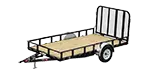
For small hay operations, a 7,000-pound Diamond C GTU or 9,890-pound TUT utility trailer can handle lighter bale loads when the rails, deck dimensions, payload, and tie-down arrangement fit the job. The GTU uses tandem 3,500-pound axles and a 4-inch channel frame, while the TUT provides a heavier 9,890-pound-GVWR utility platform. These are useful general-purpose trailers, but neither should be treated as a substitute for a heavy flatbed when the calculated bale weight exceeds the available payload. :contentReference[oaicite:10]{index=10}
A 10,000- or 14,000-pound bumper-pull deck-over can be a practical step up for moderate hay loads. H&H’s Standard Duty Deckover, for example, is currently offered in 102-inch-wide bumper-pull configurations with 10,000- and 14,000-pound GVWR packages. For heavier bumper-pull work, the Diamond C DEC provides a 102-inch deck and GVWR choices from 15,500 to 23,000 pounds. The wider deck makes side loading with a loader easier and removes the between-the-fenders limitation, but it also raises the deck and usually requires longer ramps for equipment loading. :contentReference[oaicite:11]{index=11}
For square-bale operations, individual bales are lighter but volume becomes the limiting factor. A flatbed with stake pockets, removable side boards, purpose-built hay racks, or a properly engineered side kit can carry a substantial stack. Do not depend on a lightweight homemade rail to restrain the load. Use rated straps in good condition, protect straps from sharp edges, and secure the stack so bales cannot shift forward, backward, or sideways. Stop shortly after departure to recheck tension because hay compresses and straps can loosen.
Stack height matters as much as weight. A tall stack increases the center of gravity and catches more crosswind. Measure total loaded height before leaving the farm, including the trailer deck, bales, racks, and any uneven top layer. Plan for utility lines, trees, barn entrances, railroad crossings, and low structures. Even when the load clears every obstruction, a lower, wider, well-secured stack is more stable than a narrow stack carried unnecessarily high.
If you’re moving large quantities of round bales or dense 3-by-3-by-8 large squares, a gooseneck flatbed is usually the better choice for deck length, payload, hitch stability, and load distribution. Large square bales can weigh roughly 800 pounds to well over 1,000 pounds apiece, so count and weigh them before choosing a trailer. A Diamond C FMAX is the natural gooseneck choice, with current models ranging from 15,500 to 40,000 pounds GVWR. Select the model from the required payload and deck length, not simply from how many bales will physically fit.
When hauling hay on a trailer that is also used for equipment, inspect the deck for broken boards, protruding screws, sharp ramp edges, and damaged rub rails that could cut a strap. Keep loaded bales away from exhaust heat and carry an extinguisher rated for the tow vehicle and cargo environment. Do not park a hot truck or trailer over dry stubble immediately after a hard pull.
Dump Trailers for Feed, Manure, and Gravel
A dump trailer is one of the most versatile trailers a working farm can own. It can handle manure removal, gravel for lane maintenance, soil, feed ingredients in suitable containers, scrap metal, brush, old fencing, firewood, and debris from a damaged outbuilding. The same versatility also makes dump trailers easy to overload because dense material can reach the trailer’s GVWR long before the box looks full.
The spec farmers most often misunderstand is not simply the hydraulic cylinder’s advertised force. A safe dump system is a complete combination of hoist geometry, cylinder design, hydraulic pressure, pump capacity, battery condition, bed pivot location, frame strength, load placement, and dump angle. An oversized cylinder cannot make an overloaded trailer safe, and an uneven or frozen load may not release even when the trailer is within its nominal payload.
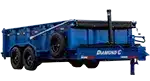
For lighter farm and property work, Diamond C’s current dump lineup begins with the GST Single Axle Telescopic Dump. The GST has a 6,000-pound GVWR, an 8-foot by 60-inch bed, a 6,000-pound Lippert drop axle, a telescopic hoist, and a 45-degree dump angle. The MDT Medium Duty Telescopic Dump steps up to a 9,890-pound GVWR, 10- or 12-foot lengths, a 77-inch bed, tandem Lippert axles, and a 45-degree dump angle. These models work well where maneuverability and a smaller footprint matter, but payload still has to be calculated from the certified empty weight. :contentReference[oaicite:12]{index=12}
For regular skid-steer loading, wet manure, stone, demolition debris, or other demanding farm use, the Diamond C LPT is the appropriate heavy-duty bumper-pull dump line. The current LPT is available in 12-, 14-, and 16-foot lengths, with an 81- to 82-inch bed and GVWR packages from 15,500 to 24,000 pounds. It uses a front-mounted three-stage telescopic cylinder, standard tandem 7,000-pound Lippert axles with heavier packages available, 14-ply all-steel radial tires in the base configuration, and a 45-degree dump angle. Empty weights vary widely with length and options, so the payload for a particular 14-foot LPT must be calculated from that unit’s actual weight rather than quoted as one universal number. :contentReference[oaicite:13]{index=13}
The telescopic hoist provides strong front-of-body leverage and avoids much of the linkage used in a traditional scissor assembly. That does not mean every load will slide automatically. Wet clay, packed manure, frozen material, and debris caught under a door can hang in the box. Keep the trailer and truck aligned on firm, level ground, open the correct gate before raising the bed, maintain clearance from power lines, and never stand under a raised dump body unless it is empty and supported by the manufacturer’s approved body-prop procedure.
H&H also offers current dump choices across several capacity levels. Its Utility Dump line covers approximately 5,000 to 9,990 pounds GVWR in compact bed sizes. The Telescopic I-Beam Dump is offered in 12- to 16-foot lengths with 14,000- and 16,000-pound GVWR packages, while the TOPLINE Telescopic Dump covers 14- and 16-foot beds with GVWR configurations from 15,400 to 22,000 pounds. Select among them by payload, tow vehicle, bed size, axle package, floor thickness, hoist type, and gate design rather than assuming every 14-foot dump is built the same. :contentReference[oaicite:14]{index=14}
Gate terminology matters. Double barn doors swing fully to the sides and are useful when loading equipment, cleaning the box, or unloading bulky debris. A spreader gate is hinged at the top and meters gravel, soil, or similar material as the trailer moves forward. A combination barn-door and spreader-gate design provides both functions. Barn doors alone are not the correct tool for controlled spreading, and driving with partially secured doors can damage the trailer or create a serious hazard.
A tarp is valuable for loose material, but it does not increase payload or make an overloaded trailer legal. Confirm whether the tarp, rear stabilizer legs, ramps, spare tire, side extensions, battery upgrades, solar charger, and hydraulic options are included in the trailer’s published empty weight. Added side extensions increase volume without increasing GVWR, which makes it especially easy to overload the trailer with wet manure, soil, silage, or gravel.
Dump-trailer batteries need farm-level maintenance. Keep terminals clean, confirm the onboard charger is operating, and fully charge the battery instead of expecting the tow vehicle’s 7-way circuit to recover a deeply discharged battery between cycles. Repeatedly raising a heavy bed with a weak battery shortens pump and battery life. Inspect the breakaway battery separately because it is part of the emergency braking system, not merely a power source for the hoist.
Quick Comparison: Common Farm Trailer Types
| Type | Best Use | Typical GVWR | Recommended Brand/Model |
|---|---|---|---|
| Gooseneck Flatbed | Tractors, hay, skid steers, heavy equipment | 15,500 to 40,000 lbs | Diamond C FMAX |
| Bumper-Pull Stock | Smaller cattle groups, hogs, goats, sheep, horses | About 7,000 to 14,000 lbs by configuration | Delco S6, S8, H6, H8 |
| Bumper-Pull Utility or Equipment | Light hay loads, mowers, compact tractors, implements | 7,000 to 23,000 lbs | Diamond C GTU, TUT, LPX, DEC |
| Dump Trailer | Manure, gravel, soil, brush, debris | 6,000 to 24,000 lbs | Diamond C GST, MDT, LPT; H&H Utility or Telescopic Dump |
A Few Honest Buying Notes
Do not spec a trailer only to the truck currently parked in your driveway, but do not buy a trailer that the truck cannot safely and legally control either. Start with what the farm needs to haul, calculate the real loaded trailer weight, and then verify that the tow vehicle, hitch, tires, wheels, brakes, and driver are suitable. Sometimes the correct answer is a different trailer. Sometimes it is a heavier truck. Sometimes it is hiring a commercial hauler for the few loads that exceed the farm rig’s capabilities.
A half-ton with a high advertised tow rating can still run out of payload before it reaches that tow number. Bumper-pull tongue weight is commonly around 10 to 15 percent of the actual loaded trailer weight. A 10,000-pound loaded trailer can therefore place roughly 1,000 to 1,500 pounds on the hitch before passengers, fuel, tools, feed, and other cargo are counted. Gooseneck pin weight is commonly higher as a percentage of trailer weight, so the truck’s rear-axle rating and payload sticker deserve as much attention as its published maximum tow rating.
Load placement changes tongue or pin weight. Too little weight on the hitch can cause sway, while too much can overload the truck’s rear axle, suspension, tires, hitch, or payload rating. Equipment should be positioned by measured axle and hitch weights, not by where it looks centered on the deck. A public scale is inexpensive compared with tires, bearings, brakes, or an accident.
Axle upgrades matter, but they must be part of a manufacturer-approved package. Installing heavier axles under an existing trailer does not automatically raise its GVWR because the frame, coupler, suspension mounts, wheels, tires, brakes, safety chains, and certification remain limiting factors. When ordering a trailer, choose the factory GVWR package that fits the job. Put money into the correct complete rating before cosmetic wheels, extra lights, or appearance options.
Brakes are not optional on the farm trailers discussed here. Indiana Code 9-19-3-3 requires brakes on trailers over the state’s 3,000-pound threshold, along with an automatic breakaway function. On a tandem-axle farm trailer, functioning brakes on the manufacturer’s designated braked axles, a compatible in-cab controller, a charged breakaway battery, and properly adjusted brake assemblies are essential. The legal threshold applies to the trailer; it is not a rule that only begins when an individual axle exceeds 3,000 pounds. :contentReference[oaicite:15]{index=15}
Do not confuse trailer GVWR with the CDL threshold. Under the federal Class A framework, the key combination is a GCWR or actual gross combination weight of at least 26,001 pounds, together with a towed unit whose GVWR or actual gross weight is more than 10,000 pounds. A trailer rated above 10,000 pounds does not by itself trigger a Class A CDL when the complete combination remains below 26,001 pounds. Agricultural and covered-farm-vehicle provisions may apply in certain operations, but they have conditions and geographic limits, so confirm your exact use rather than relying on a blanket “farm exemption.” :contentReference[oaicite:16]{index=16}
Indiana buyers must also handle title and registration promptly. Newly acquired, unregistered vehicles generally must be registered within 45 days, and title applications filed after the 45-day window can carry an administrative penalty. Keep the purchase documents, manufacturer’s certificate of origin or assigned title, weight information, and insurance records together so the process does not get delayed. :contentReference[oaicite:17]{index=17}
Compare out-the-door pricing rather than the advertised trailer price alone. Ask for the trailer price, installed options, freight, preparation charges, documentation fee, sales tax, title, registration, and any financing costs in writing. Indiana’s state-published documentation-preparation-fee ceiling was $251.05 effective July 1, 2025, with the permitted amount subject to state adjustment, so the current applicable limit should be verified when the sale is written. :contentReference[oaicite:18]{index=18}
A trailer purchased for a qualifying farm or business use may also have federal tax implications. Current IRS guidance provides a 100 percent additional first-year depreciation deduction for eligible qualified property acquired and placed in service after January 19, 2025. Eligibility, business-use percentage, basis, financing, depreciation recapture, and the choice between bonus depreciation and other deductions depend on the taxpayer’s circumstances. Get advice from a qualified tax professional before assuming the full purchase price will be deductible. :contentReference[oaicite:19]{index=19}
Finally, inspect the actual trailer before signing. Confirm the VIN plate, GVWR, axle tags, tire load range, wheel rating, coupler rating, safety chains, breakaway switch, brakes, lighting, ramp capacity, deck width, empty weight, warranty paperwork, and installed options. Manufacturer websites are useful for comparing model families, but specifications can change and individual inventory units may have different packages.
What to Do Next
The best time to look at trailers is before you need one during planting, harvest, calving, storm cleanup, or a breakdown. Check what we have in stock and compare the VIN-specific specifications, empty weight, axle package, deck dimensions, ramps, tires, brakes, and hitch requirements. If you do not see exactly what you need, we can help spec and order the correct configuration. Production and delivery times vary by manufacturer, season, model, and options, so ask us for the current estimate instead of relying on a fixed lead-time promise. :contentReference[oaicite:20]{index=20}
Before you call, gather the weight and dimensions of the heaviest machine or load you expect to haul, including attachments. Bring the tow vehicle’s door-jamb payload label, GVWR, rear-axle rating, GCWR if available, hitch rating, bed length, and information about any auxiliary fuel tank, toolbox, flatbed, or other equipment already carried by the truck. Those numbers let us narrow the choices much faster than starting with trailer length alone.
Have a specific hauling problem you’re trying to solve? Call us at (812) 829-0226 or stop by 291 West State Hwy 46 in Spencer. We work with farm and ranch customers every week, and we can help determine whether the trailer, tow vehicle, hitch, payload, and loading system will actually do the job. Reach out here if you’d rather start online. :contentReference[oaicite:21]{index=21}


