









You found a trailer listed at $4,000 under the price of comparable clean-title units. The seller says it was “just an insurance thing,” the paint looks presentable, and the trailer appears ready to work. Then you notice two words in the listing: Salvage Title. Do you walk away, or could it still be a legitimate deal?
The answer depends on the exact title brand, the state that issued it, the reason the brand was applied, the quality of the repairs, and what you plan to do with the trailer. Salvage, rebuilt, flood-damaged, and manufacturer-buyback designations do not all mean the same thing. They can also affect registration, financing, insurance, warranty coverage, commercial use, and resale in different ways. Get the details wrong and that apparent $4,000 discount can disappear through repair costs, reduced insurance coverage, financing problems, and a much lower resale value.
What a Clean Title Actually Means
A clean title generally means the current state title does not carry a salvage, rebuilt, flood, junk, manufacturer-buyback, or similar damage-related brand. It does not guarantee that the trailer has never been damaged, repaired, stolen, repossessed, overloaded, or used in a harsh commercial environment. Damage that was paid out of pocket or never reported to an insurer may never appear on the title.
A clean title also does not automatically mean the trailer is free of liens. A lender can hold a properly recorded lien on an otherwise clean title. Before buying, verify the titled owner’s identity, inspect the lien section of the title or electronic title record, and require a valid lien release when applicable. The VIN on the title must match the VIN on the manufacturer’s certification label and any permanently stamped or attached frame identification.
Clean-title trailers are generally easier to finance and insure because lenders and carriers are more comfortable with the collateral. However, approval is never automatic. Financing still depends on the buyer, lender, trailer age, condition, intended use, and verified value. Insurance availability and claim payment also depend on the policy. Some policies settle physical-damage claims on an actual-cash-value basis, while others may offer stated-value, agreed-value, or replacement-cost provisions under specific conditions.
For that reason, a clean title should be treated as one important part of the purchase, not as a complete mechanical inspection or an insurance guarantee. A clean-title trailer can still have a bent tongue, worn brakes, cracked welds, overloaded axles, dry-rotted tires, damaged wiring, or hidden corrosion. The title tells you about the state’s recorded title status. It does not certify the trailer’s present condition.
Salvage Title: What Happened and Why It Matters
A salvage title is normally issued after a trailer has been classified as a total loss or otherwise meets the issuing state’s salvage criteria. Those criteria vary significantly by state. Some jurisdictions use a percentage of the vehicle’s pre-loss value, while others allow an insurer to declare a total loss when repairs are considered economically impractical.
Indiana’s rule is more specific than a universal 70- or 75-percent threshold. For a vehicle manufactured within the last seven model years, Indiana requires a salvage title when an insurance company determines that repairing the wrecked, destroyed, or damaged vehicle is economically impractical and makes an agreed settlement with the insured or claimant. The statute also applies a repair-cost threshold exceeding 70 percent of pre-damage fair market value in certain situations involving a self-insured business, another business owner, or a person acquiring the damaged vehicle. Qualifying flood-damaged vehicles are also subject to salvage-title requirements.
That distinction matters. An insurance company does not necessarily have to calculate exactly 70 percent before declaring a covered trailer a total loss. Conversely, the fact that a repair estimate exceeds a certain percentage does not tell you what was actually damaged. Labor rates, parts availability, transportation costs, trailer age, and low pre-loss value can all make a repair economically impractical.
The insurance company may take possession of the trailer after settling the claim, but an owner may also retain the salvage in some transactions. Either way, the ownership paperwork must be handled through the required salvage-title process. A seller’s statement that the brand was “only an insurance technicality” is not a substitute for the insurer’s estimate, loss documentation, title record, and repair invoices.
A salvage brand also does not explain the nature of the loss. Collision damage, rollover damage, fire, flood exposure, falling trees, theft recovery, storm damage, and severe structural overloading can produce very different repair risks. A trailer with documented cosmetic damage is not equivalent to one with a twisted main frame, submerged brake assemblies, heat-damaged steel, or a compromised hydraulic system, even though both may be described broadly as salvage.
Flood exposure deserves special caution. Water can remain inside enclosed tubing, wall cavities, flooring, electrical junctions, axle hubs, brake assemblies, batteries, hydraulic power units, and connectors. Saltwater or contaminated floodwater can accelerate corrosion long after the trailer has been cleaned and repainted. Fire damage can be equally difficult to evaluate because excessive heat may alter steel properties, damage wiring beyond the visibly burned area, and weaken tires, seals, brake components, and hydraulic hoses.
A salvage title is an ownership document, not a certification that the trailer is ready for ordinary highway use. In Indiana, a salvage vehicle intended to return to service must go through the applicable restoration, inspection, rebuilt-title, and registration process. Buyers should not assume that placing a license plate from another trailer on the unit, carrying a bill of sale, or obtaining liability insurance makes a salvage-title trailer legal to tow on public roads.
Financing and insurance must be verified before purchase. Many conventional lenders will not accept salvage-title collateral, while others may consider it only under specialized programs. Insurance carriers may decline physical-damage coverage, require additional documentation, restrict valuation, or cover only certain risks. There is no universal rule that every salvage trailer is uninsurable, but a buyer should obtain a written, VIN-specific insurance answer instead of relying on a seller’s assurances.
Rebuilt Title: Inspected, but Not Clean
A rebuilt title generally means a vehicle that previously carried a salvage title has been repaired and has completed the issuing state’s required title-restoration process. Indiana issues a rebuilt designation after the required application, documentation, affidavit, and inspection requirements are satisfied.
It is important to understand what the Indiana inspection does and does not establish. The inspection is primarily intended to verify the identity of the vehicle, proof of ownership, the source and ownership of major component parts, and compliance with the documentation required for issuing a rebuilt title. The applicant must account for major components and provide supporting receipts or other ownership evidence.
That inspection should not be treated as a comprehensive engineering certification. It does not necessarily include frame measurement on a dedicated rack, magnetic-particle or dye-penetrant testing of welds, axle-alignment analysis, load testing, electrical diagnostics, hydraulic pressure testing, or a complete evaluation of every safety component. A state-issued rebuilt title means the statutory title process was completed. It does not guarantee that every repair was performed to the original manufacturer’s specifications.
Before buying a rebuilt trailer, have an independent trailer technician or qualified frame specialist inspect the main frame, tongue or gooseneck, coupler, safety-chain mounts, crossmembers, suspension hangers, equalizers, axles, hubs, bearings, wheels, tires, brakes, breakaway system, wiring, lights, floor, ramps, doors, tie-down points, jacks, and any hydraulic equipment. Dump trailers also require careful examination of the hoist, cylinder mounts, hinges, pump, reservoir, hoses, battery, safety prop, and electrical controls.
A properly titled and registered rebuilt trailer can generally return to legal road use, provided it also complies with Indiana’s equipment, weight, registration, and licensing requirements. The rebuilt designation remains part of the title record. Indiana also carries forward recognized rebuilt, reconditioned, distressed, and flood-related designations from other jurisdictions rather than automatically converting them into an ordinary clean title.
Indiana requires written disclosure of rebuilt status in covered sales or transfers. Even in a private-party transaction, the buyer should insist that the purchase agreement identify the title brand, issuing state, VIN, known damage, repairs performed, and documents delivered with the trailer. Never accept an altered title, an open title signed by an earlier owner, a photocopy in place of the required original ownership document, or a promise that the seller will “send the title later.”
Financing a rebuilt-title trailer is possible in some situations, but lender policies differ. Some lenders reject rebuilt collateral outright. Others may require an appraisal, repair records, photographs, an inspection, a larger down payment, or a lower loan amount relative to the trailer’s estimated value. Fixed claims such as a guaranteed 60-percent loan-to-value limit are not reliable because there is no industry-wide rebuilt-trailer financing formula.
Insurance is similarly carrier-specific. Liability associated with towing and physical-damage coverage for the trailer are separate questions. A carrier may offer both, one, or neither. When physical-damage coverage is available, ask how the company will value the trailer after a total loss, whether the rebuilt brand affects the settlement, whether theft is included, and whether prior damage or improper repairs are excluded. Obtain those answers in writing before buying.
Resale is the final concern. Rebuilt trailers normally sell for less than comparable clean-title units, but there is no defensible universal discount of 20, 25, or 35 percent. The actual reduction depends on the brand, age, trailer type, quality and documentation of repairs, local demand, configuration, and buyer confidence. A heavily documented professional repair may retain more value than an undocumented backyard rebuild, but both still carry a title history that future buyers and lenders may treat cautiously.
Lemon Title: A Different Kind of Problem
Indiana’s Lemon Law applies to qualifying cars and light trucks purchased or leased from an Indiana dealer within the law’s time and mileage limits. The state’s consumer guidance identifies a car or light truck, purchase within the preceding 18 months, fewer than 18,000 miles, and purchase or lease from an Indiana dealer as core requirements. Towable utility, equipment, dump, flatbed, and cargo trailers are not covered as a general category under that automobile-focused law.
Therefore, a lemon-related or manufacturer-buyback designation found on a trailer should not automatically be interpreted as an Indiana Lemon Law case. The designation may have originated in another state, may relate to a recreational vehicle, may reflect a manufacturer’s voluntary repurchase program, or may use terminology that has a specific meaning under the issuing jurisdiction’s title-brand system.
If a trailer title or vehicle-history record shows a manufacturer-buyback, warranty-return, lemon, or similar brand, contact the issuing title agency and ask for the exact statutory definition. Also request the manufacturer’s repurchase documentation, warranty claim history, repair orders, and a written description of the defect. The original problem could involve structure, water intrusion, electrical systems, doors, appliances on an RV, suspension, brakes, or another repeated defect.
A repurchase does not automatically prove that the trailer remains unsafe, but it does establish a history that deserves investigation. Do not rely only on a seller’s claim that the defect was corrected. Confirm who performed the repair, what parts were used, whether the manufacturer approved the work, whether any warranty remains, and whether the defect could return under load or during extended highway use.
Financing, insurance, registration, and resale consequences vary with the exact title language and issuing state. Some lenders or carriers may treat a buyback brand differently from a rebuilt-salvage brand, while others may group all branded titles into the same restricted category. The correct approach is to obtain a VIN-specific decision rather than assuming that every buyback trailer is either acceptable or automatically disqualified.
Title Brands and Trailer Financing: The Real Math
| Title Brand | Street Legal (IN)? | Traditional Financing? | Full Insurance Available? | Resale Impact |
|---|---|---|---|---|
| Clean | Yes, after proper title, registration, and equipment compliance | Commonly available, subject to credit and collateral approval | Commonly available, but coverage and valuation depend on the carrier and policy | No branded-title penalty, although age, condition, and configuration still affect value |
| Salvage | Not for ordinary road use until the required restoration, rebuilt-title, and registration process is completed | Uncommon and lender-specific | Limited and carrier-specific; obtain a written VIN-based quote | Usually substantial, but there is no universal percentage |
| Rebuilt | Generally yes after rebuilt titling, registration, and equipment compliance | Limited; some lenders require additional documentation or a larger down payment | Carrier-specific; liability and physical-damage coverage must be confirmed separately | Permanent market reduction compared with an equivalent clean-title unit |
| Lemon/Buyback | Depends on the issuing state’s brand, title eligibility, registration, and equipment compliance | Limited and lender-specific | Carrier-specific and dependent on the exact brand and defect history | Usually a lasting reduction, with the amount determined by the defect and documentation |
How to Check a Trailer’s Title History Before You Buy
Do not assume that a standard NMVTIS report will provide a complete title history for a utility, equipment, dump, flatbed, or cargo trailer. The federal National Motor Vehicle Title Information System is designed primarily around automobiles and related covered vehicle categories, and the Department of Justice’s current system overview lists trailers and semitrailers among the vehicle types excluded from required NMVTIS coverage.
A participating state or private data provider may still return some trailer information, but coverage is inconsistent. A commercial report that finds no records does not prove that the trailer has always had a clean title, has never been totaled, or has never crossed state lines. Carfax, AutoCheck, auction databases, insurance records, and other paid services may contain useful information for certain trailer VINs, but none should be treated as a guaranteed 50-state trailer-title history.
Start with the actual ownership document. Ask to see the original paper title or verify the electronic title through the issuing state. Confirm the seller’s legal name matches the owner shown in the record. Check the title number, issuing state, issue date, VIN, make, year, model or body type, title brands, lien information, and any reassignment sections. Do not proceed if the VIN is missing, altered, covered, restamped without documentation, or different from the title.
Inspect the VIN in more than one location when possible. Compare the title with the manufacturer’s certification label and any permanent frame identification. A replacement VIN plate, state-assigned identification number, or visibly disturbed attachment should have supporting documentation from the appropriate motor-vehicle agency. A legitimate state-assigned VIN is not automatically a problem, but it must match the paperwork exactly.
Contact the BMV or DMV that issued the title and ask how to verify the record and interpret every brand or notation. If the trailer was previously titled in another state, contact that state as well. Indiana generally carries recognized out-of-state rebuilt and flood-related designations forward, but the terminology used by different states is not always identical.
Ask for the insurance estimate, total-loss settlement, auction listing, pre-repair photographs, post-repair photographs, parts receipts, labor invoices, alignment results, and inspection forms. Receipts should identify the seller, buyer, date, part description, and vehicle or component identification when applicable. Vague cash receipts and parts with removed serial numbers are major warning signs.
Pay particular attention to replacement axles, couplers, tongues, gooseneck structures, hydraulic cylinders, power units, doors, ramps, and frame sections. Those components can affect the trailer’s rating and safe operation. Installing heavier axles does not legally increase the original GVWR, and repairs or modifications do not override the GVWR shown on the manufacturer’s certification label unless the trailer has been lawfully recertified by an authorized party.
Finally, schedule an independent inspection before money changes hands. The person inspecting the trailer should work for you, not the seller. For a suspected collision or rollover, request frame and axle-alignment measurements. For a flood unit, inspect enclosed tubing, hubs, brakes, wiring, flooring, wall cavities, hydraulic components, and corrosion-prone connections. For a fire unit, evaluate heat exposure well beyond the visibly burned area.
Indiana buyers should also submit the title application within 45 days after purchase to avoid the state’s administrative penalty. That filing window does not cure missing ownership documents, an unreleased lien, an improper assignment, or a title brand that was not disclosed. Resolve those issues before completing the purchase.
Specific Trailers and What They’re Worth New
Trailer length alone does not identify a model, GVWR, axle package, loading system, or new replacement cost. The correct comparison is a current clean-title trailer with the same model, year, pull type, bed dimensions, axle configuration, brakes, tires, ramps or tilt system, floor, hydraulic equipment, and factory options. These examples show why the VIN and certification label matter more than a generic size description:
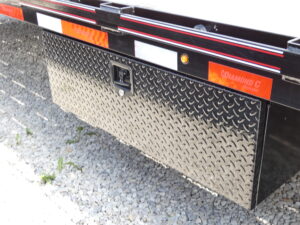
- Diamond C 22′ equipment trailer: A 22-foot Diamond C could be configured as an LPX low-profile equipment trailer, an HDT hydraulically dampened tilt trailer, a DEC deck-over equipment trailer, or a gooseneck flatbed from the FMAX family, depending on the design and pull type. Current LPX and HDT configurations cover approximately 15,500 to 24,000 lb. GVWR, with some packages or derated versions labeled around 14,900 lb. Standard premium configurations use LIPPERT axles, including dual 7,000 lb. LIPPERT axles on the base heavy-duty packages, with higher-capacity axle configurations available. A fixed rebuilt-title value cannot be assigned from “22-foot equipment trailer” alone. Compare the exact VIN, model code, certification label, loading system, options, condition, and current dealer replacement quote.
- Wells Cargo 7×14 enclosed cargo: Wells Cargo has produced multiple enclosed-trailer families and configurations in this size. A 7×14 description by itself does not establish a 7,000 lb. GVWR, axle count, wall construction, roof design, ramp-door rating, or frame specification. Use the certification label and factory build information. On a storm-, flood-, collision-, or rollover-damaged enclosed trailer, inspect the tongue, frame rails, crossmembers, suspension mounts, wall bows, roof seams, rear-door opening, floor, wiring, and moisture-sensitive areas. A rebuilt-title inspection is not a substitute for that structural and water-intrusion evaluation.
- H&H 6×12 utility trailer: H&H offers more than one utility-trailer construction and GVWR in comparable dimensions. Single-axle versions are commonly rated around 2,990 lb., while other series and configurations may use different frames, axles, brakes, floors, sides, ramps, and ratings. New pricing can vary substantially based on whether the trailer is steel or aluminum, rail-side or solid-side, braked or unbraked, and equipped with a standard gate, bi-fold gate, or other options. Do not assume every 6×12 H&H has the same value or specification.
- Liberty trailers and Delco trailers: Warranty coverage must be checked against the written warranty for the exact manufacturer, model year, VIN, original purchaser, component, and type of damage. Transferability rules differ, and a branded title does not create one universal warranty result across every manufacturer. Accident, flood, fire, overloading, misuse, and unauthorized repair damage are generally different from a defect in factory materials or workmanship. Ask the manufacturer or authorized dealer to confirm any remaining coverage in writing before assigning warranty value to the trailer.
The Case for Buying New (or Clean Used)
None of this means every salvage or rebuilt trailer is automatically a bad purchase. A professionally repaired trailer with complete photographs, measurements, invoices, and a straight frame presents a different risk from a flooded enclosed trailer or a dump trailer rebuilt with undocumented structural parts. The problem is that the title brand alone does not make those distinctions for you. The buyer must investigate the damage and prove the quality of the repair.
A branded-title trailer may make sense for a knowledgeable cash buyer who understands the repair, can obtain acceptable insurance, does not depend on conventional financing, and plans to keep the trailer long enough that resale is less important. It may also make sense for controlled off-road or farm use, provided the buyer understands that off-road ownership does not automatically authorize highway towing.
For most buyers, a new trailer or well-inspected clean-title used trailer is easier to own. You receive normal title paperwork, clearer financing options, a more predictable insurance process, a better resale market, and a more complete paper trail. With a new unit, you can also match the trailer’s GVWR, payload, dimensions, loading system, brakes, tires, and hitch type to the work instead of accepting whatever configuration happens to be available in a damaged unit.
Current Diamond C trailers are built in the United States in Mt. Pleasant, Texas, where the company has operated since its founding in 1985. Diamond C’s premium FMAX, HDT, LPT, LPX, WDT, and DEC lines use LIPPERT axles as standard equipment. Depending on the model, buyers can select purpose-built loading systems such as MAX Ramps, XDR Ramps, or the X-Ramp, along with model-appropriate axle, brake, tire, hydraulic, and suspension packages. Diamond C also uses its DM Difference Maker multi-stage coating process rather than a simple single-step paint application.
For covered current-model 2026-and-later Diamond C trailers, the current Warranty 2.0 program includes a six-year limited structural warranty and a two-year limited comprehensive warranty, subject to the complete written terms, exclusions, ownership requirements, proper use, and claim procedures. Damage caused by accidents, negligence, overloading, misuse, or unauthorized modifications is not the same as a factory defect and may be excluded or void coverage. That is another reason to confirm warranty status by VIN rather than assuming a rebuilt trailer retains the same protection as an undamaged new unit.
Title status also does not replace Indiana’s operating requirements. A trailer or semitrailer with an actual gross weight of at least 3,000 lb. when operated on a highway must have adequate brakes that the driver can apply from the tow vehicle’s cab, together with an automatic breakaway function. A rebuilt title does not excuse missing brakes, an inoperative breakaway battery, defective lights, unsafe tires, or loading beyond the trailer’s certified GVWR.
CDL requirements must be calculated from the complete combination, not from the trailer rating alone. Under the federal Class A definition, the combination must have a GCWR or actual gross combination weight of at least 26,001 lb., whichever governs, and include a towed unit with a GVWR or actual gross weight over 10,000 lb. A trailer rated over 10,000 lb. does not by itself trigger a Class A CDL when the combination remains below 26,001 lb. Commercial use, hazardous materials, passenger transportation, exemptions, and other federal or state rules can change the analysis, so business operators should verify their specific combination and operation.
Spencer Trailers keeps inventory across utility, equipment, cargo, dump, tilt, flatbed, and gooseneck categories. If you are trying to determine whether a private-party branded-title trailer is worth the risk, or you want to compare its complete cost against a properly titled new or clean-used trailer, give us a call at (812) 829-0226. Bring the VIN, title photographs, seller’s description, repair records, asking price, and the tow vehicle information. That produces a much more useful comparison than looking only at the advertised discount.
To see what properly documented trailers are available now, browse the current inventory. Availability changes, so confirm the title status, model, GVWR, axle package, payload, warranty, price, and financing eligibility of the specific unit you are considering. Financing remains subject to lender approval and the lender’s collateral requirements.
Quick rule of thumb: Any branded title, missing title, unexplained VIN issue, or unusually low price is a reason to stop and verify the paperwork before discussing payment. There is no reliable percentage discount that automatically separates a bargain from a bad risk.
What exact trailer are you looking at, what title brand appears on the document, which state issued it, and what records does the seller have from before and after the repair? Those are the right first questions to answer before the price starts looking too good to pass up.