






You pull up to load a skid steer, and suddenly the ramps are steeper than expected and the machine is close to high-centering at the transition onto the deck. Or you plan to haul a tall machine through an older covered structure and realize the trailer deck has already used nearly two feet of your available clearance. Deck height is one of those specifications many buyers overlook until it creates a loading, stability, or route-planning problem.
It matters more than most people think. Let’s talk through how bumper-pull, gooseneck, and lowboy trailers handle deck height, and what that means for the equipment or cargo you’re loading.
What “Deck Height” Actually Means
Deck height is the vertical distance from level ground to the top surface of the trailer floor where the load rests. It should be measured with the trailer properly coupled, sitting approximately level, and equipped with the tires, axles, suspension, and flooring included in the trailer’s actual configuration.
A higher deck usually creates a steeper loading transition when the ramp length and dovetail remain unchanged. It also raises the load’s center of gravity and reduces the amount of vertical space available before the combination reaches a legal or physical overhead restriction. A lower deck can make loading easier, but it also reduces ground clearance beneath the trailer frame, storage boxes, hydraulic components, and rear transition.
Indiana generally limits vehicle and load height to 13 feet 6 inches unless a different limit or permit applies. Other states and individual roads can have different rules, and a legal-height load is not guaranteed to fit under every bridge, utility line, tree limb, garage door, or covered structure. Posted clearances and the actual route still control.
Subtracting deck height from 13 feet 6 inches provides a useful first estimate of the theoretical space remaining above the deck. For example, a 30-inch deck leaves 11 feet between the deck surface and a 13-foot-6-inch overall height. An 18-inch deck leaves 12 feet. That calculation does not include blocking, mats, attachments, suspension movement, roof vents, exhaust stacks, tie-down hardware, or other items that may increase the measured overall height.
Bumper-Pull Trailers: The Everyday Workhorse
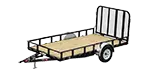
Bumper-pull utility, car-hauler, and equipment trailers do not share one standard deck height. Depending on the trailer’s intended use, deck-over or between-the-fenders construction, axle position, drop or straight axles, suspension, tire diameter, frame depth, and floor thickness, the deck may sit anywhere from the high teens to approximately 30 inches or more above level ground.
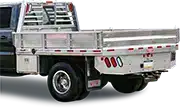
Many enclosed cargo trailers and low-profile equipment trailers use drop axles or a deck positioned between the fenders to keep the platform relatively low. Deck-over flatbeds place the floor above the tires to provide a wide, uninterrupted loading surface, but that construction normally produces a higher deck.
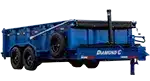
Diamond C’s LPX is a heavy-duty low-profile equipment trailer offered in bumper-pull and gooseneck configurations. Depending on its length and selected equipment, the LPX can be configured with tandem or triple Lippert axles, including 7,000-pound, 8,000-pound, and certain 10,000-pound axle packages. Available straight-axle configurations raise the deck and ground clearance by approximately four inches, illustrating why deck height must be confirmed for the specific trailer rather than assumed from the model name alone.
The LPX uses an I-beam or engineered-beam frame according to the selected configuration. Current loading choices include extra-wide 24-by-60-inch spring-assisted flip-knee ramps with a 24-inch dovetail, MAX Ramps with a longer 36-inch self-cleaning dovetail on compatible configurations, and the X-Ramp for qualifying Max Width packages. Those dovetails and ramp systems reduce the abruptness of the deck transition even though the main deck itself remains above the ground.
That type of design is a useful middle ground for farms, landscaping companies, rental fleets, and contractors. It can provide meaningful equipment capacity while remaining practical behind an appropriately rated pickup. However, buyers should not select a trailer solely by axle capacity or published GVWR. Available payload equals the trailer’s rated GVWR minus its actual empty weight, and installed ramps, spare tires, winches, toolboxes, hydraulic equipment, additional axles, and other options all affect that empty weight.
Loading becomes more challenging when a machine has limited ground clearance, a short wheelbase, a long rear overhang, or a low attachment. A compact track loader may have adequate traction on a ramp but still contact the breakover point where the ramp or dovetail meets the main deck. Mini excavators can present a different issue because the blade, counterweight, or undercarriage may contact before the machine reaches the level floor.
Bumper-pull equipment trailers are available above the familiar 14,000-pound class, but capacity is limited by the complete towing system. The truck’s receiver, hitch insert, ball, coupler, safety chains ball, coupler, safety, tires, axles, brakes, payload rating, rear-axle rating, gross vehicle weight rating, and gross combined weight rating must all support the loaded combination. A heavy trailer does not become safe merely because it can be attached to a 2-5/16-inch ball.
The Diamond C LPX begins in the roughly 14,900- to 15,500-pound GVWR range and can be configured at higher ratings depending on axle package and model configuration. Whether it can carry a particular machine depends on the certification label, actual trailer weight, attachment weight, fuel, chains, binders, buckets, and every other item placed on the trailer.
Gooseneck Trailers: More Capacity, Similar Deck
Here’s something buyers sometimes misunderstand: a gooseneck trailer is not automatically lower than a bumper-pull. The main deck of a gooseneck equipment trailer can be very similar in height to the corresponding bumper-pull version when the two use comparable frames, tires, axles, and suspension. A deck-over gooseneck flatbed may sit higher because its floor must clear the tires.
What a gooseneck connection changes is where the trailer couples to the truck. The ball is mounted in the pickup bed near or slightly ahead of the truck’s rear axle rather than behind the rear bumper. This arrangement can support greater pin weight with a properly rated truck and hitch, reduce leverage behind the truck, and provide stable handling for long and heavy trailers. It does not eliminate the need to remain within the truck’s payload, rear gross axle weight rating, tire ratings, GVWR, and GCWR.
Diamond C’s FMAX Flatbed Max gooseneck line includes FMAX207, FMAX208, FMAX210, FMAX212, FMAX216, FMAX307, FMAX310, and FMAX312 models. Depending on the model and axle configuration, the line spans approximately 15,500 pounds through 40,000 pounds GVWR. Current premium Diamond C lines use Lippert axles as standard equipment, and the exact axle quantity, axle rating, suspension, brakes, tires, frame, and GVWR must be verified on the selected model’s specification and certification label.
A 40-foot FMAX is therefore not tied to one universal GVWR. Its rating depends on whether it is an FMAX200- or FMAX300-series configuration and which axle, tire, suspension, and brake package it carries. The trailer’s usable payload must likewise be calculated from its actual empty weight rather than inferred from overall length.
If you’re buying a gooseneck because you need a shallower loading angle, examine the rear of the trailer rather than the coupler. A straight-deck gooseneck can have a substantial loading angle. A dovetail, MAX Ramps, XDR Ramps, X-Ramp, hydraulic dovetail, or hydraulically dampened tilt deck can create a more manageable approach, depending on the applicable model and configuration.
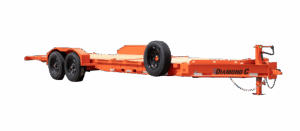
Diamond C’s HDT is a heavy-duty hydraulically dampened tilt equipment trailer with GVWR configurations in the approximately 15,500- to 24,000-pound range. Its gravity-fed hydraulic dampening system controls the tilting bed without requiring conventional loading ramps. Full-bed tilt and split-deck layouts are available in qualifying lengths. The tilt geometry can be especially useful for machines with limited clearance, but the actual loading angle still varies with deck length, stationary-deck length, truck setup, tire selection, and the slope of the loading area.
A gooseneck generally provides access to longer decks and higher-capacity configurations than a typical bumper-pull, but the correct choice still depends on the truck. Pin weight carried in the bed can use a significant portion of a pickup’s payload capacity. The truck and trailer must also sit level; an incorrectly adjusted gooseneck coupler can place unequal weight on tandem or triple axles and alter rear ground clearance and loading geometry.
Lowboy Trailers: Built to Stay Low
If you’re moving large construction equipment, oversized machinery, or cargo with strict height requirements, a commercial lowboy semitrailer changes the height calculation entirely. In heavy-haul terminology, a lowboy usually has a dropped load well between the gooseneck and rear axle group. That well is substantially lower than the deck of a pickup-towed equipment trailer.
Lowboy deck height varies by manufacturer, capacity, tire size, suspension, loaded ride height, and whether the trailer has a fixed, folding, mechanical detachable, or hydraulic detachable gooseneck. Many heavy-haul lowboys have loaded deck heights around 18 to 24 inches, while specialized configurations can be lower. Published dimensions must be checked for the exact trailer because a difference of only a few inches can determine whether an overheight permit or alternate route is needed.
At an 18-inch deck height, the theoretical vertical space between the deck and a 13-foot-6-inch overall limit is 12 feet. At a 24-inch deck height, it is 11 feet 6 inches. Those figures are planning numbers, not automatic permission to travel. The machine’s measured transport height, blocking, trailer ride height, tire deflection, suspension position, and route clearances must all be considered.
A removable gooseneck, commonly called an RGN or detachable gooseneck, allows the front of the low deck to be placed on or near the ground after the neck is disconnected. Self-propelled equipment can then drive onto the deck from the front. The deck does not normally travel at that ground-level loading position; it is raised and reconnected before transport.
Fixed-neck lowboys are commonly loaded from the rear using ramps or a rear loading arrangement. Detachable-neck models can simplify loading machines that do not climb steep rear ramps easily. Neither design should be confused with an ordinary pickup-bed gooseneck trailer. Commercial lowboys are normally paired with road tractors and are available in numerous axle and capacity configurations, commonly described by rated tons rather than one universal pound rating.
The low deck is achieved through a dropped frame well and carefully selected running gear. Smaller tires may be used in some designs, but low height is not created simply by installing small wheels. Frame strength, axle capacity, suspension travel, ground clearance, tire ratings, braking, and load distribution must be engineered as a complete system.
The tradeoff is real. A lower deck leaves less clearance beneath the trailer, particularly around the transition areas, crossmembers, outriggers, hydraulic lines, and rear frame. Lowboys can operate on prepared construction sites, but abrupt crowns, ditches, railroad crossings, ruts, and soft ground require careful evaluation. They are specialized heavy-haul trailers, not substitutes for utility trailers on rough farm lanes.
Load Angle: The Number That Matters Most for Equipment
When you’re driving equipment on and off, load angle is the practical consequence of deck height, ramp length, dovetail length, and loading geometry. A steeper approach can increase the chance of traction loss, rearward instability, undercarriage contact, or high-centering at the deck transition.
The numbers below show approximate straight-ramp angles on level ground when the ramp rises all the way from the ground to the listed deck height. They assume the stated ramp length is measured along the ramp surface. A dovetail, tilt bed, kneeling suspension, uneven ground, or ramp resting above or below deck level will produce a different angle.
| Trailer or Loading Layout | Representative Deck Height | Approx. Angle With 5-ft Straight Ramp | Approx. Angle With 7-ft Straight Ramp |
|---|---|---|---|
| Low enclosed or utility platform | 18–20 in | 17.5–19.5° | 12.4–13.8° |
| Low-profile equipment deck | 20–24 in | 19.5–23.6° | 13.8–16.6° |
| Higher equipment or deck-over flatbed | 24–30 in | 23.6–30.0° | 16.6–20.9° |
| Equipment trailer with dovetail | Main deck varies | Depends on ramp and dovetail geometry | Depends on ramp and dovetail geometry |
| Hydraulically dampened tilt deck | Main deck varies | Controlled by tilt-bed geometry | Conventional ramps not required |
| Detachable-gooseneck lowboy | Often about 18–24 in in transport | Front deck is lowered for loading | Conventional rear ramps may not be required |
There is no universal 15- or 18-degree maximum ramp angle for every rubber-tracked machine. Safe loading limits depend on the equipment manufacturer’s operating instructions, machine configuration, attachment position, surface condition, and trailer design. Consult the machine and trailer manuals instead of relying on a generic angle.
Longer ramps reduce the angle only if they remain properly rated and supported. A dovetail can reduce the initial approach and spread the vertical rise across two transitions. A tilt trailer eliminates loose loading ramps, but its deck angle must still suit the machine’s ground clearance and stability limits. Never improvise with loose lumber, landscape blocks, buckets, or unapproved ramp extensions.
Loading should take place on firm, level ground with the tow vehicle and trailer aligned. Apply the tow vehicle’s parking brake, follow the trailer manufacturer’s stabilizer instructions, keep bystanders clear, and use a spotter when visibility is limited. Once the machine is positioned, lower attachments as appropriate and secure it using properly rated anchor points and tiedowns.
Enclosed Cargo and Deck Height
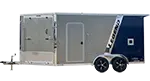
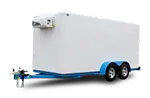
For enclosed cargo trailers, the height equation runs in both directions. A low platform can produce a lower ramp-door angle and lower overall trailer height, while additional interior height provides more room for cargo and occupants. The important specifications are platform height, interior height, rear-door opening height, and total exterior height, including permanently installed roof equipment.
Current Wells Cargo FastTrac specifications demonstrate how much dimensions can vary within one product family. Standard 5- and 6-foot-wide FastTrac models list a 17-inch platform height, while 7-foot-wide FT714T2 and FT716T2 models list an 18-inch platform height. The FT716T2 has a nominal 7-by-16-foot body designation, a 17-foot-4-inch body length, a 6-foot-6-inch interior height, and an approximately 8-foot-2-inch overall height in its standard configuration.
The 8.5-foot-wide FastTrac line lists a 20-inch platform height, a 6-foot-6-inch interior height, and an approximately 8-foot-3-inch overall height. Those specifications are more useful than assuming every 7-by-16 or 8.5-by-16 enclosed trailer uses the same chassis and platform.
Additional interior-height packages can change the exterior height and door opening. Roof vents, rooftop air conditioners, antennas, solar equipment, ladder racks, awnings, and other accessories can raise the trailer’s highest point. An air conditioner may add considerably more height than a low-profile vent, so the finished trailer should be physically measured if it will enter a garage, warehouse, carport, covered bridge, or other restricted opening.
Although an enclosed cargo trailer is ordinarily well below Indiana’s 13-foot-6-inch general vehicle-height limit, that does not make clearance irrelevant. Residential garage openings commonly fall well below the trailer’s exterior height, and private structures may not have posted or recently verified clearance measurements. When the margin is close, measure both the trailer and the opening instead of relying on a nominal model description.
Quick Guide: Which Deck Height Do You Need?
- Mowers, ATVs, and light farm equipment under 5,000 pounds: A standard bumper-pull utility trailer may be appropriate, but match the trailer’s actual payload, ramp capacity, ramp spacing, deck width, and anchor points to the machine. Do not assume a five-foot ramp is automatically long enough.
- Skid steers, compact track loaders, and mini excavators: Look for a low-profile equipment deck, a properly designed dovetail and ramp system, or a hydraulically dampened tilt trailer. Check the machine’s operating weight with attachments and verify clearance at both the initial approach and the breakover point.
- Large excavators, cranes, and bulldozers: Commercial lowboy or detachable-gooseneck equipment may be required. Select the trailer according to actual machine weight, dimensions, axle-load distribution, permits, route restrictions, and the tow vehicle rather than using a general 30,000-pound dividing line.
- Cargo and general freight: Compare platform height, rear-door opening, interior dimensions, payload, axle rating, and finished exterior height. Include roof-mounted accessories when checking overhead clearance.
- Heavy wheeled or tracked equipment: A gooseneck can provide higher-capacity and longer-deck configurations, while a dovetail, MAX Ramps, XDR Ramps, X-Ramp, or tilt deck may improve loading geometry where offered. The truck and hitch must be rated for the loaded trailer and pin weight.
A Few Questions Worth Asking Before You Buy
What’s the lowest point of the machine I’m loading? Check the belly pan, hydraulic lines, steps, mower deck, blade, counterweight, exhaust components, and any attachment that extends beyond the tracks or tires. Also consider wheelbase or track-contact length because those dimensions affect breakover clearance.
What is the machine’s real transport weight? Published base weight may exclude buckets, forks, blades, counterweights, fuel, removable attachments, or optional cab equipment. Compare the fully equipped operating weight with the trailer’s available payload, not merely its GVWR or combined axle capacity.
Am I hauling any loads taller than 10 feet? If yes, measure from the ground to the machine’s highest point while it is loaded on the actual trailer. A 30-inch deck can leave only 11 feet beneath a 13-foot-6-inch overall-height limit, and bridge or route clearance may be lower than the general legal maximum.
How long and steep are the complete loading surfaces? Ramp length alone does not describe the entire transition. Ask about deck height, dovetail length, ramp length, ramp capacity, ramp width, hinge position, tilt angle, and whether rear stabilizers are required during loading.
Do I need to load on uneven ground? Low decks can improve approach geometry, but they also have less ground clearance. High decks can become more difficult to load when the tow vehicle and trailer are not level. The safest practice is to use a firm, level loading area whenever possible.
How is the trailer configured? Tire diameter, drop versus straight axles, suspension, frame selection, deck material, hitch adjustment, and optional equipment can change height and weight. Request the specification for the exact unit and verify its federal certification label rather than relying on dimensions from a similar trailer.
If you’re not sure where your equipment falls, bring its specifications to us at Spencer Trailers. We stock Diamond C, H&H, Liberty, and other brands across a range of deck heights and loading configurations. We can compare the machine’s operating weight, width, ground clearance, wheelbase, attachments, and towing requirements with the trailer’s actual certification label and installed equipment. Browse our current inventory or call us at (812) 829-0226 and we’ll walk you through the options.
The right deck height isn’t simply the lowest or highest one available. It’s the height that provides suitable loading geometry and ground clearance while keeping the trailer, tow vehicle, cargo, and route within their applicable limits. Get that match right and loading, hauling, and unloading become safer and easier.


