







You’re 40 miles from the job site when a strap goes slack. That moment of dread, glancing in the mirror and watching the load shift, can come down to where the tiedown is anchored, how the cargo is positioned, whether the securement device was tensioned correctly, and whether every component in the securement path is rated for the job. A strong strap cannot compensate for a weak, damaged, or unsuitable anchor point.
Equipment trailers provide several securement options, including D-rings, stake pockets, pipe spools, rub-rail systems, sliding ratchets, weld-on anchors, and properly installed bolt-on rings. They are not automatically interchangeable. Their strength depends on the hardware, attachment method, supporting trailer structure, direction of pull, and manufacturer-assigned Working Load Limit (WLL).
Here’s a straight breakdown of what each tie-down point actually does, where it belongs in your securement strategy, and what to inspect when you’re shopping trailers at a place like Spencer Trailers.
D-Rings: The Workhorse of the Deck
A properly installed D-ring is one of the most useful fixed anchor points on an equipment trailer. Depending on the trailer and ring design, it may be recessed into the deck, mounted beside the deck, or welded into a structural side-rail assembly. The ring is normally attached to a mounting plate or bracket, but ring diameter and appearance alone do not establish its capacity.
What matters is the Working Load Limit of the complete assembly. The ring, mounting plate, welds or fasteners, backing structure, and trailer frame must work together. A heavy ring attached to thin sheet metal or unsupported wood is not equivalent to the same ring installed over a reinforced cross member. Do not estimate WLL from bar diameter, plate thickness, or appearance. Use the trailer manufacturer’s documentation, an identification label, or the anchor manufacturer’s rating.
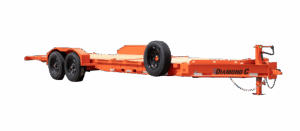
Current Diamond C LPX and LPX-GN equipment trailers list four 5/8-inch D-rings as standard equipment, with additional 5/8-inch D-rings available as options. Current HDT hydraulically dampened tilt trailers also list four 5/8-inch D-rings as standard, with extras available. Their location and supporting structure should be confirmed on the individual trailer because length, deck configuration, GVWR package, tilt arrangement, and optional equipment can affect placement.
Federal cargo-securement rules do not generally require trailer anchor points to be installed at fixed 10-foot intervals. The 10-foot provisions in 49 CFR 393.110 concern the minimum number of tiedowns for certain articles of cargo when the commodity-specific rules do not apply. Heavy vehicles, equipment, and machinery weighing 10,000 pounds or more are covered by 49 CFR 393.130 and generally require at least four tiedowns, attached as close as practicable to the front and rear or to mounting points specifically designed for securement. Good anchor placement still matters because it allows the operator to use short, direct tiedown paths without side-loading hardware or routing straps across sharp edges.
Stake Pockets: Versatile but Know the Rating
Stake pockets are receivers positioned along a trailer’s side structure. They can hold removable wood or steel stakes for side containment, and compatible hooks, straps, or removable anchor fittings may also use them when the trailer manufacturer permits that application.
The important limitation is that a stake pocket is not automatically a rated cargo anchor merely because a hook fits inside it. Capacity depends on the pocket, welds, rail, supporting frame, hook style, and direction of pull. A WLL stamped on a removable pocket accessory applies to that accessory, not automatically to the trailer’s pocket or side rail. The lowest-rated component in the complete tiedown path controls.
Where stake pockets shine is positioning flexibility. A full-length row of pockets gives an operator more choices for matching the tiedown path to the machine’s designated securement points. That can be valuable when hauling compact excavators, skid steers, tractors, attachments, or mixed cargo with different footprints. The tiedown should still connect to a machine point designed for securement whenever one is provided, and articulated or movable components may require separate restraint.
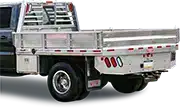
Current Diamond C FMAX flatbed gooseneck models use a 2-inch by 3/8-inch rub rail with stake pockets and pipe spools as standard equipment. Current LPX and LPX-GN configurations also list a 2-inch by 3/8-inch rub rail with stake pockets and pipe spools. Those features provide numerous routing options, but the operator should verify which parts Diamond C designates for tiedown use and obtain the applicable capacity information for the exact trailer and securement method.
Rub Rail: Anchor Point or Cosmetic Feature?
A rub rail runs along the outer edge of a flatbed or equipment trailer. It helps shield the deck edge and side structure from routine contact, and it may carry stake pockets, pipe spools, or other cargo-control features. Whether the rail itself can serve as part of a securement system depends entirely on its design and the manufacturer’s instructions.
It is therefore too broad to say that every rub rail is an anchor point or that no rub rail can be used for securement. A strap or chain should only be attached to a rail, pocket, spool, or opening that the manufacturer identifies as suitable for that purpose. Hooks must seat correctly and must not be point-loaded on a thin edge, twisted, or positioned where road vibration can make them disengage.
Diamond C’s current FMAX flatbed gooseneck trailers list a full-length 2-inch by 3/8-inch rub rail with stake pockets and pipe spools. This is a different securement arrangement from the four standard 5/8-inch D-rings listed on current LPX, LPX-GN, and HDT equipment trailers. Optional 5/8-inch D-rings can also be specified on FMAX models. Buyers should treat these as separate systems and confirm the intended attachment method and rating rather than assigning one assumed WLL to every point along the side.
Before attaching a strap or chain, inspect the selected point for cracked welds, bent pockets, elongated openings, severe corrosion, sharp burrs, or previous collision damage. Protect synthetic webbing from cutting or abrasion wherever it contacts an edge. Do not route a tiedown where it can rub against a tire, brake component, hydraulic line, wiring harness, or moving section of a tilt trailer.
Weld-On vs. Bolt-On: Which Holds Better?
Neither attachment method is automatically stronger. A properly engineered welded anchor can be extremely strong, but weld size, penetration, base-metal thickness, heat effects, bracket geometry, and supporting structure all matter. A properly engineered bolt-on anchor can also carry a substantial load when it uses the correct fasteners, backing plate, hole spacing, installation torque, and structural mounting location. The manufacturer’s WLL for the installed assembly is more useful than a general assumption about welds versus bolts.
Bolt-on tie-down rings have several practical advantages:
- Replaceability. A damaged ring can often be replaced without cutting or welding, provided the supporting structure and bolt holes remain undamaged and the replacement hardware matches the approved specification.
- Positioning flexibility. Properly rated track systems can provide movable anchor locations for different cargo. E-track and L-track products vary widely in capacity, fitting design, permitted pull angle, and intended application, so only compatible rated components should be combined.
- Controlled installation. A bolt-on anchor can be added without welding, but it still requires access to suitable structural steel, the correct backing or reinforcement, and fasteners of the specified grade and diameter.
A D-ring bolted only through wood decking is generally unsuitable for heavy-equipment securement unless the manufacturer has engineered and rated that exact installation. Deck boards can split, crush, loosen, or pull through under dynamic loading. A steel backing plate may improve load distribution, but backing-plate thickness by itself does not establish a safe WLL. The cross member, frame connection, bolts, plate dimensions, edge distance, and installation details must all be adequate.
For a new purpose-built equipment trailer, factory-installed anchors are usually the best starting point because their placement can be integrated into the trailer structure. If additional points are needed on a used trailer, consult the trailer manufacturer or a qualified trailer fabricator. Welding on a finished frame can damage the coating, create corrosion-prone areas, affect high-stress members, and potentially interfere with warranty coverage if it is not performed correctly.
What Diamond C Does (And Why It Matters for Buying Decisions)
Diamond C Trailers has built trailers in Mt. Pleasant, Texas, since 1985. Its current equipment and flatbed ranges use different securement layouts according to the trailer’s purpose. The LPX is a low-profile bumper-pull equipment trailer, the LPX-GN is its gooseneck counterpart, the HDT is a hydraulically dampened tilt equipment trailer, and FMAX identifies the company’s Flatbed Max gooseneck flatbed family.
Current published specifications show the following relevant configurations. Final equipment can vary by model year, deck length, GVWR package, and selected options, so the build sheet and certification label for the actual VIN remain controlling.
| Model | Current published GVWR range | Standard securement equipment | Additional securement options |
|---|---|---|---|
| Diamond C LPX | 15,500–24,000 lbs | 4 standard 5/8″ D-rings; 2″ x 3/8″ rub rail with stake pockets and pipe spools | Additional 5/8″ D-rings |
| Diamond C LPX-GN | 15,500–24,000 lbs | 4 standard 5/8″ D-rings; 2″ x 3/8″ rub rail with stake pockets and pipe spools | Additional 5/8″ D-rings |
| Diamond C FMAX207 | 15,500 lbs | 2″ x 3/8″ rub rail with stake pockets and pipe spools | 5/8″ D-rings selected by quantity; other cargo-control options may be available by configuration |
The current FMAX207 uses a 14-inch low-profile Engineered Beam frame, a 12-inch curved engineered gooseneck, and two 7,000-pound Lippert axles, with a published 15,500-pound GVWR. Higher-capacity FMAX models use different frame, axle, tire, brake, and GVWR packages. Current Diamond C premium lines use Lippert axles as standard. Buyers should never transfer a specification from one FMAX model code or GVWR package to another.
Current LPX and LPX-GN trailers span published GVWRs from 15,500 to 24,000 pounds. The standard 15,500-pound package uses two 7,000-pound Lippert axles, while higher packages can use triple 7,000-pound, tandem 8,000-pound, or tandem 10,000-pound arrangements depending on configuration. The standard four-D-ring count does not by itself prove that four tiedowns are adequate for every load. The chains or straps, binders or tensioners, machine attachment points, trailer anchors, cargo weight, equipment-specific rules, and tiedown geometry must all be considered.
Under the federal rules, the aggregate WLL of the tiedowns securing an article or group of articles must be at least one-half the cargo weight. How each tiedown contributes to that calculation depends on its routing. A direct tiedown running from a trailer anchor to a machine attachment point contributes one-half of its WLL to the aggregate calculation. A tiedown passing over or through the cargo and attaching to the opposite side of the trailer generally contributes its full WLL. The securement system is limited by its weakest component, so a high-capacity anchor does not increase the rating of a lower-capacity chain, hook, binder, strap, or machine attachment point.
For wheeled or tracked equipment weighing 10,000 pounds or more, federal rules generally require a minimum of four tiedowns that restrain movement laterally, forward, rearward, and vertically. Accessories or components that can move independently, such as an excavator boom, loader bucket, blade, or other articulated part, must also be restrained as required by the applicable rule. These federal requirements principally govern commercial motor vehicles operating in interstate commerce; Indiana requirements, other state laws, and company policies may also apply.
A Quick Q&A on Common Mistakes
Can I just use the trailer’s frame tube as an anchor?
Use only an anchor or structural location approved by the trailer manufacturer for securement. Wrapping a chain or strap around an arbitrary frame member can create an unknown WLL, damage wiring or brake lines, abrade webbing, crush a hollow section, or apply force in a direction the member was not designed to accept. A frame member being strong enough to support the trailer does not automatically make every point on it a rated tiedown anchor.Are all D-rings the same if they look the same?
No. Ring diameter, material, heat treatment, mounting plate, weld or fastener pattern, supporting structure, pull angle, and manufacturer testing can all affect capacity. Two visually similar 5/8-inch rings can have different ratings. Use documented WLL information for the complete installed assembly rather than estimating capacity from appearance.Does it matter which direction the D-ring faces?
Yes. Anchor ratings can change with the direction and angle of pull. Some rings pivot to align with the tiedown, while others have restricted loading directions. A side load, twisted hook, or pull against the edge of a recessed pocket may reduce capacity or damage the assembly. Follow the anchor manufacturer’s instructions and keep the tiedown aligned as cleanly as practical.
Putting It Together for Your Next Trailer Purchase
When you’re walking a trailer lot or browsing inventory, here’s what to inspect on the securement system:
- How is each anchor supported? Look beneath the deck where possible and identify whether the ring, pocket, track, or rail connects to a cross member, main rail, or factory reinforcement. Do not assume a large top plate means the structure below it is equally strong.
- What is the documented WLL? Ask for the trailer manufacturer’s rating or approved documentation for the anchor system. A marking on a chain, strap, hook, or removable fitting does not establish the capacity of the trailer anchor to which it is connected.
- How many usable points are provided, and where are they located? There is no universal rule requiring four anchors on each side of every 20-foot trailer. You need enough properly positioned, rated points to comply with the rules applicable to the cargo and to connect to the machine’s designated securement locations without unsafe routing.
- Are the stake pockets and rub-rail components intended for tiedowns? Ask which parts of the side system may be used, what hooks or fittings are compatible, and whether the allowable load changes with pull direction. Pipe spools, pockets, D-rings, and the rail itself should not automatically be assigned the same capacity.
Also inspect the tiedown hardware you plan to use. Chains should display a grade marking and be free of stretched links, deep gouges, severe corrosion, or unauthorized repairs. Synthetic straps should be legible, cut-free, and protected from sharp edges. Hooks must seat fully, and binders or ratchets must close correctly. Tie up loose strap tails, recheck tension after the first few miles, and inspect the securement system periodically during the trip as required for the operation.
Spencer Trailers stocks Diamond C equipment trailers in Spencer, Indiana, and the team can walk you through the build sheet, GVWR package, axle configuration, deck dimensions, and factory securement equipment on a specific unit before you buy. If you’re hauling equipment in Indiana and want to know exactly what you’re getting before you hook up, give them a call at (812) 829-0226 or stop by 291 West State Hwy 46 in Spencer.
Not sure which equipment trailer size actually fits your machine? Browse current inventory and compare deck lengths, empty weights, payload capacity, GVWR packages, ramp or tilt arrangements, and securement features side by side. The right cargo-control plan starts with a trailer that has enough rated capacity for the machine, enough deck space for correct weight distribution, and anchor points positioned for the equipment you actually haul.


